Illustration created with DALL-E 2
See all recent commentary
(simplified and organized)
See recent popular posts
Illustration created with DALL-E 2
See all recent commentary
(simplified and organized)
See recent popular posts

A frog in a well cannot conceive of the ocean.
Zhuangzi (perhaps more famously transliterated from the Chinese as Chuang Tzu), from the book called Zhuangzi (third century B.C.).
November 24th marks the birthdays of philosopher Baruch Spinoza (1632) and three influential Americans: ragtime composer Scott Joplin (1868), self-help writer Dale Carnegie (1888), and conservative editor, writer, and television personality William F. Buckley Jr. (1925).
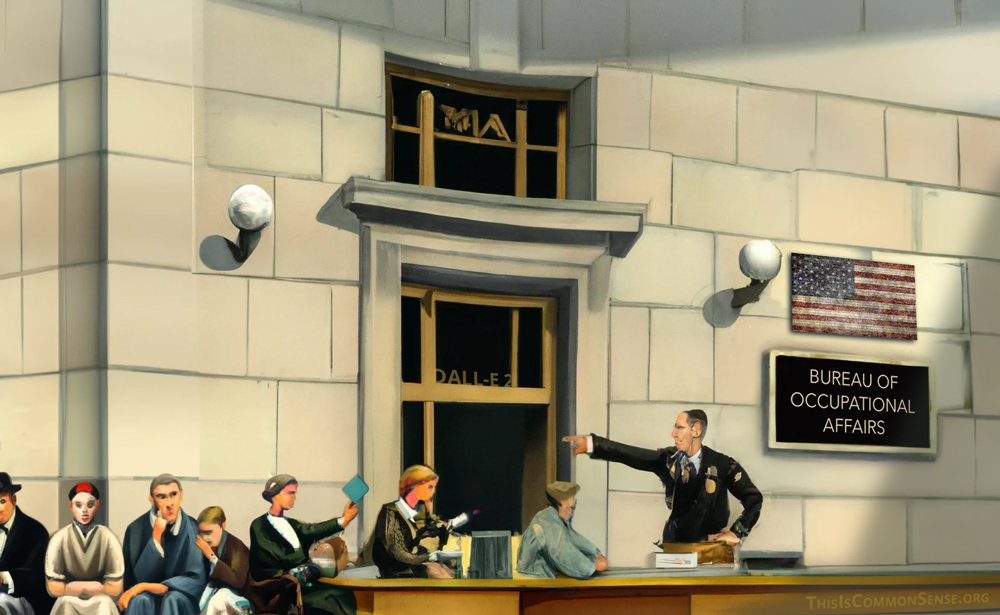
But then, in 2017, the Pennsylvania Bureau of Professional and Occupational Affairs — one of the many government agencies in the world that should not exist — told her that she was operating in Pennsylvania as a real estate broker without a license and must get one or shut down.
The obstacle was senseless. Ladd was already satisfying her customers. And getting the license would have entailed more than 300 hours of schooling, two exams, three years of apprenticeship, and opening an office in Pennsylvania. (Ladd lives in New Jersey.)
She had to shut down.
But she didn’t give up.
She teamed up with Institute for Justice, which filed suit, arguing, in IJ’s words, that “forcing her to get a full-blown real-estate license violated her right to earn an honest living under the Pennsylvania Constitution.”
At first, a lower court would not even consider the case, a decision overruled by the Pennsylvania Supreme Court in 2020. Finally, on October 31, 2022, a trial court affirmed that the “licensing requirements are unreasonable, unduly oppressive, and patently beyond the necessities of the case,” and therefore unconstitutional.
Once again, it’s IJ to the rescue!
In a world filled with government agencies that shouldn’t exist, the Institute for Justice exists to check them.
This is Common Sense. I’m Paul Jacob.
Illustration created with DALL-E 2
See all recent commentary
(simplified and organized)
See recent popular posts
When struck by a thunderbolt it is unnecessary to consult the Book of Dates as to the precise meaning of the omen.
Ernest Bramah, from “The Transmutation of Ling” in The Wallet of Kai Lung (1900).

On November 23, 1644, British poet John Milton published Areopagitica, a pamphlet decrying censorship.
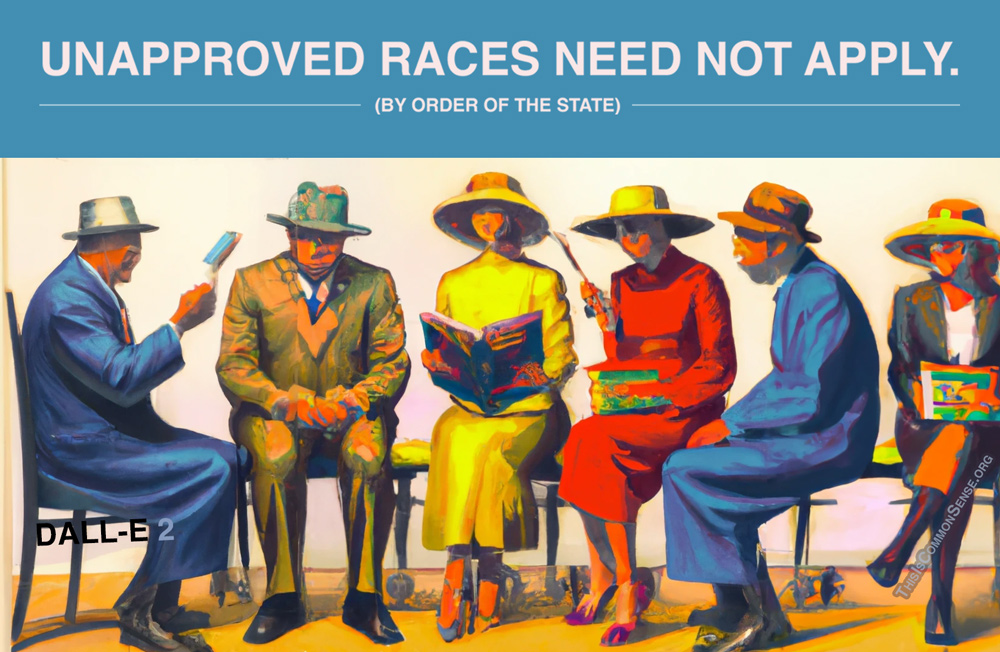
The Legal Insurrection Foundation is suing to overturn an “overtly racist and discriminatory” program being implemented by a district that receives millions in federal funding. Which means that all taxpayers are indirectly subsidizing this sort of thing.
According to the district’s new policy, an applicant for a teaching post can get up to $25,000 in college loans paid off if he teaches for three years in a row in the district. The incentive seems innocuous enough until you learn that beneficiaries of the grant, being funded by a Rhode Island charity, must “identify as Asian, Black, Indigenous, Latino, biracial, or multi-racial.”
The specification that one must “identify as” a member of one of these races may sound as if persons of unambiguously blanco tint need merely “identify as” Black or Indigenous or the like to get around the whites-need-not-apply exclusion. But such a mode of circumvention — even if, as seems unlikely, it could succeed to the extent that officials pretended to believe the claim — would require applicants to lie or become delusional.
To match this delusional policy, no doubt.
But the policy would still remain racist and discriminatory.
The Foundation’s filing quotes a dictum that if universally accepted would put an end to all this nonsense: “The way to stop discrimination on the basis of race is to stop discriminating on the basis of race.”
This is Common Sense. I’m Paul Jacob.
Illustration created with DALL-E 2
See all recent commentary
(simplified and organized)
See recent popular posts
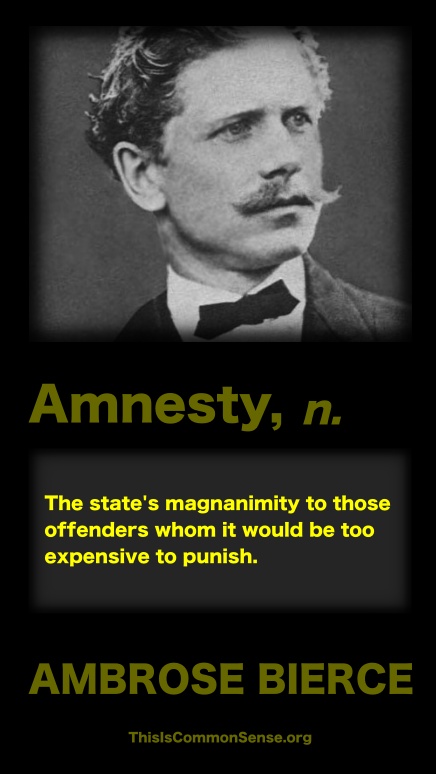
amnesty, n.
The state’s magnanimity to those offenders whom it would be too expensive to punish.
Ambrose Bierce, The Devil’s Dictionary (1911).
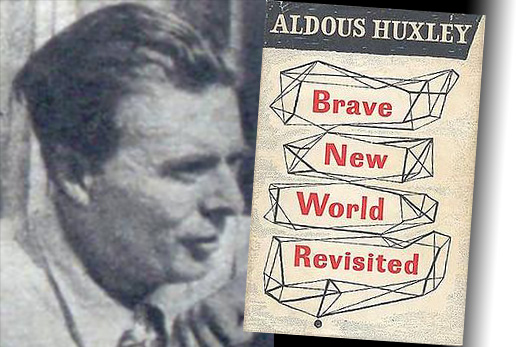
November 22 marks the death dates of a number of eminent writers, including that of English-American novelist and essayist Aldous Huxley and Irish-English novelist, theologian and medieval scholar C.S. Lewis, both of whom died in 1963, the same day as the assassination of American President John F. Kennedy. British novelist Anthony Burgess died exactly 30 years later.
The date also marks the birth of the great British novelist George Eliot (Mary Ann Evans), in 1819.
Recommended reading from these authors include:

Last month, a federal judge issued a temporary stay on the program while the litigation plays out.
On November 10, another federal judge, Mark Pittman, ruled that the program is a “complete usurpation” of congressional authority. Per Pittman, the U.S. is “not ruled by an all-powerful executive [but] by a Constitution that provides for three distinct and independent branches of government.”
In consequence, the Biden administration stopped accepting applications for student-loan debt relief. By then more some 26 million borrowers had applied.
On November 14, another federal court also blocked the program. So Biden’s debt-transfer plan is apparently at least thrice bogged down.
Except that another student-loan-debt-erasing thing has been going on since early in the pandemic, a pause on debt payments rationalized by the economic hardship imposed by lockdowns.
This pause was set to lapse at the end of this year, with payments to resume in January. But according to a White House insider “familiar with the matter,” the administration has been making “increasingly firm plans to extend the repayment pause.”
The pause also costs taxpayers money. The original rationale for it no longer exists. Like the mega-debt-relief program, extending the pause would also be unconstitutional.
This subsidy is also unlikely to inspire kindness from the courts.
This is Common Sense. I’m Paul Jacob.
Illustration created with DALL-E 2
See all recent commentary
(simplified and organized)
See recent popular posts