Categories
Today

Lysander Spooner

On January 19, 1808, Lysander Spooner was born.

Spooner’s achievements in American life, law, and political philosophy, are among the most colorful of the 19th century. Studying law privately, he sued to practice without joining the bar, and won the suit. He set up a postal service that directly competed with the United States Postal Service, delivering mail at a fraction of the cost. He wrote The Unconstitutionality of Slavery, and convinced noted Garrisonian abolitionist Frederick Douglass of his argument. (The book became the centerpiece of intellectual ammunition for the Free Soil Party.) Later in life Spooner turned against constitutionalism itself, and penned some of the most radical political works of his day, including Vices Are Not Crimes and The Constitution of No Authority. Spooner also clearly articulated a “jury nullification” position in his classic treatise Trial by Jury.

Categories
education and schooling government transparency paternalism

Motown Bully

Is the republican form of government unnatural?

People in government tend to balk at republican imperatives, anyway. You know, like transparency. Citizen control sure seems unnatural to politicians.

Case in point: Detroit.

“The Rochester Community School district is determined to keep the sun from shining on its operations,” writes Kaitlyn Buss in The Detroit News.

At issue is a new school board member, Andrew Weaver. He had campaigned on issues like “transparency, accountability and communication between the district and parents.” Well, Superintendent Robert Shaner does not like this agenda. He “sent a letter to the board president and vice president in late December targeting [the] newly elected board member” and threatening “legal action if Weaver is too forceful in challenging the way schools are being run.”

This is awfully brazen, and it should alarm parents in the Rochester Community School District. For it is not coming from some obscure bureaucrat: “Shaner was selected as Superintendent of the Year in 2020 and is one of the longest tenured and highest paid school leaders in the state.”

He epitomizes government, at least in the “education” wing of Michigan government.

Bullying is how he rolls.

Mr. Weaver explains it this way: “I sat there as a private citizen and wondered why our board didn’t do anything. Well, we found the answer. Because they’re all scared of getting one of those [letters].”

But perhaps Weaver’s prepared for the battle. Even as a parent he’d received two cease-and-desist actions from Shaner, who objected to his online attacks.

Politicians think they are kings. Above citizen criticism.

Which is why citizen control must be forced upon them. 

Over their objections.

This is Common Sense. I’m Paul Jacob.


PDF for printing

Illustration created with Midjourney

See all recent commentary
(simplified and organized)
See recent popular posts
Categories
Thought

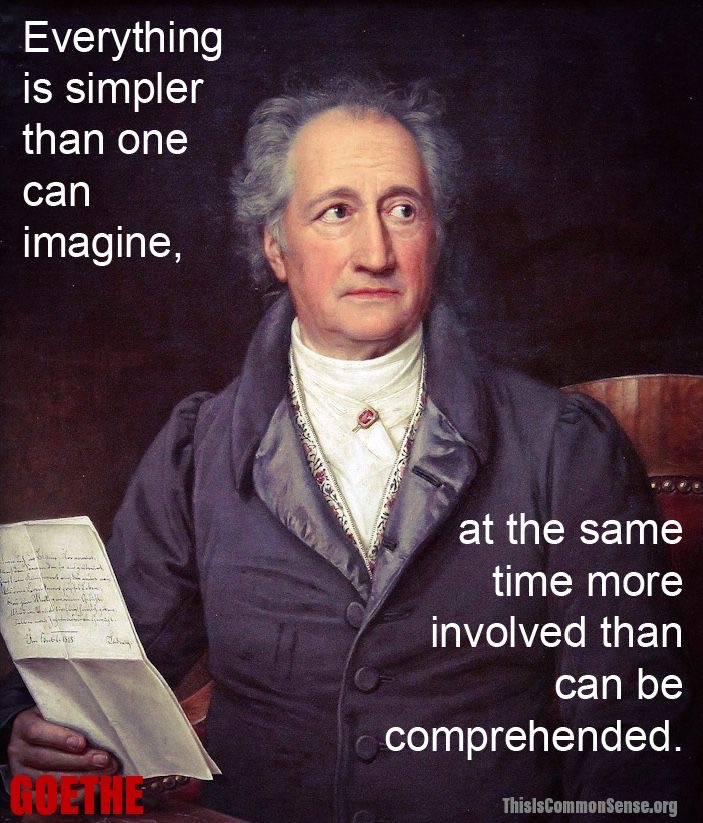
Goethe

Alles ist einfacher, als man denken kann,
zugleich verschränkter, als zu begreifen ist.

Everything is simpler than one can imagine, at the same time more involved than can be comprehended.

Johann Wolfgang von Goethe, Maxims and Reflections (1833), Maxim 1209.
Categories
Today

Montesquieu

On January 18, 1689, Charles-Louis de Secondat, Baron de La Brède et de Montesquieu, French satirist and philosopher, was born.

His treatise The Spirit of the Laws was a major influence upon America’s founding generation. He is famous for his articulation of the theory of separation of powers, which is implemented in many constitutions throughout the world. He did more than any other author to secure the place of the word despotism in the political lexicon.

In 1811, former U.S. President Thomas Jefferson translated and published Destutt de Tracy’s Commentary and Review of Montesquieu’s ‘Spirit of Laws,’ a very popular review of republican principles — which helps demonstrate how important these French writers were to the American form of government.

Montesquieu died on February 10, 1755.

Categories
education and schooling insider corruption local leaders

Lightfoot, Heavy Hand

When you’re right, you’re right.

And all of Chicago Mayor Lori Lightfoot’s critics are right that it was wrong for Lightfoot’s deserves-to-fail reelection campaign to solicit teachers to solicit students of the city’s public schools to work for her reelection campaign in exchange for class credit.

A former city inspector general called the move “deeply, deeply problematic.” Local teachers union honchos called it a “shakedown” and “exploitative and wrong.” Mayoral election challenger Brandon Johnson called it “outrageous, desperate, and downright unethical,” an abuse of power.

This may be a case of Corruption Grade B rather than Grade A if, as seems slightly possible, nobody on Lightfoot’s team understood that they were crossing another line in the endless saga of incumbents’ shameless misuse of government-controlled resources for political gain.

First, Lightfoot’s campaign said “this is common practice” and that they were just giving students “the opportunity to learn. . . .”

Eventually, they ended up saying that out of an “abundance of caution, we will cease contact with [public school] employees.” Then that campaign staff were being admonished about the “solid wall” that must exist between the campaign and “contacts” with noncampaign government employees.

Is enlisting public school teachers to enlist public school students to help an incumbent mayor’s reelection campaign really so very different from other abuses we have seen before, especially in a super-corrupt town like Chicago?

It doesn’t change the fact that when you’re wrong, you’re wrong.

This is Common Sense. I’m Paul Jacob.


PDF for printing

Illustration created with Craiyon

See all recent commentary
(simplified and organized)
See recent popular posts

Categories
Thought

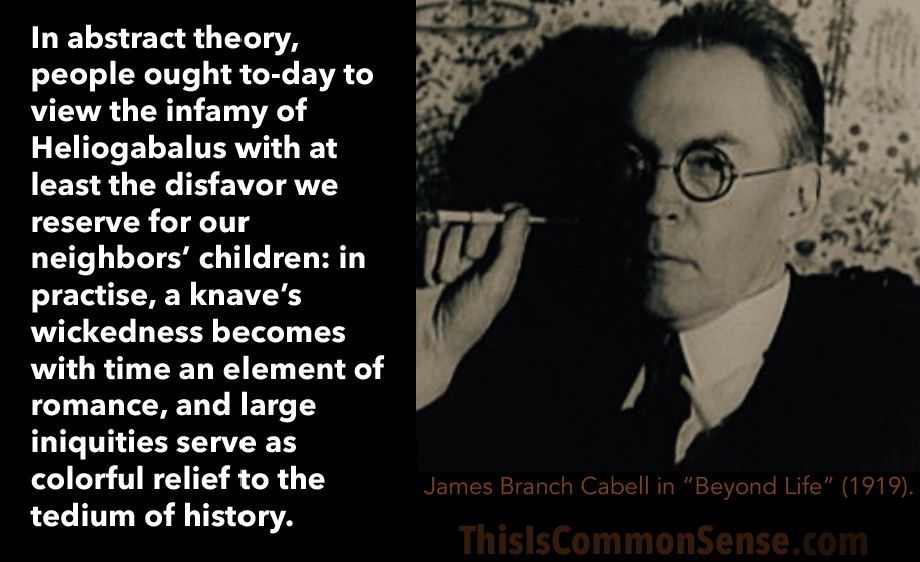
James Branch Cabell

In abstract theory, people ought to-day to view the infamy of Heliogabalus with at least the disfavor we reserve for our neighbors’ children: in practise, a knave’s wickedness becomes with time an element of romance, and large iniquities serve as colorful relief to the tedium of history. And it seems banal to point out that it no longer matters ethically, to anyone breathing, that a shoe-maker’s son, rather more than three centuries ago, made ruin of his body through intemperance, for the case is no longer within the jurisdiction of morals.

The fictional author John Charteris in James Branch Cabell’s Beyond Life: Dizaine des Démiurges (1919), Chapter IV, “Which Admires the Economist,” §5.

Categories
Today

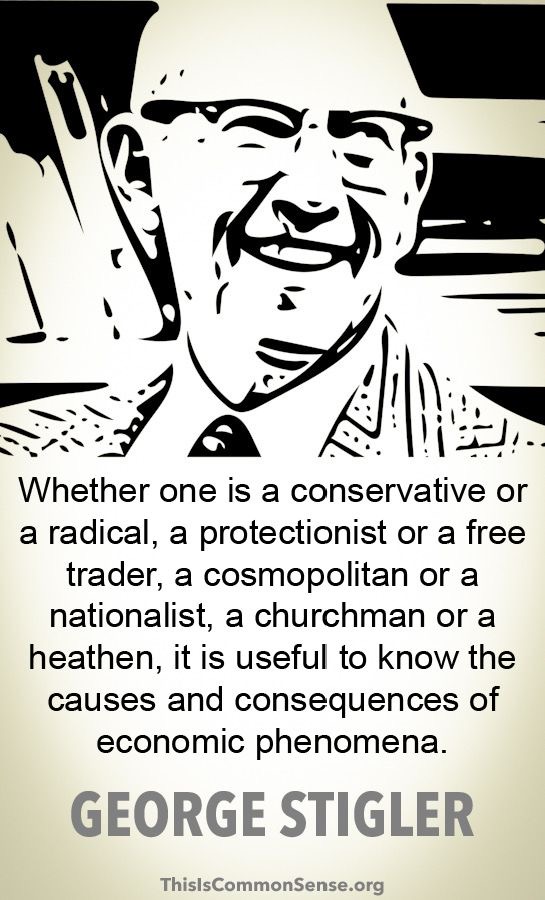
George Stigler

On January 17, 1937, Chicago School economist George Stigler was born. Stigler won a Nobel Memorial Prize for his work. His autobiography is entitled Memoirs of an Unregulated Economist.

Categories
education and schooling general freedom ideological culture

Inherent Racism of Racism

New Hampshire bans public school teachers from telling kids they’re inherently racist or oppressive because of unchosen traits like skin color.

Some lawmakers want to overturn the ban.

The debated law, Right to Freedom from Discrimination in Public Workplaces and Education, is imperfect. But we live in a world where some taxpayer-funded educators, inspired by noxious doctrines like critical race theory, are eager to accuse students of being inherently racist or sexist or oppressive.

Obviously, though, moral wrongdoing is something chosen. One doesn’t commit it merely by having a certain hue, gender, or ancestors.

So how can one reasonably object to a provision stating that “No government program shall teach [that] an individual, by virtue of his or her age, sex, gender identity, sexual orientation, race, [etc.] is inherently racist, sexist, or oppressive, whether consciously or unconsciously”?

The law itself stresses that it’s not to be interpreted as prohibiting discussion of “the historical existence of ideas and subjects” like racism. Nevertheless, critics falsely claim that the law bans classroom discussion of racism as such. And their repeal bill, HB61, seeks not to perfect the current law but to repeal all sections “relative to the right to freedom from discrimination in public workplaces and education.”

New Hampshire lawmaker Jim Kofalt rightly reminds proponents of HB61 of the vision of Martin Luther King, a future where his children would “not be judged by the color of their skin but by the content of their character.”

This is Common Sense. I’m Paul Jacob.


PDF for printing

Illustrations created with Midjourney and DALL-E2

See all recent commentary
(simplified and organized)
See recent popular posts
Categories
Thought

George Stigler

Whether one is a conservative or a radical, a protectionist or a free trader, a cosmopolitan or a nationalist, a churchman or a heathen, it is useful to know the causes and consequences of economic phenomena.

George Stigler, The Economist as Preacher and Other Essays (1982), p.61.
Categories
Today

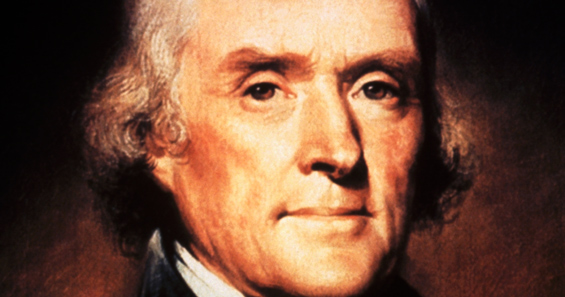
Religious Freedom

On January 16, 1786, Virginia enacted the Statute for Religious Freedom authored by Thomas Jefferson.