Categories
Thought

Mark Twain

Our papers have one peculiarity — it is American — it exists nowhere else — their irreverence. May they never lose and never modify it. They are irreverent to pretty much everything, but where they laugh one good king to death, they laugh a thousand cruel and infamous shams and superstitions into the grave, and the account is squared. Irreverence is the champion of liberty and its only sure defense.

Mark Twain’s Notebook (1935), p. 195.
Categories
Today

Victory

On December 12, 1939, Finnish forces defeated those of the Soviet Union in the first major victory of what became known as the Winter War, in the Battle of Tolvajärvi.


December 12th birthdays include:

  • Erasmus Darwin (1731) – English physician, slave trade abolitionist, inventor and poet
  • John Jay (1745) — First Chief Justice of the United States
  • William Lloyd Garrison (1805) — American abolitionist, editor of The Liberator
Categories
by Paul Jacob Common Sense video

Watch: We Didn’t Win!

Paul Jacob starts with TIME and ends with FIRE:

Categories
Thought

Thomas Babington Macaulay

Our liberty is neither Greek nor Roman; but essentially English. It has a character of its own, — a character which has taken a tinge from the sentiments of the chivalrous ages, and which accords with the peculiarities of our manners and of our insular situation. It has a language, too, of its own, and a language singularly idiomatic, full of meaning to ourselves, scarcely intelligible to strangers.

Thomas Babington Macaulay, “History,” Edinburgh Review (May 1828).
Categories
Today

Solzhenitsyn

Aleksandr Isayevich Solzhenitsyn was born on December 11, 1918. Solzhenitsyn became a novelist, philosopher, historian, and dissident who helped bring down the totalitarian Soviet Union. Solzhenitsyn’s novels include One Day in the Life of Ivan Denisovich (1962) and Cancer Ward (1966). His behemoth history of Soviet prison camps, The Gulag Archipelago, was a major event in the cultural eclipse of far left ideology in the West, when it was published in 1973.

Solzhenitsyn died on August 3, 2008.

In the last two years, variants of an aphorism about Soviet life has been making the rounds on the Internet, misattributed to him.

Categories
audio podcast

Listen: We Did Not Win

Paul Jacob talks up The Person of the Year:

Categories
Thought

Harry S. Truman

Once a government commits to the principle of silencing opposition, it has only one way to go, and that’s down the path of increasingly repressive measures until it becomes source of terror to all its citizens.

Categories
Today

Huck, Passy & Dunant

On December 10, 1884, Mark Twain’s Adventures of Huckleberry Finn was first published. This novel, narrated in the first person by the title character, is a dark comedy of the antebellum South and slavery, and has been considered by many American critics and writers to qualify as the “Great American Novel.”

On this date in 1901, the first Nobel Peace Prizes were awarded — to economist Frédéric Passy (pictured above), co-founder of the Inter-Parliamentary Union; and to Henry Dunant the founder of the International Committee of the Red Cross.

Passy was an admirer of Richard Cobden and an active member in the French Liberal School of Political Economy that developed in the tradition of J.B. Say, Destutt de Tracy, and Frédéric Bastiat. His published works include Leçons d’économie politique (1860-61); La Démocratie et l’Instruction (1864); L’Histoire du Travail (1873); Malthus et sa Doctrine (1868); and La Solidarité du Travail et du Capital (1875).

Categories
defense & war general freedom international affairs

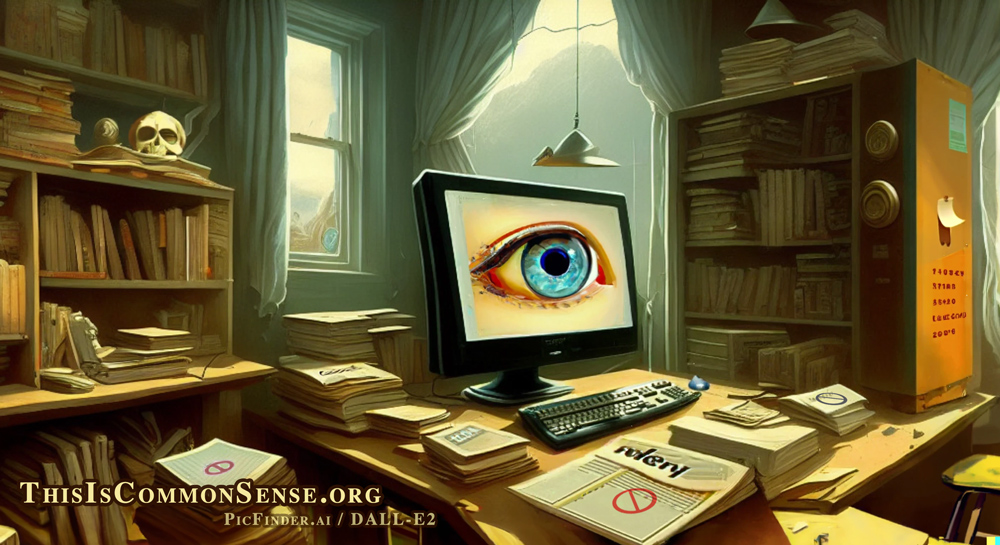
An Invisibility Cloak We Can Use

It’s not quite the magical invisibility cloak worn by Harry Potter. But it’s the next best thing.

Chinese students have created apparel that human eyes can see but that hides the wearer from security cameras and recognition software.

The InvisDefense coat looks ordinary. So it won’t by itself arouse the suspicion of other people on the street. But it is designed in such a way as to foil the kind of cameras that, for example, try to identify who is protesting Chinazi lockdown insanity.

During the day, the printed pattern of the InvisDefense coat blinds cameras. At night, the coat emits heat signals that disrupt infrared. It was invented by Chinese graduate students at Wuhan University under the guidance of computer science professor Wang Zheng. Their coat won first prize in an innovation contest sponsored by Huawei.

Wang observes that “many surveillance devices can detect human bodies. Cameras on the road have pedestrian detection functions. And smart cars can identify pedestrians, roads, and obstacles. Our InvisDefense allows the camera to capture you. But it cannot tell if you are human. . . .

“We use algorithms to design the least conspicuous patterns that can disable computer vision.”

And the coat costs only seventy bucks or so.

I’m not always a fan of the algorithms. In this case, shout Hooray for algorithms and for those who put them to such good use by inventing the InvisDefense coat. 

I hope these students sell about eight billion of them.

This is Common Sense. I’m Paul Jacob.


PDF for printing

Illustration created with DALL-E2

See all recent commentary
(simplified and organized)
See recent popular posts
Categories
Thought

Joseph Conrad

It is not the clear-sighted who lead the world. Great achievements are accomplished in a blessed, warm mental fog.

Joseph Conrad, Victory: An Island Tale (1915).