Our leaders’ lack of legitimacy is not unrelated to their open contempt for traditional republican norms:
Categories
Watch: Word Is Brazenness

Our leaders’ lack of legitimacy is not unrelated to their open contempt for traditional republican norms:

When liberty goes out of a place it is not the first to go,
Walt Whitman, To a Foil’d European Revolutionaire (1856;1881).
nor the second or third to go,
It waits for all the rest to go, it is the last.
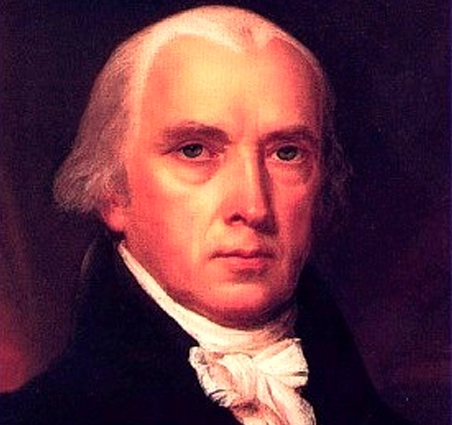
On May 7, 1992, the State of Michigan ratified a 203-year-old proposed amendment to the United States Constitution, thereby fulfilling the terms of amending the document, adding it as 27th Amendment. The amendment had been written by James Madison. He had presented it as part of the original twelve amendments that became the ten making up the Bill of Rights. It bars the U.S. Congress from giving itself a pay raise until after the next election, so that voters have a chance to decide whether those voting for the raise would remain in Congress to receive it.
Paul Jacob is worried about how little legitimacy our leaders have:
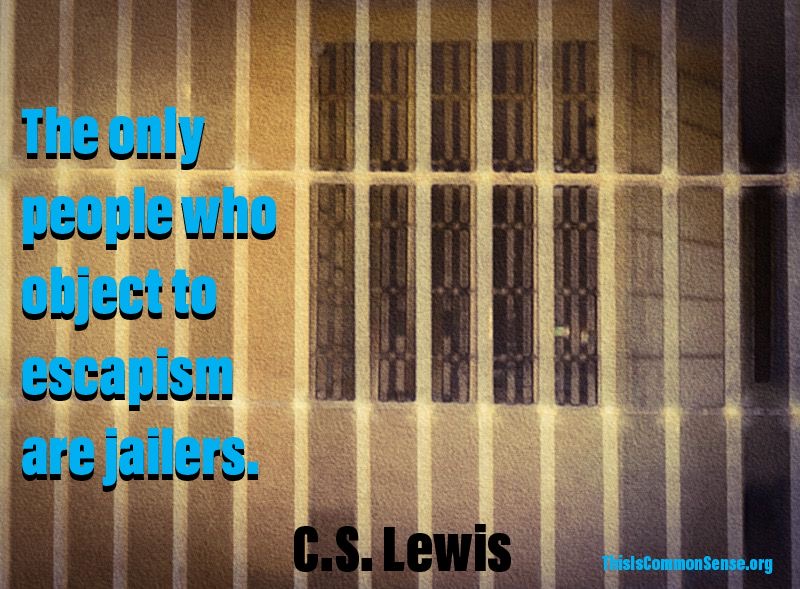
The only people who object to escapism are jailers.
C. S. Lewis, as quoted by Arthur C. Clarke, God, The Universe and Everything Else (1988).
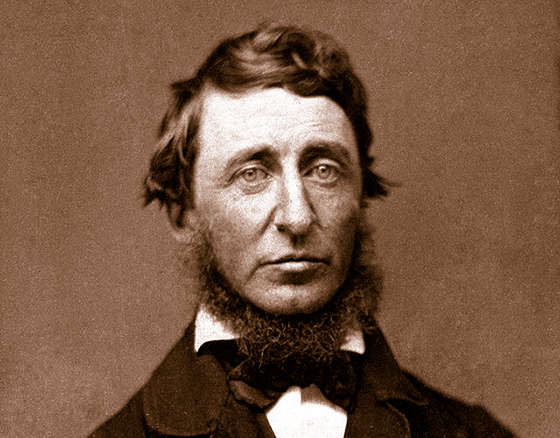
On May 6, 1862, American author, philosopher and abolitionist Henry David Thoreau died, after many years of tuberculosis.
Aware he was dying, Thoreau’s last words were “Now comes good sailing,” followed by two lone words, “moose” and “Indian.” Bronson Alcott planned the service and read selections from Thoreau’s works, and Ralph Waldo Emerson wrote the eulogy spoken at his funeral.
His remains, as well as those of members of his immediate family, were eventually moved to Sleepy Hollow Cemetery in Concord, Massachusetts.
His most famous works are An Essay on Civil Disobedience (1849) and Walden (1854).

It’s not an argument at all, actually, just a harrumph and a guffaw: we cannot have free-market police, or fire suppression, or . . . garbage collection!
But of course all those things are successfully managed in the private sector.
No media outfit has a longer history of pointing this out than Reason magazine. So when the editors of Reason brought us Joe Lancaster’s “Government Waste Monopoly Pits Private Dumpster Business Against Garbage Bureaucrats,” yesterday, I hope they took a moment to revel in a little nostalgia. For this is the kind of story that made Reason what it is today, one of the best sources for retail political economy.
The tale tells of Steven Hedrick, an Arkansas man who put together a business renting out dumpsters — like you often see on construction sites, but smaller — which he would haul away after customers filled them. He built the business without ever going into debt, and then . . . came the government.
“[I]n April 2022, the City Council in Holiday Island passed Ordinance 2022-004, which required all residents and businesses within the city to contract with the county sanitation authority, Carroll County Solid Waste (CCSW), for trash pickup and disposal services,” Reason informs us. “Anyone using private companies would have to switch, and anyone who did not have contracted trash service would have to sign up.”
And Hedrick’s little business must be . . . dumped.
What this is, at base? Sheer bigotry: preferring monopoly government to competitive private services.
For those of us who’ve been reading Reason for decades, it sports a familiar smell.
Just not a good odor, for the drive to monopolize everything stinks.
This is Common Sense. I’m Paul Jacob.
Illustration created with PicFinder.ai
See all recent commentary
(simplified and organized)
See recent popular posts

states that in any bureaucratic organization there will be two kinds of people: those who work to further the actual goals of the organization, and those who work for the organization itself. Examples in education would be teachers who work and sacrifice to teach children, vs. union representative who work to protect any teacher including the most incompetent. The Iron Law states that in all cases, the second type of person will always gain control of the organization, and will always write the rules under which the organization functions.
Jerry Pournelle, at jerrypournelle.com.

In 1862, troops led by Ignacio Zaragoza stopped a French invasion in the Battle of Puebla in Mexico — an event leading to the popular “Cinco de Mayo” celebration.
No cause for celebration, however, is the anniversary of Karl Marx’s birth 205 years ago.
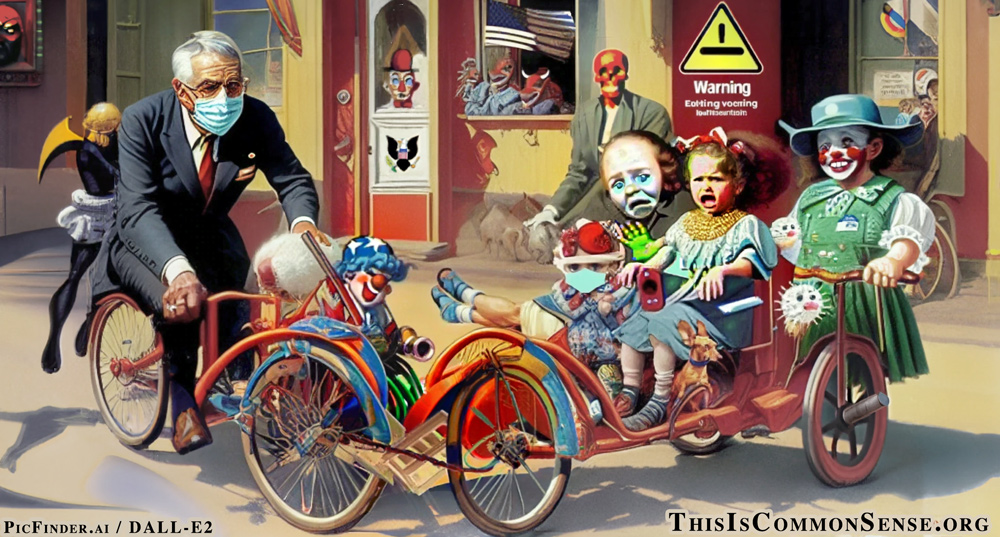
We sure are a long way from the heady days when he proclaimed, “I am the Science.” It’s more like in the book of Genesis, where Cain asks the great rhetorical question, “Am I my brother’s keeper?”
In other words, Fauci’s trying to set the record . . . crooked.
For Fauci was the Authority that bolstered all the advice from the Centers for Disease Control and elsewhere, urging mask mandates and lockdowns and what-have-you.
Now, he is doing more than back-pedaling. He is shifting blame. Blame for failed policies.
But he’s not alone in this. For The Epoch Times, Petr Svab notes another famous back-pedaler: American Federation of Teachers President Randi Weingarten. Watch Ms. Weingarten declare on C-Span, “We spent every day from February on trying to get schools open,” but click that link and read the Twitter crowd-sourced fact-checks, showing how that’s . . . deceptive:
We still argue about how much COVID leaders lied during the heat of the panic. I advised, at the time, to give them a little leeway.
Regarding policy, that is.
Not lying.
This is Common Sense. I’m Paul Jacob.
Illustration created with PicFinder.ai
See all recent commentary
(simplified and organized)
See recent popular posts