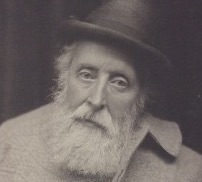
On June 18, 1838, Auberon Edward William Molyneux Herbert was born.
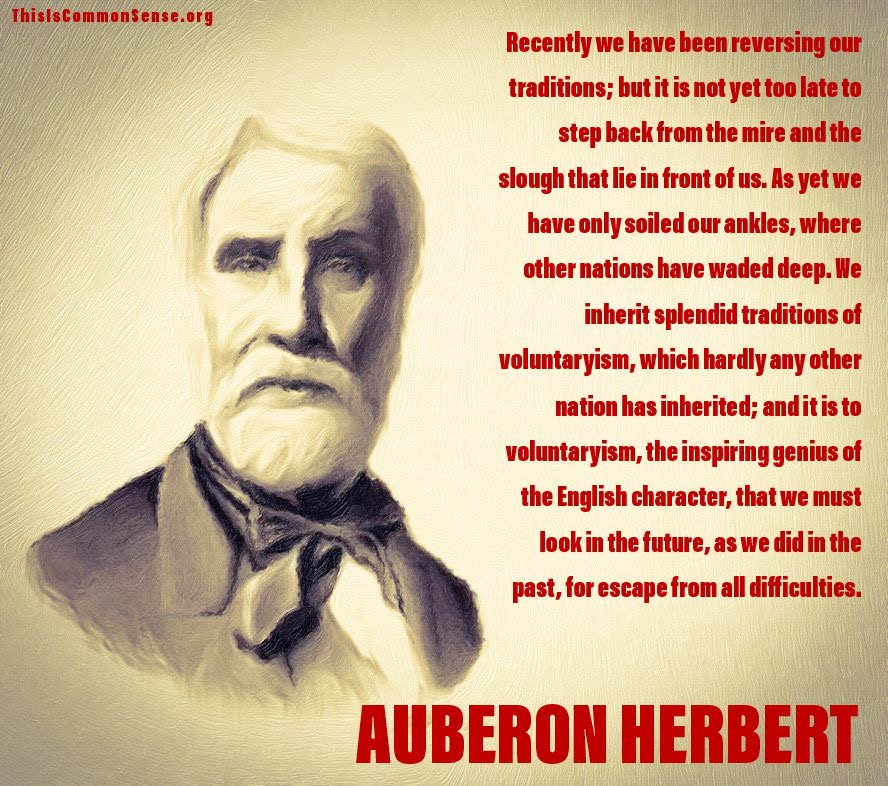
Auberon Herbert was a Liberal Member of Parliament who, after reading the writings of Herbert Spencer, became a radical individualist, authoring essays such as “The Ethics of Dynamite,” “A Politician in Trouble About His Soul,” and “The Right and Wrong of Compulsion by the State.” He termed his version of the political philosophy of liberty “voluntaryism.”
Recently we have been reversing our traditions; but it is not yet too late to step back from the mire and the slough that lie in front of us. As yet we have only soiled our ankles, where other nations have waded deep. We inherit splendid traditions of voluntaryism, which hardly any other nation has inherited; and it is to voluntaryism, the inspiring genius of the English character, that we must look in the future, as we did in the past, for escape from all difficulties.
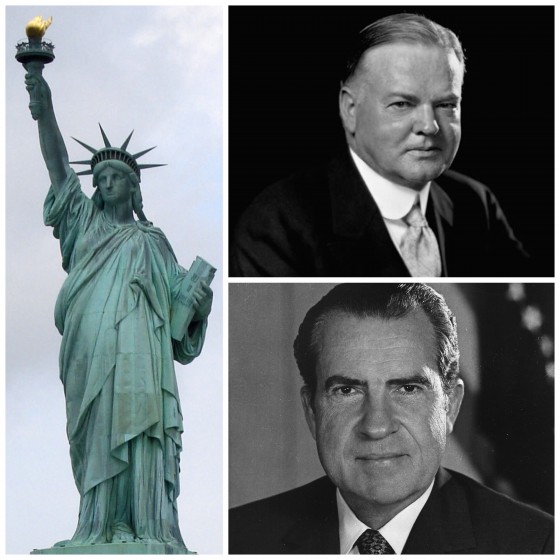
The Statue of Liberty arrived in New York Harbor on June 17, 1885.
On the same day in 1930, progressive Republican President Herbert Hoover — eager to please agricultural states, and confident that protectionism would yield greater wealth — signed the Smoot-Hawley Tariff. The Great Depression deepened, ratcheting up as each provision of the bill took effect.
Three years later, investment author and two-time Libertarian Party presidential candidate Harry Browne was born
On June 17, 1944, Iceland declared independence from Denmark.
On this day in 1971, President Richard Nixon declared a “War on Drugs,” which steadily decreased civil liberty and the rule of law in America.
Exactly one year later, five men were arrested for attempted burglary on the offices of the Democratic National Committee in the Watergate complex in Washington, D.C., igniting the Watergate scandal that ultimately led to the resignation of U.S. President Richard Nixon more than two years later.
Some gangsters take it personally if you object to being railroaded. So they railroad you some more.
That’s what happened to Robert Reeves, a Detroit auto mechanic and construction worker. In 2019, Wayne County confiscated his Camaro after police saw him visit a site that supposedly contained stolen equipment. The police did not formally accuse him of the alleged theft or try to convict him of it.
Nevertheless, the county wanted Reeves to pay $900 to retrieve his car.
Instead, Reeves went to court to end what Institute for Justice, which has been representing him, calls a “seizure-and-ransom policy.”
Soon the county was accusing Reeves of made-up felonies of receiving stolen property and telling the court that he had no right to challenge its forfeiture policy while being accused of these felonies.
Reeves challenged the county’s dishonest challenge, and the court dismissed the charges for lack of evidence. Two weeks later, though, the county did the exact same thing, making the same fake charges and asking the same judge to dismiss the same case on the same grounds. The judge again refused.
Now, years later, Reeves is suing Wayne County for the way it further violated his rights when he challenged its initial violation of his rights.
Although this again makes Reeves a target, “Robert will not be silenced,” says IJ attorney Christian Lansinger, and the Institute will continue to hold accountable governments that seize the vehicles of individuals without evidence of wrongdoing.
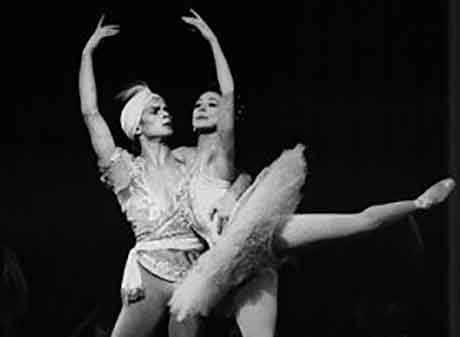
On June 16, 1961, dancer Rudolf Nureyev defected from the Soviet Union.
The great Scottish moral philosopher, political economy pioneer, and Enlightenment intelectual Adam Smith (1723-1790), best known for authoring the 1776 masterwork The Wealth of Nations, was born on June 16.
On June 16, 1858, Abraham Lincoln delivered his “House Divided” speech in Springfield, Illinois.
On this date in 1963, the Soviet Space Program achieved a first with the Vostok 6 mission, placing Cosmonaut Valentina Tereshkova into orbit as the first woman in space.
June 16th is Bloomsday, a celebration of the life and work of Irish expatriate author James Joyce (1882-1941). The date was selected because June 16, 1904, was the date in which Joyce’s 1922 novel Ulysses was set. The ceremonial day is named after the character Leopold Bloom.
Three-and-a-half years late, the U.S. Government is admitting and publicizing the first victims of COVID-19 in Wuhan, China — who just so happen to be scientists at the Wuhan Institute of Virology.
In a Substackarticle by Michael Shellenberger, Matt Taibbi, and Alex Gutentag, we get something close to actual evidence strengthening “the case that the SARS-CoV-2 virus accidentally escaped from the Wuhan Institute of Virology (WIV).”
The “patient zero” is not one but three, namely:
Ben Hu
Yu Ping
Yan Zhu
The Substack authors quote Alina Chan, a molecular biologist and coauthor with Matt Ridley of Viral: The Search for the Origin of Covid19, who identifies Ben Hu as the “star pupil” of “the bat woman of China,” who, with Yu Ping, co-authored a paper on the coronavirus strain in question with said “bat woman.”
David Asher, who led a State Department inquiry on the virus’s origin during the Trump Administration, toldThe Daily Mail: “I’m very doubtful that three people in highly protected circumstances in a level three laboratory working on coronaviruses would all get sick with influenza that put them in the hospital or in severe conditions all in the same week, and it didn’t have anything to do with the coronavirus.”
Much of the talk from officials in the U.S. and in China has stretched our credulity — but they were obviously trying to cover their foolhardy and borderline illegal gain-of-function research program.
Unfortunately, a great deal remains unclear, like “who in the U.S. government had access to the intelligence about the sick WIV workers, how long they had it, and why it was not shared with the public.”
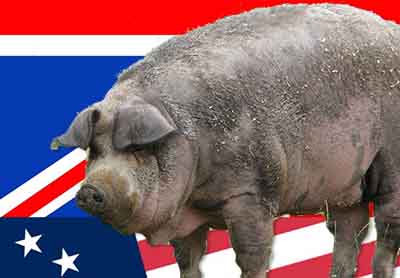
The Oregon Treaty, signed June 15, 1846, established the boundary between Great Britain’s Canadian territory and the United States of America, from the Rocky Mountains to the Strait of Juan de Fuca, using the 49th Parallel as the handy marker. However, the treaty was not exactly clear on the territorial status of the San Juan Islands, so exactly 13 years later, to the day, a war erupted . . . over a shot pig.
An American farmer shot a pig rooting through his garden. The pig belonged to an Irishman. The two did not agree upon compensation, and “the authorities” were called in, with infantry mustering from the south and the Governor of Vancouver Island instructing marines to land on San Juan Island — though the rear admiral in charge refused to comply with the order, on the reasonable grounds that war over a pig was not worth it. Local troops from both sides lined up against each other, but under command to defend themselves only and not shoot first. All that was exchanged in this war were insults. It turned out to be a bloodless war, discounting the pig, so it might qualify as the best war in American history.