Categories
Thought

Malcolm X

You get freedom by letting your enemy know that you’ll do anything to get your freedom; then you’ll get it. It’s the only way you’ll get it.

Malcolm X, speech, “Advice to the Youth of Mississippi” (December 31, 1964).
Categories
Today

U. S. Military Zones

February 19, 1942, was a sad day for constitutional rights, with President Franklin D. Roosevelt signing Executive Order 9066, authorizing the Secretary of War to prescribe certain areas of the country as military zones. These zones were used to incarcerate Japanese Americans in internment camps.

Categories
meme Thought

What He Says and What He Means

A handy reference chart.

Categories
Thought

James Thomson

   Whatever freedom for ourselves we claim,
We wish all others to enjoy the same,
In simple womanhood’s and manhood’s name!
Freedom within one law of sacred might:—
‘Trench not on any other’s equal right.’

James Thomson, quoted as an epigraph to J. H. Levy’s The Outcome of Individualism (1897).
Categories
Today White Rose

White Rose

On Feb. 18, 1943, Hans and Sophie Scholl, a brother and sister, were arrested at the University of Munich for secretly (or not so secretly) putting out leaflets calling on Germans to revolt against Adolf Hitler and the Nazi regime.

In the previous year Hans had founded a group of students, who called themselves “The White Rose.” The group wrote and distributed six leaflets aimed at educated Germans. The leaflets made their way across Germany and to several other occupied countries. The Allies later dropped them all over the Third Reich.

Categories
education and schooling ideological culture

Urinals De- and Re-commissioned

Remember when opponents of the Equal Rights Amendment said that we would wind up with unisex bathrooms should the constitutional amendment be ratified? And ERA advocates scoffed?

Well, here we are: no ERA, but unisex bathrooms . . . in public schools.

Or, more precisely, two flavors of unisex bathrooms: one room for girls along with those boys who identify as girls, and another for boys and those girls who identify as boys. 

In early February, New Hampshire’s Milford School District school board voted to cover over boys’ room urinals with garbage bags while members investigated the cost of turning all the restrooms into all-stall accommodations.

Why? A few parents of trans students had complained that urinals made their trans boys uncomfortable — their girls “transitioning” to become boys didn’t . . . well, I’ll let you imagine some of this.

Of course, urinals in boys’ rooms allow for faster turnover of users. Getting rid of them makes boys spend more time in a place they, as often as not, would like to minimize.

But it affects actual girls negatively, too.

“As a female,” one girl told a local TV station, “I don’t think it’s safe to have males in our bathroom.”

The board had also ruled that the number of students in each restroom should be limited to the number of stalls — not an efficient way to serve students’ needs, completely ignoring time spent at the sink in front of a mirror. More bizarrely yet, the board had specified that clothing changes for physical ed. be confined to locker room toilet stalls.

Last Friday, students held a walkout. And the school board backpedaled, unbagging the urinals.

Good. But I don’t think anyone can mistake all this “business” for common sense.

This is Common Sense. I’m Paul Jacob.


PDF for printing

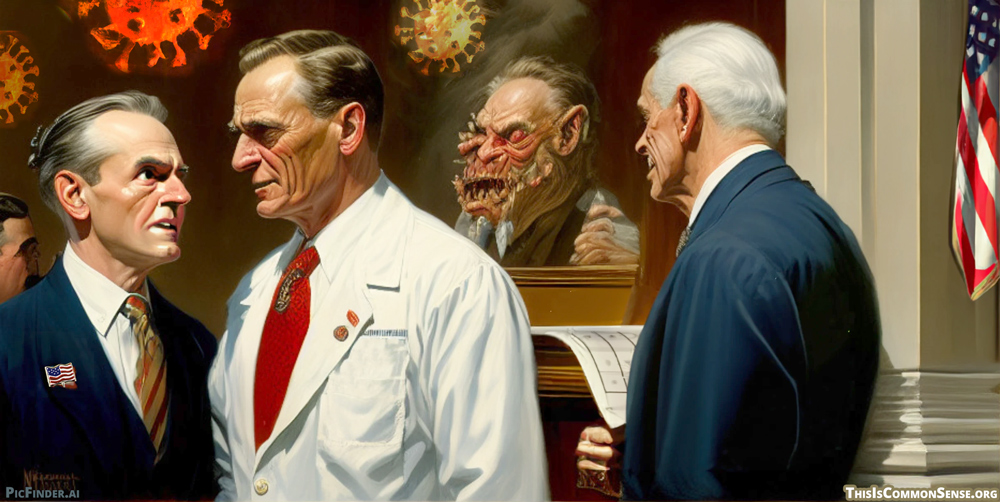
Illustration created with PicFinder.ai

See all recent commentary
(simplified and organized)
See recent popular posts
Categories
Thought

J. H. Levy

It is useless to consume our energies in mere verbal disputes. I must, however, caution students that definition is not a matter of indifference. Nine-tenths of the embarrassments which surround most philosophical questions arise from the difficulty of getting a firm hold of them. When this is done, the solution is comparatively easy. Until it is done no solution can be rationally hoped for.

Joseph Hiam Levy, The Outcome of Individualism (1890; Third Edition, 1892), p. 11.
Categories
Today

President Jefferson

On Feb. 17, 1801, Thomas Jefferson was elected by the U.S. House of Representatives to be the third president of the United States, after an arduous election process that ended only 15 days prior to inauguration.

The fracas included a tie vote in the Electoral College followed by 35 indecisive ballots in the House. At that time, votes were cast for president, with the second place candidate becoming Vice-President. But in the Electoral College, Jefferson tied with his vice-presidential running mate, Aaron Burr. When that sent the balloting to the House of Representatives, the Federalists opposing Jefferson initially threw their support to Burr.


On Feb. 17, 1933, a constitutional amendment to repeal the Eighteenth Amendment to the U.S. Constitution, which had established the national prohibition of alcohol, was passed by the U.S. Senate. Known as the Blaine Act, the prime author was Wisconsin Senator John J. Blaine. By the end of 1933, the repeal of prohibition was adopted as the 21st Amendment to the Constitution.

Categories
crime and punishment First Amendment rights Internet controversy

Court Invokes First Amendment

This is where we’re at. We must be in suspense about whether a judge will object when governments act to repress speech in the name of combatting “misinformation,” “disinformation,” or “hate speech.”

Fortunately, Judge Andrew Carter sees the obvious and has blocked a new New York State law to regulate “hateful” online speech. The law was challenged by anti-censorship video platform Rumble and the Foundation for Individual Rights and Expression.

Carter says: “The First Amendment protects from state regulation speech that may be deemed ‘hateful,’ and generally disfavors regulation of speech based on its content unless it is narrowly tailored to serve a compelling governmental interest.”

The alleged “compelling governmental interest” exception is vague and not really consistent with the First Amendment. But the judge otherwise makes sense.

Laws like New York’s constitute a cart blanche for government to repress speech — any speech.

Any controversial words can be labeled hateful, misinformative, disinformative. People have been censored for asseverating that there are only two sexes, that the COVID-19 injections aren’t really vaccines, that the U.S. shouldn’t send more than $100 bazillion to Ukraine, etc.

It’s hatefully misinformative disinformation to proclaim that debates about such questions are impermissible. But people in any case have a right to be wrong; others, the right to refute them.

When the truth is on your side, you have an advantage. But you can’t beam your understanding into the minds of others.

You must be free to speak.

This is Common Sense. I’m Paul Jacob.


PDF for printing

Illustration created with PicFinder.ai

See all recent commentary
(simplified and organized)
See recent popular posts
Categories
Thought

William Lloyd Garrison

The world is too much governed. The race is not to the swift nor the battle to the strong, but to the crafty; and statutes adroitly devised hedge in monopolies as if they were divinities. The resultant misery and inequality, that curse mankind through loss of freedom, are adduced by the State Socialist as a reason for more government. The patient must be cured by a hair of the dog that bit him

William Lloyd Garrison, quoted as an epigraph to J. H. Levy, The Outcome of Individualism (1890; Third Edition, 1892).