Categories
Today

Vietnam

On August 11, 1972, the last of American ground combat troops exited South Vietnam.

Categories
education and schooling First Amendment rights general freedom

Students Strike Back

In November 2021, at taxpayer-funded Clovis Community College, the group Young Americans for Freedom requested permission to post flyers. College officials assented.

The flyers attacked socialism. Uh oh. This was a grave violation of the alleged inalienable right of socialist students on the campus to never be exposed to disagreement with their views.

Some of the aggrieved students complained. We are offended, they told the school.

Administrators furrowed their brows and quickly determined that the school could not permit such offensive speech.

Suddenly censored, the YAF students who had posted the flyers went to court, represented by the Foundation for Individual Rights and Expression (FIRE). They quickly won a district court victory that has now been affirmed in the Ninth Circuit Court of Appeals.

According to the court’s ruling, “The district court did not abuse its discretion when it concluded that [the students] were likely to succeed on the merits of their claim that the ‘inappropriate or offens[ive] language or themes’ provision was facially overbroad.”

This means that the case can continue.

Clovis YAF Chair Juliette Colunga hopes that in response to the ruling, Clovis will finally decide “to explicitly protect the constitutional rights of its students to speak freely.”

The school has tried to forestall further litigation to require it to set forth an unambiguous policy protecting freedom of speech by conceding that the students may post the anti-socialist flyers.

That’s not enough for FIRE, though, which is proceeding with the litigation.

This is Common Sense. I’m Paul Jacob.


PDF for printing

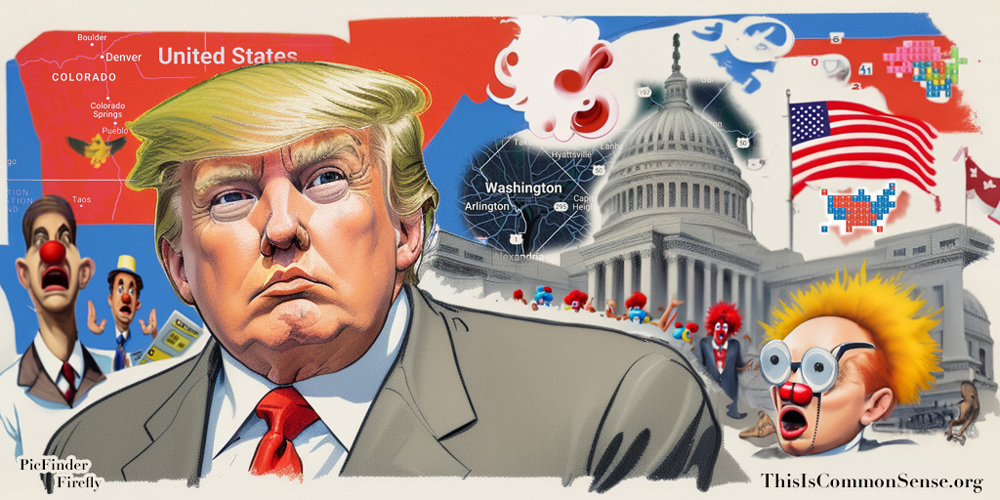
Illustration created with PicFinder.ai and DALL-E2

See all recent commentary
(simplified and organized)
See recent popular posts
Categories
Thought

Ludwig von Mises

If we wish to gain insight into the essence of nationality, we must proceed not from the nation but from the individual. We must ask ourselves what the national aspect of the individual person is and what determines his belonging to a particular nation.

Ludwig von Mises, Nation, State and Economy (1919; 1983, Leland B. Yeager, trans.), p. 34.
Categories
Today

Independence

On August 10, 1809, Ecuadorians attempted independence from Spain with the Declaration of Independence of Quito, but failed with the execution of all the conspirators a few days less than a year later.

Independence was finally achieved in 1822.

Categories
crime and punishment election law privacy

Donors Don’t Donate Their Privacy

Alabama recently passed a law to prohibit public agencies from disclosing information “that identifies a person as a member, supporter, or donor of a 501(c) nonprofit organization . . . except as required by law.”

SB59 is comprehensive, stating that “notwithstanding any provision of law to the contrary,” no public agency may compel disclosure of such information or itself publicly release such information. 

The initial delimitation “except as required by law” seems ambiguous. But SB59 goes on to specify that exceptions would pertain to things like the requirements of a “lawful warrant” or a “lawful request for discovery of personal information in litigation.”

Passage is a big deal because, until now, agencies in the state had been permitted to collect and disclose such information.

Many nonprofits are political or ideological in character, promoting causes that are controversial. When this is so, who especially appreciates unfettered access to donors’ names and addresses? Obviously, opponents of the cause who would like to target donors with propaganda or even actively harass them.

On the national level, recognition of the problem is represented by the U.S. Supreme Court’s 2021 ruling in Americans for Prosperity Foundation v. Bonta. The court threw out a California requirement that nonprofits in the state had to divulge the names and addresses of their biggest donors to the attorney general. The Foundation plausibly argued that the requirement would deter people from contributing.

Several other states have also enacted SB59-style legislation. The number we need is 50.

This is Common Sense. I’m Paul Jacob.


PDF for printing

Illustration created with Midjourney

See all recent commentary
(simplified and organized)
See recent popular posts

Categories
Thought

Jonathan Haidt

Our politics will become more civil when we find ways to change the procedures for electing politicians and the institutions and environments within which they interact.

Jonathan Haidt, The Righteous Mind: Why Good People Are Divided by Politics and Religion (2012).
Categories
Today

Gandhi & Yeltsin

On August 9, 1942, British forces arrested Mahatma Gandhi in Bombay, spurring the Quit India Movement into nationwide action.

In 1999, Russian President Boris Yeltsin fired his Prime Minister, Sergei Stepashin, and his entire cabinet.

Categories
Fifth Amendment rights Fourth Amendment rights national politics & policies

Time to Slap Grabby Hands

Is the House of Representatives readying itself to do something to limit civil asset forfeiture initiated by federal agencies?

The legislation has emerged from the Judiciary Committee, so there is hope.

The Fifth Amendment Integrity Restoration Act (FAIR) would impose substantial limits on federal civil asset forfeiture — on the power of officers to grab someone’s cash or other belongings on the unsupported suspicion that it was involved in a crime.

Currently, this power to steal based on zero evidence and zero due process remains untrammeled. And forfeited funds thus grabbed can then be spent by the agencies that did the asset-grabbing. 

Victims must spend years in the courts to get their stuff back, if they ever do.

FAIR would require “clear and convincing evidence” of wrongdoing. It would also prohibit law-enforcement agencies from being able to spend forfeited funds, eliminating a perverse incentive to rob people naïve enough to be carrying “too much” cash for whatever reason.

At National Review Online, Jill Jacobson says that the bill is “a step in the right direction” but doesn’t go far enough. Arguing on the premise of innocent until proven guilty, she insists “there is no reason why federal law enforcement should be seizing personal property from everyday citizens on tenuous suspicion.” 

Or even non-tenuous suspicion, I would add, for not everyone strongly suspected of doing wrong can be proven to have done wrong. And citizens caught on the wrong end of a government official’s steely gaze should not be regarded as a public resource. 

The reform isn’t finished until civil asset forfeiture is abolished altogether.

This is Common Sense. I’m Paul Jacob.


PDF for printing

Illustration created with PicFinder.ai and DALL-E

See all recent commentary
(simplified and organized)
See recent popular posts
Categories
Thought

Ludwig von Mises

It is not the task of history to project the hatred and disagreements of the present back into the past and to draw from battles fought long ago weapons for the disputes of one’s own time. History should teach us to recognize causes and to understand driving forces; and when we understand everything, we will forgive everything.

Ludwig von Mises, Nation, State and Economy (1919; 1983, Leland B. Yeager, trans.), p. 28.
Categories
Today

Born & Died

Francis Hutcheson, philosopher of the Scottish Enlightenment and a great influence on David Hume and Adam Smith, was born in Ireland on August 8, 1694. He died on his birthday in 1746.


Followers of Mahatma Gandhi launched the Quit India Movement against the British rule on August 8, 1942.

On the same day in 1974, President Richard M. Nixon resigned.