Categories
property rights tax policy

Tax Assessor, House-Nabber

In 1994, Scott Pung won exemption from a school tax. He died in 2004. But years later, a local tax assessor contended that his widow, now also deceased, should have submitted new paperwork to retain the exemption.

Pacific Legal Foundation observes that according to state law, “the exemption continues as long as family members continue to live in the home. . . . Based on her misreading of the law, the tax assessor retroactively denied the exemption for several previous years.”

The estate’s administrator, Mike Pung, got nowhere trying to explain things to the tax assessor. So he brought his case to the Michigan Tax Tribunal. The tribunal ruled in favor of the Pungs.

Didn’t matter. When Mike paid the property taxes for 2012, the assessor called it an underpayment, since payment for the tax that the Pungs did not owe had not been included.

Mike still refused to pay the school tax. So the county grabbed the home that it had assessed at $200,000 and auctioned it for $76,000 to recover the amount of that tax.

With PLF’s help, the Pungs ultimately received $73,000 of this amount, less than half the home’s assessed value. Now PLF is headed to the Supreme Court to make the case for further compensation.

Chances are good. Two years ago, the Supreme Court affirmed in other PLF litigation that local governments “are not allowed to abuse the tax system to take more from families than is owed.”

Or not owed.

This is Common Sense. I’m Paul Jacob.


PDF for printing

See all recent commentary
(simplified and organized)
See recent popular posts

Categories
Thought

Yves Guyot

It is not the astronomer’s business to consider whether it would be better if the sun were nearer or farther from the earth, or if he turned round her, instead of turning round him. Nor is it the chemist’s business to consider whether carbonic acid and carbonic oxide are noxious gases that ought not to exist. It has never been thought desirable to make Newton responsible for tiles falling on the people’s heads.
Economists, however, are held answerable for the laws which they discover.

Yves Guyot, The Principles of Social Economy (1892). Caricature by André Gill (1845–1885).
Categories
Today

Prohibition Ends

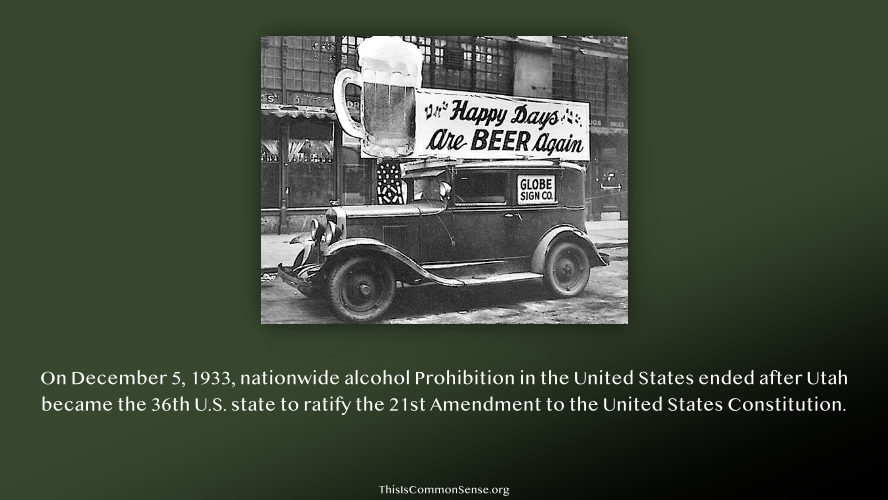
On December 5, 1933, nationwide alcohol Prohibition in the United States ended after Utah became the 36th U.S. state to ratify the 21st Amendment to the United States Constitution, thus establishing the required 75 percent of states needed to enact the amendment that overturned the 18th.

Categories
Accountability government transparency national politics & policies

One Day an Audit?

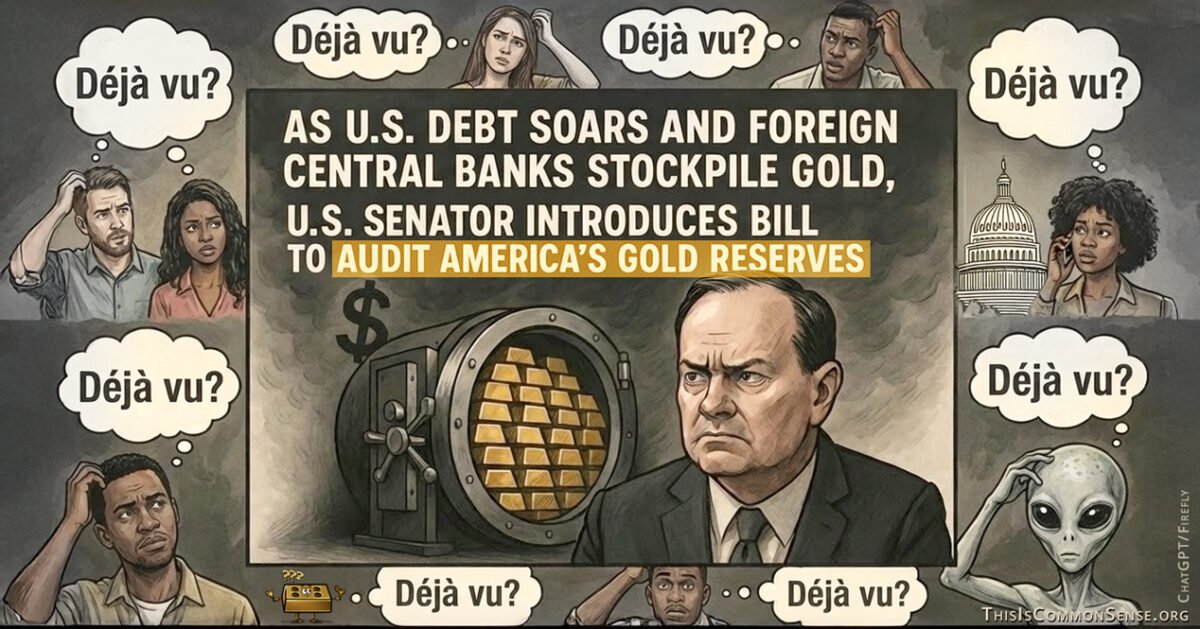
“As U.S. debt soars and foreign central banks stockpile gold,” asserts a new article, “a U.S. senator today introduced a bill to require the first comprehensive audit of America’s gold reserves in decades.”

Reading the Mises Institute piece, I got a sense of déjà vu.

“Sponsored by Sen. Mike Lee (R-UT), the Gold Reserve Transparency Act would require a full assay, inventory, and audit of all United States gold holdings,” the author, Jp Cortez, explains, “along with an upgrade in the purity of the gold so that it meets global market standards.”

The “haven’t I read this before?” thought hit me hard. Talk of auditing the gold reserves is not new. Earlier this year, in the heady days of Elon Musk and DOGE, a lot of folks dared wonder: does the federal government even have any gold at all? 

I asked the question in February, in the context (I kid you not) of UFOs!

A “Gold Reserve Transparency Act” has been introduced four times in the House since 2011, always by Republican sponsors aligned with sound-money advocates. But it has also never passed the House, let alone advanced to the Senate or become law. 

The House Committee on Financial Services received these bills but only the 2011 version got so much as a hearing. 

No Senate version existed until Sen. Mike Lee’s introduction (S. __, 119th Congress) weeks ago, which mirrors the House bill and remains unnumbered and in committee as of yesterday.

A gold audit would be very interesting. But I get the feeling this will be treated like UFOs: full disclosure forever forthcoming.

This is Common Sense. I’m Paul Jacob.


PDF for printing

Illustration created with ChatGPT/NanoBanana/Firefly

See all recent commentary
(simplified and organized)
See recent popular posts
Categories
Thought

Courcelle-Seneuil

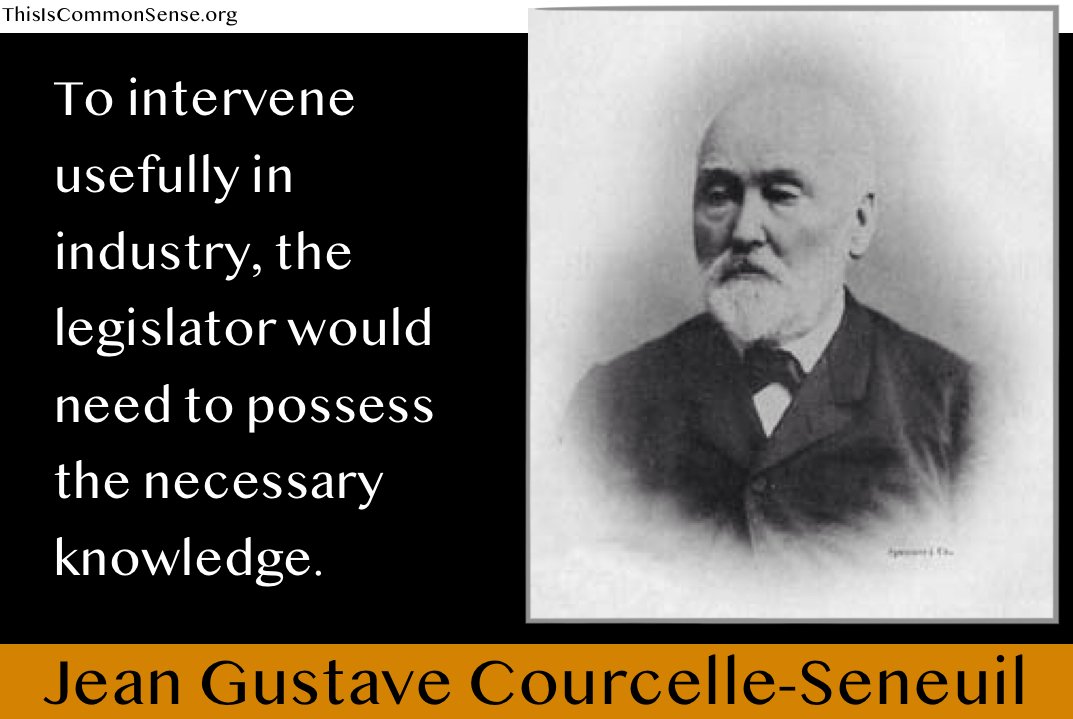
Pour intervenir utilement dans l’industrie, il faudrait
que le législateur possédât les connaissances nécessaires.

To intervene usefully in industry, the legislator would need to possess the necessary knowledge.

Jean Gustave Courcelle-Seneuil (December 22, 1813 – June 29, 1892), Protection et libre-échange (1879).
Categories
Today

A Farewell to Arms

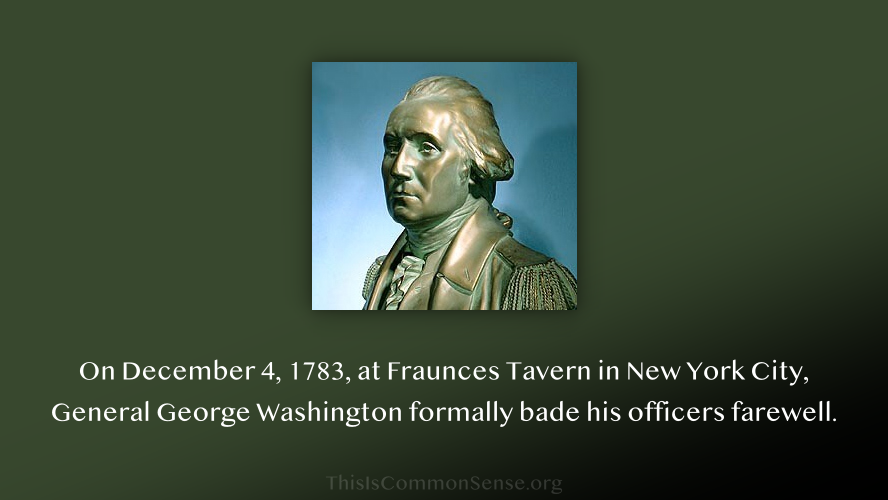
On December 4, 1783, at Fraunces Tavern in New York City, General George Washington formally bade his officers farewell.

Categories
defense & war national politics & policies

The War on Drugs War

The Trump Administration is at war . . . with Senator Rand Paul. 

Tensions between the President and Senator Paul have heated up noticeably since mid-October, with Trump taking sharp public swipes at Paul, a longtime ally. This scuffle seems primarily driven by Paul’s outspoken criticism of the Venezuelan boat strikes, which Trump sees as a betrayal of his “tough on drugs” agenda and a threat to GOP unity. 

The budget hawk angle — mentioned here in a weekend update — is a secondary irritant, tied to Paul’s broader push for fiscal restraint. But it hasn’t dominated the feud.

While Trump decries a lack of unity, Paul offers Trump’s bellicosity as “detrimental to the party.”

Against the Kentucky senator’s war-powers/war-crimes critiques, the president is acerbic: “Rand wants trials for narco-terrorists 2,000 miles away? Tell that to the fentanyl orphans.”

Tough zinger, sure, but think about it: it’s the standard argument against all civil liberties. The idea that those suspected by the government of awful crimes, even lacking any proof or semblance of due process, do not deserve rights. 

Leading to a modern adaptation of “Kill them all and let God sort them out” in the Carribean.

Meanwhile, in a bizarre reversal of the ongoing marijuana legalization and hemp deregulation trend, the federal government has “turned back the clock”: Tucked into the continuing resolution (CR) that ended the 43-day government shutdown, Congress passed (and Mr. Trump signed) language that effectively bans most hemp-derived products containing more than 0.4 milligrams of THC per container — a threshold so low it sweeps up even basic CBD items, which naturally contain trace THC.

Since Kentucky sports over 5000 acres devoted to the ancient industrial product, you might suspect that this could be part of Trump’s war on Kentucky’s junior senator.

But it appears the state’s senior senator was behind the move!

New War on Drugs, meet the old War on Drugs.

This is Common Sense. I’m Paul Jacob.


PDF for printing

Illustration created with NanoBanana and Firefly

See all recent commentary
(simplified and organized)
See recent popular posts
Categories
Thought

Brett Weinstein

Think about what you just did to Gen Z. . . . You just flat-out told them that men could become women magically. . . . You have now in a weird way inoculated them against your own bullshit by giving them something so ridiculous and obviously wrong that they now understand that it doesn’t matter how punished you’ll [sic] be for departing from the mainstream consensus — that the mainstream consensus is at least sometimes just total crap.

Brett Weinstein, segment from his Dark Horse podcast (“9/11: Does Gen Z Believe the Official Narrative?” 12/01/2025), in conversation with his wife Heather Heying.

Categories
Today

Cold War Ends

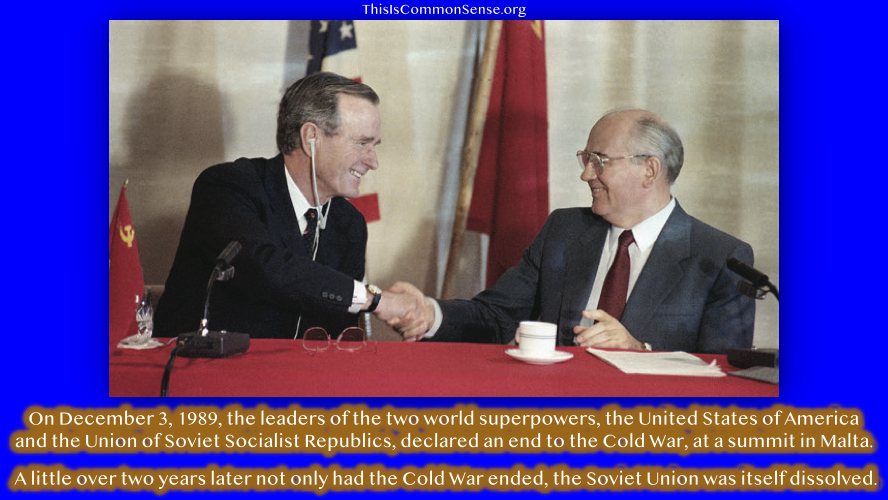
On December 3, 1989, the leaders of the two world superpowers, the United States of America and the Union of Soviet Socialist Republics, declared an end to the Cold War, at a summit in Malta. A little over two years later not only had the Cold War ended, the Soviet Union was itself dissolved.

Categories
Accountability folly political economy

Green Goes Red

Well, at least they were earnest. Hopeful. Committed.

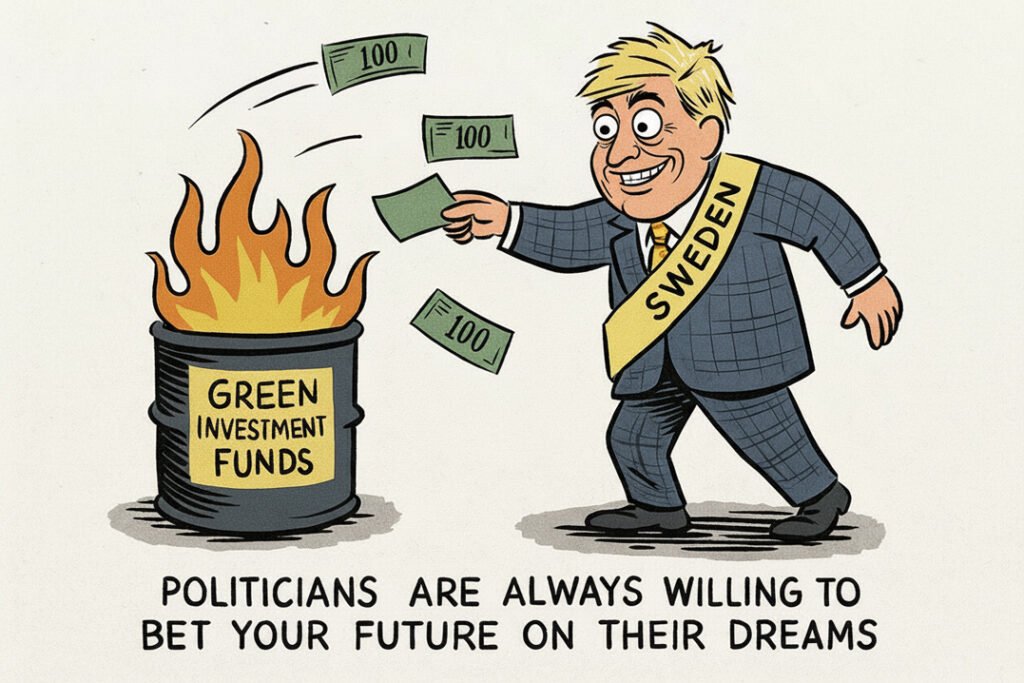
Swedes in the north part of their country channeled State pension funds — billions of kronor! — into climate-friendly projects.

Well, I’m not sure to what degree Swedish citizens were for this ideologically driven investment portfolio, but Swedish politicians sure were!

And now those investments appear iffy. “State pension fund AP2 had invested £117.7 million in Northvolt before its collapse,” explains GBN News, out of Great Britain. “It also holds £46.8 million in Stegra, plus a further £15.6 million exposure through its investment in Al Gore’s Just Climate fund.” And both Northvolt and Stegra — “once flagship companies of the energy transition,” as Blackout News puts it — teeter at the abyss of failure.

Northvolt was once Europe’s leading Great Green Hope, an electric vehicle battery company with a commitment to sustainability; in November it filed for bankruptcy protection.

Stegra was until recently seen as Sweden’s high-profile “green steel” leader, but now faces an £858 million funding gap.

There has been some shuffling of management, but even were the world’s most magical managers to pull these companies’ feet out of the fire — even if the endeavors can limp out of the current fire-sale conflagration — ask yourself: does it ever make sense to leave pension funds in the hands of zealots who seek to change the world for some utopian dream? 

It makes far more sense to let private equity fund risky projects, for private fund managers have more (voluntarily given funds) on the line.

Politicians, after all, are notoriously irresponsible — always willing to bet your future on their dreams.

This is Common Sense. I’m Paul Jacob.


PDF for printing

Illustration created with ChatGPT and NanoBanana

See all recent commentary
(simplified and organized)
See recent popular posts