Categories
crime and punishment general freedom Second Amendment rights

Balking at the Ban

Key Albuquerque officials won’t enforce the New Mexico governor’s recent order.

At a press conference last Friday, Governor Michelle Lujan Grisham had vowed to suspend the right to publicly carry firearms “in any public space” in the Albuquerque area. The temporary order, declared in response to recent shootings, was justified by the governor as an “emergency health measure.”

The response has been far from uniformly positive. In addition to officials balking, a gun-rights group, National Association for Gun Rights, is suing to block the order. And there has been talk of impeaching the governor. There was even an armed protest.

The governor is either unaware or heedless of the possibility that bad people with guns can be stopped by good people with guns — a lesson that would-be robbers belatedly learned in Maryland a couple weeks ago when they failed to rob a pub full of police officers. (They had missed the cop-bar scene in Code of Silence.) Violent criminals in the area, for their part, have somehow not agreed to defer their activities for a month in deference to her wishful thinking, however.

Officials who say they won’t cooperate with the governor’s aggressive power grab include Albuquerque Mayor Tim Keller, Police Chief Harold Medina, and Bernalillo County District Attorney Sam Bregman.

Bernalillo County Sheriff John Allen says he is wary of the risks “posed by prohibiting law-abiding citizens from their constitutional right to self-defense.”

District Attorney Bregman says, “As an officer of the court, I cannot and will not enforce something that is clearly unconstitutional.” 

Thus raising a standard to which people in positions of authority should repair much more often than they do.

This is Common Sense. I’m Paul Jacob.


PDF for printing

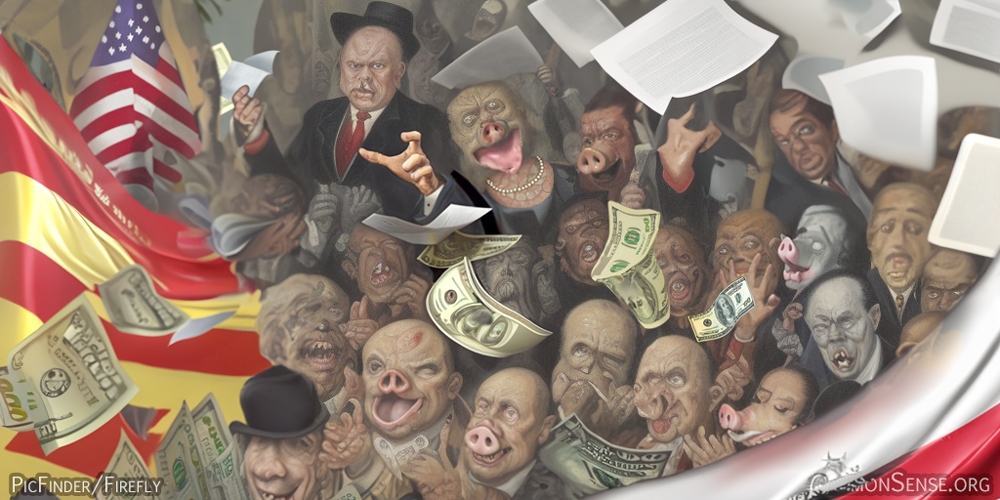
Illustration created with PicFinder.ai

See all recent commentary
(simplified and organized)
See recent popular posts

Categories
Thought

James Fenimore Cooper

Equality, in a social sense, may be divided into that of condition, and that of rights. Equality of condition is incompatible with civilization, and is found only to exist in those communities that are but slightly removed from the savage state. In practice, it can only mean a common misery. 
Equality of rights is a peculiar feature of democracies. These rights are properly divided into civil and political, though even these definitions are not to be taken as absolute, or as literally exact.

James Fenimore Cooper, The American Democrat: Or, Hints on the Social and Civic Relations of the United States of America (1838).
Categories
Today

Switzerland federalized

On September 12, 1848, Switzerland became a unified federal state with a constitution limiting central government powers and providing decentralized state (canton) power patterned on the U.S. Constitution.


In 1880 on this date, H.L. Mencken was born. One of his earliest books was a debate with a socialist, The Men versus The Man (1910); his greatest lasting contribution was probably The American Language (1919) and its supplements (1945, 1948). His work has been collected in numerous anthologies, such as Alistair Cooke’s Vintage Mencken (1955) and the author’s own Mencken Chrestomathy.

Categories
Accountability folly national politics & policies

Will We Comply?

“To every COVID tyrant who wants to take away our freedom, hear these words,” intoned Donald J. Trump, eleven days ago, “we will not comply.”

The former president did not stop there: “So don’t even think about it. We will not shut down our schools. We will not accept your lockdowns. We will not abide by your mask mandates. And we will not tolerate your vaccine mandates.”

While Trump still boasts about his vaccine heroism, his supporters range from iffy to hostile on the subject. So Trump positions himself against mandates and for “freedom,” while in the past he was for masks and for lockdowns, as well as pushing the novel vaccines that cleverly (and perhaps dangerously) leveraged the spiked protein protuberances on SARS-CoV-2.

Meanwhile, Dr. Anthony Fauci, whom Trump brought into the world conversation about the pandemic in 2020, is similarly trying to position himself with some trickiness and . . . care. 

Fauci foresees mask recommendations, but no mandates — but note that he focuses on what federal bureaucrats say and do, not on what governors in the states do under federal bureaucrats’ advisement. 

CNN’s Michael Smerconish interrogated Fauci about the many studies showing that masks are ineffective against respiratory diseases like COVID. 

Fauci’s reply? Against the big study cited here in February, Fauci mentioned “other studies,” lamely and unconvincingly. He admitted that, overall — as affecting the course of the pandemic — “the data” about mask efficacy have been “less strong.” But “on an individual basis of someone protecting themselves, or protecting themselves from spreading to others,” Fauci still insists “there’s no doubt that there are many studies” showing “an advantage.”

If you buy that, you’ll wear masks forever — or comply with anything.

This is Common Sense. I’m Paul Jacob.


PDF for printing

Illustration created with PicFinder.ai

See all recent commentary
(simplified and organized)
See recent popular posts

Categories
Today

9/11: Ante-, Post-

On September 10, 2001, Secretary of Defense Donald Rumsfeld gave a speech about an “adversary that poses a serious threat to the United States of America.” Describing it as “one of the last bastions of central planning, governs by dictating five year plans,” and that “with brutal consistency it stifles free thought and crushes new ideas.”

The adversary? “The Pentagon bureaucracy — not the people, but the processes.” And he went on to state that the Pentagon could not account for more than $2.3 trillion.

The next day, September 11, “some people did something,” in the immortal words of Rep. Ilhan Omar (D-Minn.),* and nearly everybody forgot about Rumsfeld’s alarm. The terrorist attacks on 9/11, in New York and at the Pentagon itself, along with a citizen-led resistance on United Flight 93, resulted in 2,977 fatalities, over 25,000 injuries, and substantial long-term health consequences.

The unaccounted-for spending and receipts of the Pentagon and the Department of Housing and Urban Development increased ten-fold in the next 19 years. It appears to balloon like the federal debt. But we almost never talk about it.


Rep. Omar said these words on March 23, 2019. They were not a hit.

Categories
Thought

Ralph Waldo Emerson

We boil at different degrees.

Ralph Waldo Emerson, Society and Solitude (1870).
Categories
Thought

James Fenimore Cooper

It is probable a true history of human events would show that a far larger proportion of our acts are the results of sudden impulses and accident, than of that reason of which we so much boast.

James Fenimore Cooper, The Pilot: A Tale of the Sea (1823), preface.
Categories
Today

Missing Money

On September 10, 1608, John Smith was elected council president of Jamestown, Virginia.


On September 10, 2001, Secretary of Defense Donald Rumsfeld gave a speech about an “adversary that poses a serious threat to the United States of America.” Describing it as “one of the last bastions of central planning, governs by dictating five year plans,” and that “with brutal consistency it stifles free thought and crushes new ideas.”

The adversary? “The Pentagon bureaucracy — not the people, but the processes.” And he went on to state that the Pentagon could not account for more than $2.3 trillion.

Categories
Thought

Ralph Waldo Emerson

What is a weed? A plant whose virtues have yet to be discovered.

Ralph Waldo Emerson, Fortune of the Republic (1878).
Categories
Today

Leo Tolstoy

On September 9, 1828, Count Lev Nikolayevich Tolstoy was born. Known most commonly in the English-speaking world as Leo Tolstoy, he became the celebrated author of the novels Anna Karenina and War and Peace, as well as the novellas and short stories such as “Family Happiness,” “The Death of Ivan Ilyich,” and “The Kreutzer Sonata.”

His political and religious ideas heavily influenced Gandhi and Martin Luther King, Jr.

Tolstoy died in 1910.