Categories
crime and punishment folly too much government

The California Experiment

California is determined to give us the full bleak picture of totalitarianism, American-style.

Anticipating proposed SEC regulations, Newsom’s California is set to impose nonsensical mandates for reporting greenhouse gas emissions and “climate-related financial risk” that target companies with annual revenue of $1 billion or more (according to the terms of SB253) and $500 million or more (SB261).

Billion-dollar businesses will have to report all direct and indirect emissions, including emissions produced throughout a business’s supply chain. Business travel. Employee commutes. Penalties for failure to report could be as high as $500,000.

The cost is in time, money, privacy, freedom, with no benefits except to bureaucrats and politicians who enjoy bossing us around and destroying our ability to function.

These requirements are tyrannical in the same way they’d be tyrannical if required of you and me as individuals. 

Do you know all about the emissions produced in delivering the water, electricity, electronics, gas, paper you use each month? 

Care to drop everything you’re doing to find out? 

And submit the data in a bureaucrat-satisfying format?

We already know what the results of California’s experiment will be. We already know that crushing freedom and giving unfettered power to slave-masters is not the road to wealth and happiness.

What we don’t know is exactly how far the Tarnished State’s aspiring totalitarians will go. But whatever the consequences, they’ll blame others . . . or just mutter “Good riddance, we didn’t want that prosperity and those evil businesses anyway.”

This is Common Sense. I’m Paul Jacob.


PDF for printing

Illustration created with DALL-E2 and PicFinder.ai

See all recent commentary
(simplified and organized)
See recent popular posts
Categories
Thought

Epicurus

Natural justice is a pledge of reciprocal benefit, to prevent one man from harming or being harmed by another.

Epicurus, Principal Doctrines, no. 31.
Categories
Today

Shays’ Constitution

On September 26, 1786, protestors shut down the court in Springfield, Massachusetts, beginning a military standoff and ushering in Shays’ Rebellion. This anti-tax revolt spurred a dramatic reaction on the part of the day’s politicians, including their attempts to reform the Articles of Confederation and to figure out better ways than high state taxes to pay off Revolutionary War debts. These efforts directly led to the adoption of a new Constitution.

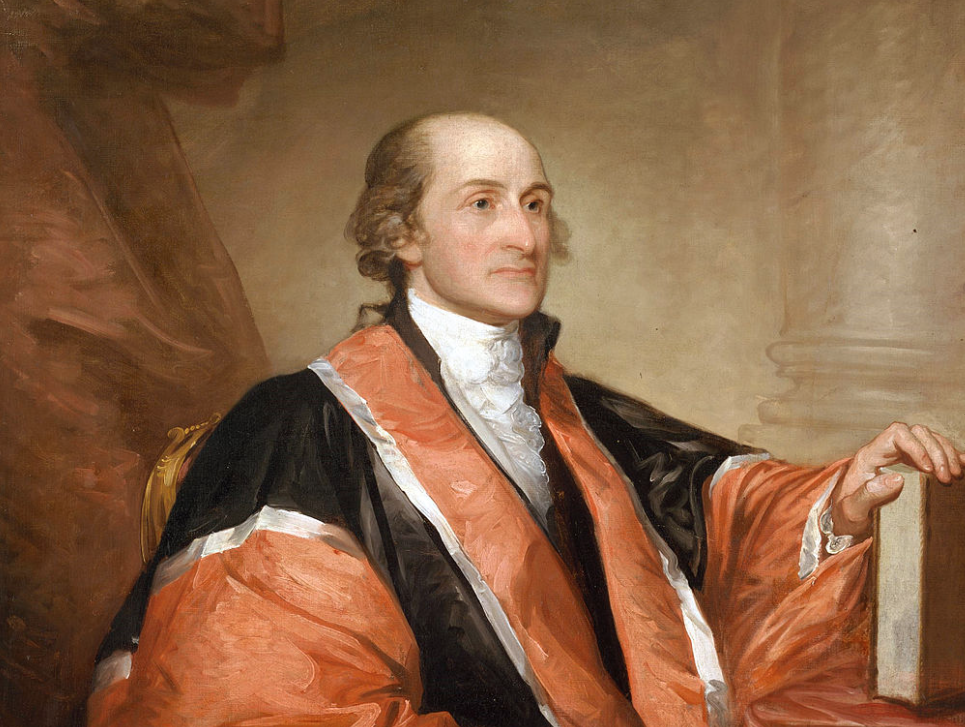
§   Three years later, to the day, Thomas Jefferson was appointed the first United States Secretary of State; John Jay (pictured) was appointed the first Chief Justice of the United States; Samuel Osgood was appointed the first United States Postmaster General; and Edmund Randolph was appointed the first United States Attorney General — all under the new Constitution.

§   In 1960 on this date, John F. Kennedy and Richard M. Nixon engaged in the first televised presidential campaign debates.

§   September 26 is celebrated, by some who know history, as “Petrov Day,” after Stanislav Yevgrafovich Petrov, who on this day in 1983 may have saved civilization by resorting to hunch. While serving as a lieutenant colonel in the Soviet Air Defense Forces, he took the initiative to downgrade information from the USSR’s computerized early warning missile defense system that the United States had initiated a nuclear first strike against the Soviet Union. He interpreted the warning as a false alarm. His hunch was correct; the U.S. had not initiated a first strike: the data he had received was misleading. A later investigation determined it was the result of high altitutde cloud interference with a satelite view of a U.S. Air Force base. Petrov was not rewarded for his decision, however. His decision showed up the military higher-ups and scientists to have concocted an extremely faulty system, so a reward would also have required some sort of punishment. He retired soon after with a very, very small pension.

Petrov died on May 19, 2017.

Categories
crime and punishment folly too much government

Downshifting Before the Cliff

A scenario: You and millions of others are willy-nilly running toward a cliff.

You don’t want to go over the cliff; like Bartleby, you would prefer not to. But you’re caught in the surging mass. Enough of the stampeders think that it’s the greatest idea ever — long overdue, in fact.

But just as you’re coming within sight of the cliff, the Great Leader leading the charge raises his hand and asks to be heard.

“We have decided that we are running too fast toward the cliff. We need more time to make the transition. We will therefore reduce the speed of our blind hurtling toward the cliff by 11 percent.”

Fiction? No.

The above summarizes the amended policy of British Prime Minister Rishi Sunak vis-à-vis how quickly policymakers will shove Britain’s industrial society over the proverbial cliff in the name of pretending to fine-tune global climate. Various bans on various things that people need in order to function will reportedly be slightly delayed so that people have more time to . . . pretend . . . to prepare.

It won’t become illegal to sell petrol (gas) and diesel vehicles so that buyers of new cars would be stuck with more expensive and impractical battery-powered cars until 2035

Not 2030 as previously stated.

Instead of 100 percent of gas boilers being phased out by 2035, the new goal is 80 percent.

Off-grid oil burners will now be banned in 2035, not 2026.

Other slight delays of annihilative mandates are also in the works.

British people, enjoy your five-year and nine-year reprieves.

This is Common Sense. I’m Paul Jacob.


PDF for printing

Illustration created with PicFinder.ai

See all recent commentary
(simplified and organized)
See recent popular posts

Categories
Thought

William Henry Harrison

The only legitimate right to govern is an express grant of power from the governed.

William Henry Harrison, inaugural address (March 4, 1841); Inaugural Addresses of the Presidents of the United States from George Washington, 1789, to John F. Kennedy, 1961 (1961), p. 72. House Doc. 87–218.
Categories
Today

Bill of Rights Passed Congress

On September 25, 1789, the U.S. Congress passed twelve amendments to the United States Constitution: the Congressional Apportionment Amendment (which was never ratified), the Congressional Compensation Amendment (which was later enacted as the Twenty-seventh Amendment), and the ten that are known as the Bill of Rights.

Centuries earlier on that date, in 1555, the Peace of Augsburg was signed in Augsburg by Charles V and the princes of the Schmalkaldic League.

Categories
Thought

Francis Hutcheson

Wisdom denotes the pursuing of the best ends by the best means.

Categories
Today

Judiciary Act

On September 24, 1789, the United States Congress passed the Judiciary Act, creating the office of the United States Attorney General and the federal judiciary system, and ordered the composition of the Supreme Court of the United States.

On the same day that President George Washington signed the bill into law, he officially nominated John Jay to the new position of Chief Justice of the Supreme Court. Jay (pictured in his official portrait, above) served in that position until 1795, when he resigned to take up his elected position as second governor of the State of New York. The Supreme Court heard only four cases during Jay’s Chief Justiceship; Jay refused to consult, officially, on legislation written by Alexander Hamilton, establishing the precedent that the Supreme Court has followed to this day: the Court would only rule on cases tried before it.

Categories
Thought

Bolesław Prus

A scoundrel will be a scoundrel, even with two university degrees.

Categories
Today

Sweden minus Norway

On September 23, 1905, Norway and Sweden signed the “Karlstad treaty,” peacefully dissolving the union between the two countries.