You cannot dig a hole in a different place by digging the same hole deeper.
Edward de Bono, Lateral Thinking : Creativity Step by Step (1970), p. 8.
Categories
Edward de Bono
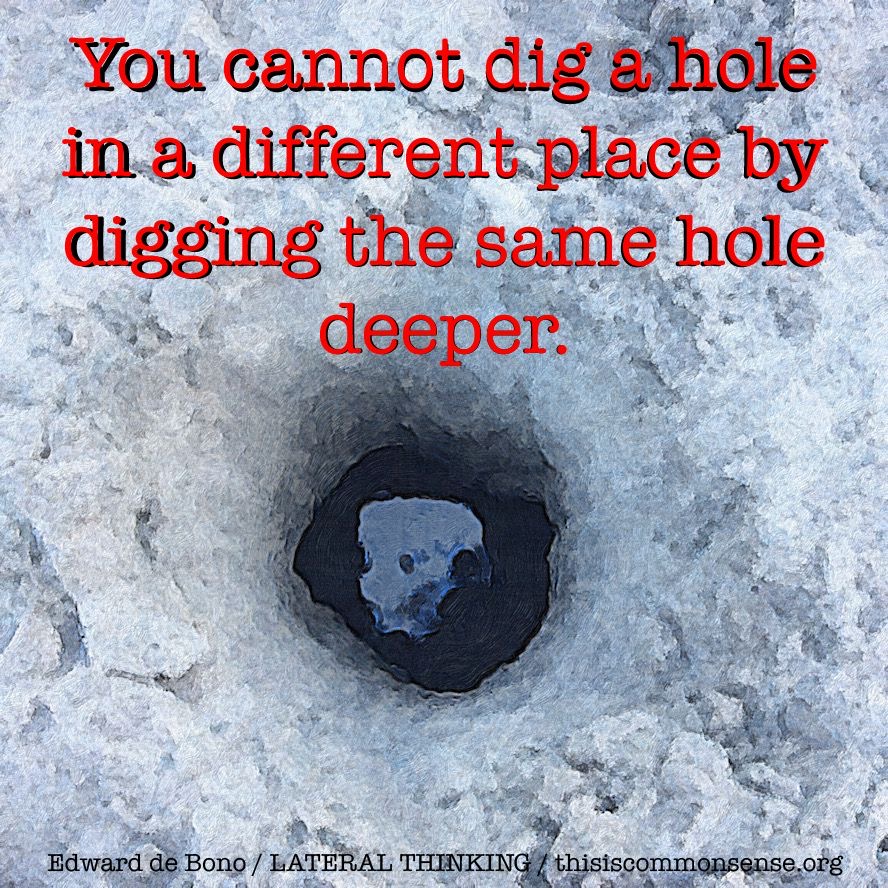
You cannot dig a hole in a different place by digging the same hole deeper.
Edward de Bono, Lateral Thinking : Creativity Step by Step (1970), p. 8.
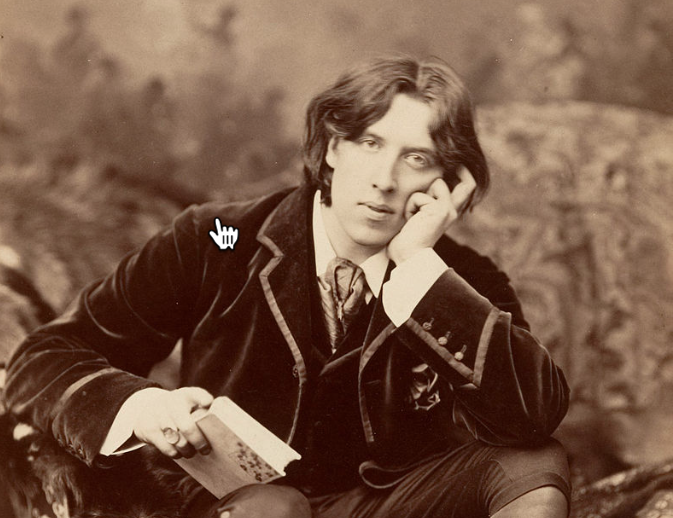
On May 19, 1897, Irish author, playwright, and poet Oscar Wilde (October 16, 1854 – November 30, 1900) was released from Reading Prison, where he had finished, in ill health, his hard labor sentence for “gross indecency.” His “Ballad of Reading Gaol,” first published pseudonymously in a periodical with wide circulation amongst criminals, quickly achieved the status of a
He died less than three years later, in exile in Europe. His most famous works include the play The Importance of Being Earnest, the novel The Picture of Dorian Gray, and the fascinating essay “The Soul of Man Under Socialism.”
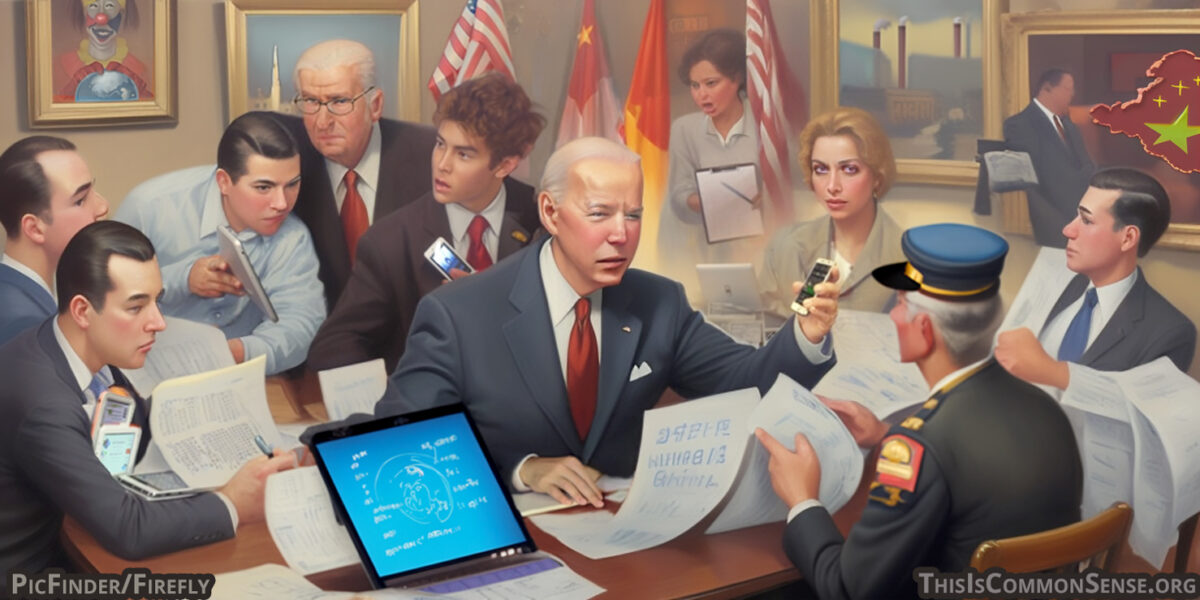
The blurb explains the title:
Joe Biden’s new tariffs on Chinese goods mark the decisive rejection of an economic orthodoxy that dominated American policy making for nearly half a century.
Rogé Karma, “Reaganomics Is on Its Last Legs,” The Atlantic, May 18, 2024.
The article explains the bipartisanship of the new economic policy:
On Tuesday, President Joe Biden announced plans to impose steep new tariffs on certain products made in China, including a 100 percent tariff on electric cars. With that, he escalated a policy begun during the Trump administration, and marked the decisive rejection of an economic orthodoxy that had dominated American policy making for nearly half a century. The leaders of both major parties have now turned away from unfettered free trade, a fact that would have been unimaginable less than a decade ago.
And that bipartisan nature is made exceedingly clear:
A president announcing a new policy does not mean that the political consensus has shifted. The proof that we are living in a new era comes instead from the reaction in Washington. Congressional Democrats, many of whom vocally opposed Trump’s tariffs, have been almost universally supportive of the increases, while Republicans have been largely silent about them. Rather than attacking the tariffs, Trump claimed credit for them, telling a crowd in New Jersey that “Biden finally listened to me,” and declaring that he, Trump, would raise tariffs to 200 percent. Most of the criticism from either side of the aisle has come from those arguing that Biden either took too long to raise tariffs or didn’t go far enough.
Mr. Karma explains how this trend is not insignificant, not a blip in the winds of policy change:
The shift on trade is part of a broader realignment that Biden’s national security adviser, Jake Sullivan, has aspirationally called the “new Washington consensus.” What unites Biden’s tariffs with the other core elements of his agenda, including massive investments in manufacturing and increased antitrust enforcement, is the notion that the American government should no longer passively defer to market forces; instead, it should shape markets to achieve politically and socially beneficial goals. This view has taken hold most thoroughly among Democrats, but it is making inroads among Republicans too — especially when it comes to trade.
But this perspective, of how politicians “passively” “deferred” to “market forces,” suggests that active opposition to market forces makes any kind of sense. Truth is, as economist Eugen von Böhm-Bawerk explained, “there is one . . . thing that not even the most imposing dictate of power will accomplish: It can never effect anything in contradiction to the economic laws of value, price, and distribution; it must always be in conformity with these; it cannot invalidate them; it can merely confirm and fulfill them.” The consequences of policies that seek to use State regulatory powers to guide market outcomes tend not to conform to politicians’ and regulators’ expectations, for at no point do they magically alter the laws of supply and demand.
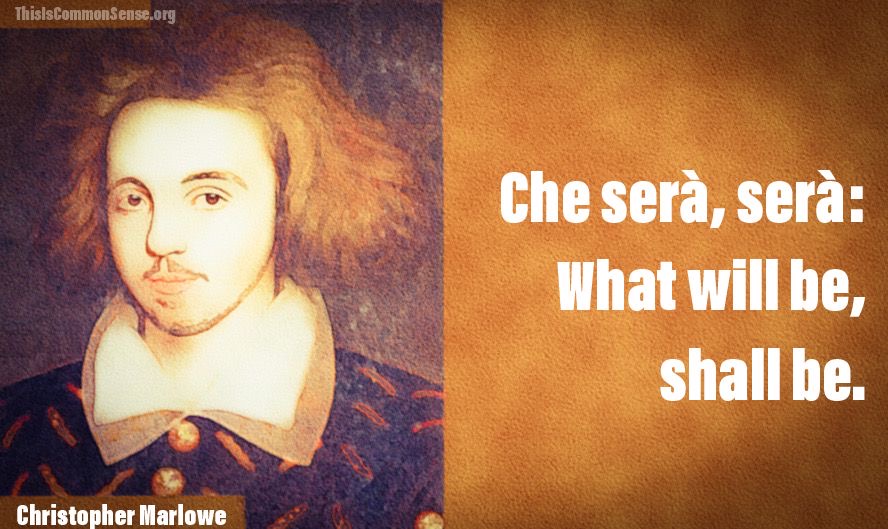
Che serà, serà:
Christopher Marlowe’s Faustus, Act I, scene i, lines 47–58.
What will be, shall be.

On May 18, 1652, Rhode Island passed the first law in English-speaking North America making slavery illegal.
On May 18, 1593, playwright Thomas Kyd’s accusations of heresy led to an arrest warrant for fellow playwright Christopher (“Kit”) Marlowe.
Kyd was the famed author of The Spanish Tragedy, and Kit Marlowe [pictured] was known for a number of plays, including The Jew of Malta and The Tragicall History of the Life and Death of Doctor Faustus.
Marlowe died a few weeks later, on May 30, without having been arrested. The circumstances of his death were bizarre, suspicious — as if written by a playwright.

Back then, Bradley Smith, chairman of Institute for Free Speech, observed that the legislation aimed to violate the rights of groups “who do nothing more than speak about policy issues before Congress.” It would also have limited political speech on
Now the bill is being resurrected as two separate pieces of legislation, each with language purporting to counter the purported threat of artificial intelligence. They are the Protect Elections from Deceptive AI Act and the AI Transparency in Elections Act.
Some Republicans seem to be buying into the resuscitated anti-speech agenda, even though the legislation incorporates many proposals — even much of the same language — from the earlier bill. Again, says Smith, the goal is to expose conservative donors to “to harassment and boycotts.” Also to outlaw content called “materially deceptive content” as judged by a “reasonable person.”
Of course, “reasonable persons” can and do disagree about the meaning of various speech and whether it’s “deceptive.” It’s reasonable to assume that the legislation, if enacted, will be used against speech that enforcers happen to disagree with.
As for actually deceptive speech: all manner of jabberwocky is protected by the First Amendment unless uttered to rob or defraud someone. If I tell you the moon is green cheese and you believe it, that may be sad. But I haven’t picked your
This is Common Sense. I’m Paul Jacob.
Illustration created with PicFinder and Firefly
See all recent commentary
(simplified and organized)
See recent popular posts
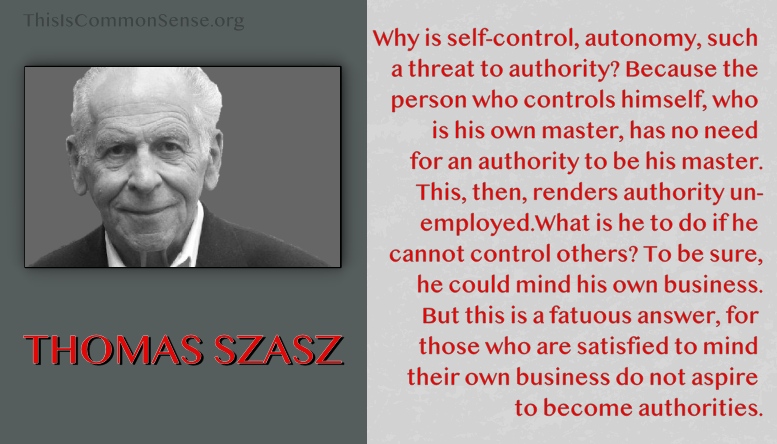
Why is self-control, autonomy, such a threat to authority? Because the person who controls himself, who is his own master, has no need for an authority to be his master. This, then, renders authority unemployed. What is he to do if he cannot control others? To be sure, he could mind his own business. But this is a fatuous answer, for those who are satisfied to mind their own business do not aspire to become authorities.
Thomas Szasz, Ceremonial Chemistry (1974; Revised edition, 1985) p. 175.
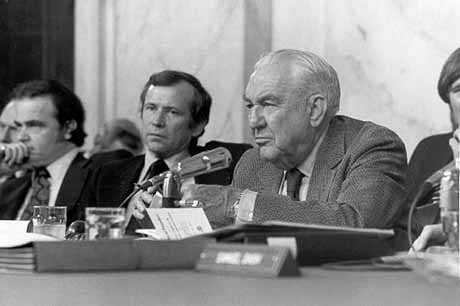
On May 17, 1973, televised hearings regarding the Watergate scandal began in the United States Senate, Sen. Sam Ervin presiding.
Little did participants know that the name of the hotel in which the White House-arranged break-ins occurred would provide a template for most future political scandals: “-gate” would be suffixed to nearly every other possible designator of scandal. The Democratic vendetta against Republican Donald Trump for winning the 2016 election has been called “Russiagate,” for example.
And on May 11, 2020, Trump retweeted a previous post with one additional word: “OBAMAGATE!”
This could be called a “suffix meme.” Or “insufferable meme,” if you prefer.
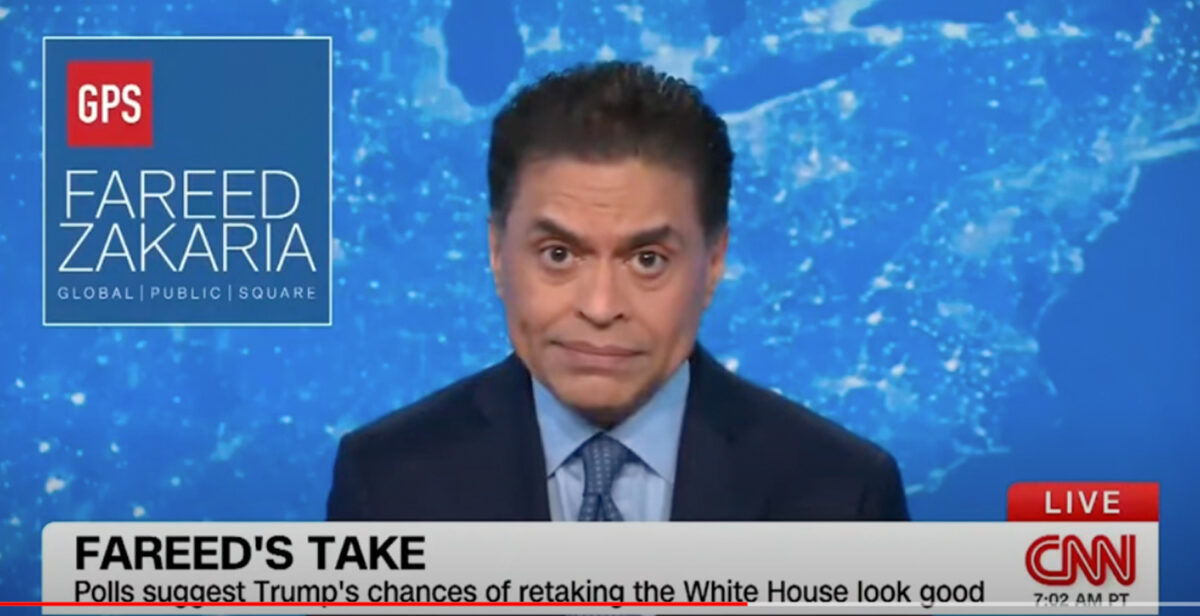
“Trump is now leading in almost all the swing states,” Zakaria noted, adding that he is “someone worried about the prospects of a second
The host’s opening monologue on Fareed Zakaria: GPS went on, complaining that, “The trials against [Trump] keep him in the spotlight, infuriate his base — who see him as a martyr and even may serve to make him the object of some sympathy among people in general who believe that his prosecutors are
Leave it to the Democrats to turn Mr. Trump into a sympathetic figure . . . with Zakaria then agreeing that these prosecutions are politically motivated.
“This happens to be true, in my opinion. I doubt the New York indictment would have been brought against a defendant whose name was not Donald Trump.”
And Fareed is not alone, even at CNN, where Elie Honig also acknowledged that, had the prosecution been brought in a less rabidly Democrat area than New York City, “there’s no chance of a conviction.”
No statement is more compelling in a court of law than what is known as a statement against interest, the admission of facts that do not serve the person so conceding or that person’s side. That’s what we now witness . . . as even CNN commentators recognize that the former president is being
No one is above the law. That phrase loses some punch, however, when “the law” sinks so low.
This is Common Sense. I’m Paul Jacob.
See all recent commentary
(simplified and organized)
See recent popular posts

A modern philosopher who has never once suspected himself of being a charlatan must be such a shallow mind that his work is probably not worth reading.
Leszek Kołakowski, Metaphysical Horror (1988).