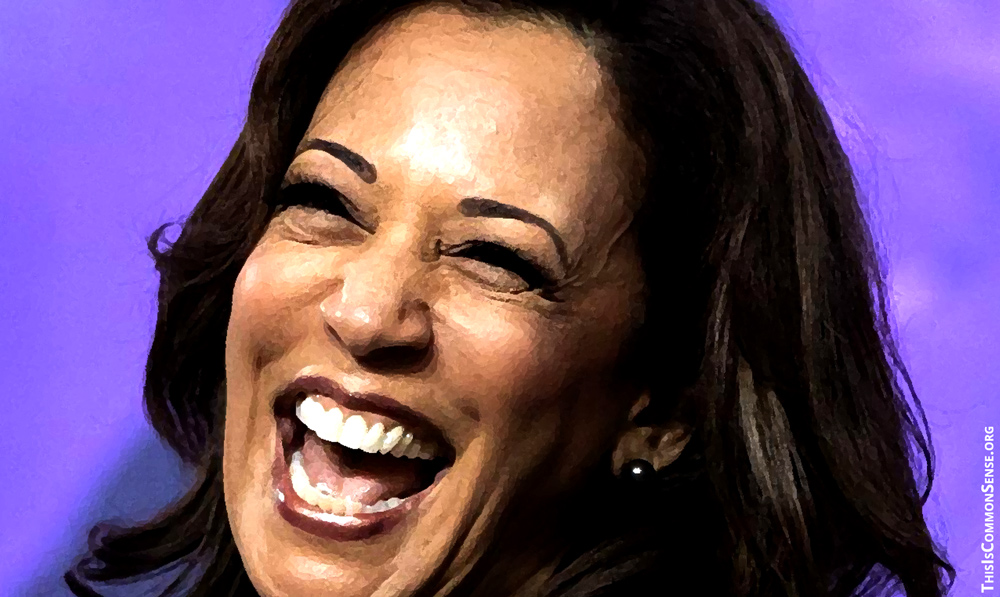
In September 2019, Paul Jacob offered “Chortling Evil,” in which he checked in on a would-be President Kamala Harris in full campaign mode. Now that she is back in that full-chortle mode, let us review:
On her campaign website, Harris assures us that should Congress fail “to send comprehensive gun safety legislation” to her “desk within her first 100 days as president” she would “take executive action to keep our kids and communities safe.”
Included in such a demanded “comprehensive” bill is “universal background checks, an assault weapons ban, and the repeal of the NRA’s corporate gun manufacturer and dealer immunity bill.”
Former Vice President Joe Biden, on last Thursday’s Democratic presidential candidates’ debate stage, challenged the notion of executive orders to ban assault weapons. At issue? Constitutionality. She smiled wide, all teeth and bright eyes, with “Hey, Joe, instead of saying, ‘No, we can’t,’ let’s say, ‘Yes, we can.’”
And she laughed and laughed.
But aside from mocking the idea of abiding within the limits of the Constitution, what else has Kamala Harris supported?
Well, for one she has supported the Democrats’ lashing out at the gig economy, and at freelancers and contract workers in general. She was on the list of opponents of California’s measure to strike down AB5, the Democratic-dominated Assembly law to do just that:
[A]ll the listed opponents of this measure were politicians, including our current Vice President (then Senator) Kamala Harris as well as socialist Bernie Sanders. . . .
Paul Jacob, “The Ultimate Legislature,” September 7, 2021.
Of course, it is not policy that takes center stage any longer, but politics and wild maneuvering. It is not just now, after the June 27th debate debacle and the July 13th assassination on presidential contender Donald Trump. The strange proceedings against Trump in case after case has been called “lawfare” — political warfare under cover of law — and former prosecutor Kamala has boasted that she would be likely to prosecute Trump after she is elected! The vendetta is strong. And the ugliness. Here is a sample from the recent past:
“This Judge,” the former president wrote on his own social media site, “by issuing a vicious ‘Gag Order,’ is wrongfully attempting to deprive me of my First Amendment Right to speak out against the Weaponization of Law Enforcement, including the fact that Crooked Joe Biden, Merrick Garland, and their Hacks and Thugs are tracking and following me all across the Country, obsessively trying to persecute me, while everyone knows I have done nothing wrong!”
To them, Orange Man’s very existence is “wrong,” and the thing they most want is Trump to shut up. So, in the course of a trial upon a subject combining campaign finance regulations with more prurient interests, a judge gagging the defendant from speaking in public about his prosecutors is … well, convenient. For them.
The prosecution is arguably an attempt to silence Trump; gag orders remove doubt. And allow the Empire State to exact the punishment before the trial concludes.
The prosecutors and politicians and major media propagandists who are aghast at Trump’s charges aren’t exactly saying that what Trump says about the judge’s daughter (that she “represents Crooked Joe Biden, Kamala Harris, Adam ‘Shifty’ Schiff, and other Radical Liberals”) is false.
They object … because … what he says makes them look bad.
Paul Jacob, “Richly Revealing,” March 28, 2024.
Kamala Harris looks and sounds bad in general, and the substance of her badness will only get more obvious as we approach the Democratic Convention. Will she stay as the Democratic candidate to “beat Trump?” Comedian Dave Smith and outré historian Joseph Farrell are among the many voices that predict she will not be chosen at the convention.
What do you think?