There is no wish more natural than the wish to know.
Michel de Montaigne, Essais, Book III, Ch. 13 (1595).
There is no wish more natural than the wish to know.
Michel de Montaigne, Essais, Book III, Ch. 13 (1595).
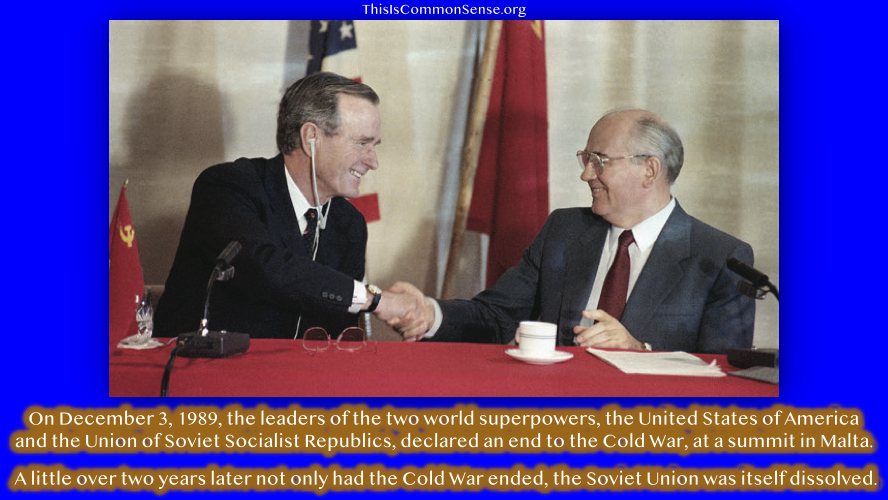
On December 3, 1989, the leaders of the two world superpowers, the United States of America and the Union of Soviet Socialist Republics, declared an end to the Cold War, at a summit in Malta. A little over two years later not only had the Cold War ended, the Soviet Union was itself dissolved.
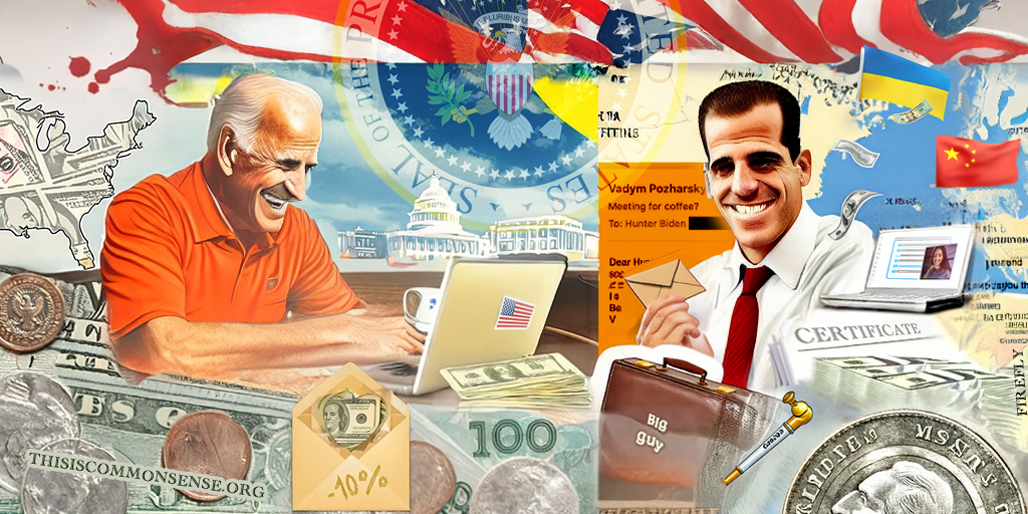
Back in June, after his son was found guilty on gun charges, President Biden said: “I will not pardon him.”
Now he’s saying “I believe in the justice system, but . . .”
Let’s remember the Conspiracy Theory floating around before the election.
Various cynical people, cynics I call them, declared that despite Biden’s pledge not to pardon his son, he was only waiting for the election. After the election, when the action could no longer hurt him or any Biden-substitute candidate, he would then pardon his son.
And so it has come to pass— as of last night.
I guess if you can’t get Al Capone on anything else, you get him on tax evasion. But I don’t care that much about the gun charges or the tax charges against Hunter Biden. I care about the corruption.
I care about the many millions of dollars funneled into the Biden family and the Big Guy, Joe Biden, in consequence of Hunter Biden’s influence-peddling deal-making with firms in Ukraine, Romania, and China. Millions that fell into his lap over the years only because of who his dad is. And what daddy could do — as in fire a Ukrainian prosecutor looking into Biden family corruption.
Riding high, Hunter Biden felt he could get away with anything, including massive tax evasion.
The son can, I take it, no longer be imprisoned for any of the law-breaking we know about. Or even suspect.So maybe, thus unencumbered, Hunter can now take the stand about his father’s role in all the graft and bribery.
Interestingly, Hunter’s pardon removes his ability to assert his Fifth Amendment right against self-incrimination. Because he can’t be incriminated, i.e. criminalized, he can be compelled to testify.
This is Common Sense. I’m Paul Jacob.
Illustration created with Firefly
See all recent commentary
(simplified and organized)
See recent popular posts
Wherever there is an enforced orthodoxy — or even two orthodoxies, as often happens — good writing stops. This was well illustrated by the Spanish civil war. To many English intellectuals the war was a deeply moving experience, but not an experience about which they could write sincerely. There were only two things that you were allowed to say, and both of them were palpable lies: as a result, the war produced acres of print but almost nothing worth reading.
George Orwell, “The Prevention of Literature,” Polemic (January 1946).

On December 2, 1823, U.S. President James Monroe delivered a speech establishing American neutrality in future European conflicts. The policy became known as the Monroe Doctrine.
Though a much-discussed principle of American foreign policy, it was undermined by the Spanish-American War and proved a dead letter as the U.S. entered World War I.

Since the election in early November, we’ve seen a lot of think-piece essays on the meaning of it all. Here are some examples:
The end of an American world
Donald Trump’s re-election to a second term on Wednesday, November 6, and the success of the Republican Party, of which he has taken total control, represent a major turning point for the United States.
It’s a reality that needs to be examined with eyes wide open. The path on which Trump, strengthened for his second term by his party’s success in the Senate, will take his country diverges fundamentally from the one charted by the United States since the end of the Second World War. It marks the end of an American era, that of an open superpower committed to the world, eager to set itself up as a democratic model. It’s the famous “shining city on a hill,” extolled by President Ronald Reagan. The model had been challenged over the past two decades. Now, Trump’s return is putting a nail in its coffin.
Editorial, Le monde, November 6, 2024.
Ding, Dong, the Cult is Dead!
The national mass psychosis is finally dealt a blow, making it safe to be sane again
Yes, it’s a cult. The mass movement that continually renamed itself (appearing as #Resistance, antiracism, “prodemocracy,” etc) hits most all the classic definitions. It demonizes outsiders, rejects critical thought, encourages cutting off family and friends (never more than this week), demands adherence to bizarre/nontraditional beliefs, embraces lies in recruitment (cough cough Russiagate), worships secrecy, exaggerates sinfulness of old beliefs, and has an answer for everything. It lacks a charismatic leader. But the lodestar is Trump, cause of all bad things. It’s really an Anti-Trump cult, the perfect postmodern movement, where the animating emotion is panicked rejection of an anti-leader.
Matt Taibbi, November 10, 2024
Trump Has Put an End to an Era. The Future Is Up for Grabs.
This may sound a bit like the most alarmist interpretations of the Trump era — that we are exiting the liberal democratic age and entering an autocratic, or at least authoritarian, American future.
But the new future is much more open and uncertain than that dark vision. While many people voted against Trump because they felt that liberalism or democracy was under threat, many other people moved rightward for the same reason — because they felt that was the way to defend liberal norms against the speech police, or democratic power against control by technocratic elites.
We don’t know which perspective, if either, will be vindicated. All we know is that right now our core political categories are contested — with vigorous disagreement about what both democracy and liberalism mean, unstable realignments on both the left and the right, and “post-liberal” elements at work in right-wing populism and woke progressivism and managerial technocracy alike.
All this indicates the first way that we are not going back: We are not returning to the narrowing of political debate that characterized the world after 1989, the converging worldviews of the Reaganite center-right and the Clinton-Blairite center-left, the ruling-out of radical and reactionary possibilities.
Ross Douthat, “Trump Has Put an End to an Era. The Future Is Up for Grabs,” The New York Times, November 16, 2024.
The End of the Age of Scientism
The only way to save science from itself is to apply it in proper ways while recognizing the limits of the ability to construct the world according to the imaginings of a handful of intellectuals. It’s tragic we had to come to the point of nearly destroying the globe to discover this but here we are. Let the rebuilding begin.
Keep the real science, but throw out the scientism.
Jeffrey Tucker, The Epoch Times, November 29, 2024.
The End of the Age of Hitler
In the age of Hitler, the post–World War II age in which we live, “humanity” is our shared faith. The concept of “human rights” is of course much older, going back to the age of Enlightenment and beyond, and most famously to Thomas Jefferson, who held it to be self-evident “that all men are . . . endowed by their Creator with certain unalienable rights.” And yet this claim is a problem. Not only because Jefferson wrote it while holding hundreds of men and women in slavery, but also because it is simply, factually wrong. Jefferson and a few of his Enlightenment friends thought that the existence of human rights was a self-evident truth; but it can’t be, because a great many people in a great many historical settings have not believed in any such thing. The claim that “We hold these truths to be self-evident” reveals the doctrine of human rights for what it is: a castle in the air, a defiant existential assertion of values.
But that is not the deepest problem. The deepest problem is that most of us, most of the time, neither know nor care whether “human rights” have a solid foundation beneath them: like Jefferson, we have come simply to believe in them in their own right. Now, in the post-1945 era, in the age of Hitler, we really do hold the existence of human rights and human equality to be self-evident. We can’t, intellectually, prove it to be true; but that doesn’t matter, because we feel that it is true. For now.
Why do we believe that human beings have rights? Even asking it feels uncomfortable, a questioning of what ought not to be questioned. To raise the problem is almost to blaspheme.
Alec Ryrie, First Things, November 2024.
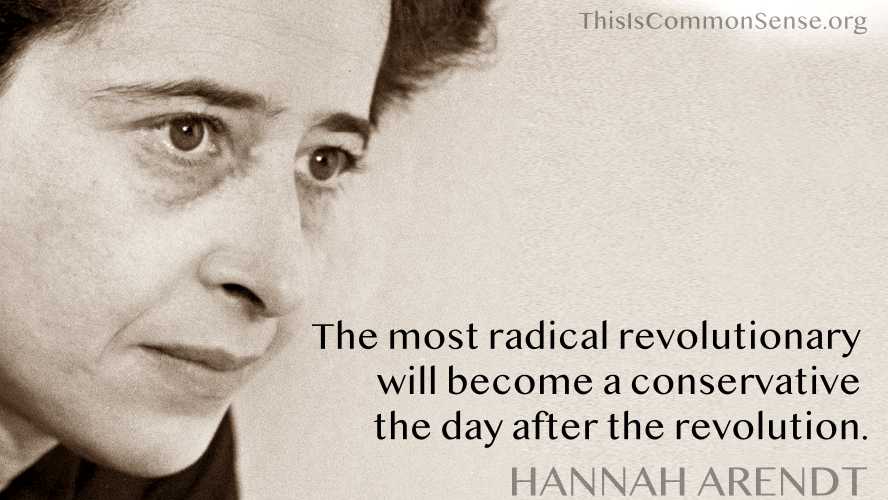
The most radical revolutionary will become a conservative the day after the revolution.
Hannah Arendt, The New Yorker (September 12, 1970).

The “Stolen Election” of 1824: Since no candidate had received a majority of the total electoral college votes in the election, the United States House of Representatives was given the task, on December 1, 1824, of deciding the winner of that year’s presidential race in accordance with the Twelfth Amendment to the United States Constitution. The congressional vote took place on February 9, 1825 — the only time in U.S. election history that Congress decided an election in accordance with the Twelfth Amendment.
Democratic candidate Andrew Jackson was none too pleased about Congress’s selection of John Quincy Adams over himself, despite his winning the greatest number of popular and Electoral College votes. He charged Henry Clay and Adams with having struck a “Corrupt Bargain,” and campaigned for four years on the grievance of a “stolen election.”
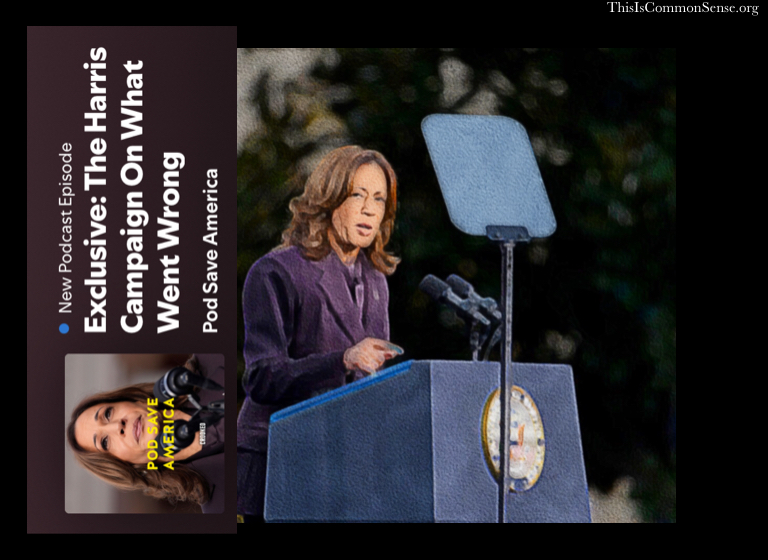
“In 107 days, what typically takes us a year and a half to two years in our presidential campaign, we were defining someone who was wholly undefined from the start, trying to remind people about the opponent and what life was like underneath him, and also take into account what the political environment was and the realities that we had to deal with,” the Harris–Waltz campaign senior adviser for strategy messaging Stephanie Cutter said on the November 26th episode of the progressive podcast “Pod Save America,” hosted by Dan Pfeiffer.
“When asked on ‘Pod Save America’ if Harris should or should not have done more to distance herself from Biden,” summarized The Epoch Times, campaign chair Jen “O’Malley Dillon said that it wouldn’t have helped to separate herself from Biden by cherry-picking what should have been done instead.
“Look, vice presidents never break with their presidents,” O’Malley Dillon said. “The only time in recent memory is when Pence broke with Trump.”
Harris chose to remain loyal to Biden to avoid changing precedent, O’Malley Dillon said.
“Our focus was to look at the future,” she said.
On the failure of the campaign to secure a spot on the most influential podcast in the world, Ms. Cutter was politic: “We had discussions with Joe Rogan’s team. They were great. They wanted us to come on. We wanted to come on. Will she do it sometime in the future? Maybe. Who knows. But it didn’t ultimately impact the outcome one way or the other.”
The general consensus of podcasters seems to be that Kamala Harris appearing on Joe Rogan’s Spotify podcast would have only doomed her campaign. Rogan is known for authentic long-form interviews; few observers believe Harris could fake authenticity for ten minutes, not to mention two hours.
As for these excuses made by campaign staffers, eighty-year-old Democrat campaign guru James Carville is on record with a ‘slightly different’ take:
“The vice president (Harris) was thinking about going on the Joe Rogan show and a lot of the younger progressive staffers pitched a hissy fit,” Carville said.
While Carville reiterated Harris’s staff claim that avoiding Rogan was not the determining factor for her election loss, he unleashed a vulgar rant about their management of her losing campaign.
“When you put a campaign together and you hire young people to do work, let me tell you exactly what you tell these people: What I would tell them, ‘Not only am I not interested in your f***ing opinion, I’m not even going to call you by your name. You’re 23 years old. I don’t really give a s*** what you think.’”
“James Carville rips Kamala Harris staffers over choice to skip Joe Rogan podcast,” Toronto Sun (November 28, 2024).
In point of fact, Ms. Cutter was born in 1968 and Ms. Dillon in 1976.
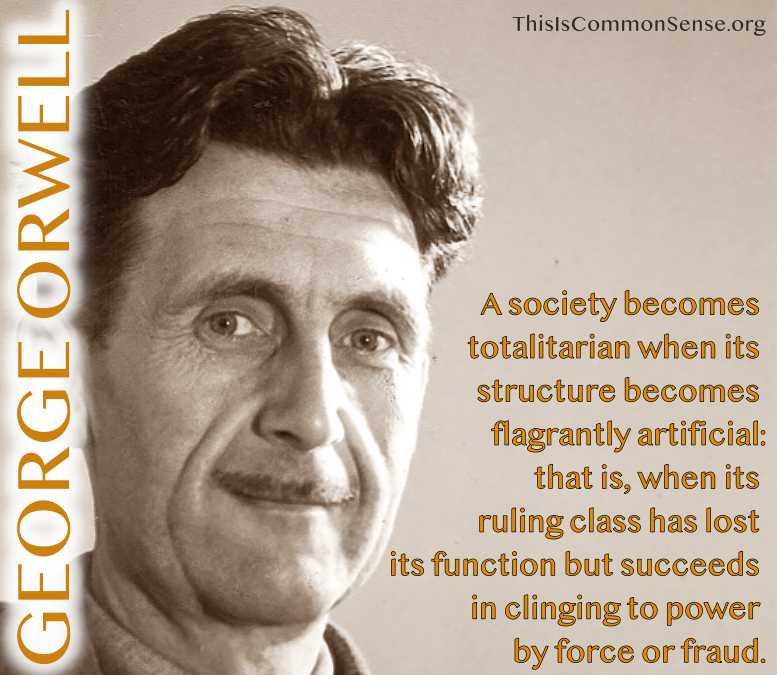
A society becomes totalitarian when its structure becomes flagrantly artificial: that is, when its ruling class has lost its function but succeeds in clinging to power by force or fraud.
George Orwell, “The Prevention of Literature,” Polemic (January 1946).