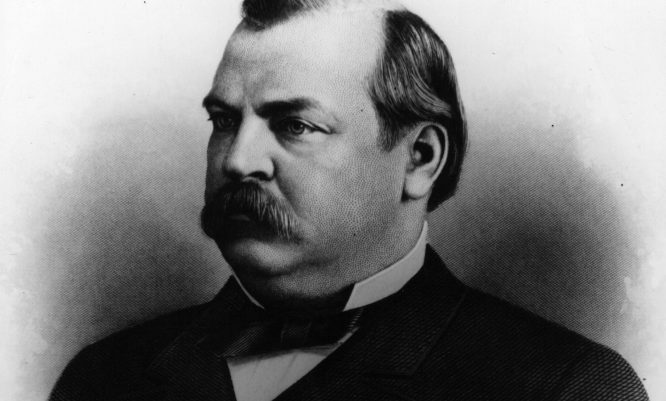
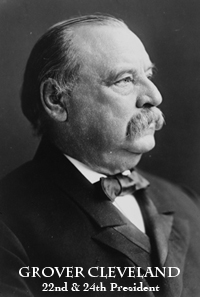
“I begin to think, that a calm is not desirable in any situation in life. Man was made for action and for bustle too, I believe.”
People change.
George W. Bush won the presidency pledging a dose of “humility” in our foreign policy and forswearing the temptation to rebuild failed foreign states. But after the 9/11 attacks, the U.S. went to war in Afghanistan and Iraq . . . followed by even more deadly and difficult nation-building efforts.
Presidential powers expanded.
Along came Barack Obama, the peace candidate. His advantage in winning the 2008 Democratic Party nomination was his unequivocal opposition to the Iraq War. Meanwhile, then-Senator, now Secretary of State, Hillary Clinton had voted to give Bush congressional approval to launch that war.
During the campaign, Obama recognized constitutional limits on the commander-in-chief: “The President does not have power under the Constitution to unilaterally authorize a military attack in a situation that does not involve stopping an actual or imminent threat to the nation.”
But as president, Mr. Obama launched air strikes against Libya without congressional authorization. In fact, he refused to even report to Congress as required by law.
And then last week, Sen. Jeff Sessions (R-Ala.) asked Defense Secretary Leon Panetta, “Do you think that you can act, without Congress, and initiate a no-fly zone in Syria, without congressional approval?”
“Our goal would be to seek international permission,” Panetta replied, and then added, “and we would come to the Congress and inform you and determine how best to approach this.”
A republic? America goes to war on the order of one man: Emperor Obama.
But empires change. Past empires rarely asked foreign permission for their military adventures.
This is Common Sense. I’m Paul Jacob.
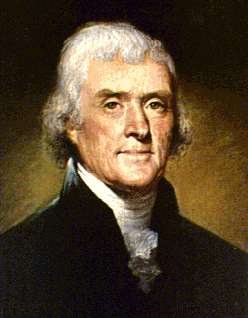
On March 11, 1942, General Douglas MacArthur abandoned the island fortress of Corregidor in the Philippines under orders from President Franklin Roosevelt. Left behind at Corregidor and on the Bataan Peninsula were 90,000 American and Filipino troops, who, lacking food, supplies, and support, would soon succumb to the Japanese offensive. MacArthur issued a statement to the press in which he promised his men and the people of the Philippines, “I shall return.”
On March 11, 1985, Mikhail Gorbachev was selected by the Communist Party as the new general secretary and leader of the Soviet Union, following the death of Konstantin Chernenko the day before. Gorbachev oversaw a radical transformation of society during the next six years, concluding with the break-up of the Soviet Union.
On March 11, 1990, Lithuania became the first Soviet Republic to proclaim its independence from the USSR. The Soviet government responded with an oil embargo and economic blockade against the Baltic republic and, in January 1991, Soviet paratroopers and tanks invaded Vilnius, the Lithuanian capital, beginning a standoff that lasted until September 6, 1991, when the crumbling Soviet Union agreed to grant independence to Lithuania and the other Baltic republics of Estonia and Latvia.
Douglas MacArthur
“I am concerned for the security of our great Nation; not so much because of any threat from without, but because of the insidious forces working from within.”
My Townhall column this weekend is “Another Forced-Innovation Fiasco,” which shows that another congressional cost-cutting measure has gone up in smoke. Here are some relevant links to that article:
- A typical congressional cost-cutting regulation: “Flushing Congress From the Toilet Industry” (Common Sense)
- Katherine Mangu-Ward’s terrific exposé: “Feds Pay $10 Million for $50 Light Bulb” (Reason)
- That innovative, super-efficient diode: “MIT engineers create LED that has 230% efficiency. Thermodynamics laws still in place” (ZME Science)
One of the things I do is promote the initiative and referendum process. Have you noticed? Well, that means traveling around the country and speaking before groups of people interested in making the world a freer, better place. Recently I spoke at “Liberty On the Rocks” in Denver:
Ari Armstrong asked some great questions — questions I think that would come to most thoughtful people’s minds, when contemplating direct action via the ballot.
On March 10, 1959, more than 300,000 Tibetans surrounded Norbulinka Palace in Lhasa to prevent China’s occupation forces, the People’s Liberation Army (PLA), from taking the Dalai Lama to Beijing, where he had been invited to travel alone (without any military personnel or bodyguards) for “official tea” with PLA leaders. During the standoff, the Dalai Lama was evacuated to India. On March 21, the Chinese began shelling the palace, killing tens of thousands still camped outside. In the PLA crackdown that followed, the Dalai Lama’s guards were executed and Lhasa’s major monasteries destroyed.
“An oppressive government is more to be feared than a tiger.”
Where do billionaires come from?
Douglas French, president of the Ludwig von Mises Institute, reminds us where the term “millionaire” came from. It was
coined in 1720 during John Law’s “Mississippi Bubble” to describe those making vast fortunes in Law’s Mississippi Company stock that rose from 150 livres to 10,000 in the matter of months. But just as quickly, the stock and the currency wildly inflated by Law’s Banque Royale, crashed and Law was forced into exile.
Today’s plethora of billionaires — which in 15 years has increased fivefold — is (argues French) at least in part the result of Ben Bernanke’s monetary manipulations. He’s the John Law of our time. “What were once Law’s millionaires are now Bernanke’s billionaires. . . . Bernanke has been on the job for six years, and the Gates, Buffetts, and Slims of the world are reaping the benefit. But for how long?”
Keeping track of today’s billionaires has become both a form of popular entertainment (Forbes’s list) as well as a topic for careful study. The political “philanthropy” of George Soros and Charles Koch inspires both enthusiasm and dread in activists, left and right; Warren Buffett has become something of a hero to the 99 percenters, what with his repeated pitches for higher taxes on the rich.
But Buffett is a sly one. He makes his money in a variety of ways — one of which Peter Schiff recently explained: “Buffett actually stated in September 2008 that he would not have invested in Goldman Sachs if not for the implicit guarantee of federal assistance. As a result, he profited at the expense of taxpayers at the very time when they were losing their savings in the markets.”
Not all billionaires are created equal.
This is Common Sense. I’m Paul Jacob.
United States v. The Amistad
On March 9, 1841, the U.S. Supreme Court ruled in the case, United States v. The Amistad, that captive Africans who had seized control of the ship carrying them across the Atlantic Ocean had been taken into slavery illegally. Abolitionists returned the 35 men and boys and three girls to Africa.