 Law did not leap into life as something perfect and complete. For thousands of years it has grown and it is still growing. The age of its maturity — the age of impregnable peace — may never arrive.
Categories
Law did not leap into life as something perfect and complete. For thousands of years it has grown and it is still growing. The age of its maturity — the age of impregnable peace — may never arrive.
Having chucked presidential term limits, Venezuela dictator Hugo Chavez recently won re-election to a third six-year term in office. Not surprising.
What is surprising, according to Francisco Toro writing in the New Republic, is that the election was so close.
Toro, writing before election day, wasn’t surprised that the failings of Chavez’s socialistic and repressive policies have been getting harder for the public to evade. But in an “increasingly autocratic petrostate, the advantages of incumbency are so deep, [re-election] really ought to be a walk.”
Toro saw Chavez’s own campaign as awkward and unpersuasive, the challenger’s as smart and effective. Come October 7, though, the former tramped across the finish line with 54 percent, a comfortable if smaller margin than he had enjoyed in previous elections.
Chavez’s advantages included rules for political ads permitting each candidate to advertise only three minutes a day on each broadcast outlet — even as the incumbent ran frequent “institutional” ads promoting the government’s doings that looked an awful lot like campaign ads. During the campaign, his government often claimed emergency to take over the air waves to spout campaign pitches. All this is in the context of years of efforts to increase the number of state-owned media and browbeat private media into uncritical silence.
The more tyrannical a government becomes, the more urgently a citizenry needs term limits in self-protection. Yet the more tyrannical a government becomes, the more easily it can get rid of such safeguards.
This is Common Sense. I’m Paul Jacob.
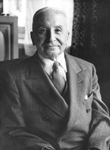
It is not true that the masses are vehemently asking for socialism and that there is no means to resist them. The masses favour socialism because they trust the socialist propaganda of the intellectuals. The intellectuals, not the populace, are moulding public opinion. It is a lame excuse of the intellectuals that they must yield to the masses. They themselves have generated the socialist ideas and indoctrinated the masses with them. No proletarian or son of a proletarian has contributed to the elaboration of the interventionist and socialist programmes. Their authors were all of bourgeois background. The esoteric writings of dialectical materialism, of Hegel, the father both of Marxism and of German aggressive nationalism, the books of Georges Sorel, of Gentile and of Spengler were not read by the average man; they did not move the masses directly. It was the intellectuals who popularized them.
The intellectual leaders of the peoples have produced and propagated the fallacies which are on the point of destroying liberty and Western civilization. The intellectuals alone are responsible for the mass slaughters which are the characteristic mark of our century. They alone can reverse the trend and pave the way for a resurrection of freedom.
 If Columbus had an advisory committee he would probably still be at the dock.
The two major presidential candidates, incumbent Obama and challenger Romney, must spend their final weeks of the campaign appealing to
How to appeal to all three groups simultaneously? Well, go for the old standby: fear and hatred of foreigners.
This year, it’s the Chinese.
Romney started the China-bashing by calling our Chinese trading partners “cheaters.” Apparently he is much vexed about how the Chinese don’t respect established intellectual property rights, “stealing” our technology, “everything from computers to fighter jets.” Of course, this mainly happens after “we” set up manufacturing plants for that technology there. He charged that President Obama has not deigned to “stand up to China.”
Earlier, he had accused China of manipulating its money in its favor. He seems to have dropped that, perhaps out of embarrassment — our own Fed’s monetary manipulations, after all, dwarf China’s.
The Obama campaign responded by avoiding the intellectual property issue just as Romney now avoids the monetary one, calling Romney himself a “cheater.” You see, in his Bain Capital days, Romney invested in firms that relocated jobs to “low wage countries like China.” Romney, we are told, has “never stood up to China.”
By which is meant: Romney engaged in globalism and opposed protectionism.
Is Mr. Obama really suggesting that prosperity will come if we shrink from global competition and enact barriers to international trade in goods and services?
The biggest problem the U.S. economy faces isn’t Beijing; it’s Washington.
This is Common Sense. I’m Paul Jacob.
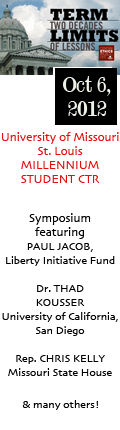 Over at Townhall, a defense of term limits. Read the column (in which I reference a conference I attended yesterday, see image at right), and come back here. If you don’t find the links, below, satisfying, search the archives of This Is Common Sense (this very site) and you’ll find quite a lot about term limits.
 If not an economist, what am I? An outdated freak whose functional role in the general scheme of things has passed into history? Perhaps I should accept such an assessment, retire gracefully, and, with alcoholic breath, hoe my cabbages. Perhaps I could do so if the modern technicians had indeed produced “better” economic mousetraps. Instead of evidence of progress, however, I see a continuing erosion of the intellectual (and social) capital that was accumulated by “political economy” in its finest hours.
 There is a Passion natural to the Mind of man, especially a free Man, which renders him impatient of Restraint.
If you agree to a “free speech wall,” you can’t complain about the speech that offends you, can you? Well, if you run a college, I guess you can:
Note that it wasn’t the use of the vulgar “f-bomb” that upset the professors. It was the use of one against the current U.S. president.
The tale of how Chicago’s teachers union beat the Chicago School District, and got their way, is inspiring . . . if you belong to a union, if you don’t care about costs, if you don’t want to improve the quality of education.
And if you define “inspirational” as inspiring copycats.
That’s happened already, and may break out big time. Illinois’s Evergreen Park District (#124) is now on strike. Lake Forest High School District (#115) teachers recently concluded a strike, with a tentative agreement allegedly being finalized as I type. At least two other district teachers’ unions have declared strikes, and contract negotiations have stalled elsewhere. Add to that, AFSCME bigwigs wrote their 40,000 members that “direct action at the work site” might be necessary. I’m hoping that’s a work stoppage, and not sabotage. (“Direct action” sounds ominous, doesn’t it?)
Paul Kersey, writing on the Illinois Policy Institute website, opines that it “would be unfortunate if union officials chose to shut down key government services at a time when so many Illinoisans are struggling economically, but unfortunately it seems that the results of the Chicago Teachers Union strike may have encouraged many of them to do just that.”
Unions arose in the 19th century as a way to deal with poor working conditions, and, over time, the idea of a closed shop took hold with the specific program of excluding competitive workers. That made it easier to negotiate for higher wages, etc.
While private sector unions fought “evil businessmen” — that’s what I read in school — public employee unions fight . . . taxpayers. I always wonder how taxpayers feel, being dragooned into the role of “evil” skinflint.
This is Common Sense. I’m Paul Jacob.