It only takes 20 years for a liberal to become a conservative without changing a single idea.
Robert Anton Wilson, The Illuminati Papers (1980).
Categories
Robert Anton Wilson

It only takes 20 years for a liberal to become a conservative without changing a single idea.
Robert Anton Wilson, The Illuminati Papers (1980).
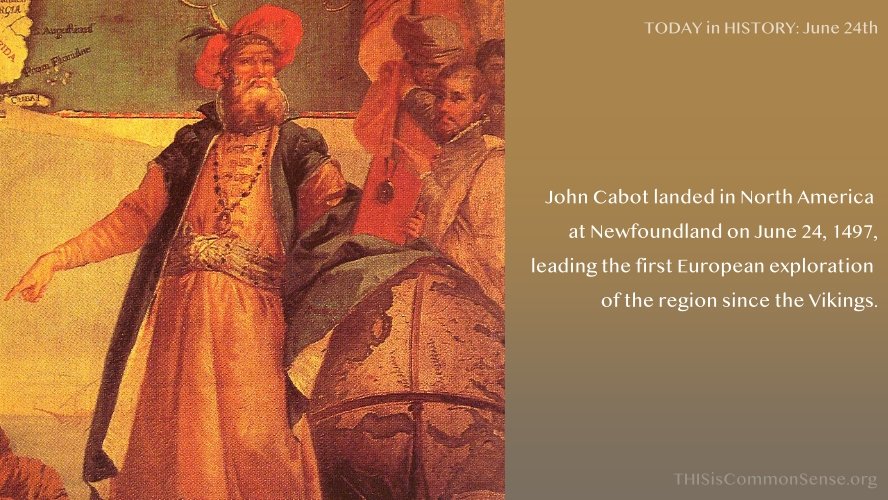
John Cabot landed in North America a Newfoundland on June 24, 1497, leading the first European exploration of the region since the Vikings.
In 1535 on this date, the Anabaptist state of Münster was conquered and disbanded.
June 24 birthdays include Henry Ward Beecher, clergyman and reformer (1813; died 1887); Ambrose Bierce, author of “An Occurrence at Owl Creek Bridge” and The Devil’s Dictionary — his dark, cynical wit earned him the epithet “Bitter Bierce” (1842; disappeared 1914); Richard Timberlake, American free-market economist (1922; died 2020).

On March 20, 2025, President Donald Trump signed an executive order aimed at shutting down Carter’s Department of Education, fulfilling his campaign promise to reduce federal involvement in education.
This was popular because everybody who’s not a bureaucrat or a teachers’ union agent knows that federal involvement in schooling, since Carter’s time, has been, not just a waste, but a detriment.
Still, teacher union-dominated Democrats are swiping at the administration with numerous lawsuits. U.S. District Judge Myong Joun in Boston issued a preliminary injunction blocking Trump’s layoffs and transfers, ruling that they amounted to an unlawful attempt to dismantle the department without congressional approval.
Earlier this month, the 1st U.S. Circuit Court of Appeals upheld Joun’s injunction, rejecting the Trump administration’s request to pause the order while appealing.
Two days later, the Trump administration, through Solicitor General D. John Sauer, filed an emergency appeal with the U.S. Supreme Court. The plea? Lift the injunction and allow the layoffs and reorganization to proceed. Trump’s team argued that the lower court had overstepped its authority and that the layoffs were a lawful personnel action to streamline the department, not an attempt to abolish it without Congress.
The injunction sent DOE functionaries back to work. Nothing’s been resolved.
Not even the rationales for Carter’s “greatest achievement” (to quote the title of a USA Today op-ed). Carter had promised to reduce the number of departments, for efficiency’s sake. When creating the DOE, he said the move would increase efficiency.
Instead, it merely increased education spending while academic achievement has plummeted.
This is Common Sense. I’m Paul Jacob.
Illustration created with Krea and Firefly
See all recent commentary
(simplified and organized)
See recent popular posts
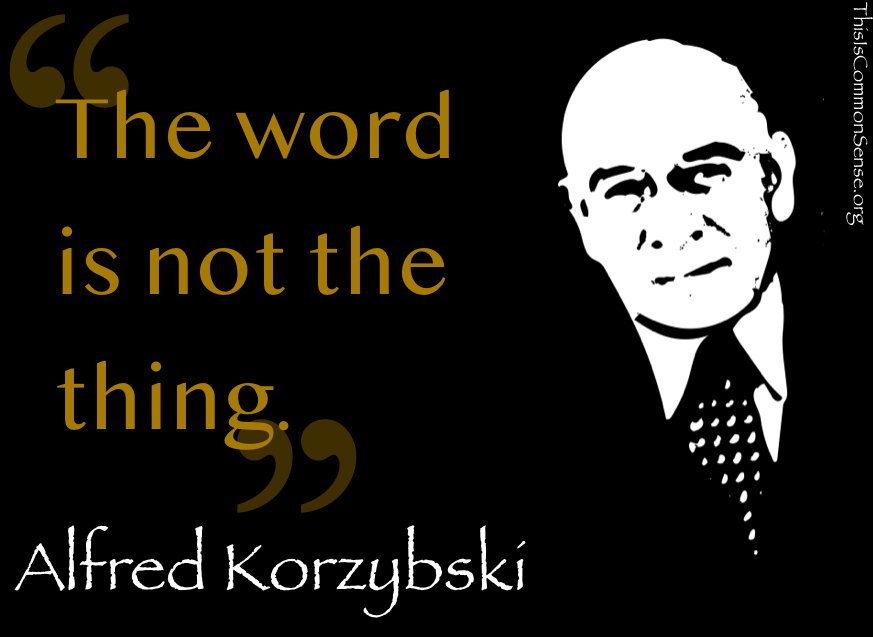
The word is not the thing.
Alfred Korzybski, Science and Sanity (1933).

Today is Estonia’s Victory Day, which has been celebrated on June 23 every year since 1934. The date recalls the victory in the 1919 Battle of Vonnu of the Estonian military forces (and Latvian North brigade) and their allies over German forces (Baltische Landeswehr) who sought to re-assert Baltic-German control over the region. The battle was part of the 1918-1920 Estonian War of Independence, where the main adversary of the newly independent Estonia was Communist Russia.
Today, Victory Day also marks the contributions of all Estonians in their fight to regain and retain their independence. Estonian celebration of June 23 is ceremonially tied to the following Midsummer Day celebrations on the 24th.
According to Estonian laws, the state flags are not to be lowered during the night between days.

From early on, blood clotting has been rumored to be associated with COVID and its treatments [“vaccines”]:

The entry for “clot shot” in the Urban Dictionary is amusing:

Slangsphere.com has advice:

But is it really the case that rumors of clotting are merely that, mere rumors? An efflorescence of dark humor in a trying time? Dr. John Campbell has been following the story, and interviewing doctors, scientists, and embalmers:
In this repeat interview with Major Tom Haviland, who has spoken to and polled embalmers at morticians’ conventions, we learn that while the stories told and evidence collected by embalmers working on dead bodies (preparing them for internment) are alarming, scientists and government funders have shown remarkable restraint in following up on clues.
The clots being found after the rollout of the various “vaccines” are not just small, easy to tear. They are large, “tough and rubbery.”

However, the mainstream of the medical profession takes pains to debunk these stories every now and then, dismissing them as tall tales, or as almost anodyne, quite common before and after the pandemic, contrary to the testimony of Haviland.
Note that Haviland and Campbell are not talking about microclotting. Nor is Haviland referring to “chicken fat clots,” which are small, yellow, and have been observed for a very long time. Haviland is on track of an even more alarming trend, which features clots of sometimes gruesome length.
Be careful in choosing an emoji to accompany your “clot shot” epithet.
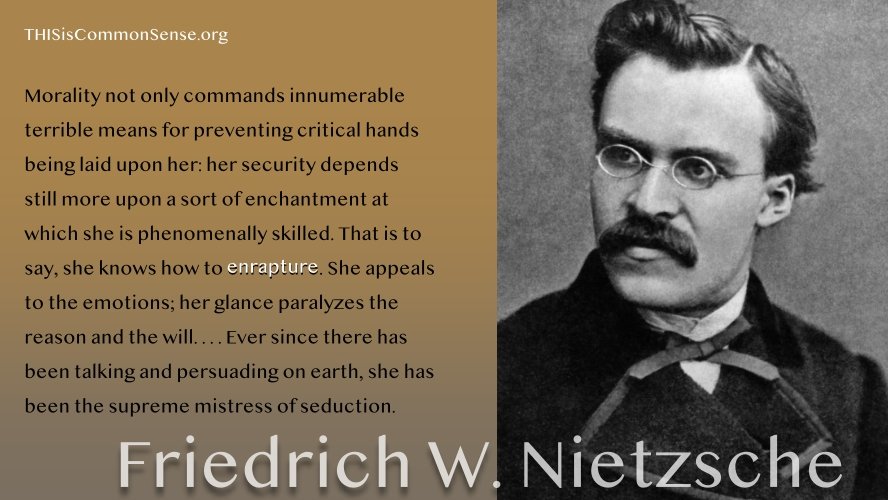
Morality not only commands innumerable terrible means for preventing critical hands being laid upon her: her security depends still more upon a sort of enchantment at which she is phenomenally skilled. That is to say, she knows how to enrapture. She appeals to the emotions; her glance paralyzes the reason and the will. . . . Ever since there has been talking and persuading on earth, she has been the supreme mistress of seduction.
Friedrich W. Nietzsche, as quoted and translated by H.L. Mencken, The Philosophy of Friedrich Nietzsche (1913), from Daybreak (“Morgenröte,” preface, § 3).
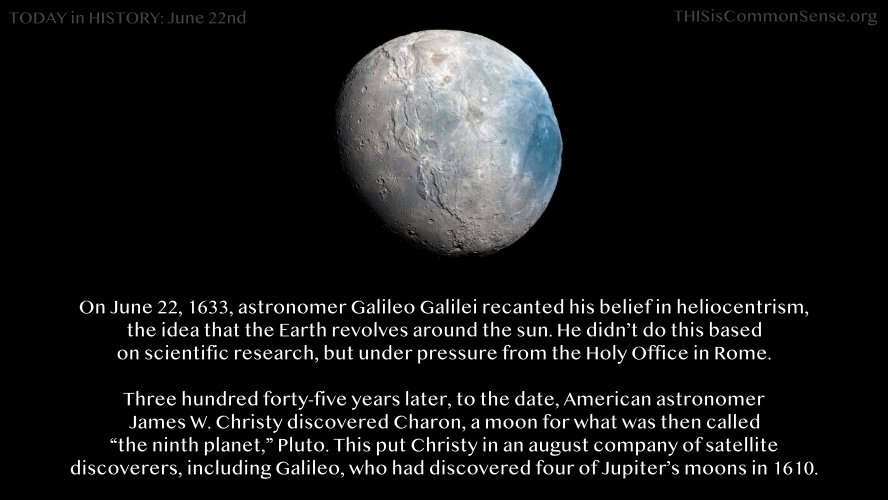
On June 22, 1633, astronomer Galileo Galilei recanted his belief in heliocentrism, the idea that the Earth revolves around the sun. He didn’t do this based on scientific research, but under pressure from the Holy Office in Rome.
Three hundred forty-five years later, to the date, American astronomer James W. Christy discovered Charon (pictured above), a moon for what was then called “the ninth planet,” Pluto. This put Christy in an august company of satellite discoverers, including Galileo, who had discovered four of Jupiter’s moons in 1610.
When Pluto was later “demoted” to “dwarf planet” status, in 2006, no one was put under house arrest for objecting, or for not changing his or her mind, as had Galileo been centuries before.
The ratio in sizes between Charon and Pluto make the pair, effectively, a “double dwarf planet.”

“A recent Reuters/Ipsos poll reveals a significant wave of discontent among Democratic voters,” explains Billy Adams at MSN, “with a strong majority expressing a desire for new leadership and a shift in party priorities.”
The spectacular failure of party leadership in the debacle that was the transition from the Biden re-election campaign, last year, to the Harris presidential election campaign, is just the tip of the proverbial calved glacier.
“The survey indicates that many Democrats feel their party is over-emphasizing issues such as transgender rights and electric vehicles, while not paying enough attention to pressing economic concerns,” the article points out. “Voters are eager for their leaders to address ‘kitchen-table issues’ like the cost of living and affordability, and to work towards reducing corporate influence.”
Are we seeing an end to identity politics as the focus of the left? Or perhaps the end of the left’s influence on the party? “Some prominent Democrats have openly criticized the party for being too ‘weak and woke,’” and the general trend of complaints about the pathetic response of Democrats, in 2024, to a resurgence of Trump support showed, apparently, a need to reconnect “with its base on core economic issues.…”
But can the party retreat from cringe woke nonsense to return to its core strengths of cringe statist/socialist nonsense? Rep. Marc Pocan (D-Mich.) has expressed how difficult this is proving to be: “I would love to have a day go by that @DNC doesn’t do something embarrassing & off message.”
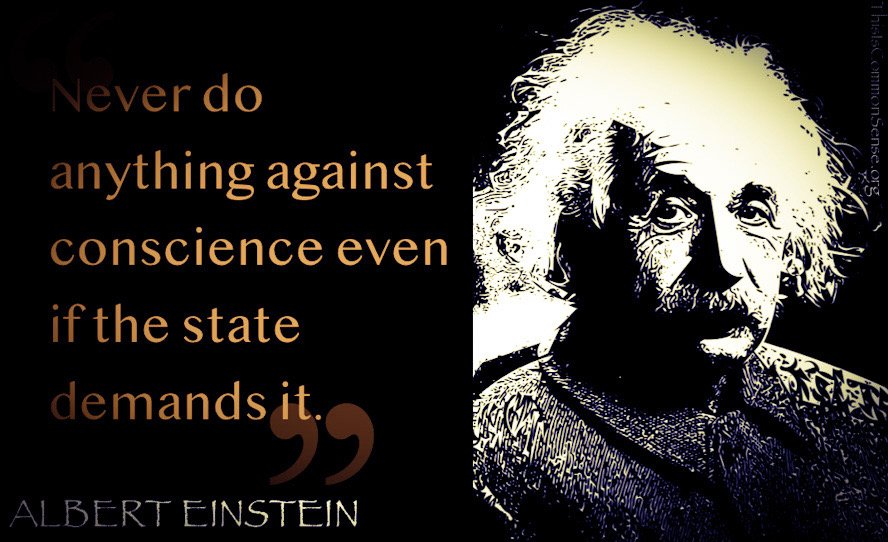
Never do anything against conscience even if the state demands it.
Albert Einstein, as quoted by Virgil Henshaw in Albert Einstein: Philosopher Scientist (1949) edited by Paul A. Schilpp.