On Leap Year Day 1796, the Jay Treaty between the United States and Great Britain came into force, facilitating ten years of peaceful trade between the two nations.
A Leap Day Milestone
On Leap Year Day 1796, the Jay Treaty between the United States and Great Britain came into force, facilitating ten years of peaceful trade between the two nations.
Unlike a taxpayer-funded NGO, always on the march to push big government or social decay, these organizations go to bat for people around the country who are being abused by local governments.
As an example, take a current IJ case, Brooks Township in Michigan, which has been struggling to prevent Peter and Anna Quackenbush from opening a business: a cemetery.
This was to be a “green” burial forest that the township board blocked because it disliked the idea.
After losing a court fight over a proposed ban of all new cemeteries as a way to block Peter and Anna’s particular cemetery, the township is now seeking to impose an ordinance dictating that “No new cemetery shall be created, installed, constructed or instituted . . . unless a written cemetery permit has first been approved and issued by the Brooks Township Board under this Ordinance.”
In other words, a de facto ban by a Board that has made clear its determination to stop Peter and Anna from opening a cemetery on their own property. If this ordinance is allowed to stand, no permit will be issued to them. It’ll be the end of the cemetery.
Worth fighting against.
This is Common Sense. I’m Paul Jacob.
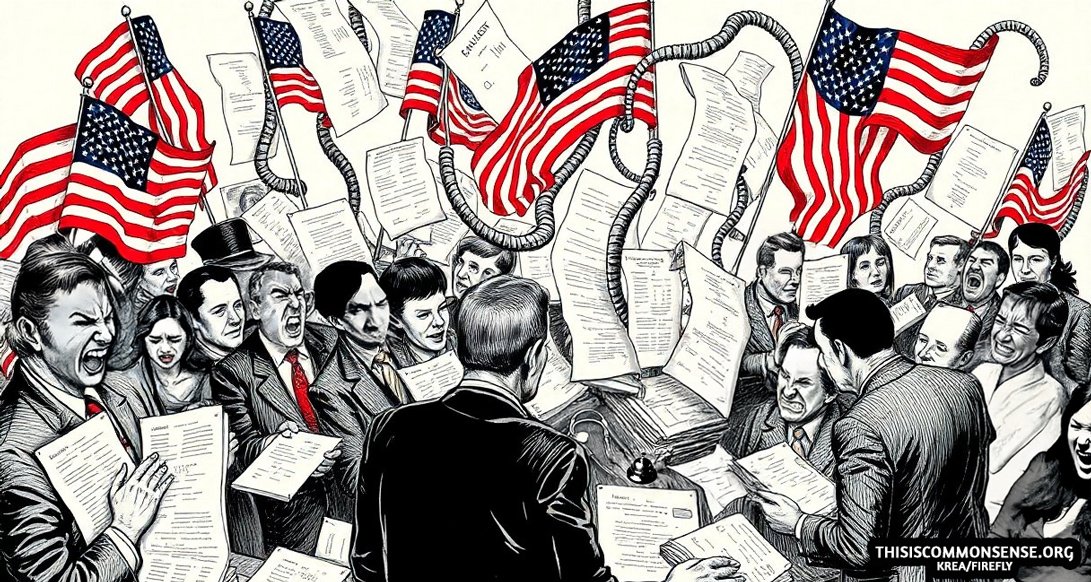
Illustration created with Krea and Firefly
See all recent commentary
(simplified and organized)
See recent popular posts
Adventures do occur, but not punctually.
E. M. Forster, A Passage to India (1924), chapter 3.
On February 28, 1646, Roger Scott, of Lynn, Massachusetts, was tried for sleeping in church. Awakened in church by a tithingman’s long, knobbed staff hitting him on the head, he struck back at the man, and garnered a whipping as punishment, as well as the dark designation as “a common sleeper at the publick exercise.”
O, the prospect of any significant shrinking of the federal behemoth!
Any significant rooting out of the corruption that benefits them. . . .
Many combat this horror by flinging every fallacy in the book. Like the notion that Elon Musk and his team are unqualified. They ask, is Musk a certified public accountant?
He’s only a mega-successful serial entrepreneur, not an accountant.
Monster Hunter Nation’s Correia45 answers a slew of the fallacies, not in the most genteel manner. Cover your ears if you click in.
First, there’s nothing odd about an internal audit, which “is what Donald Trump (the man in charge) is doing now, by having his people (DOGE) audit the executive branch he runs. CEOs and owners do this all the time.”
Nor need you be a CPA to contribute. That’s essential for only certain types of accounting, which “isn’t even close to what DOGE is doing.”
Correia45, an accountant, has been on teams that included programmers, lawyers, machinists. Machinists because, when auditing a factory, “I could count the parts, but I couldn’t tell you if the parts were b******t or not.”
Another thing: I can certainly think of reasons to have smart energetic young people on an auditing team.
But, contra some assumptions (based on the fact that 20-somethings are “who got doxxed first”), young people are not the whole team. Newsweek’s list of known DOGE staff includes persons ranging in age from 19 to 67.
And so DOGE goes. Godspeed.
This is Common Sense. I’m Paul Jacob.
Illustration created with Krea and Firefly
See all recent commentary
(simplified and organized)
See recent popular posts
The discovery that one cannot convince an opponent and that it is hopeless to go on trying involves a confession of subjectivity that deprives the world of meaning.
Mary McCarthy, The Oasis (1949).
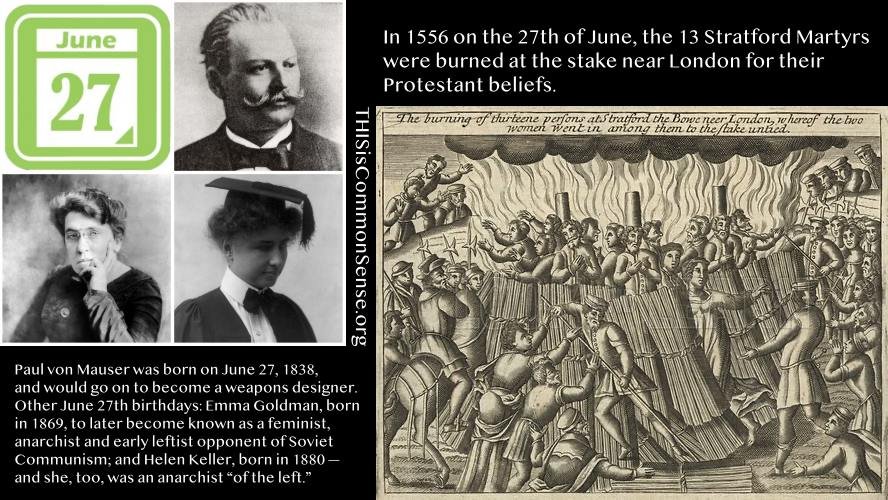
The Twenty-second Amendment (Amendment XXII) of the United States Constitution, which sets a term limit for election and overall time of service to the office of President of the United States, was ratified by the requisite 36 of the then-48 states of the union on February 27, 1951.
Congress had passed the amendment on March 21, 1947.
The suit is brought by a group of white male professors that does not include Eugene Volokh, one of its examples of applicants summarily ignored under the alleged hiring practices.
“Northwestern University School of Law refuses,” the plaintiff’s complaint reads, “to even consider hiring white male faculty candidates with stellar credentials, while it eagerly hires candidates with mediocre and undistinguished records. . . .
“Professor Volokh’s candidacy was never even presented to the Northwestern faculty for a vote, while candidates with mediocre and undistinguished records were interviewed and received offers because of their preferred demographic characteristics.”
One of those with the requisite demographic characteristics is Destiny Peery, a black woman who graduated near the bottom of her class at Northwestern Law School.
The suit alleges that Dan Rodriguez, the dean in 2014, the year she was hired, threatened to penalize faculty members who voted against her. She would “never even have been considered” for the appointment but for her sex and race.
Rodriguez also ordered the faculty to abstain from discussing candidates on the faculty listserv and mentioned the risk of litigation as his reason for the ban. In other words, this administrator knew that his policy was illegal and sought to cover it up.
Now the feared lawsuit has arrived, brought against Northwestern by Faculty, Alumni, and Students Opposed to Racial Preferences (FASORP).
Wobbly acronym, sure, but Federal law is clear in outlawing hiring discrimination based on race or sex.
This is Common Sense. I’m Paul Jacob.
Illustration created with Krea and Firefly
See all recent commentary
(simplified and organized)
See recent popular posts
The untold story mothers the lie.
Ursula K. Le Guin, Another Story or a Fisherman of the Inland Sea (1994).
February 26 marks the Dominican Republic’s Independence Day.