 A journalistic purpose could be someone with a Xerox machine in a basement.
Categories
A journalistic purpose could be someone with a Xerox machine in a basement.
“Beware: Second-hand stupidity kills.”
That’s just one of the killer lines from Greg Gutfeld’s rant against the five Democratic senators who introduced a bill to ban marketing e-cigarettes to teenagers. (It’s from The Five’s e-cig segment I linked to on Saturday.) Gutfeld called the e-cig “the greatest medical device since The Clapper,” arguing that it signifies the “first real progress for ending smoking . . . for good.”
To Barbara Boxer’s claim that there is no way of knowing whether e-cigs are harmful, Gutfeld responded: “Science, you bozo.”
Boxer and her comrades are, by my lights, far worse than bozos.
They fixate — like the puritanical Nanny State thugs they are — on the “Ooh, bad people get addicted to bad substances” aspect of the issue, rather than on the tremendous leap forward the new technology provides existing smokers. They fear, they say, kids starting with e-cigs and then taking up smoking tobacco. An unlikely scenario. Nicotine via water vapor is not a likely “gateway” to nicotine-with-deadly-tars via smoke.
E-cigs aren’t for everyone. The guy who puts these Common Sense episodes up online for me has tried it, and failed. Not a smoker, he wanted to see if he could swap some caffeine over-use with some controlled nicotine use. But he could not breathe the hot steam in.
The gateway was closed.
For smokers, however, the device serves as a wonderful substitution, swapping deadly tar-producing smoke sticks with a much cleaner nicotine rush. It will save lives.
Regulating it, taxing it — discouraging its use — would, as Gutfeld says, “make Death smile.”
This is Common Sense. I’m Paul Jacob.
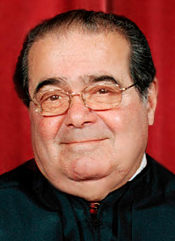
On March 11, 1936, Supreme Court Justice Antonin Scalia was born.
It is one of the unhappy incidents of the federal system that a self-righteous Supreme Court, acting on its Members’ personal view of what would make a “more perfect Union” (a criterion only slightly more restrictive than a “more perfect world”) can impose its own favored social and economic dispositions nationwide.
 He who rejects liberty has no faith in human nature.
March 10, 1762: Jean Calas, a Huguenot, died after torture, after having been wrongly convicted of killing his son; the event inspired Voltaire to begin a campaign for religious tolerance and legal reform.
Newly elected New York Mayor Bill de Blasio made waves, recently. He nixed the establishment of two new charter schools and halted the expansion of another.
Widespread protest followed, with over ten thousand people showing up to express their frustration and ire. The charter chain under de Blasio attack, Success Academy, has been very successful increasing student test scores, and can boast a waiting list of five applicants for every school opening.
So why would the mayor be against them? What would make him so against this non-radical form of education reform?
Well, de Blasio received the overwhelming support of teachers’ unions during his campaign for office. Teachers’ unions are no fans of charter schools, which gain some of their advantages by not being hampered by union contracts.
Sure, the mayor’s heavy-handed slap at charter schools may simply be a political payoff to the teachers’ unions, but couldn’t there be something more to it?
Last May he directed his metaphorical guns at the head of the Success Academy, former New York councilwoman Eva Mosokowitz. “It’s time for Eva Moskowitz to stop having the run of the place,” he promised the United Federation of Teachers at a mayoral candidates forum. “She has to stop being tolerated, enabled, supported.”
Knee-capping the less politically muscular charter school folks to please the immensely powerful public education unions is indeed classic patronage politics. But maybe de Blasio’s personal animus also shows his true colors, his commitment to undercut any successful competition to the governmental way of doing things.
This is Common Sense. I’m Paul Jacob.
The most ludicrous suggestion of last week deserves a column this week (yes, it’s based on a segment of ABC’s “This Week”). Click on over to Townhall. Then click back here, for more fuel to your incredulity and ire.
On March 9, 1954, the CBS show “See It Now” reviewed Wisconsin Sen. Joseph R. McCarthy’s anti-Communism campaign.
The innovation of e-cigarettes seems a major advance. Instead of smoking tobacco, complete with its carcinogenic tars clogging up lungs, one inhales water vapor imbued with a liquid containing a concentration of nicotine. And so of course there’s a political movement to ban the things, or at least heavily regulate them. The specified reason for most of these regulations or prohibitions is that “vaping” looks like smoking.
But it isn’t smoking. It’s much, much safer. So, argues Greg Gutfeld, the practice of vaping will save lives:
Not mentioned in this discussion (on Fox News’s evening talk show The Five) is the possible puritanism behind the move. The five Democratic politicians who are moving against the technology recognize, I am sure, that e-cigs are nicotine-delivery systems. To be against nicotine is to be against “addiction.” And, on this very simplistic view, for “health.”
But as mentioned by more than one of Fox’s talking heads, it’s hard to support free needle distribution on the one hand, and prohibit or “crack down” on e-cigs, on the other.
Strange world.