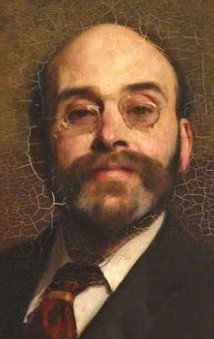
 Cowper’s Mahometans ate up the hog while denouncing it as an unclean thing, by judging each piece — as the phrase of the empirical Socialist goes — ‘on its merits.’ So you are being made to swallow Socialism bit by bit.
Categories
Cowper’s Mahometans ate up the hog while denouncing it as an unclean thing, by judging each piece — as the phrase of the empirical Socialist goes — ‘on its merits.’ So you are being made to swallow Socialism bit by bit.
“In war,” the Greek dramatist Aeschylus told us, “truth is the first casualty.”
This came to mind when Secretary of State John Kerry testified in the Senate last week.
 The new Iraq War has been pitched exhaustively to the American people as “only air strikes” and “absolutely no boots on the ground” — even as the Obama Administration continues to send additional U.S. military advisors to place their boots on Iraqi sand (and, at least once thus far, to engage ISIS directly via Apache attack helicopters hovering above Iraqi ground.)
Kerry again assured senators that the president “has been crystal clear that his policy is that U.S. military forces will not be deployed to conduct ground combat operations against ISIL.”
Strangely, however, the Secretary most adamantly urged Senators not to pass an Authorization for Use of Military Force (AUMF) that would restrict President O from doing precisely what he has so often and emphatically pledged not to do: put combat boots on the ground in Iraq.
The fact that the Obama Administration has foreclosed any possibility of putting US troops on the ground to fight, according to Sec. Kerry, “doesn’t mean that we should preemptively bind the hands of the commander in chief or our commanders in the field in responding to scenarios and contingencies that are impossible to foresee.”
Impossible to foresee? Yeah, right. The “no boots” promise provides all the stability of leaves in the wind.
Having any trust in this administration is impossible to foresee.
This is Common Sense. I’m Paul Jacob.
On December 15, 1791, the United States Bill of Rights became federal law when ratified by the Virginia General Assembly. On December 15 in 1933, the Twenty-first Amendment to the United States Constitution officially became effective, repealing the Eighteenth Amendment (which had enabled the Volstead Act) that had prohibited the sale, manufacture, and transportation of alcohol.
December 15 birthdays include that of Pehr Evind Svinhufvud af Qvalstad, 1861, first head of state of independent Finland, strongly anti-Communist.
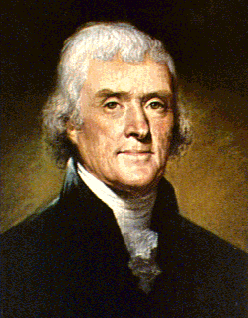 Rightful liberty is unobstructed action according to our will within limits drawn around us by the equal rights of others. I do not add ‘within the limits of the law’ because law is often but the tyrant’s will, and always so when it violates the rights of the individual.
On December 14, 1819, Alabama became the 22nd state of these United States. On the same December date in 1918, Friedrich Karl von Hessen, a German prince elected by the Parliament of Finland to become King Väinö I, renounced the Finnish throne. In 1939, the Soviet Union was expelled from the League of Nations for invading Finland and starting the Winter War.
What we learn when an insider blurts out the impolitic truth. Click on over to Townhall. Then come back here for more reading, or discussion, below.
On December 13, 1920, American economist, statesman, and 60th United States Secretary of State George Shultz was born.
A movie has been made from the science fiction novel Alongside Night, by the author of the book, and starring Kevin “Hercules” Sorbo. These two interviews provide an interesting look at not merely the film in question (which we here at Common Sense haven’t seen), but also the transit of the American ideal through the old domain of Hollywood and the revolutionary realm of independent film:
To learn more about the film, visit the official website.
On December 12, 1939, Finnish forces defeated those of the Soviet Union in the first major victory of what became known as the Winter War, the Battle of Tolvajärvi.
December 12th birthdays include:
* Erasmus Darwin (1731) – English physician, slave trade abolitionist, inventor and poet
* John Jay (1745) — First Chief Justice of the United States
* William Lloyd Garrison (1805) — American abolitionist, editor of The Liberator
 Reform will only be established in the long term to the degree that it passes into the ideas and habits of the majority.