Categories
folly free trade & free markets general freedom ideological culture too much government

Bitter Pill

When Martin Shkreli, CEO of Turing Pharmaceuticals, announced his August acquisition of Daraprim, the only available version of the anti-parasitic pyrimethamine, and his plan to raise its price from under $14.00 to $750 per dose, I did not comment. Everybody else seemed to know exactly how evil the man was, and how awful the system that allowed his machinations.

I knew only that I didn’t know enough.

After reading Mary J. Ruwart’s “The $750 Pill: Corporate Greed, Excessive Regulation—or Both?,” I’m glad I waited. According to Dr. Ruwart, who has worked in the pharmaceutical industry, even the barest facts in the case incite suspicion:

Daraprim was patented in the 1950s, and is used for treating parasitic infections in fewer than 13,000 people a year in the U.S.  Turing bought exclusive rights to distribute the drug in the U.S. from Impax for $55 million; drug sales are less than $10 million/year. Impax itself bought daraprim several years earlier. It upped the price from $1 to $13.50/pill, causing the number of prescriptions to drop about 30%.

As Ruwart explains, the drug is no longer patent-protected, and “any generic company could make daraprim. . . .” So, what gives?

A company cannot just jump into the market. It has to prove — to the Food and Drug Administration — that its new generic would enter the bloodstream exactly as the old one. With the FDA’s red tape, this costs millions.

Which allows companies like Turing to effectively reclaim a monopoly for a little-used generic. Blame the FDA.

Still, there is some competition, from a company with a similar drug, priced at $1 per tablet.

This is Common Sense. I’m Paul Jacob.


Printable PDF

Martin Shkreli, Turing Pharmaceuticals, Daraprim, greed, FDA, ilustration, Common Sense


Categories
Thought

Baruch Spinoza

“If slavery, barbarism and desolation are to be called peace, men can have no worse misfortune. No doubt there are usually more and sharper quarrels between parents and children, than between masters and slaves; yet it advances not the art of household management to change a father’s right into a right of property, and count children but as slaves. Slavery, then, and not peace, is furthered by handing the whole authority to one man.”


Baruch Spinoza, Tractatus Politicus (1677; translated by A. H. Gosset, 1883), Ch. 6, Of Monarchy

Categories
Today

Czech, Slovak

November 25, 1975, Suriname gained independence from the Netherlands.

On the same month and date 17 years later, the Federal Assembly of Czechoslovakia voted to split the country into the Czech Republic and Slovakia (officially disjoined as of January 1, 1993).

Categories
free trade & free markets general freedom government transparency national politics & policies responsibility too much government

Post Dated

What does a business do whose market share is decreasing, is billions of dollars in debt, and which incurred one-third of that debt just last year?

Realistically, it cannot be sustained. Not as a normal business.

Of course, the business in question has been struggling to reform, has been cutting costs. But can’t cut enough.

I’m referring to the United States Postal Service. Not a “normal business,” either: no “normal business” is authorized in the U.S. Constitution — or must suffer with the 535 members of Congress as its board of directors.

Kevin Kosar, writing at the Foundation for Economic Education, says the “existential crisis is already happening.”

And by this he doesn’t mean that the organization is going through a bout of anxiety leading to Nausea, or is so estranged from humanity that on a beach the company will kill an Arab — though that may be indeed true, “going postal” and all. He means, simply, what his title says: “USPS Is Going Down, and It’s Taking Billions with It.”

Many on the left say the problem is Congress’s insistence that the enterprise fund its employee retirement program. Kosar quotes an economist who figures that, even without current (and still inadequate) levels of pension contributions, the post office would have “lost $10 billion over the past seven years.”

Besides, those pensions must be paid for at some time — postponing them just delays the inevitable, making a future bust that much bigger, less manageable. (Current level of unfunded liability? $54 billion — which is not accounted for in its official debt.)

The Internet is more important than the post, now. Could it be time to junk mail?

This is Common Sense. I’m Paul Jacob.


Printable PDF

USPS, Postal Service, Post Office, Mail, bankrupt, government, inefficiency, Common Sense, Illustration


Categories
Thought

John Milton

“Unless wariness be used, as good almost kill a man as kill a good book; who kills a man kills a reasonable creature, God’s image; but he who destroys a good book, kills reason itself, kills the image of God, as it were in the eye.”


John Milton, Areopagitica, 1644

Categories
Today

Happy Birthday, Baruch!

November 24th marks the birthdays of philosopher Baruch Spinoza (1632) and three influential Americans: ragtime composer Scott Joplin (1868), self-help writer Dale Carnegie (1888), and conservative editor, writer, and television personality William F. Buckley Jr. (1925).

Categories
Accountability crime and punishment general freedom government transparency moral hazard national politics & policies property rights

Equitable Stealing?

Is freedom a simple matter of drafting a lofty document about respecting the rights of citizens?

Alas, no.

Our Constitution does that, as does Turkey’s and, for that matter, so did the now-defunct Soviet Constitution. Obviously, vigilance is also required. Keeping powerful government agencies respectful of the law — our liberties — and, when not, fully accountable for transgressions, is crucial.

That necessary vigilance is lacking here in America, today.

Your local police — the guys and gals who might respond if, heaven forbid, your home were broken into, or come upon your spouse broken down on a dark, rainy highway — are being encouraged to take people’s stuff . . . for “profit.”

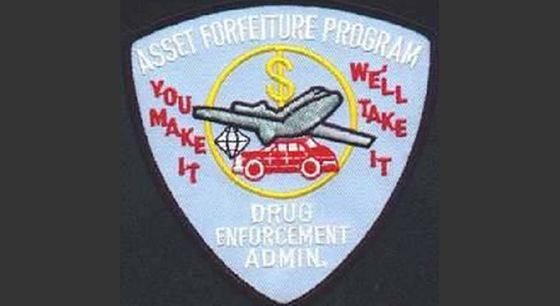
It’s called civil asset forfeiture. This “legal” ability to stop people and snatch their money (or car or what-have-you) without ever charging anyone with a crime forces victims to hire a lawyer to sue the government to prove their stuff is innocent.

Last Friday, I heralded a new Institute for Justice report on the growth of this dangerous practice of official police thievery. At Townhall on Sunday, I pointed out that even when reforms are enacted at the state and local level, federal law enforcement still facilitates civil forfeiture. The Feds encourage locals to continue taking stuff through a federal program known as “equitable stealing.”

No, my bad, it’s actually called “equitable sharing.”

But it’s the same thing, just with the Feds and locals splitting the loot.

We need new laws at the federal, state and local level that abolish forfeiture without a criminal conviction. If our “leaders” won’t act, we can petition at the local level to end this pernicious policy, forbidding any involvement with the Feds.

This is Common Sense. I’m Paul Jacob.


Printable PDF

civil asset forfeiture, asset, forfeiture, police, abuse, stealing, theft, property, Common Sense


Categories
Thought

C. S. Lewis

“And all the time — such is the tragi-comedy of our situation — we continue to clamor for those very qualities we are rendering impossible. You can hardly open a periodical without coming across the statement that what our civilization needs is more “drive,” or dynamism, or self-sacrifice, or “creativity.” In a sort of ghastly simplicity we remove the organ and demand the function. We make men without chests and expect of them virtue and enterprise. We laugh at honour and are shocked to find traitors in our midst. We castrate and bid the geldings be fruitful.”


C. S. Lewis, The Abolition of Man, 1943

Categories
Today

Areopagitica

On November 23, 1644, British poet John Milton published Areopagitica, a pamphlet decrying censorship.

Categories
links

Townhall: Our Innocent Stuff vs. Guilty Government

Government is supposed to defend our rights, including rights to property. Too often, our police departments merely steal. Play criminal themselves. Click on over to Townhall.com for the full story. Come back here for more reading . . . and viewing: