The National Science Foundation (NSF) changed priorities with the new Trump administration. It terminated some previously awarded research programs to develop “diversity-related projects,” since they do not align with the goal of creating “opportunities for all Americans everwhere.”
While the reader may be wondering why the National Science Foundation concerns anything but the advancement of science, the more immediate questions are Is the NSF allowed to just stop funding some projects on the basis of altered executive branch priorities? and What is required of the NSF by statute?
Sixteen states sued, asking for a court injunction to stop the halt of spending on DEI by the NSF. On August 1, a federal judge declined the request. “In a 78-page opinion, U.S. District Judge John Cronan declined to issue the injunction,” explains an Epoch Times article, “noting that the case involves monetary claims and therefore falls within the jurisdiction of the Court of Federal Claims.
Cronan determined that the plaintiffs failed to demonstrate that NSF’s directive runs counter to its mandatory statutory obligations, according to the court ruling.
The judge also stated that NSF’s directive, by its terms, does not require the agency to stop supporting projects aimed at increasing participation of women, minorities, and people with disabilities in STEM fields, citing evidence presented by the plaintiffs.
For example, the University of Northern Colorado stated that NSF funding supported nine of its programs that specifically aim to promote minority participation in STEM fields. Of those, only one had its funding terminated following the change in the agency’s policies, according to the court order.
“To the contrary, the record makes clear that, under the Priority Directive, NSF continues to fund many projects that advance the congressional objectives reflected in the NSF Act,” Cronan stated.
Aldgra Fredly, “Judge Declines to Block National Science Foundation From Ending DEI-Related Grants,” The Epoch Times (August 2, 2025).
Paul Jacob has been following the DEI issue for years, most recently in January with “DEI, Dying?” He remembers when its “diversity/equity/inclusion” policies were called “reverse discrimination.”
The Hubble telescope’s photo looks like an iPhone snap of a faux-granite countertop, complete with the intrusive glare of an overhead kitchen light.
But scientists swear it is indeed a real photo of a real object in outer space — and one that stirs up substantive controversy. Discovered on July 1, it sports a hyperbolic trajectory and was designated 3I/ATLAS, with the “3” and the “I” indicating the third interstellar object discovered in our solar system.
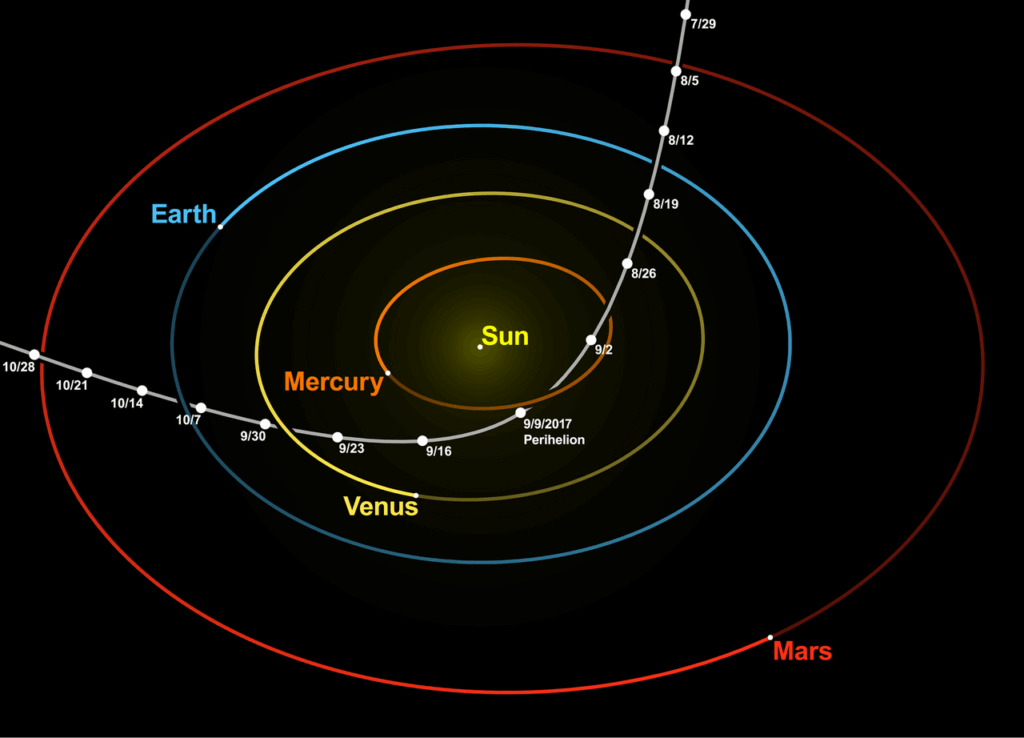
So it’s not the first. In October of 2017, astronomers espied an object apparently coming from the direction of the star Vega. Its brightest was the opposite of constant, with a light curve (of dark-light-dark-light . . .) that most scientists extrapolated evidence of an oblong object tumbling, not spinning, through space. Most intriguingly, it picked up speed after perihelion (when it was closest to the sun), which could not be attributed to a gravitational effect. The object goes by a number of related names, 1I; 1I/2017 U1; 1I/ʻOumuamua; or 1I/2017 U1 (ʻOumuamua), with the “I” standing for “interstellar” and the proper name deriving from Hawaiian, meaning “scout.”
‘Oumuamua’s path through the solar system.
A second interstellar visitor passed through our system two years later. Unlike ‘Oumuamua, it showed a “coma” (cloud of surrounding gas, or out-gassing from the object) that lit up as it approached the Sun, so it is generally designated a comet. (Comets got comas.)
2I/Borisov’s path through the solar system.
3I/ATLAS, however, has some more striking oddities. It is bigger than the others. Much bigger: perhaps 20 kilometers wide.
It will come close to three planets: Mars, Venus, and Jupiter. When closest to Mars, it may reach an apparent magnitude of 11 from the planet, perhaps allowing Mars orbiters to observe it. On the other hand, it will not be observable from Earth when at perihelion because Earth and the comet will be on opposite sides of our yellow star. In early December, if all goes according to normal, predictable comet behavior, 3I/ATLAS will be observable again.
3I/ATLAS at perihelion, and its predicted course.
This odd transit, coming so close to three planets but “avoiding” the most interesting (ours), has suggested to statisticians that something funny is going on. And some scientists are taking note:
A new study authored by Adam Hibberd, Adam Crowl, and Abraham Loeb proposes a possibility that 3I/ATLAS may be technological in origin. While the authors openly describe their hypothesis as a speculative and pedagogical exercise, the investigation itself is grounded in detailed trajectory analysis, dynamic modeling, and mission planning frameworks used in interplanetary navigation. The underlying premise of the paper is a simple one: if 3I/ATLAS exhibits features or behaviors inconsistent with known natural interstellar bodies, then it is worth investigating whether those features point to artificiality. . . . The object’s passage through the Solar System is unusually efficient in its interactions with planetary orbits. Its trajectory brings it into close proximity with Venus, Mars, and Jupiter. Each of these encounters happens within a tight orbital window. The likelihood of all three alignments occurring simultaneously, if 3I/ATLAS had entered the system at a random time and trajectory, is calculated to be less than 0.005 percent. These odds, according to the authors, are small enough to merit attention. The close approach distances are not trivial. In the case of Mars, the approach is as close as 0.19 astronomical units, with a longitude difference of just over 7 degrees. Jupiter and Venus show similarly close alignments. The low inclination of 3I/ATLAS’s orbit allows for such interactions to occur without substantial maneuvering.
David Freeman, “Is 3I/ATLAS Acting Like a Probe? New Models Say Yes” (July 19, 2025).
The authors make a rather obvious point: the object passes close enough to Jupiter that, with minor modifications of trajectory, the gas giant could be used to be used to decelerate and swing into an orbit in the solar system.
If artificial.
The timing of any interaction with Earth is another feature analyzed in the study. The authors project that an optimal intercept trajectory would lead to an arrival in Earth’s vicinity sometime between November 21 and December 5, 2025. While this does not confirm intent, it sets a testable timeframe. If no perturbations or anomalies are observed during that window, the hypothesis can be weakened. If, however, a significant change in course, acceleration, or luminosity occurs, the discussion would need to be revisited.
Ibid.
This moves us to something out of a science fiction story. And the authors of the paper have indeed made public comments on this eerie element. See Avi Loeb, “Is the Interstellar Object 3I/ATLAS Alien Technology?” (Medium, July 16, 2025):
One of the solutions to Enrico Fermi’s question about extraterrestrials: “where is everybody?” is offered by the dark forest hypothesis, popularized by Cixin Liu’s science fiction novel “The Dark Forest.” This hypothesis proposes that our cosmic neighborhood is dangerous, filled with intelligent civilizations that are hostile and silent to avoid detection by potential predators. In this context, the silence in searches for radio signals by the SETI community is not caused by the lack of extraterrestrial intelligent civilizations, but is instead a consequence of them fearing mutual destruction. Our paper explores the possibility that the recently discovered interstellar object, 3I/ATLAS, may provide evidence in support of the dark forest hypothesis.
Yikes?
Yes, yikes: “The velocity thrusts needed for launches of gadgets out of 3I/ATLAS to intercept Venus, Mars, or Jupiter are smaller than 5 kilometers per second, achievable by intercontinental ballistic missiles.” In other words: possible probe. Or probe carrier.
3I/ATLAS comes from the direction of the galactic center. But what matters is where it is going. And, if it changes course, why.
“Australia plans to take US beef for the ‘first time,’ Trump said in a post on Truth Social on Thursday,” Reuters reports, “calling it a ‘very big market.’
Last night, in another Truth Social post, Trump said the US would “sell so much to Australia because this is undeniable and irrefutable Proof that US Beef is the Safest and Best in the entire World.”
“The other Countries that refuse our magnificent Beef are ON NOTICE,” the post continued.
Though Trump’s social media boasting has been shared fairly widely, things are not as they seem.
Australian officials say the relaxation of restrictions was not part of any trade negotiations but the result of a years-long assessment of US biosecurity practices.
On Wednesday, Australia’s agriculture ministry said US cattle traceability and control systems had improved enough that Australia could accept beef from cattle born in Canada or Mexico and slaughtered in the United States.
The decision has caused some concern in Australia, where biosecurity is seen as essential to prevent diseases and pests from ravaging the farm sector.
Ibid.
So while Trump seems to be talking trade policy and opposing Australian protectionism, if Australian officials are right (and why would they lie), a very different issue is at play here.
Could it be that Trump is again taking credit for something he has nothing to do with? Like his recent sugar cane Coke boasts?
WASHINGTON – President Trump secured expanded access to Australia’s market for U.S. fresh and frozen beef, scoring a historic win for American ranchers. For over two decades, Australia imposed non-scientific barriers on U.S. beef, closing off a critical market. Thanks to President Trump’s leadership, Australia opened its market to U.S. beef, scoring a major win for U.S. ranchers.
The rule in statism is that everything not prohibited is subsidized. Or, worse yet, mandated. And that has been recent American practice.
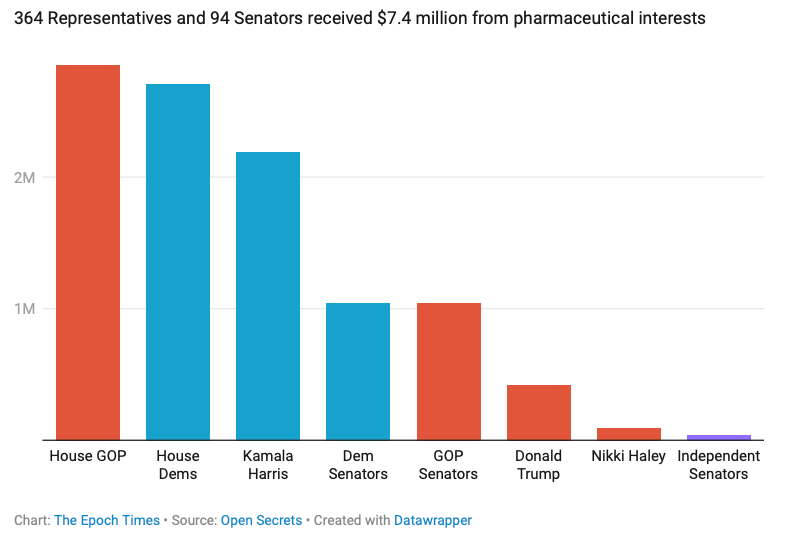
You can see it in the nine charts The Epoch Times published Friday.
In 2020 Americans filled 6.4 billion prescriptions, about 19 per person.
By 2023, Americans were consuming more than 210 billion daily doses of medication annually. That’s more than 600 pills, shots, drops, IVs, creams, mists, or suppositories for every person in the country.
“9 Things to Know About Big Pharma, in Charts,” The Epoch Times (July 18, 2025).
And all these drugs have political consequences:
And consequences on federal government spending:
Meanwhile, the federal government’s hand in the creation of SARS-Cov-2 — the coronavirus that induced the pandemic and the panic — is clearer than ever, and the clarity is all about America’s most notorious bureaucrat, Anthony Fauci:
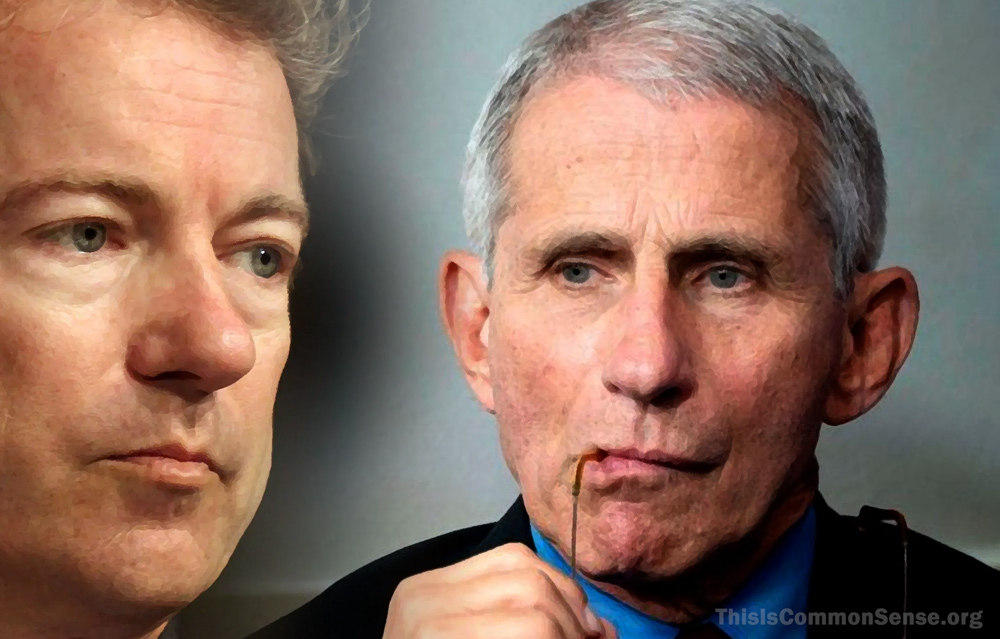
Sen. Rand Paul (R-KY) wrote a letter to Attorney General Pam Bondi on Monday requesting that the Department of Justice investigate Dr. Anthony Fauci for possible criminal prosecution regarding Fauci’s congressional testimony in May 2021 about gain-of-function research in the Wuhan Institute of Virology.
“Rand Paul ‘re-refers’ Fauci to Department of Justice,” The Washington Examiner (July 15, 2025).
In formally requesting the prosecution of Fauci again, Sen. Paul cited the questionable legality of the autopen signatures that preemptively pardoned Fauci, while “Sleepy Joe Biden” was . . . on who-knows-how-many drugs.
The spread of the novel coronavirus led, we all remember, to the roll-out of a number of new novel medications, subsidized by government and, in many cases, required by government.
Rep. Anna Paulina Luna (R-Fla.) has once again postponed her next UAP (UFO) hearing. The whistleblowers keep balking. “We asked multiple people, and they weren’t willing to testify. They said, ‘we either didn’t want to be the only one,’ ‘we were worried about our safety,’ etc.”
The real issue, Secrets Task Force Chair Luna suggests, appears to be that they are avoiding SCIFs — secure meetings between testifiers and congressfolk — perhaps because their bosses do not want them exposed to the more freewheeling, spontaneous and to-the-point lines of questioning that come up during SCIFs.
Well, that’s what Daniel “Dark Journalist” Liszt hazards, anyway. He names at least one Deep State orchestrator: Chris Mellon.
Meanwhile, Newsmax’s Ross Coulthart blurted out that he “categorically” knows that the “tic tac” UFO is the property of Lockheed-Martin.
By the way, is it funny that the House committee investigating UFOs is led by someone names “Luna”?
Regardless, the ongoing UFO “disclosure” is not mimicking reported outré UFO behavior: turning on a dime, G-force defying speeds. It’s proceeding, instead, at a snail’s pace — if the snail is traveling a salt flat.
The previous site update on UFOs was in mid-June; Paul Jacob has been covering the subject for years, in December in the context of “drones.”
On July 11, 2025, Paul Jacob covered the suspensions of key Secret Service personnel in “Secret Stupidity?”
The next day, the General Accounting Office (GAO) came out with a new report, revealing “that the Secret Service received classified intelligence regarding a threat to Trump’s life ten days before the rally, but failed to share the information with other key agencies,” explains a FoxNews story.
“It also identified a series of procedural and planning mistakes, including ‘misallocation of resources, lack of training and pervasive communication failures’ that led to the near assassination,” the FoxNews coverage declares.
Senator Chuck Grassley (R-Iowa), who ordered the report, blames the failures on “years of mismanagement.” But what else could he say?
On Wednesday, in “The Devil and the Deep Blue Dress,” Paul Jacob dealt with the closing of the Jeffrey Epstein case. Since then, reactions have run the gamut, but there is a persistent theme: disbelief. What President Trump and his Attorney General, Pam Bondi, have told us about Epstein is not widely believed. But what does this mean for those most closely associated with reforming the FBI, Dan Bongino and his boss, Kash Patel?
The New Republictries to place this tweet in context: “It’s important to keep in mind that Loomer has her own agenda when she ‘reports’ on the Trump administration, and is desperate for anyjob that will keep her in close to the Oval Office.” But the progressive magazine goes on to say that Loomer has exerted no small amount of influence on the Trump Administration in the past.
“Conservatives have taken to social media to back FBI Deputy Director Dan Bongino in an apparent falling out between the FBI and Department of Justice (DOJ) following Attorney General Pam Bondi’s defense of a memo regarding the Epstein files,” explainsNewsweek.
“According to a far-left Axios scoop,” the Independent Sentineltells us, “Dan Bongino took the day off today after a clash with Pam Blondi [sic] over the handling of the Epstein tapes. The dispute erupted Wednesday amid the fallout on the administration walking back its claims about Epstein. They said there was no client list and he committed suicide.”
Kash Patel, Director of the FBI, is also rumored to be thinking of throwing in the towel — but also seeks to put the AG to the curb.
What does this all mean? “Could you imagine you’re Dan Bongino?” asks the host of The Quarteringpodcast. “And you’re worth like . . . 200 million dollars. You know. F**k it. Just quit…. All he has to do is quit and say ‘I did the best I could; the Deep State is still real.’ You know. That kind of stuff. And then . . . 99% of people will forgive him. I guarantee you that fact.” The podcaster’s belief? The one that quits first will have the least mess on them.
Seems about right.
But nothing has happened yet, and Trump Again/Off-Again Bill Mitchell thinks a whole lot of folks are speculating, not reporting:
Uh, we know who.
Oh, wasn’t it odd to see Ms. Loomer’s put-down of AG Bondi as “Blondi” carry over into the news reports without correction?
“The year 2024 was transformative for both President Javier Milei and Argentina,” wrote Alejandro Werner in January. “After just one year in office, Milei has achieved significant milestones: eliminating the fiscal deficit, bringing inflation to moderate levels (see figure 1 [above]), reducing the gap between the official and the parallel exchange rate (a free but illiquid market), and implementing the most ambitious liberalization and deregulation program Argentina has seen this century.”
As we Americans endure information-free debates about our president’s reforms and bills — at least one being “Big” and “Beautiful,” according to presidential ballyhoo — it’s worth remembering that in South America one politician is making significant changes indeed.
“The upcoming mid-term elections in October will be a test of his political strength, so the first challenge is securing a strong performance in these elections,” Werner’s article for the Peterson Institute for International Economics goes on. “With half of the seats in the lower house of Argentina’s Congress and a third of the Senate up for renewal, the stakes are high. Currently, Milei’s political party, La Libertad Avanza, has minimal representation in Congress. A favorable mid-term outcome, buoyed by Milei’s consistent approval ratings, could cement his party as the dominant political force ahead of the 2027 presidential elections.” So note: Milei has accomplished a lot more than Trump with much more opposition than Trump has within his own government, with his own political party boasting of majorities in both the House and the Senate.
The view from Cato Institute is worth considering: “Argentine President Javier Milei has lowered inflation, drastically reduced government spending, and dismantled large parts of the federal bureaucracy,” explains Ian Vasquez for Cato. “But one of the most far-reaching efforts by his administration has been its deregulation push. . . .”
This push may remind Americans of Trump’s first term, and perhaps also of DOGE, but Milei has been much more successful.
Since coming to power, Milei has made wide-ranging cuts to Argentina’s bureaucracy. In his first year, he reduced the number of ministries from 18 to 8 (eliminating some and merging others), fired 37,000 public employees, and abolished about 100 secretariats and subsecretariats in addition to more than 200 lower-level bureaucratic departments.
The president has also aggressively pursued deregulation. Using a conservative methodology, my colleague Guillermina Sutter Schneider and I calculated that during Milei’s first year in office, he implemented about two deregulations per day. Roughly half of the measures eliminated regulations altogether, while the rest modified existing regulations in a generally market-oriented direction.
Milei has implemented these reforms legally and constitutionally, and they have resulted mainly from two broad measures. First, Milei began his administration by issuing an emergency “megadecree” that consisted of 366 articles. Emergency decrees are consistent with Argentine law if they meet certain conditions. They are also reviewable by Congress, which has the right to reject the orders within a specified period of time. Since the legislature did not object, most of the deregulations in the megadecree went into effect.
“Deregulation in Argentina: Milei Takes “Deep Chainsaw” to Bureaucracy and Red Tape,” Spring 2025.
A request for more information from Grok, this morning, elicited an important context from the AI:
Milei’s deregulation is driven by a consistent libertarian ideology aiming to dismantle the state, while Trump’s ismore pragmatic, focusing on economic competitiveness and political appeal, often paired with protectionistpolicies that contradict free-market principles.
If your general impression is that Trump’s much less impressive than Milei in curbing government bloat, Grok concurs: “Trump’s rhetoric suggests continued deregulation, but specific actions in 2025 are less documented, with DOGE’s efforts described as ‘meager’ compared to Milei’s.”
The difference between a “liberal” and a “leftist” is lost on many, especially on the political right. But understanding is coming. A liberal is a person ostensibly for an “open society” and against treating “the other” badly, but is also for the basic structures of society. A leftist, on the other hand, sees the causes of “the marginalized” and “the poor” and anyone not hyper-obviously benefitting from the current order as an excuse to tear down that order. “Fundamentally transform America” might be a slogan to excite a liberal, but a leftist sees it as a demand with immediate consequences.
Leftists do wish for a fundamental transformation of America!
Liberals might still think that free speech, for example, is a good thing. Whereas a leftist sees it as a barrier to that fundamental transformation.
Rumination on this subject is all over YouTube. Consider Styx:
Of Democrats and their institutional liberalism, he says, “I find it very funny that Reagan broke their minds so much that they began trying to absorb far leftists . . . and now Trump is breaking their minds again.”
The problem with the liberal is an inability to deal with substantive challenge.
And leftists are proving to be just as much a challenge as Trump, now, especially with the recent anti-ICE riots (the subject of Styx’s talk), so liberals are trying to distance themselves from the left. But, Styx says, that isn’t working.
Author Andrew Doyle, in a recent book, is trying to understand whither “the woke.” He sees the woke as “unprecedented” for being authoritarian and successful at it while pretending to be powerless:
Doyle is the creator of the infamous “Titania McGrath” persona and Twitter account, and his new book is called The New Puritans. He expects that the new puritans of wokeness will wither quickly as a movement, because of the fundamental contradiction. The “unprecedented” contradiction.
The only big success in opposing leftist policies, on the other hand, is not in the U.S., it is far, far south. Hence the seemingly random placement of a Milei image at top. More updates to come on him and his Argentine movement.
One often heard the opinion, as recently as a year ago — sometimes as a whisper, sometimes as a boast of savvy opinion or special knowledge, or even daring prophecy — that Michelle Obama was the Democrats’ secret weapon, the most likely next “sure thing” candidate for the presidency.
Is anyone saying it now?
Michelle Obama’s candidacy is off the table. Comb through X — you’ll see almost no one thumping for Mrs. Obama.
But what made the savvy sages of our time drop the issue?
There are probably two issues:
I. The general collapse of Democratic Party cultural cachet after the debacle that was the Kamala Harris campaign. The Democrats have great trouble reaching a majority of Americans right now. It is the party’s issues. Michelle Obama would not solve this problem. (Or would she?)
II. The fizzle that was (or at least yawns induced by) “IMO with Michelle Obama & Craig Robinson.” It is not doing well on YouTube, and not creating much buzz outside of a narrow fan base. Or so it appears to those outside the fan base. Apple and Spotify say the podcast is a success.
But if success it be, Michelle Obama’s enduring popularity does not seem to be remotely political. This may reflect her own non-political outlook on life.
Almost certainly the lack of Michelle O. buzz has nothing to do with this: