“We’ve got major fiscal problems and a completely unsustainable fiscal trajectory. I haven’t heard anyone, Democrat or Republican, witness or member, that [sic] doesn’t accept that fact,” Reason magazine quotes Rep. Jodey Arrington (R-Texas), chairman of the House Budget Committee. “We won’t know when the dominoes fall on us in a sovereign debt crisis, it’s going to be difficult to put the pieces back together and maintain our global leadership.”
Eric Boehm, the Reason author, relays the gist of last week’s committee hearing. He also acknowledges the limits of the committee’s wherewithal: “While there is little disagreement about the seriousness of America’s fiscal problems, the committee hearing also inadvertently highlighted the immense difficulty of solving them.”
Which is why many people have yearned for something like a constitutional balanced budget amendment:
Of course, lawmakers don’t need a constitutional constraint to prevent them from borrowing too much. They could simply pass a budget that doesn’t depend on trillions of dollars in annual borrowing.
Yes, yes, it’s okay to laugh. But that is the thing that must happen.
Which brings us to DOGE, the “Department of Government Efficiency,” Trump’s brain trust on reducing government spending, headed by Elon Musk and Vivek Ramaswamy. Which Ron Paul has advised.
And now, so has David Stockman.
In a long piece on Substack, the former Reagan era budget bulldog offers “Memo To Musk & Ramaswamy: How To Cut $2 Trillion of Fat, Muscle And Bone—The Complete Plan.” It’s comprehensive and daring, but we’ll quote only the setup, where Stockman paints the picture of the challenge America faces:
On Thursday, Paul Jacob addressed the wave of UFOs over the North American east coast and elsewhere, mostly thinking of them as drones. At that point, ufologists had not taken up the story in a big way, and it was local and national news sources that had been covering the story.
But UFO historians, enthusiasts, and theorizers have discussed them, to some extent, both before and since. On her “Earthfiles” channel, on Wednesday, Linda Moulton Howe chatted with a very speculative Whitley “Communion” Strieber about the issue. And on Friday, Richard Dolan, author of a multi-volume history, UFOs and the National Security State: Chronology of a Coverup, looked at the subject with some care:
Meanwhile, the fascinating YouTube channel “Earth Watchman” by “MrMBB333” presented extended plane-controller conversations about truly outré UFOs over Oregon. These are not propeller-driven drones, but classic “woo-woo” UFOs. The New York Post covers this story too:
“You are cleared to maneuver as necessary left and right to avoid the UFO out there.”
The LifeFlight pilot, 37-year-old Joe Buley, told KGW he and two medics onboard the fixed-wing aircraft reported flying from Aurora, Colorado, to North Bend, Washington, when they saw the orange lights.
“The biggest thing that stood out was it was changing direction. Usually, things don’t change directions unless it’s an aircraft,” Buley told KGW Thursday.
So the subject just gets stranger and stranger. While much of the east-coast phenomena seems drone-like, if breathtakingly advanced, simultaneous encounters elsewhere suggest more traditional “alien” interpretations.
An interesting part of the human reaction was noted by Mr. Dolan: “You get a real local-national divide here.” The federal level is not helping locals deal with what looks like an invasion of sorts.
Meanwhile, The New York Times dutifully feeds readers the official nothing-to-see-here-folks line:
Federal authorities investigating the sightings have provided few answers about what the objects are or their origin, leaving residents unsettled and local leaders frustrated.
U.S. officials on Thursday said that they had been unable to corroborate the reported drone sightings, and suggested that many of the objects might in fact be manned aircraft, such as airplanes or helicopters.
That latter suggestion from officials seems extremely dubious regarding the New Jersey sightings, and preposterous regarding the “above Oregon” ones — though the debunking interpretations of those Oregon encounters finger Starlink satellites, no matter how dissonant that explanation is with the pilots’ descriptions of maneuverings.
The east-coast/west-coast differences have not been lost on the Post, which mentions the breadth of speculation, as well:
Last week, the House Select Subcommittee on the Coronavirus Pandemic released its major report. The press release, “FINAL REPORT: COVID Select Concludes 2-Year Investigation, Issues 500+ Page Final Report on Lessons Learned and the Path Forward,” shows that at least some people in high places are coming around to answering questions — and taking positions — similar to those you’ve read in past entries on this website, Common Sense with Paul Jacob.
Here are a few passages:
COVID-19 ORIGIN: COVID-19 most likely emerged from a laboratory in Wuhan, China. The FIVE strongest arguments in favor of the “lab leak” theory include:
The virus possesses a biological characteristic that is not found in nature.
Data shows that all COVID-19 cases stem from a single introduction into humans. This runs contrary to previous pandemics where there were multiple spillover events.
Wuhan is home to China’s foremost SARS research lab, which has a history of conducting gain-of-function research at inadequate biosafety levels.
Wuhan Institute of Virology (WIV) researchers were sick with a COVID-like virus in the fall of 2019, months before COVID-19 was discovered at the wet market.
By nearly all measures of science, if there was evidence of a natural origin it would have already surfaced.
…
EcoHealth — under the leadership of Dr. Peter Daszak — used U.S. taxpayer dollars to facilitate dangerous gain-of-function research in Wuhan, China. After the Select Subcommittee released evidence of EcoHealth violating the terms of its National Institutes of Health (NIH) grant, the U.S. Department of Health and Human Services (HHS) commenced official debarment proceedings and suspended all funding to EcoHealth.
…
NIH’s procedures for funding and overseeing potentially dangerous research are deficient, unreliable, and pose a serious threat to both public health and national security. Further, NIH fostered an environment that promoted evading federal record keeping laws.
…
The Paycheck Protection Program — which offered essential relief to Americans in the form of loans that could be forgiven if the funds were used to offset pandemic-era hardships — was rife with fraudulent claims resulting in at least $64 billion of taxpayers’ dollars lost to fraudsters and criminals.
…
Fraudsters cost the American taxpayer more than $191 billion dollars by taking advantage of the federal government’s unemployment system and exploiting individuals’ personally identifiable information.
…
At least half of the taxpayer dollars lost in COVID-19 relief programs were stolen by international fraudsters.
…
The WHO’s response to the COVID-19 pandemic was an abject failure because it caved to pressure from the Chinese Communist Party and placed China’s political interests ahead of its international duties. Further, the WHO’s newest effort to solve the problems exacerbated by the COVID-19 pandemic — via a “Pandemic Treaty” — may harm the United States.
…
The “6 feet apart” social distancing recommendation — which shut down schools and small business across the country — was arbitrary and not based on science. During closed door testimony, Dr. Fauci testified that the guidance, “sort of just appeared.”
…
There was no conclusive evidence that masks effectively protected Americans from COVID-19. Public health officials flipped-flopped on the efficacy of masks without providing Americans scientific data — causing a massive uptick in public distrust.
…
Prolonged lockdowns caused immeasurable harm to not only the American economy, but also to the mental and physical health of Americans, with a particularly negative effect on younger citizens. Rather than prioritizing the protection of the most vulnerable populations, federal and state government policies forced millions of Americans to forgo crucial elements of a healthy and financially sound life.
“In October 2022, Chinese leader Xi Jinping held a secret meeting instructing top state officials — overseeing political, intelligence, and influence operations — on a new strategy to target the Falun Gong religious group internationally,” reportsThe Epoch Times in a new 2000+ word report.
“At the core of the Chinese Communist Party (CCP)’s new anti-Falun Gong strategy is launching disinformation campaigns via social media influencers and Western media outlets; and using the American legal system to go after companies started by Falun Gong practitioners.”
The report concludes by quoting Rep. Scott Perry (R-Pa.) on the need to counter-act the CCP’s anti-Falun Gong initiative. “‘The Communist Party of China is essentially a criminal organization running a country,’ Perry said, adding that since the United States doesn’t allow criminal organizations to use government systems to persecute adversaries or violate basic human rights, ‘we certainly shouldn’t let the CCP do it either.’”
Since the election in early November, we’ve seen a lot of think-piece essays on the meaning of it all. Here are some examples:
The end of an American world
Donald Trump’s re-election to a second term on Wednesday, November 6, and the success of the Republican Party, of which he has taken total control, represent a major turning point for the United States.
It’s a reality that needs to be examined with eyes wide open. The path on which Trump, strengthened for his second term by his party’s success in the Senate, will take his country diverges fundamentally from the one charted by the United States since the end of the Second World War. It marks the end of an American era, that of an open superpower committed to the world, eager to set itself up as a democratic model. It’s the famous “shining city on a hill,” extolled by President Ronald Reagan. The model had been challenged over the past two decades. Now, Trump’s return is putting a nail in its coffin.
The national mass psychosis is finally dealt a blow, making it safe to be sane again
Yes, it’s a cult. The mass movement that continually renamed itself (appearing as #Resistance, antiracism, “prodemocracy,” etc) hits most all the classic definitions. It demonizes outsiders, rejects critical thought, encourages cutting off family and friends (never more than this week), demands adherence to bizarre/nontraditional beliefs, embraces lies in recruitment (cough cough Russiagate), worships secrecy, exaggerates sinfulness of old beliefs, and has an answer for everything. It lacks a charismatic leader. But the lodestar is Trump, cause of all bad things. It’s really an Anti-Trump cult, the perfect postmodern movement, where the animating emotion is panicked rejection of an anti-leader.
Trump Has Put an End to an Era. The Future Is Up for Grabs.
This may sound a bit like the most alarmist interpretations of the Trump era — that we are exiting the liberal democratic age and entering an autocratic, or at least authoritarian, American future.
But the new future is much more open and uncertain than that dark vision. While many people voted against Trump because they felt that liberalism or democracy was under threat, many other people moved rightward for the same reason — because they felt that was the way to defend liberal norms against the speech police, or democratic power against control by technocratic elites.
We don’t know which perspective, if either, will be vindicated. All we know is that right now our core political categories are contested — with vigorous disagreement about what both democracy and liberalism mean, unstable realignments on both the left and the right, and “post-liberal” elements at work in right-wing populism and woke progressivism and managerial technocracy alike.
All this indicates the first way that we are not going back: We are not returning to the narrowing of political debate that characterized the world after 1989, the converging worldviews of the Reaganite center-right and the Clinton-Blairite center-left, the ruling-out of radical and reactionary possibilities.
Ross Douthat, “Trump Has Put an End to an Era. The Future Is Up for Grabs,” The New York Times, November 16, 2024.
The End of the Age of Scientism
The only way to save science from itself is to apply it in proper ways while recognizing the limits of the ability to construct the world according to the imaginings of a handful of intellectuals. It’s tragic we had to come to the point of nearly destroying the globe to discover this but here we are. Let the rebuilding begin.
Keep the real science, but throw out the scientism.
In the age of Hitler, the post–World War II age in which we live, “humanity” is our shared faith. The concept of “human rights” is of course much older, going back to the age of Enlightenment and beyond, and most famously to Thomas Jefferson, who held it to be self-evident “that all men are . . . endowed by their Creator with certain unalienable rights.” And yet this claim is a problem. Not only because Jefferson wrote it while holding hundreds of men and women in slavery, but also because it is simply, factually wrong. Jefferson and a few of his Enlightenment friends thought that the existence of human rights was a self-evident truth; but it can’t be, because a great many people in a great many historical settings have not believed in any such thing. The claim that “We hold these truths to be self-evident” reveals the doctrine of human rights for what it is: a castle in the air, a defiant existential assertion of values.
But that is not the deepest problem. The deepest problem is that most of us, most of the time, neither know nor care whether “human rights” have a solid foundation beneath them: like Jefferson, we have come simply to believe in them in their own right. Now, in the post-1945 era, in the age of Hitler, we really do hold the existence of human rights and human equality to be self-evident. We can’t, intellectually, prove it to be true; but that doesn’t matter, because we feel that it is true. For now.
Why do we believe that human beings have rights? Even asking it feels uncomfortable, a questioning of what ought not to be questioned. To raise the problem is almost to blaspheme.
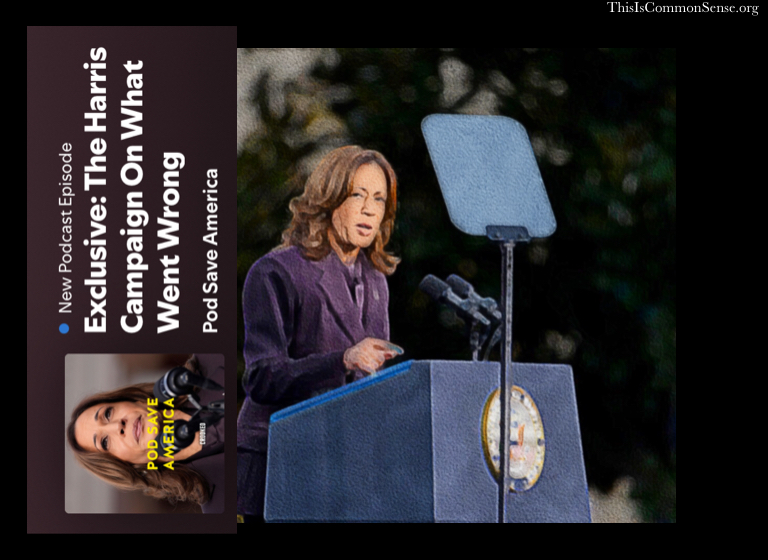
“In 107 days, what typically takes us a year and a half to two years in our presidential campaign, we were defining someone who was wholly undefined from the start, trying to remind people about the opponent and what life was like underneath him, and also take into account what the political environment was and the realities that we had to deal with,” the Harris–Waltz campaign senior adviser for strategy messaging Stephanie Cutter said on the November 26th episode of the progressive podcast “Pod Save America,” hosted by Dan Pfeiffer.
“When asked on ‘Pod Save America’ if Harris should or should not have done more to distance herself from Biden,” summarizedThe Epoch Times, campaign chair Jen “O’Malley Dillon said that it wouldn’t have helped to separate herself from Biden by cherry-picking what should have been done instead.
“Look, vice presidents never break with their presidents,” O’Malley Dillon said. “The only time in recent memory is when Pence broke with Trump.”
Harris chose to remain loyal to Biden to avoid changing precedent, O’Malley Dillon said.
“Our focus was to look at the future,” she said.
On the failure of the campaign to secure a spot on the most influential podcast in the world, Ms. Cutter was politic: “We had discussions with Joe Rogan’s team. They were great. They wanted us to come on. We wanted to come on. Will she do it sometime in the future? Maybe. Who knows. But it didn’t ultimately impact the outcome one way or the other.”
The general consensus of podcasters seems to be that Kamala Harris appearing on Joe Rogan’s Spotify podcast would have only doomed her campaign. Rogan is known for authentic long-form interviews; few observers believe Harris could fake authenticity for ten minutes, not to mention two hours.
As for these excuses made by campaign staffers, eighty-year-old Democrat campaign guru James Carville is on record with a ‘slightly different’ take:
“The vice president (Harris) was thinking about going on the Joe Rogan show and a lot of the younger progressive staffers pitched a hissy fit,” Carville said.
While Carville reiterated Harris’s staff claim that avoiding Rogan was not the determining factor for her election loss, he unleashed a vulgar rant about their management of her losing campaign.
“When you put a campaign together and you hire young people to do work, let me tell you exactly what you tell these people: What I would tell them, ‘Not only am I not interested in your f***ing opinion, I’m not even going to call you by your name. You’re 23 years old. I don’t really give a s*** what you think.’”
At Ballotpedia, referenced here yesterday, we learn that a number of minimum wage measures were on the ballots this last election. The results were interesting. “In California and Massachusetts, voters rejected ballot measure to increase the minimum wage — the first time since 1996 that minimum wage increase measures were defeated.”
As Paul Jacob has often explained, in these pages, minimum wage hikes do not do what their advocates think, or at least say, they do. And the usual results present a problem for the policy’s advocates. A Reasonarticle by Justin Zuckerman, “The New York Times Claimed D.C.’s Minimum Wage Hike Created Jobs. We Exposed Their Error,” from Friday, shows a grand example of a persuasive article in the Gray Lady being used to convince voters that a Washington, D.C., minimum wage hike did no harm while also being based on a gross misunderstanding of statistics. Its author “misunderstood the data she was looking at. The chart she linked to in the article presented numbers ‘in the thousands,’ meaning that the actual data were not 14,168 but 14,168,000, which also makes sense because Krishna [the Times contributor] didn’t realize she was reading national BLS data — not local figures.” A huge error. Which Reason told The Times about, “and the paper issued a correction.”
But the advocates for minimum wage hikes continued to cite the article, despite the error, despite the admission that was the official correction.
Some errors go on repeat because they re-inforce ideological prejudice. The minimum wage is one of those policies usually advanced in ignorance of all the work done on the issue. Often in defiance of common sense.
November 2024: There were 146 ballot measures certified for statewide ballots in 41 states. On the Fifth, “Election Day,” these measures were decided by voters.
According to Ballotpedia, from “2010 to 2022, the average number of statewide ballot measures in an even-numbered year was 161,” making 2024 slightly below average — noting that Louisiana will decide four constitutional amendments on December 7, and five states decided nine measures earlier in the year, bringing the total for the year up to 159.
A record number of abortion-related measures were decided this year: eleven.
Drug-use policies were on state ballots, including for marijuana (recreational, three; medicinal, two) and psychedelics: six.
Democratic processes were on state ballots, including both for and against ranked-choice voting: ten.
Democratic processes more specifically about voting were also on state ballots, including citizenship requirements (all passed) and voter i.d.: ten.
Labor policies, including minimum wage policies, were on ballots as well: seven.
The number of education-related measures was the highest in in 18 years: twelve.
Ballotpedia is a great resource, and if you are looking for good information about what people are voting for and against, ballotpedia.org should be your first resource.
Last Monday, Paul Jacob covered the brewing story of Federal Emergency Management Agency supervisor Marn’i Washington, who told FEMA workers on the ground in Lake Placid, Florida, not to help households with Trump signs in the yard. Since then we’ve learned more. The problem wasn’t just a rogue supervisor.
The next day, the New York Post offered a juicy headline: “FEMA worker accused of telling staff to skip hurricane-ravaged Trump homes claims it was common practice: ‘This is not isolated.’”
The Post article relied heavily on an episode of the Roland S. Martin podcast on YouTube:
Her explanation may not be what you have seen reported, however. The idea at FEMA, Ms. Washington says, is a policy of “avoidance and de-escalation.” The trouble with Trump supporters, FEMA lore has it, is that they tend to be rude or otherwise resistant to FEMA help. So the agency, to avoid conflict, avoids some natural disaster victims as a policy. Washington says she did nothing wrong, or out of the ordinary.
FEMA is a controversial agency within the federal government, with a bad reputation amongst many Americans, not just Trump supporters. That hardly needs verification. Ms. Washington insists that the logs of FEMA workers will justify her claims.
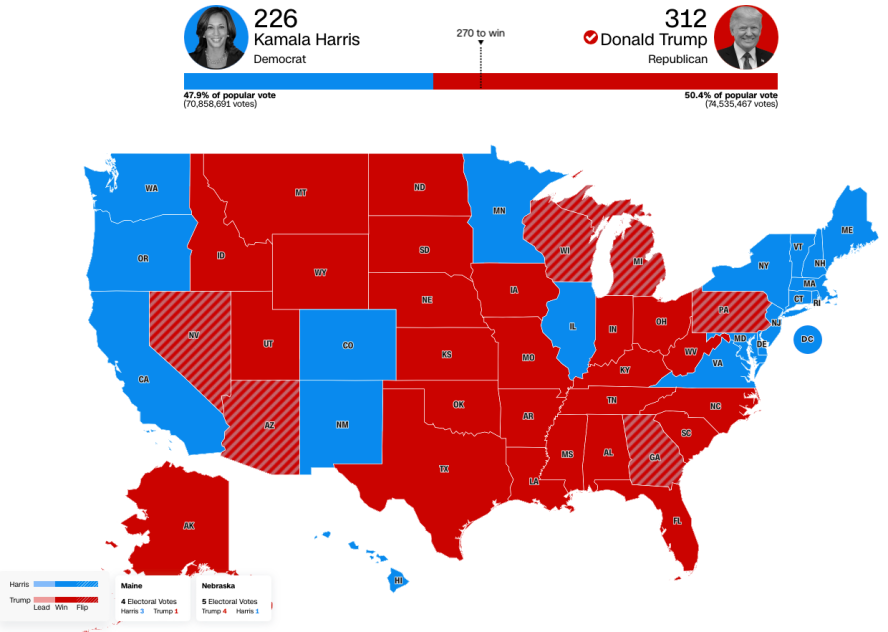
“Donald Trump will be America’s 47th president,” explained CNN on Saturday, “after mounting the most momentous comeback in political history. . . .”
But is it?
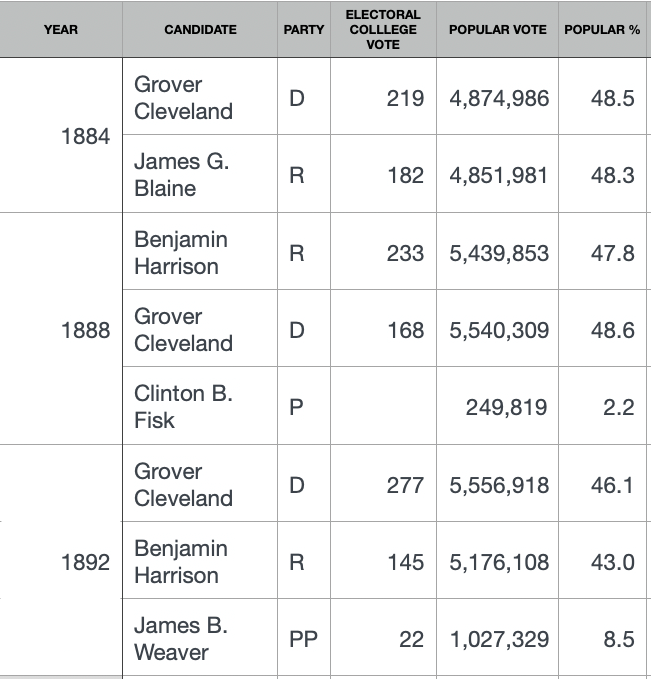
Consider the three federal elections that 19th century Democratic politician Stephen Grover Cleveland participated in (winning two non-consecutive presidencies):
Note the course of Grover Cleveland’s three Electoral College returns: 219; 168; 277. Compare with Trump’s: 304; 232; 312*. Cleveland’s popular vote went up each time. Trump’s did too: 62,984,828; 74,223,975; 74,535,879*. You do the math, but it a quick look suggests that Trump’s comeback is no more momentous than Cleveland’s.
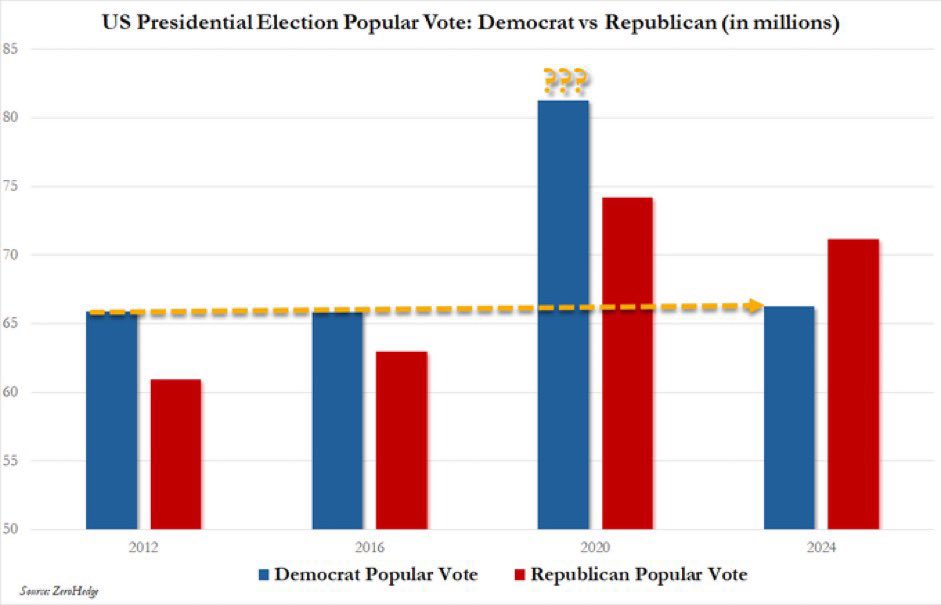
The real anomaly in the recent series of three elections was the whopping turnout for the 2020 outing, where Joe Biden, who did not engage in anything like a normal campaign, garnered a whopping 81,283,501 votes. Compare that to Hillary Clinton’s 65,853,514 votes in 2016 and the less-than 71 million votes for Kamala Harris in 2024.
The real question is what happened, in 2024, to 2020’s over ten million “eager” voters. The question may be easy to answer, but it is nevertheless a huge one, and has elicited a popular graph online, widely shared:
Note that it has at least one obvious inaccuracy: the Republican presidential vote did not go down from 2020 to 2024.
Also note that CNN, quoted above, characterized the election as one that “will hand [Trump] massive, disruptive power at home and will send shockwaves around the world.” Accurate, or just CNN being CNN?
The asterisk, above, for 2024 returns is there to remind us that the election counts are not final.