Categories
Common Sense general freedom national politics & policies political challengers

Defeat the Machine

Standing with Rand, as Sen. Rand Paul (R-Ky.) announced yesterday his candidacy for the U.S. Presidency? A banner: “Defeat the Washington Machine — Unleash the American Dream.”

I know and like Rand, both personally and politically. I love that message.

Yet, today, I come not to praise Dr. Paul but to use him as an example about political reality, nuts and bolts.

Like Jeb Bush and Hillary Clinton, Dr. Paul inherited a tremendous leg up in politics. All three have access to extensive networks of supporters and funding. But, “they didn’t build” those networks, not in toto. They are standing on the efforts of family members — a husband in Hillary’s case; parents for Paul and Bush, plus a Bush brother president.

The Kentucky senator’s father, Dr. Ron Paul, served 23 years representing a Houston, Texas, U.S. House district and ran for president three times.

I’m not whining. And I’m certainly not proposing a new area for the Federal Election Commission (FEC) to police. I’m glad, frankly, for Rand’s parental good fortune. (Mother, too.)

I am simply identifying the built-in advantages that come with holding political power . . . and the potential danger it unleashes: an entrenched, unaccountable, unrepresentative government.

Like we have.

The solution to powerful political dynasties? More competition. More participation. More activity and organizing, more money raised and spent and more messages expressed. Fewer limits and regulations blocking fundraising.

Easier entry into the political marketplace of ideas.

Is that what the IRS and the FEC have been working toward? Facilitating our opportunity to “Defeat the Washington Machine”?

Be that the case, or no, I’m happy to note that Rand Paul, in his kick-off, endorsed term limits.

This is Common Sense. I’m Paul Jacob.

Printable PDF

Rand Paul


Categories
Common Sense First Amendment rights tax policy too much government

Feinstein No Einstein

Government’s job is to protect our lives and liberties. But how best to accomplish this? Should books be banned? Websites blocked?

Diane Feinstein thinks so.

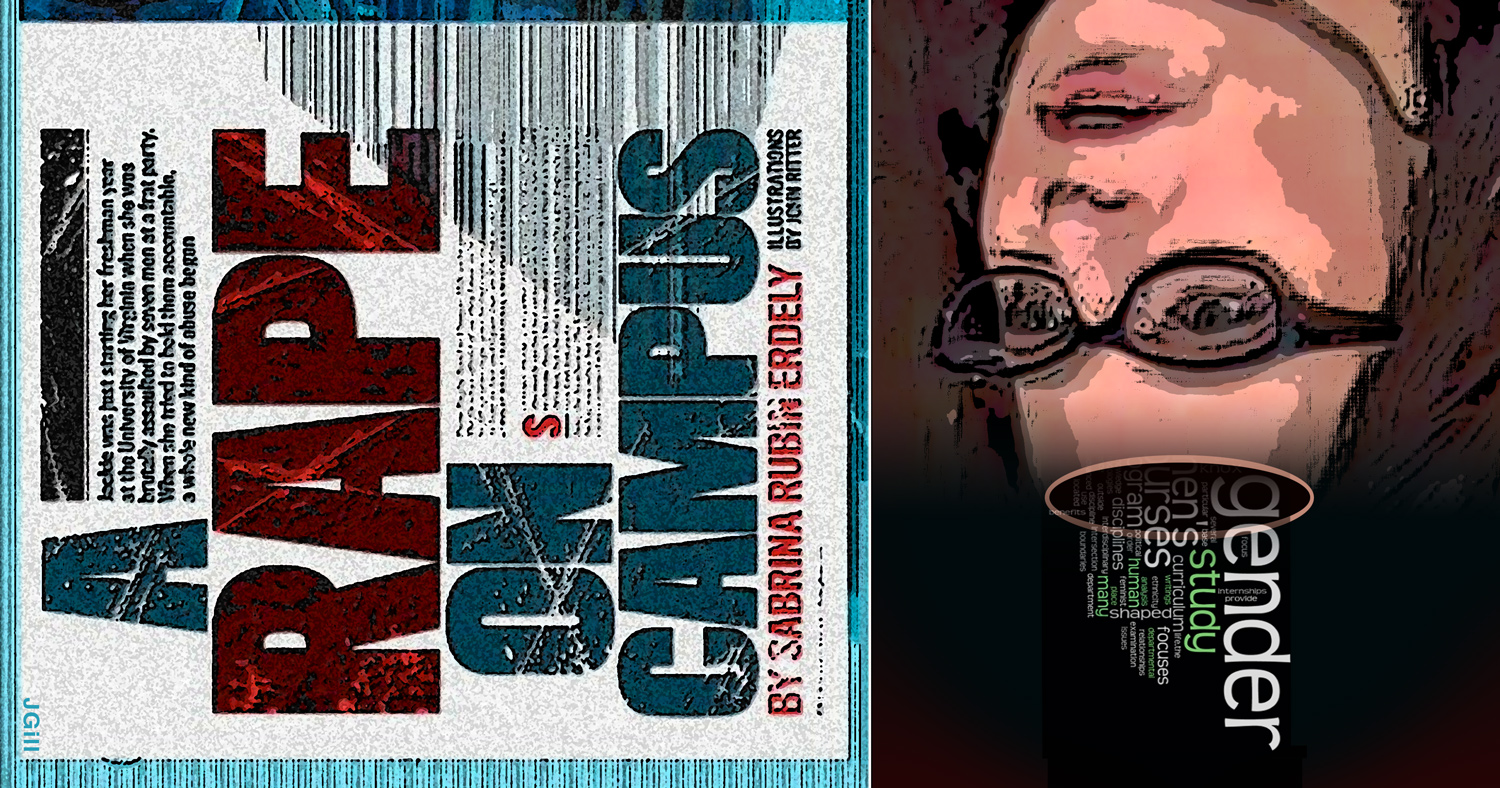
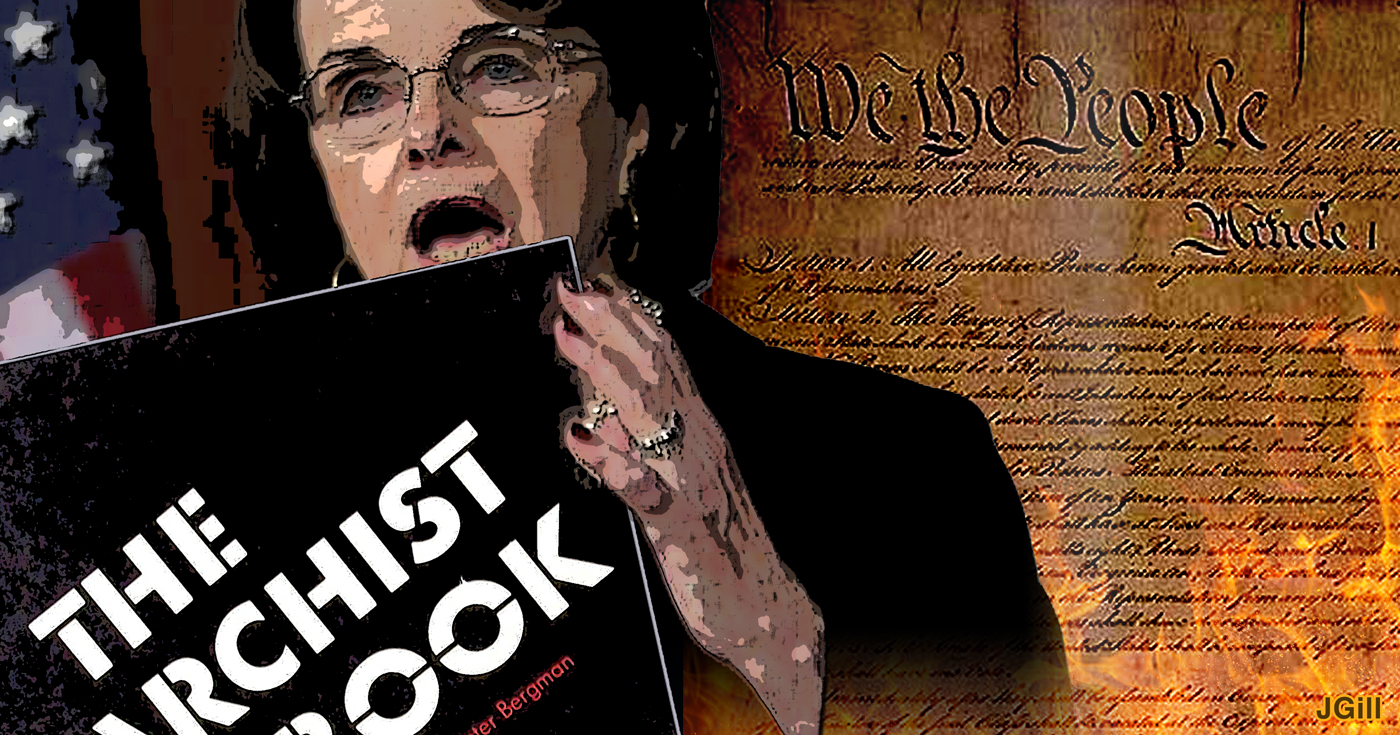
Sen. Feinstein (D-California) wants to ban The Anarchist Cookbook from the Internet. The book, which came out in 1971 with lots of radical ideas, including notoriously unreliable instructions for making bombs, is now a website. Perhaps the quality of  the “cookbook” has helped us survive against the anarchist threat these last five decades.

Today, the threat is not anarchist but Islamist terrorism. So of course Sen. Feinstein also wants the Al Qaida magazine Inspire “off the Internet.”

Government censorship, anyone? Free speech, Senator?

Now, I don’t approve of the bombing and murdering of innocents for any cause. So I am not at one with deadly anarchists or deadly jihadists. Count me as among their enemies.

But, at the risk of being called a “liberal,” I don’t think we should defend ourselves against anarchists or jihadists or other terrorists just any old way. For both moral and strategic reasons, we ought not be killing innocents by drone strike, along with those simply declared guilty, without any lawful process at all.

Likewise, we ought not abridge our own cherished principles and the rule of law.

Including the First Amendment.

After all, that’s what government is supposed to be protecting in the first place.

The fact that Feinstein seems so comfortable with simply “banning” books and magazines and websites suggests an illiberal, unAmerican attitude. An attitude that threatens to do more damage to the homeland than any “cookbook” or pro-terrorist magazine or website ever will.

This is Common Sense. I’m Paul Jacob.


Printable PDF

Anarchy and Chaos


Categories
Common Sense

Townhall: Out Like a Lamb?

This weekend at Townhall, I expand my thoughts from Thursday, on the whole Indiana RFRL controversy. Click on over to Townhall. But then back here, for I have by no means written the last word on the subject. Here is a wide variety of opinion:

Categories
Common Sense general freedom ideological culture national politics & policies

Lions and Lambs

“March comes in like a lion, goes out like a lamb.”

Tell that to Indiana Governor Mike Pence, whose signing of the Religious Freedom Restoration Act (RFRA) into law at the end of March created a roaring controversy.

Does the law enable discrimination? Or protect religious freedom? Or both? Neither?

An Associated Press report explains: “Religious freedom laws like the one causing an uproar in Indiana have never been successfully used to defend discrimination against gays — and have rarely been used at all, legal experts say.”

Of course, discrimination continues. In 2014, a Texas restaurateur refused service to a gay couple. As a FindLaw.com article explains, the 1964 Civil rights Act “only prohibits discrimination on the basis of color, race, religion, or national origin, and says nothing about sexual orientation.”

So some states, such as New Mexico and Oregon, added legal protections for sexual orientation. But that’s led to reverse violations of rights — facing a $150,000 fine, a bakery closed its shop after the Oregon Bureau of Labor and Industries ruled it violated a lesbian couple’s civil rights by declining to make a wedding cake; a New Mexico photographer was found guilty of violating the state’s Human Rights law for declining to photograph a gay couple’s commitment ceremony.

In times’ past, both state and private violence enforced invidious racial discrimination. Thankfully, those days are gone — cafes, hotels and stores are open to all.

But the civil rights laws that prohibit discrimination in public accommodations cases are distinct from forcing photographers or florists or flutists to personally participate in a ceremony they choose not to.

This is Common Sense. I’m Paul Jacob.


Printable PDF

LIons and Lambs


Categories
Common Sense folly media and media people national politics & policies

Cruz Country

The cultural differences between left and right may be stronger than the political.

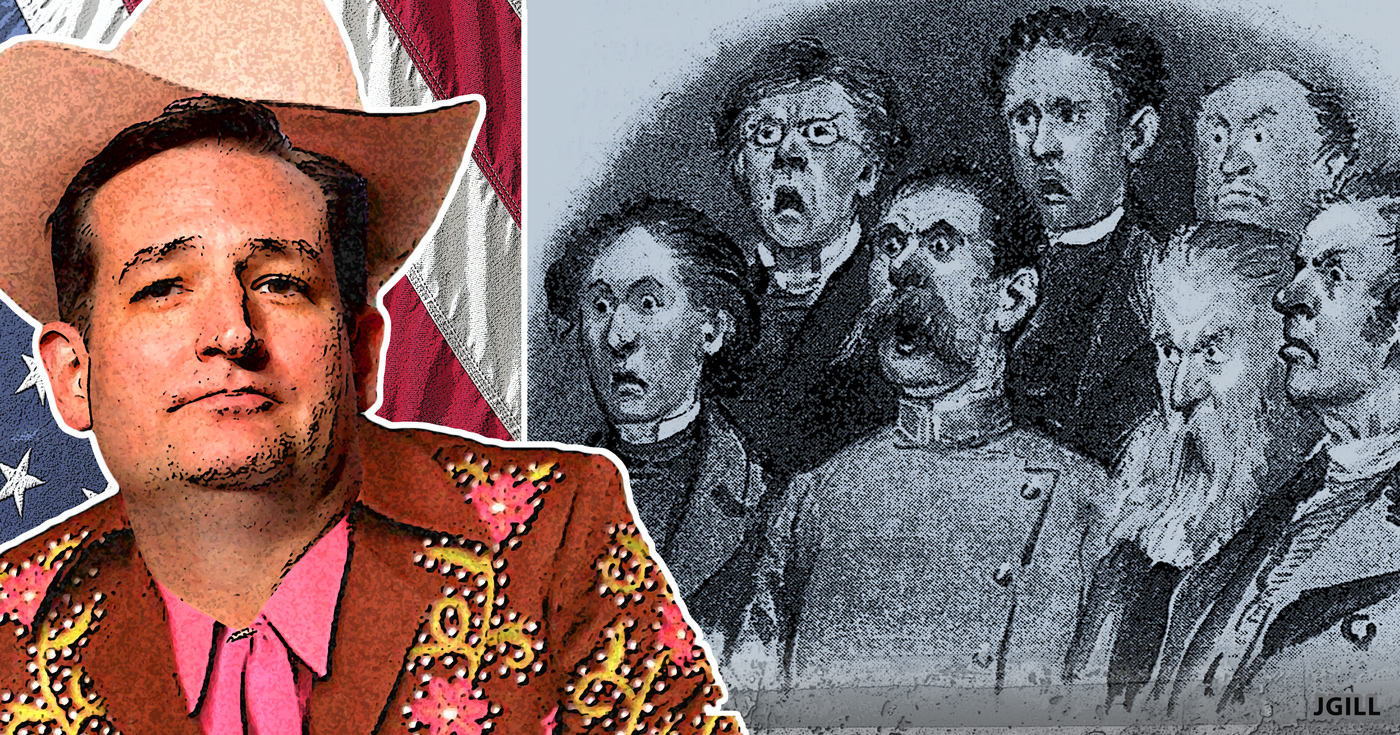
When Sen. Ted Cruz answered a question about his musical taste posed by a CBS news correspondent, and he announced that his preference switched after 2001, 9/11, the leftosphere fell of its rocker and into convulsions.

Why?

He said he switched from listening to classic rock to country, and did so because the country music culture responded to the 9/11 atrocity so much better than did rock-and-roll culture.

Confession: my musical tastes lean toward classic rock. But there’s no way I would get upset about a politician’s musical choices — unless he started listening to Wagner while reviving an interest in National Socialism.

But boy, on the left there was a lot of outrage and indignation. At least, Matt Welch of Reason quoted a good spattering of it, and I found more on Twitter and elsewhere. On Slate? Snark. A YouTuber tubed Cruz’s change as “pandering.” And in New York magazine, Jonathan Chait identified Cruz’s professed change-of-taste “an incredible testament to his personal willpower.”

Huh?

You may or may not like country music, or appreciate the last 30 years of it, or its origins, or its commercialization, or the twang, but that stuff’s really not that important.

A conservative found political reasons to change his listening habits. Wow. A matter  of self-definition? Whatever. It neither builds up nor undermines his philosophy or program.

Though certainly Conway Twitty’s “It’s Only Make Believe” provides more than a cultural context for understanding much of what happens in Washington.

This is Common Sense. I’m Paul Jacob.

Printable PDF

Categories
Accountability Common Sense government transparency term limits

The Article V Path

Can Americans term-limit Congress?

Twenty-three states had passed term limits on their congressional delegations by 1995 — many while simultaneously term-limiting state lawmakers.

Voters in most other states lack statewide initiative rights. But if the term limits passed by the 23 had been left alone, the pressure would have been enormous to bring term limits to the whole Congress.

Alas, in its 1995 Thornton decision, the Supreme Court ruled, five to four, that this method of building a more perfect union is constitutionally imperfect.

U.S. Term Limits currently backs an amendment that would originate in Congress to limit House members to three two-year terms and senators to two six-year terms. Just in case congressmen don’t get around to passing such an amendment, though, USTL has also endorsed the Article V path to term limits being promoted by Citizens for Self-Governance.

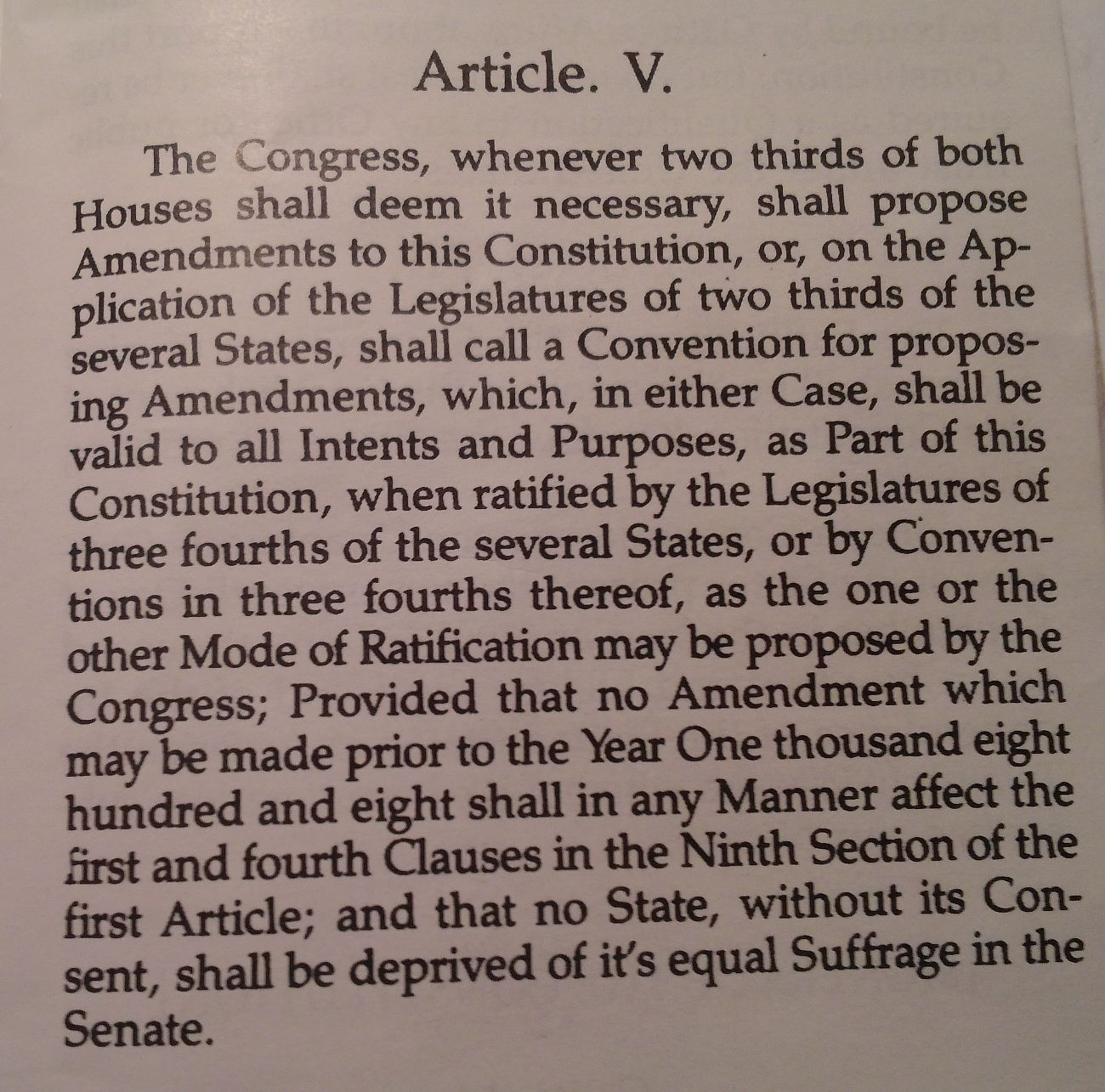
Article V of the Constitution authorizes states to call a constitutional convention if two thirds of them apply. In 2014, Georgia, Alaska and Florida did formally apply for a convention to consider term limits and other reforms. Lawmakers in many other states advocate similar applications. As with congressionally proposed amendments, any amendment offered by the states’ convention would then have to be ratified by three fourths of the states.

Is Article V a long shot? Yes. Every means of imposing congressional term limits has proven to be a long shot.

When we get there, it will be because one of the long shots paid off.

This is Common Sense. I’m Paul Jacob.

Click on the thumbnail below to see larger version

article-vScreenshot


Printable PDF

Categories
Common Sense general freedom individual achievement meme U.S. Constitution

Everything That Could Be Done

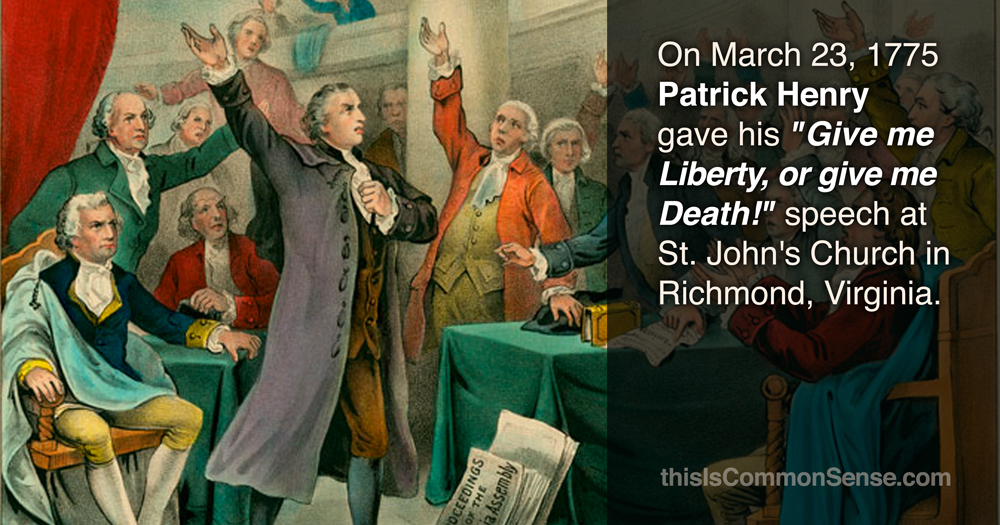
Two hundred forty years ago, the situation was dire. In the Virginia Colony, not too far from where I live, representatives to the Second Virginia Convention were debating the problems they were having with their “masters” in Britain — and the more dangerous, violent situation that was developing to the north.

Several days into the convention, Patrick Henry spoke. His speech was rousing. And it changed minds, concluding with the famous words “give me liberty or give me death!” — an ultimatum quite stark indeed.

Mr. Henry was for action, and waiting no longer. Addressing himself to the president of the convention, he said, “Let us not, I beseech you, sir, deceive ourselves longer. Sir, we have done everything that could be done to avert the storm which is now coming on.” And they had done a great deal, engaging in

– petitioning

– remonstration

– supplication

and, Henry went on, had even “prostrated ourselves before the throne.” And they got worse than the cold shoulder for all their efforts. They got the brush-off, the turn of the cold robe. Along with troops of occupation.

Hence the need for serious action.

Then, Americans were wrestling with the world’s most powerful nation: the British Empire. Today we again face the world’s most powerful empire: our own.

A federal regime similarly out of control in terms of spending and debt, arrogance and corruption, intrusiveness and incompetence. As if dictated by a know-it-all king of old, or a cabal of insiders acting as oligarchs.

Then it was a far-off Parliament; today it is our own far out-of-it representatives . . . duly elected.

We are engaged in a sort of class war, insiders vs. outsiders, and it is the insiders who are bringing the country to the brink of collapse.

The biggest difference between 1775 and 2015? We haven’t done all we can. There is much more to do. And possibly even succeed before the doom of another financial collapse, sovereign debt crisis, or . . . worse.

It often seems a Herculean task, but as Mr. Henry implored, “Sir, we are not weak, if we make a proper use of those means which the God of nature hath placed in our power.”

Let’s join together to give ourselves, our loved ones, and generations hence liberty.

This is Common Sense. I’m Paul Jacob.


Printable PDF

Read the entire speech here

Printable PDF of the entire speech here

Get a high-resolution screensaver of this day’s image. Click on the thumbnail picture below to open a large version that you can download.

The Meaning of "Liberal"


Categories
Accountability ballot access Common Sense First Amendment rights general freedom initiative, referendum, and recall

Really Protecting Our Rights

Incentives matter. Which is why Ohioans have much to celebrate
this week
.

Federal District Judge Michael Watson turned his previous temporary injunction against enforcement of Senate Bill 47 into a permanent injunction. That statue outlawed non-residents from helping Buckeye State residents by gathering petition signatures for an initiative or referendum.

The case is Citizens in Charge v. Husted. Citizens in Charge — where I work — protects initiative rights. Jon Husted is the Ohio Secretary of State.

But Judge Watson went further, declaring Sec. Husted’s office liable for damages to one of our co-plaintiffs, Cincinnati for Pension Reform. The judge found that “a reasonable official would have understood that enforcement of the residency requirement would violate plaintiffs’ First Amendment right to engage in political speech.”

Public officials have what’s known as “qualified immunity,” which protects them from liability when acting in good faith. A spokesman for Husted offered a defense: they were acting “on the assumption that the law is constitutional.”

“Some qualified-immunity cases are difficult,” countered election-law expert Daniel Tokaji. “Not this one.”

Ohio’s residency law was ruled unconstitutional in 2008, after Ralph Nader’s presidential campaign sued. In 2009, the previous secretary of state officially acknowledged the law unenforceable regarding all petitions. Yet, seeking to block citizen petitions, legislators passed it again, and Husted was quick to enforce.

Maurice Thompson of the 1851 Center for Constitutional Law, our attorney, cheered the “deterrence” this decision provides.

“If public officials from the governor down through the police know that they will be liable for enforcing an unconstitutional law,” he explained, “they are far more likely to take Ohioans’ constitutional rights seriously.”

This is Common Sense. I’m Paul Jacob.


Printable PDF

Categories
Common Sense folly national politics & policies too much government

The Latest Big Fix

Transformer-in-Chief Barack Obama is at it again.

The president’s latest tune is a variation on a very old theme: whatever government breaks “requires” a new government program.

See a problem; propose and enact a government solution; the problem gets worse, some new ones pop up; blame everything on the voluntary, “freedom” side; demand more and newer government programs.

It’s a trap. Literally, since it involves more coercion by government at every step.

Here’s the story: President Obama was largely repudiated at the polls last November. The performance of his administration and congressional allies proved so lackluster that his party couldn’t muster much of a vote in their favor.

So now Obama promotes the idea of compulsory voting.

“It would be transformative if everybody voted,” Obama said. He mentions Australia, which has had mandatory voting for a while. He doesn’t mention North Korea, which also forces its citizens to vote, or that totalitarian and authoritarian regimes have often used compulsory voting to give their dictators a patina of “democratic legitimacy.”

I’d be embarrassed to bring it up.

Obama brought it up in the context of fighting the influence of big money.

So, to fix particular problems, government gets involved in the economy generally, everywhere — and not by playing umpire to establish a “level playing field,” but by siding first with one group, then with another, with mandates, prohibitions, regulations, etc. (He calls all this “fair,” incredibly.) Naturally enough, affected businesses and individuals petition for insulation from each and every proposed “fix.” Many go on for special favors. This leads to increased money in campaigns, as well as increased lobbying.

So now? Direct coercion of citizens — simply to “get out the vote.”

It’s always force with these folks.

This is Common Sense. I’m Paul Jacob.


Printable PDF

Categories
Common Sense government transparency national politics & policies

What a Day for an Insult

Much of politics is timing. When you release information is key.

One favorite “statesman” trick is to bury unflattering information by “releasing” it on a Friday, right before the weekend.

This gives politicians a respite. Surely world events will have spewed up some worse (that is, more interesting!) story over the weekend, so on Monday, when journalism and its followers are back into the work week, coverage will be distracted and lessened.

I guess that’s why the White House waited till last Friday to explain it was officially removing Freedom of Information Act (FOIA) requests from the burdens on its Office of Administration.

Barack Obama, when he was running for office, proclaimed that his administration would be “the most transparent in history.” But he’s been following President Bush in keeping the administrative side of the White House as opaque as possible.

White House flunkies say this “cleanup” of FOIA regulations is “consistent with court rulings that hold that the office is not subject to the transparency law.”

Accept that, arguendo, and it still looks bad for the “most transparent” prez of all. He didn’t have to do this. He just wanted to.

Adding insult to injury, as noted by Gregory Korte in USA Today, “the timing of the move raised eyebrows among transparency advocates, coming on National Freedom of Information Day.”

This all relates to the current Hillary email scandal, too. It just so happens that the White House office now unencumbered by FOIA requirements is in charge of filing . . . old emails.

Coincidence?

Perhaps that’s why they risked announcing this on Freedom of Information Day. The irony was lost over the weekend.

This is Common Sense. I’m Paul Jacob.

Printable PDF