Categories
Today

Titus Broke the Wall

In one of the most consequential sieges in western history, Titus Caesar Vespasianus and his Roman legions breached the Second Wall of Jerusalem on May 30 of A.D. 70. Jewish defenders retreated to the First Wall, but were overcome before summer’s end. Titus’s armies crucified thousands and destroyed the historic Second Temple.

Categories
Today

The Thirteenth State

Rhode Island became the last of North America’s revolutionary thirteen colonies to ratify the United States Constitution, on May 29, 1790.

Categories
Today

Exeunt the Communards

After two months of vigorous revolutionary acts — from “social democratic” reforms to public executions — the Paris Commune fell on May 28, 1871.

Categories
Today

FDR Was Not Pleased

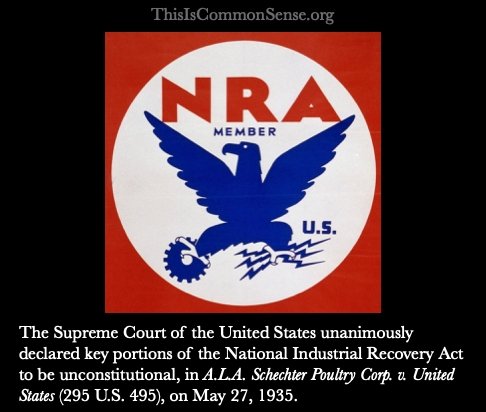
The Supreme Court of the United States unanimously declared key portions of the National Industrial Recovery Act to be unconstitutional, in A.L.A. Schechter Poultry Corp. v. United States (295 U.S. 495), on May 27, 1935.

Categories
Today

Market Milestones

Capitalism’s 26th of May milestones:

  • On May 26, 1896, Charles Dow publishes the first edition of the Dow Jones Industrial Average.
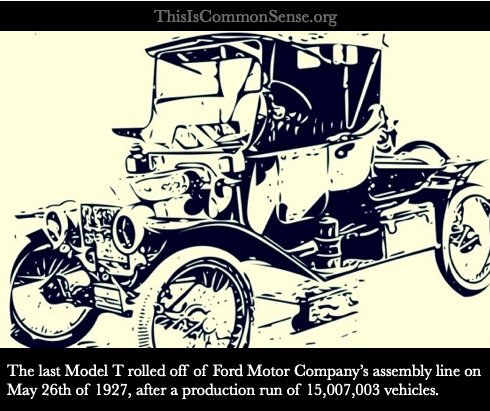
  • The last Model T rolled off of Ford Motor Company’s assembly line on May 26th of 1927, after a production run of 15,007,003 vehicles.
  • The Beatles’ album Sgt. Pepper’s Lonely Hearts Club Band was released on the 26th of May, 1967.
Categories
Today

Pinafore, Formosa

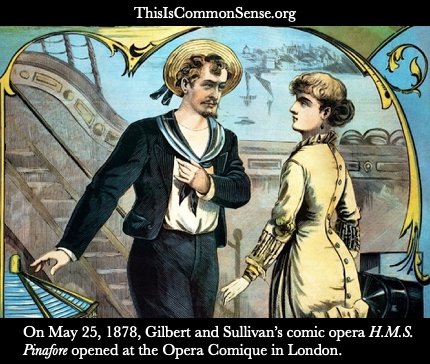
On May 25, 1878, Gilbert and Sullivan’s comic opera H.M.S. Pinafore opened at the Opera Comique in London. (Image is a detail from an 1879 theater poster.)

On the same date in 1895, playwright, poet and novelist Oscar Wilde was convicted of “committing acts of gross indecency with other male persons” and sentenced to serve two years in prison — becoming history’s most famous prosecutions for homosexual activity.

In 1895 on the 25th of May, the Republic of Formosa was formed, with Tang Jingsong as its president. It lasted less than half a year, dissolving upon conquest by Japan.

Categories
Today

Toleration

On May 24, 1689, the English Parliament passed the Act of Toleration, protecting dissenting Protestants.

Pointedly, Roman Catholics were excluded from this official tolerance.

Categories
Today

El Libertador

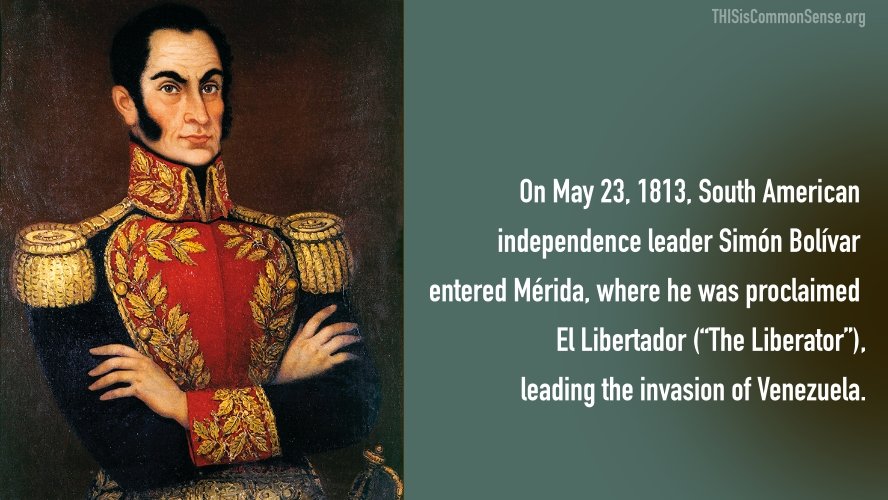
On May 23, 1813, South American independence leader Simón Bolívar entered Mérida, where he was proclaimed El Libertador (“The Liberator”), leading the invasion of Venezuela.

Other May 23 events include:

1788: South Carolina became the eighth state to ratify the U.S. Constitution.

1900: Sergeant William Harvey Carney became the first African American to be awarded the Medal of Honor, for his heroism in a Civil War battle fought 37 years prior, in 1863.

1958: Birthday of American comedian and game show host Drew Carey.

Categories
Today

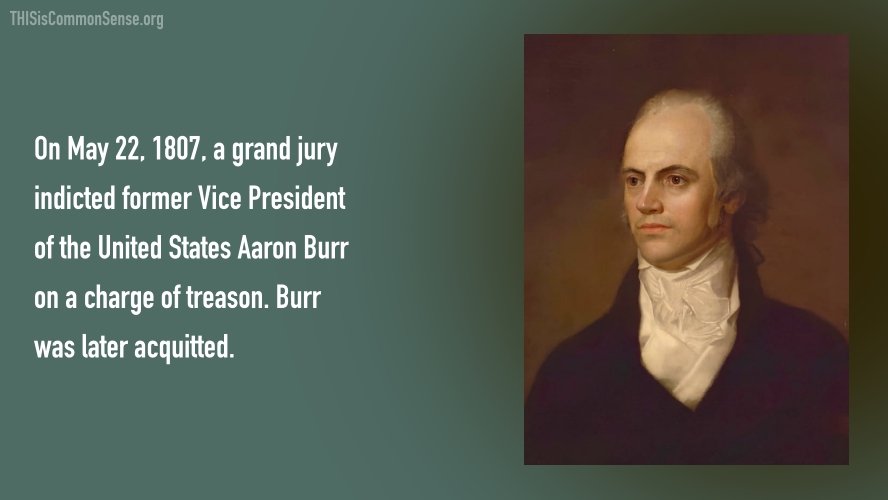
Aaron Burr Indicted

On May 22, 1807, a grand jury indicted former Vice President of the United States Aaron Burr on a charge of treason.

At issue in the trial was Burr’s dealings in Louisiana, including leasing 40,000 acres and forming “an army.” President Thomas Jefferson issued an order for Burr’s arrest, and, after a chase, Burr was captured and charged with treason, though the case was always shaky. His defense lawyers included Edmund Randolph, John Wickham, Luther Martin, and Benjamin Gaines Botts. Jefferson’s distant cousin, Chief Justice John Marshall — who hated Jefferson — presided over the trial, which began on August 3. Article 3, Section 3 of the U.S. Constitution requires that treason either be admitted in open court or proven by an overt act witnessed by two people. No witnesses came forward; Burr was acquitted on the first of September. He was ten immediately tried on a misdemeanor charge and was again acquitted.

Other May 22 events include:

  • 1848: Slavery was abolished in Martinique.
  • 1856: South Carolina Congressman Preston Brooks savagely beat Massachusetts Senator Charles Sumner in the halls of Congress as tensions rise over the expansion of slavery. Sumner did not return to the Senate for the three years of his recovery period.
  • 1995: In U.S. Term Limits v. Thornton, the U.S. Supreme Court struck down Arkansas’s congressional term limits law, 5-4, overturning the congressional term limits then the law in 23 states: Arizona, Arkansas, California, Colorado, Florida, Idaho, Louisiana, Maine, Massachusetts, Michigan, Missouri, Montana, Nebraska, Nevada, New Hampshire, North Dakota, Oklahoma, Ohio, Oregon, South Dakota, Utah, Washington and Wyoming.
Categories
Today

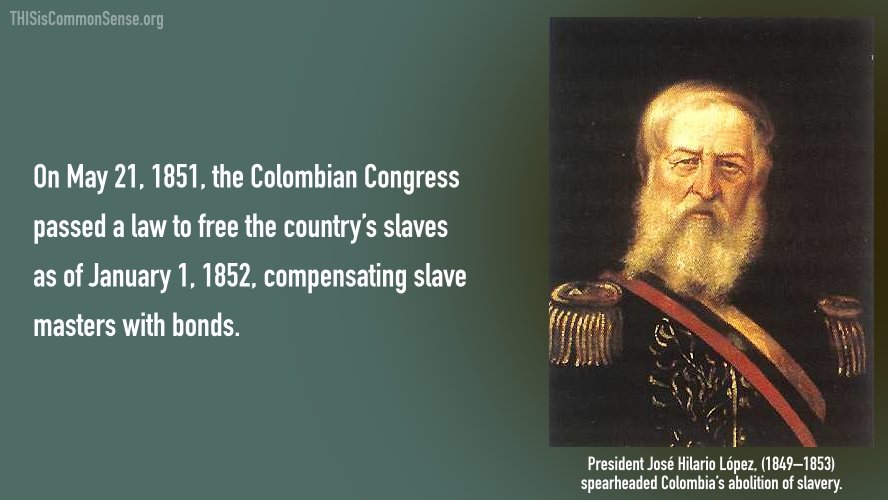
Colombian Emancipation & War Against Slavery

On May 21, 1851, the Colombian Congress passed a law to free the country’s slaves as of January 1, 1852, compensating slave masters with bonds. The decree itself was insufficient to abolish the practice, however, with masters refusing, in many locales, to let the slaves go in a peaceful way. This led to the Civil War of 1851, which began with an insurrection in Cauca and Pasto headed by Manuel Ibáñez and Julio Arboleda — with the support of the Ecuadorian government. In Antioquia the rebellion broke out led by Eusebio Berrero. The war would end in four months with a liberal victory and the final liberation of the slaves.