Categories
Today

The Watergate Dam Breaks

On July 24, 1974, the U.S. Supreme Court told President Richard Nixon that he lacked constitutional authority to withhold the infamous “Nixon Tapes” from Congress.


On July 24, 1487, citizens in Leeuwarden, Netherlands, went on strike against a ban on foreign beer.

On the same day of 1823’s calendar, slavery was abolished in Chile.

July 24 serves as Pioneer Day in Utah and as Simón Bolívar Day in Bolivia, Ecuador, Colombia, and Venezuela.

Categories
Today

Huxleyian A.F.

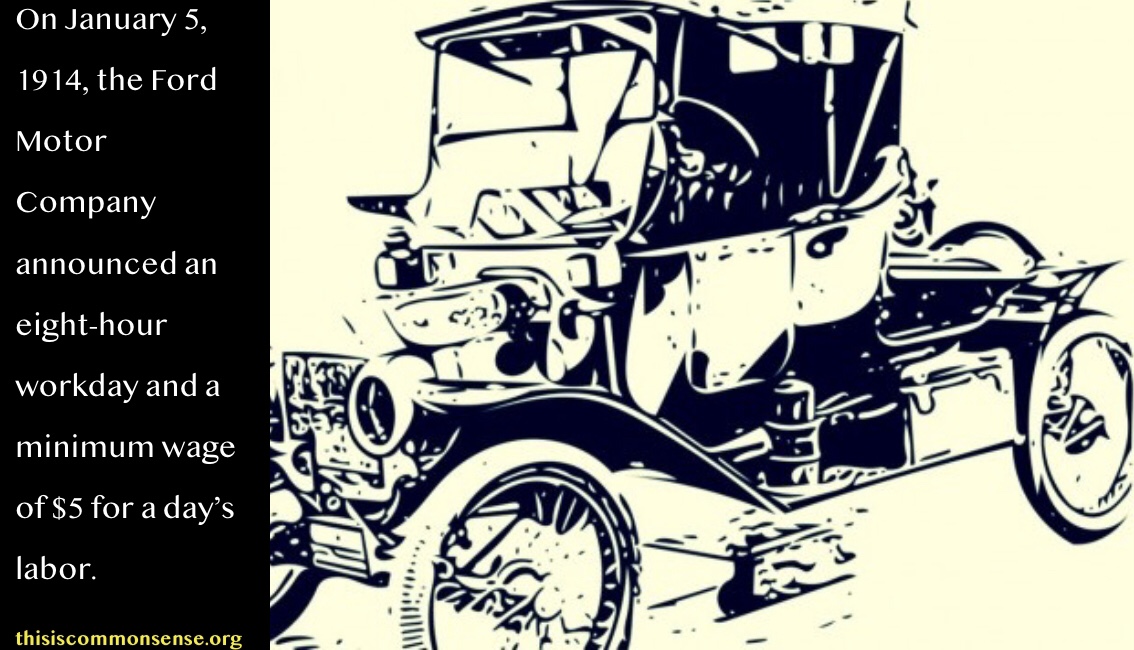
On this day in 1903, the Ford Motor Company sold its first car. Less than 30 years later, Aldous Huxley satirized Ford’s assembly line procedures in his novel Brave New World. Arguably, both the assembly line and the satire advanced freedom.

Today is July 23, A.F. 162. The “A.F.” is not what “af” means in popular online abbreviation, but “in the Year of Our Ford” — “After Ford,” specifically.

Categories
Today

Holding at Nine

On July 22, 1937, the U.S. Senate voted down President Franklin Delano Roosevelt’s court packing scheme.

Categories
Today

Monkeyshine, Moonshine

On July 21, 1925, in Dayton, Tennessee, high school biology teacher John T. Scopes was found guilty of teaching evolution in a public school classroom, and fined $100. The ambiguous legacy of the trial would continue — for decades, even to the present — to reveal the tensions inherent within a school system run by government and funded by taxpayers.

Scopes’ biology lessons leaned heavily on a “eugenics” play on Darwinism, at variance both with Darwin and the general thrust of today’s evolutionary thought.


Today is the 56th anniversary of the Apollo 11 mission’s perambulation upon the Moon, on July 21, 1969. Neil Armstrong and Buzz Aldrin walked upon the surface of Mare Tranquillitatis for about two hours and 15 minutes. They spent over 21 hours on the surface, total, most of it inside the Lunar Module, at the site they called Tranquillity Base, before launching to rejoin astronaut Michael Collins in lunar orbit and returning to Earth on the 24th.

Categories
Today

The Count Tracy

Born on July 20, 1754, Antoine Louis Claude Destutt, comte de Tracy, French philosopher and economist. Perhaps best remembered for coining the term “ideology,” he didn’t mean by that term what scornful Napoleon and communist Karl Marx later turned it into — for Destutt de Tracy ideology meant “the science of ideas,” a unified approach to all knowledge, from epistemology to social theory.

Though his family had been enobled twice, he renounced the title and entered the 1789 Estates General conference as a member of the Third Estate. During the Reign of Terror, he was imprisoned, and would have been executed had not Robespierre been pushed to the scaffold ahead of him.

Two of his books became popular in early 19th century America, his commentaries on Montesquieu’s Spirit of the Laws, and his Traité de la volonté, which Thomas Jefferson, the editor of the American edition, retitled A Treatise on Political Economy. Tracy’s economics was of a deductivist stripe, familiar to readers of later economists such as Nassau Senior and Ludwig von Mises.

Destutt de Tracy’s political philosophy was republican, and his preferred economic policy was laissez-faire.


NASA’s Apollo 11 landed two humans on the Moon — Commander Neil Armstrong and lunar module pilot Buzz Aldrin — on July 20, 1969, at 20:17 UTC.

Categories
Today

Kauaʻi & Fire

On July 19, 1817, Georg Anton Schäffer — unsuccessful in his attempt to conquer the Kingdom of Hawaiʻi for the Russian-American Company — was forced to admit defeat and leave Kauaʻi. The effort had begun in 1815 as a shipwreck recovery mission but escalated after the German physician in the company’s employ had been played by native politicians. Legal action against Schäffer — considered, after the fact, a bungler (his efforts cost his employer over 200,000 roubles) — proved unsuccessful.


In A.D. 64 on the 19th of July, the Great Fire of Rome began. It caused widespread devastation and raged for six days, destroying half the city.

One thousand seven hundred eighty-one years later, the last great fire to affect Manhattan began early in the morning and was subdued that afternoon. This “Great New York City Fire of 1845” killed four firefighters and 26 civilians, destroying 345 buildings.

Categories
Today

Succession?

President Harry S. Truman signed the Presidential Succession Act on July 18, 1947. Article II, Section 1, Clause 6 of the United States Constitution authorizes Congress to enact such a statute, which Congress has done on three occasions: 1792, 1886, and 1947. The 1947 Act was last revised 59 years after passing, in 2006.

Categories
Today

Wrong Way?

On July 17, 1938, pioneer aviator Douglas Corrigan took off from Floyd Bennett Field in Brooklyn — New York City’s first municipal airport — with a flight plan for a return trip to his previous disembarkation point, Long Beach, California. His official story was that he got confused after ten (or 26) hours in flight, and wound up the next day in Ireland. Most folks judged his “error” as deliberate, but he never publicly admitted to anything but error. He was nicknamed “‘Wrong Way’ Corrigan,” an affectionate moniker, and received a 14-day suspension of his pilot’s license as punishment for his breaking of many, many regulations.

One occasionally hears the epithet “Wrong Way Corrigan” applied to anyone who similarly takes a slight liberty, skirting official rules or practices — or simply goes the wrong direction.


July 17, 1975, had a very different kind of aviation event, one well-planned: Apollo 18 and Soyuz 19 made the first US/USSR linkup in space.

Categories
Today

Ethiopia

On July 16, 1931, Ethiopia’s Emperor Haile Selassie I signed a new Constitution. Not exactly a model of limited government, the new document proved that the emperor was in keeping with the time, which was a period of weakening constitutional limits in America, Europe, and Britain. A flavor of the document can be gained by its most “rights-oriented” measures:

Art. 22. Within the limits laid down by the law, Ethiopian subjects have the right to pass freely from one place to the other.
Art. 23. No Ethiopian subject may be arrested, sentenced, or imprisoned except in pursuance of the law.
Art. 24. No Ethiopian subject may, against his will, be deprived of his right to be tried by a legally established court.
Art. 25. Except in cases provided for by law, no domiciliary searches may be made.
Art. 26. Except in cases provided by the law, no one shall have the right to violate the secrecy of the correspondence of Ethiopian subjects.
Art. 27. Except in cases of public necessity determined by the law, no one shall have the right to deprive an Ethiopian subject of any movable or landed property which he owns.
Art. 28. All Ethiopian subjects have the right to present to the Government petitions in legal form.
Art. 29. The provisions of the present chapter shall in no way limit the measures which the Emperor, by virtue of his supreme power, may take in the event of war or public misfortunes menacing the interests of the nation.

Categories
Today

“Malaise”

On July 15, 1976, Jimmy Carter accepted the nomination of the Democratic Party to run for the presidency.

Three years later, as president, he gave his infamous “malaise” speech, in which he focused on energy but did not mention the one thing that actually helped turn the 1970s’ energy crisis around: the phased deregulation of oil prices that had started three months earlier, under his own directive. Instead of touting this deregulatory effort, Carter did the politic thing, promising a number of new government programs while extensively grinding a “crisis of confidence” message and vaguely speaking of a spiritual challenge.

The deregulation was startlingly effective, in the long run — though the immediate effect was a rocketing of prices. These high prices presented profit opportunities, and (lo and behold!) domestic production greatly increased, allowing for many, many years of lower prices. Those high prices would have worked better as market signals had not Carter and Congress also established “windfall profits” taxes, to take away those temporary gains to existing business.

Had Carter deregulated prices earlier, he would probably have been re-elected president. Had he emphasized deregulation, he probably would have beat back Ronald Reagan’s free market rhetoric — with actual action.

The price controls had been put in place earlier in the decade by the Republican president at the time, Richard M. Nixon, with the great help of his aides Dick Cheney and Donald Rumsfeld.