Who can compare with justice? It creates life.
Proverb from the city of Ur, an ancient Mesopotamian city. Image does not show this specific text.
Categories
Urim Proverb
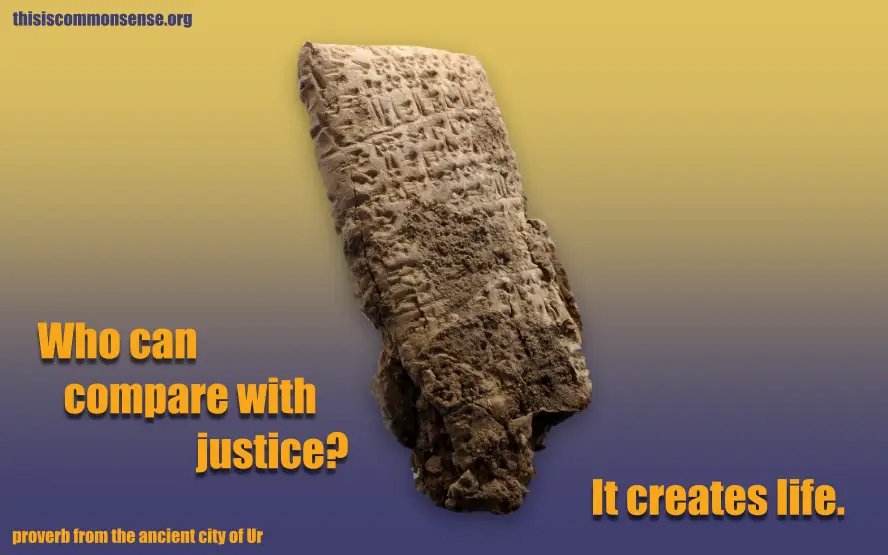
Who can compare with justice? It creates life.
Proverb from the city of Ur, an ancient Mesopotamian city. Image does not show this specific text.


It is cheering to see that the rats are still around — the ship is not sinking.
Eric Hoffer, “Thoughts of Eric Hoffer, Including: ‘Absolute Faith Corrupts Absolutely,” The New York Times Magazine (April 25, 1971), p. 24.

A small leak can sink a great ship.
Ben Franklin, from Poor Richard’s Almanack.

Le sage quelquefois évite le monde, de peur d’être ennuyé.
Wise men sometimes avoid the world, that they may not be surfeited with it.
Jean de La Bruyère, Les Caractères (1688), “Of Society and Conversation,” #83.
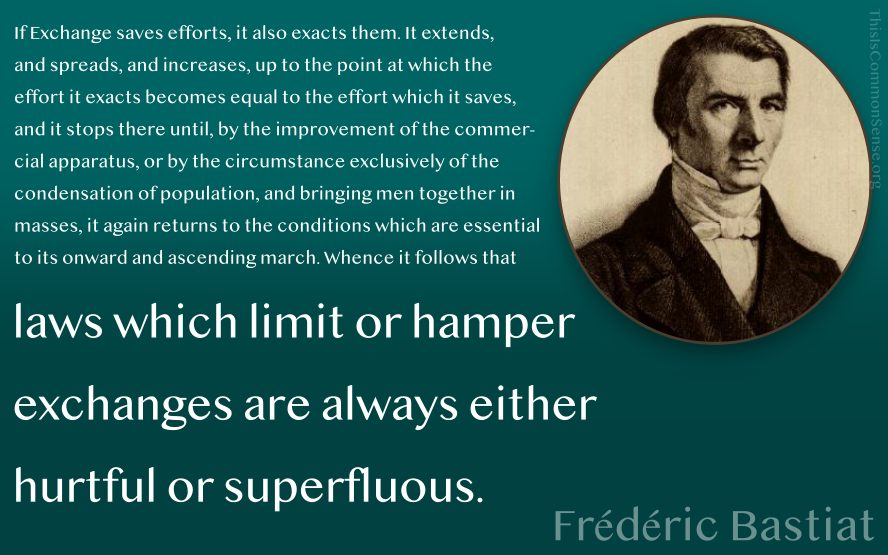
If Exchange saves efforts, it also exacts them. It extends, and spreads, and increases, up to the point at which the effort it exacts becomes equal to the effort which it saves, and it stops there until, by the improvement of the commercial apparatus, or by the circumstance exclusively of the condensation of population, and bringing men together in masses, it again returns to the conditions which are essential to its onward and ascending march. Whence it follows that laws which limit or hamper Exchanges are always either hurtful or superfluous.
Frédéric Bastiat, Harmonies of Political Economy (from the Third French Edition, Patrick James Stirling, trans.).
Governments which persuade themselves that nothing good can be done but through their instrumentality, refuse to acknowledge this harmonic law.
Exchange develops itself NATURALLY until it becomes more onerous than useful, and at that point it NATURALLY stops.
In consequence, we find governments everywhere busying themselves in favouring or restraining trade.
In order to carry it beyond its natural limits, they set to conquering colonies and opening new markets. In order to confine it within its natural bounds, they invent all sorts of restrictions and fetters.

Governments, if they endure, always tend increasingly toward aristocratic forms. No government in history has been known to evade this pattern. And as the aristocracy develops, government tends more and more to act exclusively in the interests of the ruling class — whether that class be hereditary royalty, oligarchs of financial empires, or entrenched bureaucracy.
Frank Herbert, “Politics as Repeat Phenomenon: Bene Gesserit Training Manual,” from Children of Dune (1976).

Nature has provided, by means as simple as they are infallible, that there should be dispersion, diffusion, coordination, simultaneous progress, all constituting a state of things that your restrictive laws paralyze as much as they can; for the tendency of such laws is, by isolating communities, to render the diversity of condition much more marked, to prevent equalization, hinder integration, neutralize countervailing circumstances, and segregate nations, whether in their superiority or in their inferiority of condition.
Frédéric Bastiat, from Economic Sophisms, “To Equalize the Conditions of Production” — the “such laws” mentioned are protectionist measures, and protectionism was the chief target of Bastiat’s famous book.

The real problems of our world are not being confronted by those in power. In the guise of public service, they use whatever comes to hand for personal gain. They are insane with and for power.
Frank Herbert, The Dosadi Experiment (1977).

Either fraternity is spontaneous, or it does not exist. To decree it is to annihilate it. The law can indeed force men to remain just; in vain would it try to force them to be self-sacrificing.
Frédéric Bastiat, “Justice and fraternity,” in Journal des Économistes (June 15, 1848).