You touch on a disheartening truth. People never want to be told anything they do not believe already.
James Branch Cabell, The Cream of the Jest: A Comedy of Evasions (1917), Ch. 13: “Suggesting Themes of Universal Appeal.”
James Branch Cabell
You touch on a disheartening truth. People never want to be told anything they do not believe already.
James Branch Cabell, The Cream of the Jest: A Comedy of Evasions (1917), Ch. 13: “Suggesting Themes of Universal Appeal.”
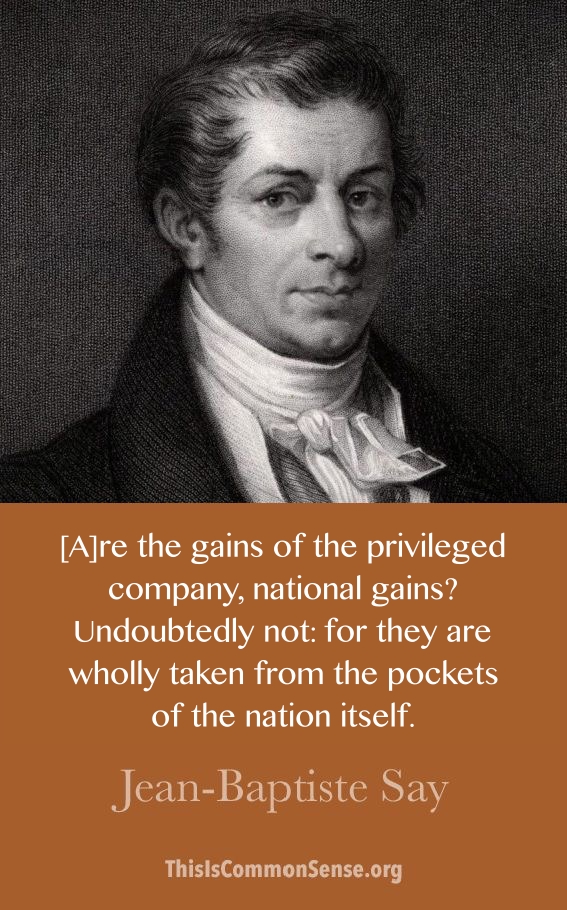
[A]re the gains of the privileged company, national gains? Undoubtedly not: for they are wholly taken from the pockets of the nation itself.
Jean-Baptiste Say, A Treatise on Political Economy (1903, first pub. 1855), Book I, Chapter 17.
Headline: “Hate talk in homes ‘must be prosecuted.’”
“Must”?
The proposed legislation targets speech alleged to promote prejudice. It is backed by Scotland’s secretary for justice, Humza Yousaf.
Might the law be deployed to squelch debate regarding, say, radical Islam?
“Are we comfortable giving a defence to somebody whose behaviour is threatening or abusive, which is intentionally stirring up hatred against, for example, Muslims?” Yousaf asks. “Are we saying that that is justified because that is in the home?”
I suspect that here we have someone who has never attended a sizable family gathering. Many attendees might report “hate talk” but oppose fining or imprisoning the so-called hate-talkers.
Could the law be directed against journalists and others who publicly express loves and hatreds?
“We wouldn’t want to give the likes of Tommy Robinson a defence by saying that he’s ‘a blogger who writes for The Patriot Times,’” says Yousaf.
“Stirring up hatred” is, of course, not identical to threatening or instigating violence. Presumably it is already illegal in Scotland to plan murder and mayhem over the dinner table.
There’s an awful lot of speech out there with which we might vehemently disagree. Plenty of dumb, hateful, prejudice-laden speech that violates the rights of no one does get uttered in homes and Internets. We must preserve the distinction between “things that are wrong to say or do” and “actions that should be illegal.”
Scots should resist these hateful assaults on their right to speak freely.
This is Common Sense. I’m Paul Jacob.
See all recent commentary
(simplified and organized)
See recent popular posts
Influences of various kinds conspire to increase corporate action and decrease individual action. And the change is being on all sides aided by schemers, each of whom thinks only of his pet plan and not at all of the general reorganization which his plan, joined with others such, are working out. It is said that the French Revolution devoured its own children. Here, an analogous catastrophe seems not unlikely. The numerous socialistic changes made by Act of Parliament, joined with the numerous others presently to be made, will by-and-by be all merged in State-socialism—swallowed in the vast wave which they have little by little raised.
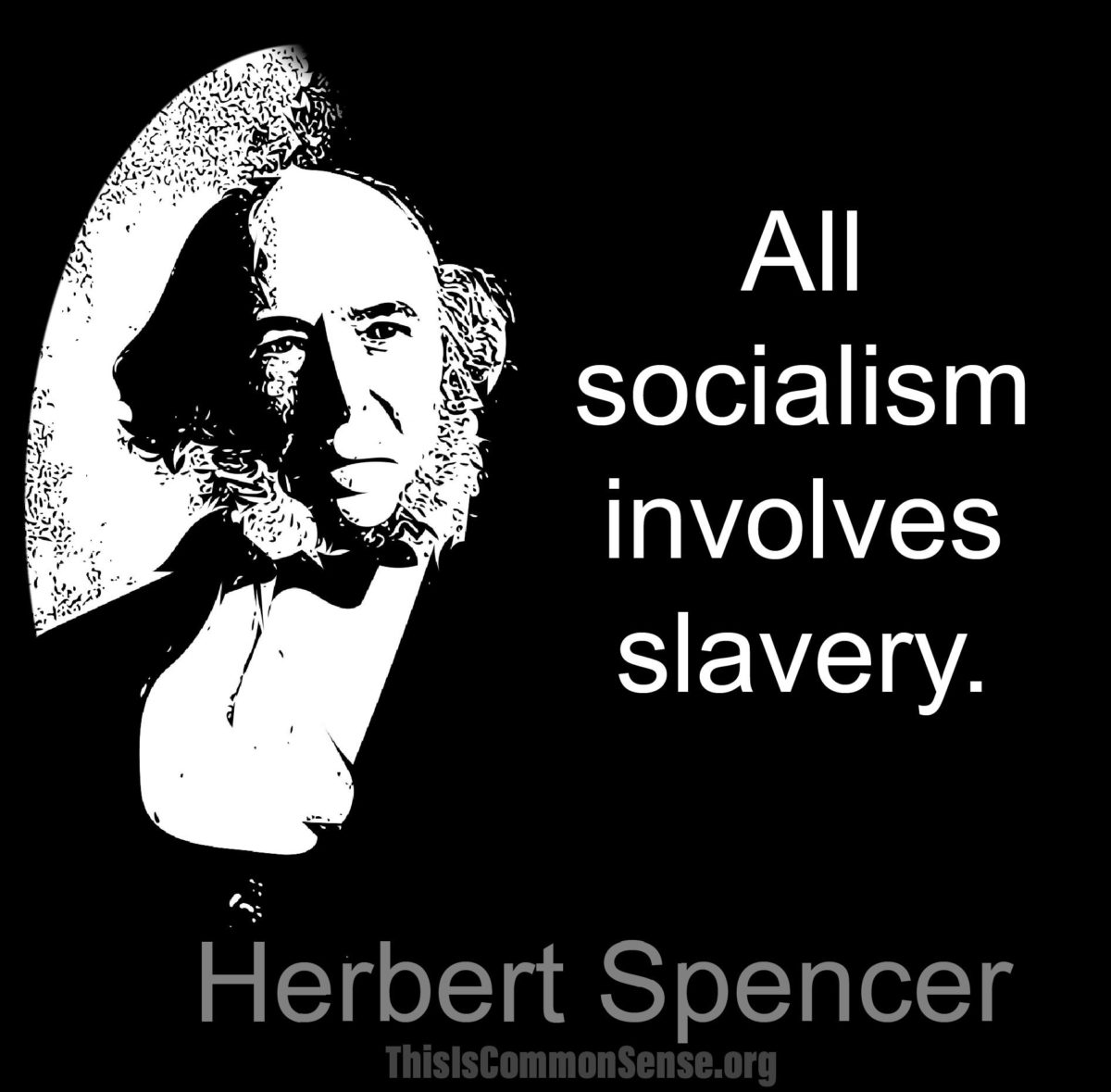
“But why is this change described as ‘the coming slavery’?,” is a question which many will still ask. The reply is simple. All socialism involves slavery.
Herbert Spencer, “The Coming Slavery,” The Man versus the State (1884); originally in The Contemporary Review (April 1884).
When you find yourself in a hole, stop digging.
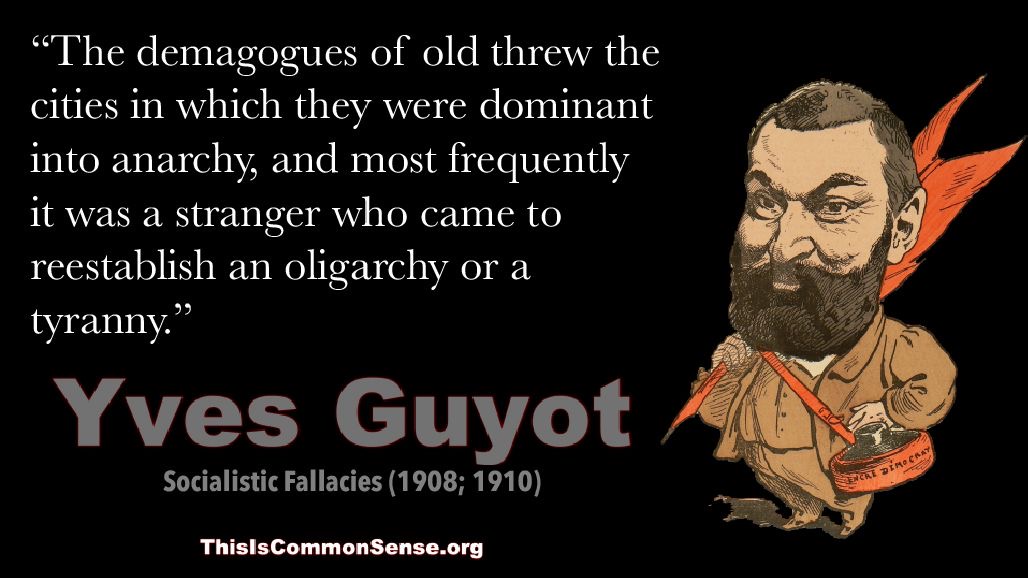
The demagogues of old threw the cities in which they were dominant into anarchy, and most frequently it was a stranger who came to reestablish an oligarchy or a tyranny.
Yves Guyot, Socialistic Fallacies (1908; 1910).
There is always a ‘but’ in this imperfect world.
Helen Graham, a character in The Tenant of Wildfell Hall (1848), Ch. XXII: ‘Traits of Friendship,’ by Anne Brontë (writing as Acton Bell)
Disputes with men, pertinaciously obstinate in their principles, are, of all others, the most irksome; except, perhaps, those with persons, entirely disingenuous, who really do not believe the opinions they defend, but engage in the controversy, from affectation, from a spirit of opposition, or from a desire of showing wit and ingenuity, superior to the rest of mankind. The same blind adherence to their own arguments is to be expected in both; the same contempt of their antagonists; and the same passionate vehemence, in inforcing sophistry and falsehood. And as reasoning is not the source, whence either disputant derives his tenets; it is in vain to expect, that any logic, which speaks not to the affections, will ever engage him to embrace sounder principles.
The great art in writing advertisements is the finding out a proper method to catch the reader’s eye; without which a good thing may pass over unobserved, or be lost among commissions of bankrupt.
Joseph Addison, The Tatler (1711-1714), No. 224.
Can liberty be born from the bosom of despots? and shall justice be rendered by the hands of piracy and avarice?
Constantin-François de Chassebœuf (1757–1820), Comte de Volney, The Ruins; Or, Meditation on the Revolutions of Empires: And The Law of Nature, Chapter II (Thomas Jefferson, translator).