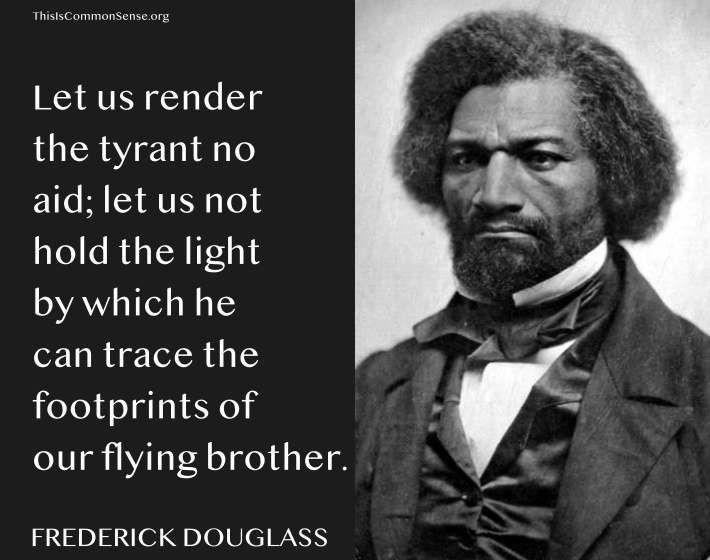
Let us render the tyrant no aid; let us not hold the light by which he can trace the footprints of our flying brother.
Frederick Douglass, Narrative of the Life of Frederick Douglass, An American Slave (1845), Chapter 11.
Frederick Douglass
Let us render the tyrant no aid; let us not hold the light by which he can trace the footprints of our flying brother.
Frederick Douglass, Narrative of the Life of Frederick Douglass, An American Slave (1845), Chapter 11.
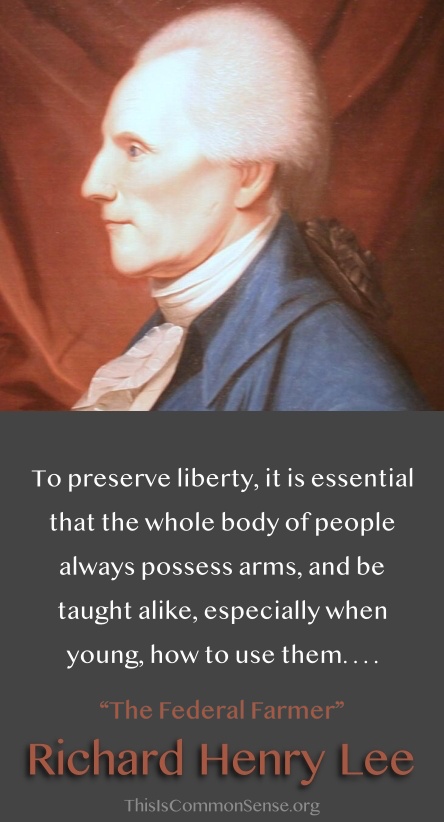
To preserve liberty, it is essential that the whole body of people always possess arms, and be taught alike, especially when young, how to use them. . . .
Additional Letters From The Federal Farmer, 53 (1788), authorship usually attributed to Richard Henry Lee (pictured), but this has been disputed.
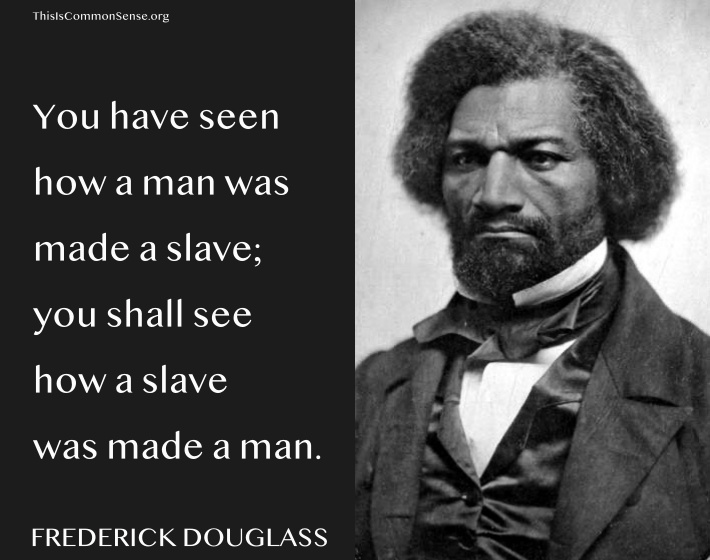
You have seen how a man was made a slave; you shall see how a slave was made a man.
Frederick Douglass, Narrative of the Life of Frederick Douglass, An American Slave (1845), Chapter 10.
La République est l’organisation par laquelle toutes les opinions, toutes les activités demeurant libres, le Peuple, par la divergence même des opinions et des volontés, pense et agit comme un seul homme. Dans la République, tout citoyen, en faisant ce qu’il veut et rien que ce qu’il veut, participe directement à la législation et au gouvernement, comme il participe à la production et à la circulation de la richesse. Là tout citoyen est roi ; car il a la plénitude du pouvoir, il règne et gouverne. La République est une anarchie positive. Ce n’est ni la liberté soumise A l’ordre comme dans la monarchie constitutionnelle, ni la liberté emprisonnée DANs l’ordre, comme l’entend le Gouvernement provisoire. C’est la liberté délivrée de toutes ses entraves, la superstition, le préjugé, le sophisme, l’agiotage, l’autorité; c’est la liberté réciproque, et non pas la liberté qui se limite; la liberté non pas fille de l’ordre, mais MÈRE de l’ordre.
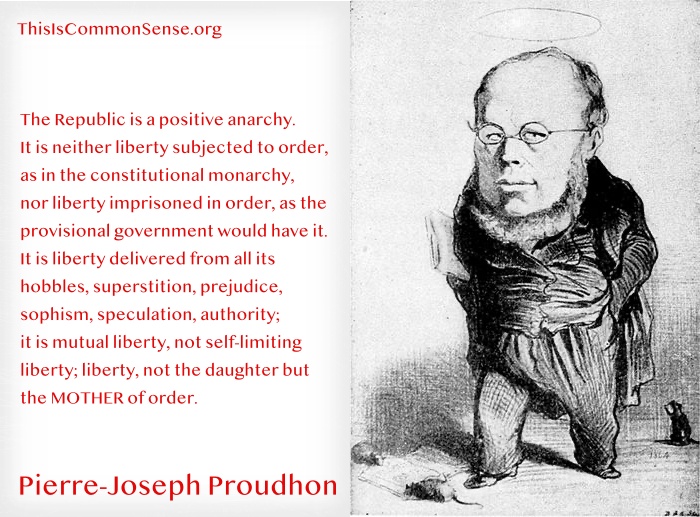
The Republic is the organization by which, all opinions and all activities remaining free, the People, by the very divergence of opinions and of wills, thinks and acts as a single man. In the Republic every citizen, in doing what he wishes and nothing but what he wishes, participates directly in legislation and government, just as he participates in the production and circulation of wealth. There every citizen is king; for he has plenary power, he reigns and governs. The Republic is a positive anarchy. It is neither liberty subjected to order, as in the constitutional monarchy, nor liberty imprisoned in order, as the provisional government would have it. It is liberty delivered from all its hobbles, superstition, prejudice, sophism, speculation, authority; it is mutual liberty, not self-limiting liberty; liberty, not the daughter but the MOTHER of order.
Pierre-Joseph Proudhon, Idée générale de la revolution au XIXe siècle (1851), p. 235, as cited in Anarchism (1908) by Paul Eltzbacher, p. 76.
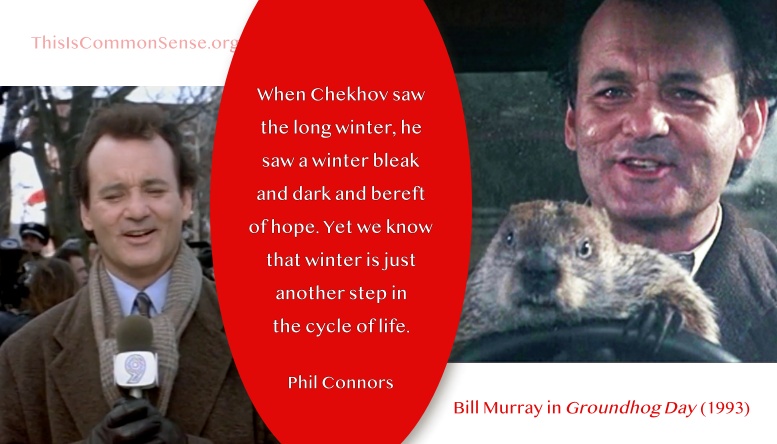
When Chekhov saw the long winter, he saw a winter bleak and dark and bereft of hope. Yet we know that winter is just another step in the cycle of life. But standing here among the people of Punxsutawney and basking in the warmth of their hearths and hearts, I couldn’t imagine a better fate than a long and lustrous winter.
Phil Connors, as played by Bill Murray in the film Groundhog Day (1993), written by Danny Rubin and Harold Ramis. Groundhog Day was celebrated in America on February 2, 2023.
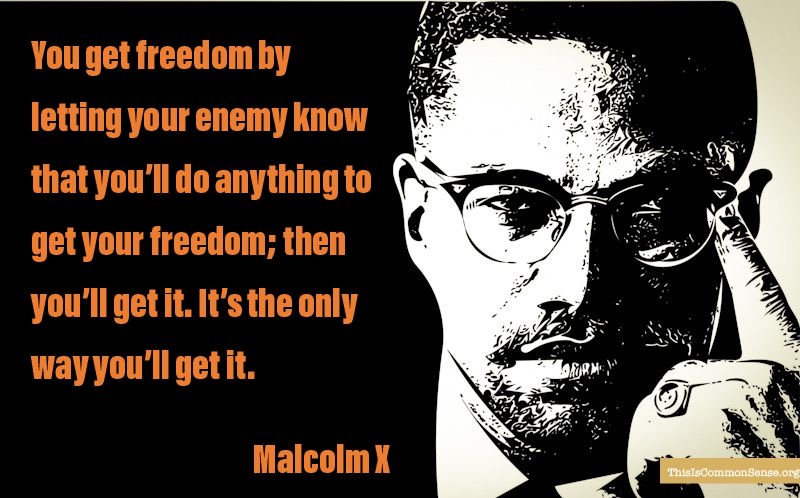
You get freedom by letting your enemy know that you’ll do anything to get your freedom; then you’ll get it. It’s the only way you’ll get it.
Malcolm X, speech, “Advice to the Youth of Mississippi” (December 31, 1964).
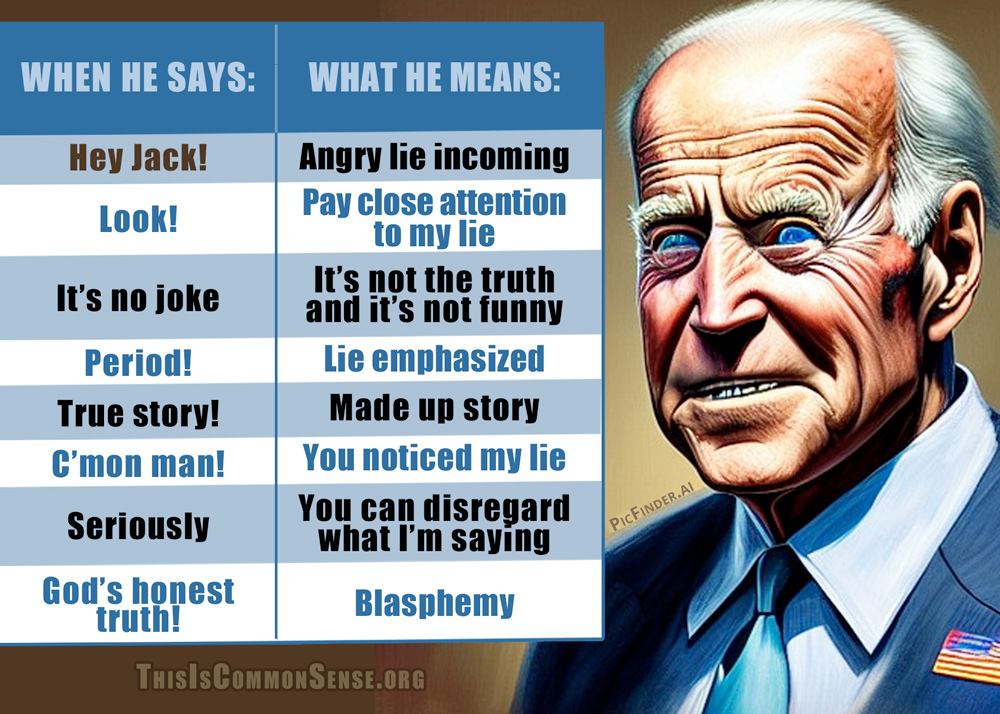
A handy reference chart.
Whatever freedom for ourselves we claim,
James Thomson, quoted as an epigraph to J. H. Levy’s The Outcome of Individualism (1897).
We wish all others to enjoy the same,
In simple womanhood’s and manhood’s name!
Freedom within one law of sacred might:—
‘Trench not on any other’s equal right.’
It is useless to consume our energies in mere verbal disputes. I must, however, caution students that definition is not a matter of indifference. Nine-tenths of the embarrassments which surround most philosophical questions arise from the difficulty of getting a firm hold of them. When this is done, the solution is comparatively easy. Until it is done no solution can be rationally hoped for.
Joseph Hiam Levy, The Outcome of Individualism (1890; Third Edition, 1892), p. 11.
The world is too much governed. The race is not to the swift nor the battle to the strong, but to the crafty; and statutes adroitly devised hedge in monopolies as if they were divinities. The resultant misery and inequality, that curse mankind through loss of freedom, are adduced by the State Socialist as a reason for more government. The patient must be cured by a hair of the dog that bit him
William Lloyd Garrison, quoted as an epigraph to J. H. Levy, The Outcome of Individualism (1890; Third Edition, 1892).