War prosperity is like the prosperity that an earthquake or a plague brings.
Ludwig Edler von Mises, Nation, State and Economy (1919; 1983, Leland B. Yeager, trans.), p. 186.
Categories
Ludwig von Mises
War prosperity is like the prosperity that an earthquake or a plague brings.
Ludwig Edler von Mises, Nation, State and Economy (1919; 1983, Leland B. Yeager, trans.), p. 186.
We fear those in power who think and act least like us and therefore scrutinize their every decision.
Brion McClanahan, Nine Presidents Who Screwed Up America and Four Who Tried to Save Her (2016), introduction. Image from a recent podcast video.

The tyranny of a prince in an oligarchy is not so dangerous to the public welfare as the apathy of a citizen in a democracy.
Charles-Louis de Secondat, Baron de La Brède et de Montesquieu, The Spirit of the Laws (1748).
Patronage is the sword and cannon by which war may be made on the liberty of the human race.
John Tyler, speech in Congress (February 24, 1834) against the policies of President Andrew Jackson. Seven and a half years later, as president of the United States, Tyler would veto a revival of the national bank, opposition to which was one of Jackson’s most memorable policies.
The right to buy weapons is the right to be free.
Alfred Elton van Vogt, “The Weapon Shop,” in Astounding Science Fiction (December 1942).

The future is already here — it’s just not very evenly distributed.
William Gibson, repeatedly said on radio in 1993.
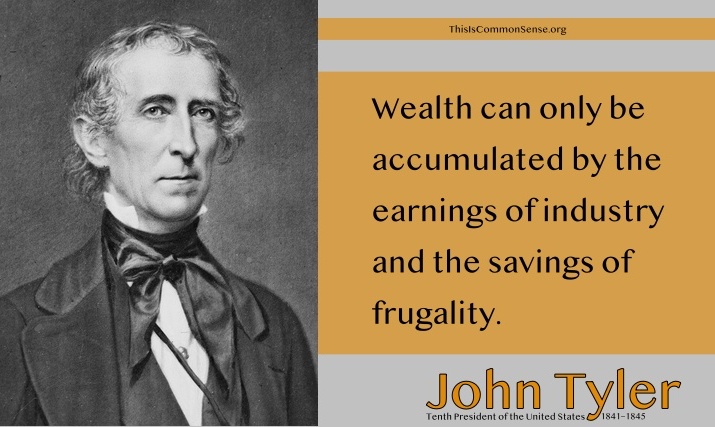
Wealth can only be accumulated by the earnings of industry and the savings of frugality.
President John Tyler (1841–1845), first annual message to Congress (June 1, 1841).
[T]here are prices too high to pay to save the United States. Conscription is one of them. Conscription is slavery, and I don’t think that any people or nation has a right to save itself at the price of slavery for anyone, no matter what name it is called. We have had the draft for twenty years now; I think this is shameful. If a country can’t save itself through the volunteer service of its own free people, then I say: Let the damned thing go down the drain!
Robert A. Heinlein, Guest of Honor Speech at the 29th World Science Fiction Convention, Seattle, Washington (1961).

We live in fascinating times.
Socialism is the theory that the desire of one man to get something he hasn’t got is more pleasing to a just God than the desire of some other man to keep what he has got.
H.L. Mencken, A Little Book in C Major (1916), p. 51.