Categories
property rights regulation too much government

The Regulatory Flex

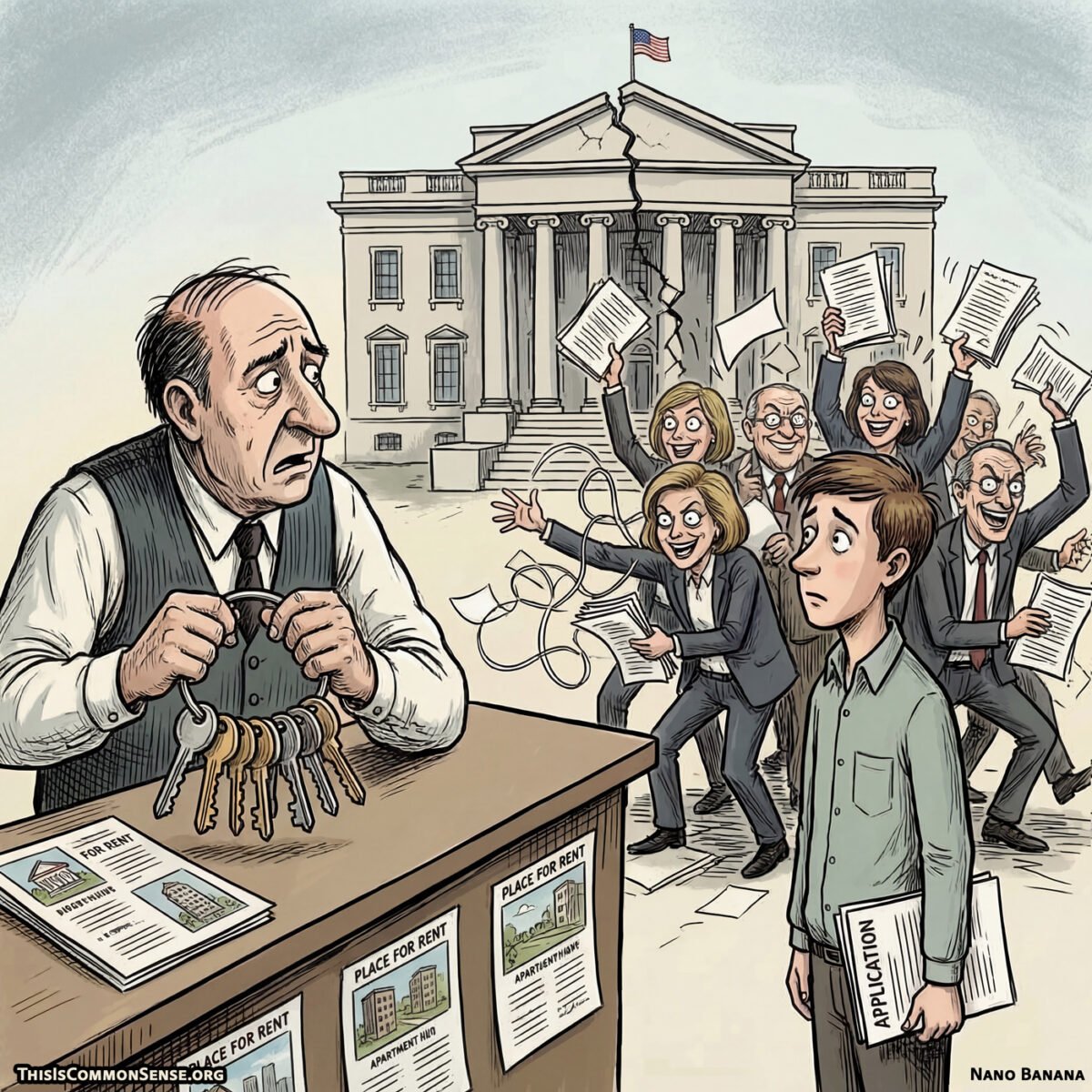
If you’re a homeowner devastated by wildfires, you may want to rebuild. Since you have also suffered a financial setback, especially if your property insurance was canceled just before the fire, you may also want to earn money by renting a part of your new home.

Such are the considerations that motivate some property owners devastated by last January’s conflagrations in California to want to build a duplex. 

So what’s the problem?

The governor is the problem.

That he’s listening to other property owners in your neighborhood — the Pacific Palisades — who dislike duplexes makes the problem worse. 

Your property is not their property, mind you. But they’re acting as if it were.

California Governor Gavin Newsom has issued an executive order letting cities ban duplex construction in neighborhoods affected by last January’s wildfires. A pro-development group called YIMBY Law was willing to refrain from filing a lawsuit if the governor issued a new order to let property owners build duplexes after a year had passed.

But Newsom won’t budge. So YIMBY Law is suing

A spokesman for the governor says that letting owners build duplexes (on their own property) amounts to an “attack” on the Pacific Palisades and an undermining of “local flexibility to rebuild.”

“Local,” here, seems to mean the sum total of all neighbors who are loath to allow you to enjoy the flexibility of building on your own property. 

But the individual and his rights are as local as it gets. 

And reducing options, as a prohibition on building duplexes where single-family homes once stood, is the very opposite of “flexibility.”

This is Common Sense. I’m Paul Jacob.


PDF for printing

Illustration created with Nano Banana

See all recent commentary
(simplified and organized)
See recent popular posts

Categories
folly international affairs regulation

Denmark’s Cows Must Die

Sorry, cows. The planet comes first.

I don’t want to give the wrong impression. No order has been issued requiring Danish farmers to kill their cows. The state is merely requiring that they feed the cows poison.

The purpose of the wonder-additive, Bovaer, produced by a company called Elanco Animal Health, is to limit the methane that cows produce as they digest their food. Then, says Elanco, the amount of methane that the cows emit — by a method too indelicate to mention — will be reduced 30 percent. Elanco must have done some kind of testing to figure this out, I suppose.

What is the point, though? Why does anybody want to accomplish this?

Well, the central planners who mandate such things believe or say they believe that even a smidgen less methane in the air will enable them to fine-tune the global climate thus wise and so and thereby, something something something, a perfect optimization. Well, not perfectly perfect, not until all the bovines everywhere are gobbling Bovaer. Denmark is not the only country pushing the drug though.

Alas, some Danish farmers are being obstreperous, complaining that their cows are getting sick: lethargy, diarrhea, miscarriages, drops in milk production. Etc. Some are even dying as result of the additive.

It is sad. But I’d rather have a few dead cows than a dead planet with nonstop hurricanes and tornadoes. And that’s what’s gonna happen if we don’t find a way to inhibit the cows’ . . . methane emissions.

This is Common Sense!! I’m Paul Jacob.


PDF for printing

Illustration created with NanoBanana and Firefly

See all recent commentary
(simplified and organized)
See recent popular posts

Categories
international affairs political economy regulation

Rents After the Chainsaw

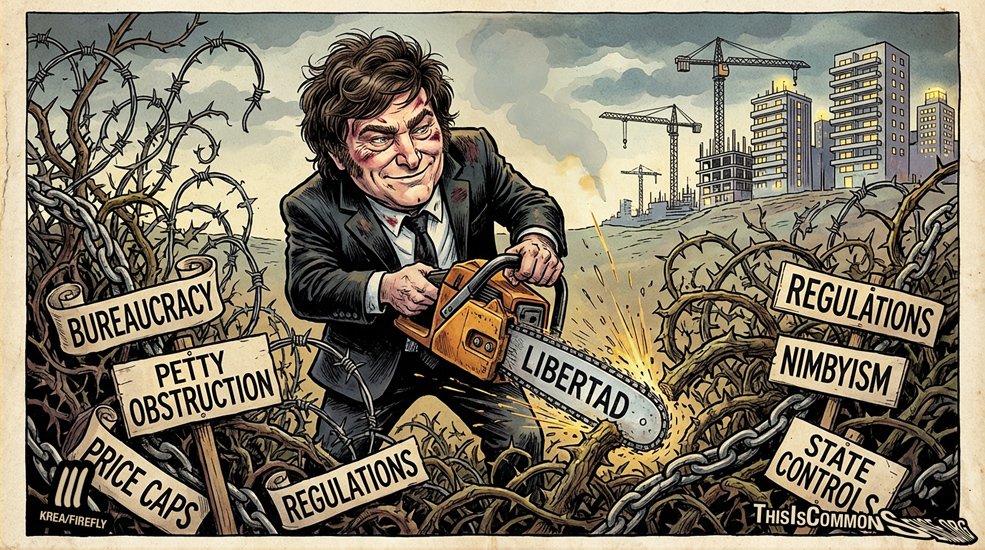
Argentina’s Ministry of Deregulation — yes, it now has one — reports that by June 2024, little more than half a year after chainsaw-wielding libertarian candidate Javier Milei won the presidential election, the housing market boomed . . . into a magnificent recovery.

Back in March, Reason magazine observed that listings on the Argentinian real-estate platform Zonaprop had increased from 5,500 before Milei’s deregulation “to 15,300 today, a staggering 180 percent rise.”

Why the big jump?

Strict national rent controls had been imposed in 2020, by the previous administration. When Milei lifted them, replacing them “with nothing,” tenants and landlords could then make whatever arrangements they could agree upon.

One method of evading the punishing controls had been switching to an Airbnb model of renting, with contracts renewable every three months. Such expedients were almost mandatory . . . given Argentina’s galloping inflation. But they introduced their own kinds of uncertainty.

Owners also took units off the market.

Annual rentals plummeted under this anti-market regime. In late 2023, Valentina Morales saw maybe “12 apartments advertised in the entire Palermo neighborhood,” a region with a population of almost 250,000.

Rents on the few apartments available with annual contracts skyrocketed. Tenancies were required by regulation to last for three years, with arbitrary and unrealistic caps on rent increases. And rent had to be paid only in pesos. But since inflation did not pause under the pre-Milei regime, owners were forced to guess how high inflation would go over the three years . . . and they charged accordingly.

Now? All such nonsense is gone.

This is Common Sense. I’m Paul Jacob.


PDF for printing

Illustration created with Krea and Firefly

See all recent commentary
(simplified and organized)
See recent popular posts

Categories
regulation

I Can’t Believe It’s Not Overkill

Butter is made from cream, which is derived from milk. Not a new truth; it’s never been anything but.

B-but — some people are allergic!

And we must protect them.

Under the Food Allergen Labeling and Consumer Protection Act (FALCPA) of 2004, milk is one of nine major allergens that must be explicitly declared — either in parentheses after the ingredient (e.g., “cream (milk)”) or in a separate “Contains: Milk” statement. 

Which is why Costco had to recall 79,200 pounds of butter. A labeling oversight meant that perfectly good and safe butter was placed on the big box store’s shelves without the explicit warning that butter contains milk. The FDA issued a Class II recall, and Costco began the process on October 11.

“Voluntarily,” we’re told. 

No doubt “voluntary” because neither Costco nor the bulk of its customers wants to get into arguments about government regulation designed to protect people with cows’ milk allergies.

In a world run by common sense and not a federal bureaucracy, however, even the most litigious lawyers would surely be satisfied by extra signage at point of sale — something like

But even this may strike us as bending too far backward for people whose responsibility is to know what the stuff they ingest is made from. They must protect themselves. If milk makes you ill, you’ll forswear all butter and reach for some good oil, or even margarine.

Something like I Can’t Believe It’s Not Butter . . . but only in its original spray and vegan versions . . . all others contain milk!

I can’t believe this isn’t Common Sense. I’m Paul Jacob.


PDF for printing

Illustration created with Krea and Firefly

See all recent commentary
(simplified and organized)
See recent popular posts

Categories
crime and punishment regulation

Fix-It Man Pardoned

Troy Lake, the mechanic who helped truckers and bus drivers keep their vehicles going by removing crippling emissions systems, paid the price — jailed for this “crime,” and also fined $52,000. 

Prosecutors made an example out of the Wyoming fix-it man for following a practice that had become mandatory to keep rigs — in his case, at least 344 heavy-duty diesel trucks — on the road.

I’ve discussed his case, saying that President Trump should pardon him for this non-crime.

Though Troy Lake served about seven months in a federal prison, and he’s been out for a while, the conviction was still hanging over his head.

Now President Trump has indeed pardoned Mr. Lake.

He learned about it from a congratulatory voicemail left by U.S. Senator Cynthia Lummis, calling to “let you know how very sorry I am that this even happened to you guys but how delighted I am that the pardon has come through.”

“It’s great,” says 65-year-old Lake, who broke down after hearing the good word. “It’s news that, you know — I guess I look at it as, there are some good things that happen in the world.”

Troy and his wife, Holly, also tearfully relieved by the news, are grateful to Senator Lummis, Wyoming legislators, and others who went to bat for him.

About the environmental regulations that sent him to prison for helping diesel drivers survive, he says, “We need to sit down and think about a more logical way of doing it, not putting people out of work.”

Talk about an understatement.

This is Common Sense. I’m Paul Jacob.


PDF for printing

Illustration created with Krea and Firefly

See all recent commentary
(simplified and organized)
See recent popular posts

Categories
folly regulation

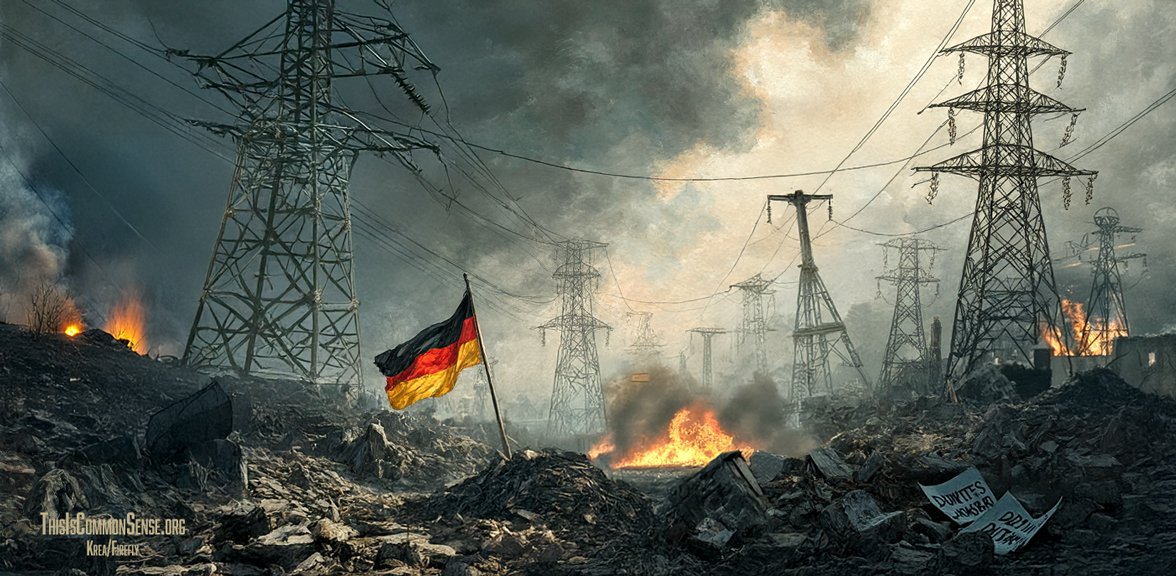
Twilight of Electrical Civilization

Paige Lambermont reminds us that Germany’s phase-out of nuclear power has its reasons.

Construction, transport, and other processes involved in making and maintaining a nuclear power plant emit carbon dioxide. But nuclear power itself does not emit carbon dioxide, which is supposed to be terrible for climate and planet. So, “What would prompt a country seeking to sharply reduce CO2 emissions to get rid of its largest source of carbon-free energy?”

Lambermont, a policy associate at the Institute for Energy Research, reviews the history of anti-nuclear sentiments, going back to the 1970s, and various news-driven decisions by the German government. A tsunami in Japan didn’t help, though safety measures were strengthened at the affected nuclear power plant.

Now we seem to be nearing the end of the line. German pubs host “demolition viewing parties” as the country self-destructively continues to destroy another nuclear power plant, specifically the part consisting of two giant cooling towers.

A controlled demolition caused 56,000 tons of concrete to collapse in seconds. The speed is misleading, for the job is far from finished. Further work dismantling the Bavaria-based plant is expected to continue until 2040. Of course, the useful life of the plant is already over.

It’s all part of the plan, the German government’s energy-transition plan called Energiewende. The energy has to become “renewable,” a word meaning — in effect — unreliable (wind, solar). Also, Germans must drastically reduce their consumption of energy.

Maybe they should call the plan Götterdämmerung — twilight of the gods or, in this case, of industrial civilization.

This is Common Sense. I’m Paul Jacob.


PDF for printing

Illustration created with Krea and Firefly

See all recent commentary
(simplified and organized)
See recent popular posts
Categories
First Amendment rights ideological culture media and media people regulation

Cancel Kimmel Culture

Reverse cancel culture is here, so to speak.

For years, leftists hounded any and all offenders against politicalcorrectness — meaning they’d root out anyone they disagreed with, including for saying anodyne things like “women are adult female humans and men are adult male humans” — directing hysterical online mobs against offenders’ employers, advertisers, and even ISPs.

Now it appears rightists are doing the same. People have lost their jobs for saying horrific — tasteless, hateful — things regarding the killing of Charlie Kirk. And Jimmy Kimmel just lost his high-profile late-night “comedy show” with ABC.

He’s literally been cancelled.

What happened? The Sinclair and Nexstar affiliate groups announced they will not (barring some apology) air Kimmel’s show anymore, and the two, together, own over 70 ABC affiliates — suggesting a substantial hit to the network’s bottom line.

“‘Jimmy Kimmel Live will be pre-empted indefinitely,’ a spokesperson for the Disney-owned network said in a statement,” reports the BBC. 

The offense? “In his Monday night monologue, Kimmel said: ‘The Maga Gang desperately trying to characterise this kid who murdered Charlie Kirk as anything other than one of them and doing everything they can to score political points from it.’”

One could nitpick. 

It has, after all, been embarrassing to watch the anti-MAGA folks desperately try to pin the accused shooter’s motive on some bizarre theory about “groyper” culture and “furry” larping; truth is, after an obviously political assassination, nearly everyone will aim to “score political points.” Kimmel one-sidedly points only to his opponents.

Missing in the back-and-forth? The Federal Communications Commission (FCC), which regulates broadcast TV in the first place. 

The FCC actually has a case that what Kimmel said was offensive and not “in the public interest.” But why should that count for anything? Were the broadcast spectrum privately owned — slots sold to the highest bidder, getting government out of any regulatory role whatsoever over media outlets — then, maybe, ABC wouldstand by its divisive host to satisfy only their core audience of partisan MAGA-haters.

And keep losing money . . . as is its right.

This is Common Sense. I’m Paul Jacob.

Categories
free trade & free markets regulation

Regulating Restrooms

Perhaps you remember the good old days — when men were men, women were women, and private establishments could maintain men’s restrooms and women’s restrooms for the men and the women without worrying about totalitarian edicts from a Human and Civil “Rights” Commission.

Those days may not be gone forever. But it sure must feel like it to the owners of the Hideout Arcade Bar & Grille in Rehoboth Beach, Delaware.

The restaurant refused the request of a man, what news reports call a “biological man,” who wanted to use the woman’s bathroom at the restaurant. His reason was that — well, I’m not sure his exact rationale matters. Anyway, the restaurant said no, doubtless feeling that it had a right to protect the sensibilities of the women using its bathrooms and to establish rules for their use.

He must have complained, because the Delaware Human and Civil “Rights” Commission got involved and, ignoring any common-sense defense the restaurant offered, has fined the restaurant $2,000 and imposed “anti-discrimination training” — i.e., reeducation — on its employees. 

No word on whether they’ll be forced to wear dunce caps, as were some unfortunates during China’s Cultural Revolution.

Commission members might say they’re merely following the law — they just work there. Delaware enacted an Equal Accommodations Law mandating that “All persons within the jurisdiction of this state are entitled to full and equal accommodations, facilities . . . regardless of . . . sex.”

Notice that the law did not say “heedless” of sex, however.

This is Common Sense. I’m Paul Jacob.


PDF for printing

Illustration created with Krea and Fireflly

See all recent commentary
(simplified and organized)
See recent popular posts

Categories
free trade & free markets regulation

Regulating Refineries to Death

Punish them! 

That might as well be the explicit goal of California’s regulators and politicians — and all too many voters — for the results are clear enough. All who refuse to use electric cars and solar energy must suffer . . . with ever-higher gas prices, at the very least.

Two major oil refineries that provide gas for California as well as a few neighboring states have announced that they are closing their doors. They can’t hack it.

One analyst predicts that in consequence of these closures and related destruction of production, the price of gas will shoot up to $8 per gallon.

Lane Riggs, CEO of Valero Energy, which is closing a refinery near San Francisco, says the state’s tough “regulatory enforcement environment” is to blame for the loss of the sixth-largest refinery in the state.

Also throwing in the towel is a Los Angeles refinery, this one the state’s seventh-largest, operated by Phillips 66.

Brittany Bernstein notes that Phillips announced the closure “just 72 hours after California passed ABX-2, which requires refineries to hold additional inventories of finished stocks.” Yet another arbitrary burden on a company’s ability to function.

Last year, Chevron moved its headquarters from California to Texas because of the toxic environment for producers in California.

The researcher who’s predicting $8 per gallon gas, USC Professor Michael Mische, says Californians have “legislated ourselves into a situation where the costs are extraordinarily high and the political environment is extraordinarily harsh.”

Solution: reverse and undo. Please permit me to assume that this is possible.

This is Common Sense. I’m Paul Jacob.


PDF for printing

Illustration created with Krea and Firefly

See all recent commentary
(simplified and organized)
See recent popular posts

Categories
First Amendment rights free trade & free markets national politics & policies regulation

Banks Not the Only Debankers

A recent executive order that President Trump issued to stop regulators from abetting and even compelling the “debanking” of bank customers for their political views is clear and on-target.  

On-target as far as debanking by banks goes.

But Reclaim the Net notes a glaring omission. The order’s identifies financial institutions willing to blacklist customers for possessing the “wrong” political opinions or missions. (“Wrong” here means not too pro-criminal or pro-terrorist but too constitutionalist, too much in favor of individual rights of the First or Second Amendment variety.)

The problem is that the order says nothing about major payment processors like Visa and PayPal.

Now, perhaps a penumbra of the new regulatory marching orders would influence the policies of the credit-card companies, whose cards are after all typically issued in cooperation with banks. But this is highly uncertain.

And Reclaim the Net thinks that Visa and Mastercard, “the twin tollbooth operators of the global payments highway,” are, like PayPal and Stripe, untouched by Trump’s order. Yet all of these payment processors have in recent years been blacklisting individuals and organizations that the processors happen to disagree with.

The practice goes back at least to the Obama administration, which instructed regulators that it could regard something called “negative public opinion” as a legitimate risk factor. 

This doctrine “quickly turned into a permission slip for politically driven account closures.” 

The government shouldn’t be issuing such “permission slips” — or implicit instructions — to banks, payment processors, or anybody.

This is Common Sense. I’m Paul Jacob.


PDF for printing

Illustration created with Krea and Firefly

See all recent commentary
(simplified and organized)
See recent popular posts