
Categories
insider corruption political challengers

Straw Candidacy

“No Corporate PACs,” says a Facebook ad by the Sara Gideon for U.S. Senate campaign, “Just You.”

“Gideon is running to unseat Republican Sen. Susan Collins in 2020,” the Portland Press Herald reports, noting that “fighting corporate money in politics” has been a prime “focus of her campaign.”

Yet, as Democratic Speaker of the Maine House, the challenger ran something called the Gideon Leadership PAC that raked in a majority of its funds from corporations such as Aetna, American Express, AT&T, Comcast, Eli Lilly, Time Warner, Verizon, Visa, and Walmart. The Maine Examiner informs that “records from the Maine Ethics Commission show she has built her career, and funded efforts to boost her statewide support, with contributions from large corporations.”

Last month, Gideon was slapped with a Federal Election Commission complaint for violating campaign finance law forbidding one person or entity from making contributions that are reimbursed by another. Gideon made numerous personal contributions to Democrats running for federal office only to turn around and have her leadership PAC reimburse her for the expense.

Her PAC being the true donor, Speaker Gideon is what’s known as a straw donor.

But it gets worse, explains Erin Chlopak, a former FEC official and currently with the Campaign Legal Center. “Corporations cannot make contributions to a federal campaign, and you can’t circumvent that ban by using a straw donor to funnel money originally from a company to a federal candidate.”

A spokesperson for Gideon’s campaign blamed “incorrect advice.” 

At her level of corporate involvement, I’d say the “incorrect advice” was to emphasize the anti-corporate money pledge.

This is Common Sense. I’m Paul Jacob.


PDF for printing

Sara Gideon, candidate, Portland,

See all recent commentary
(simplified and organized)
See recent popular posts


Categories
partisanship political challengers

Such Is Today’s Politics

“You do have a problem with a President demanding the federal government go ahead and seize private land and then promising to pardon those who seized the land,” challenged Joe Walsh, the former Illinois congressman running in the Republican Party primaries against Donald Trump. 

“Don’t you?”

Matt Welch, writing in the LA Times, quoted this Walsh tweet (three days after the Walsh2020 campaign announcement) to express alarm about where the GOP is heading. “We are accustomed to some ideological shape-shifting when the White House changes teams,” writes Welch. “But what’s so striking about this week’s slate of immigration-related controversies — including the one that supplanted the land-grab pardon: the administration’s new rules governing potential citizenship for the children of U.S. service people abroad — is that none of it should come as a surprise.”

Because Trump is doing (sorta) what he promised to do. Which includes taking land by eminent domain. 

Before his election, Trump had proclaimed his support for the Kelo decision that signed off on governments nabbing land to give to private developers. At issue now is condemning land to build The Wall — at least an arguably public use. 

While “private property rights used to be foundational to the conservative movement,” Welch bemoans that Trump “didn’t care. And that Republicans cared a hell of a lot less than they claimed to.”

Again, unsurprising. Republican pols did little to nothing for property rights or limited government pre-Trump. So these anti-leftist voters went for someone — anyone? — who could deliver something.

I doubt that candidate Walsh will convince many that he can deliver much of anything.

This is Common Sense. I’m Paul Jacob.


PDF for printing

land grab, eminent domain, theft, property, border,

See all recent commentary
(simplified and organized)
See recent popular posts


Categories
political challengers too much government

Recognizing a Problem

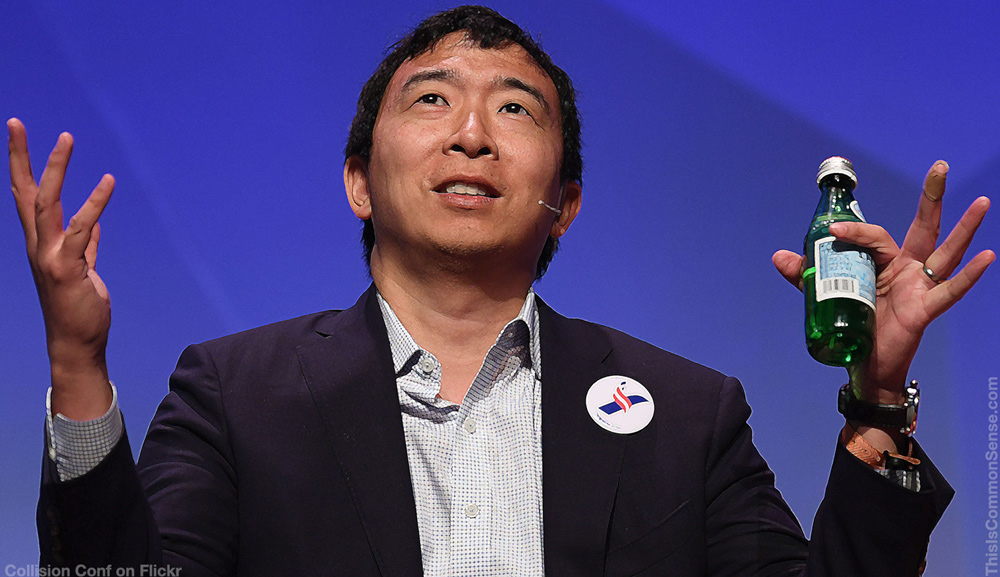
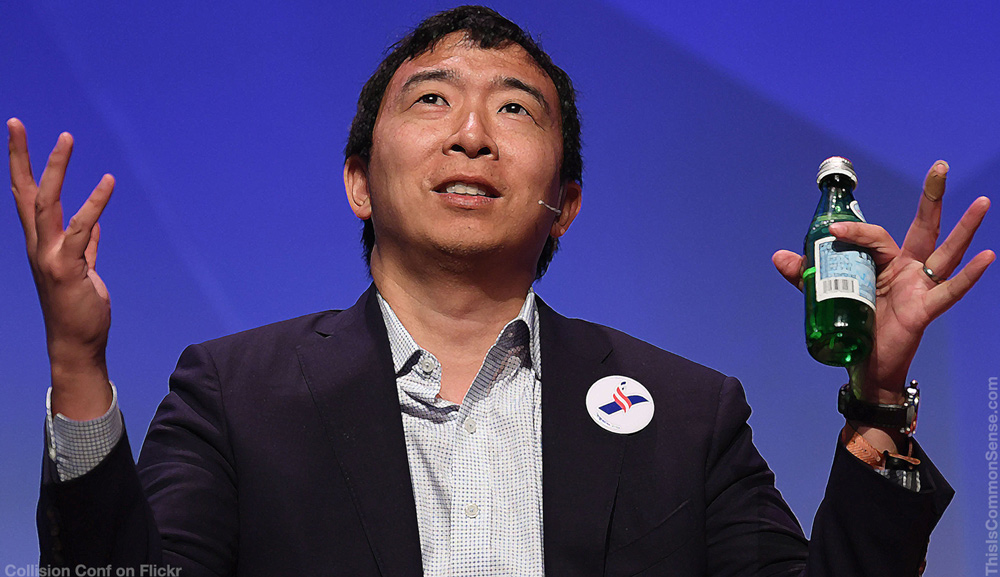
Democratic Presidential candidate Andrew Yang has at least one good policy preference: he opposes tough land use and zoning regimes.

And he is not alone. 

“Yang’s criticism of zoning is pretty close to what other Democratic primary candidates have said on the subject,” writes Chistian Britschgi at Reason. “Sens. Cory Booker (D–N.J.), Elizabeth Warren (D–Mass.), and Amy Klobuchar (D–Minn.), and former Housing and Urban Development Secretary Julian Castro have all targeted restrictive local land use regulations as a cause of high housing costs.”

Mr. Yang’s website clarifies the problem: “Those who already own homes have made it significantly harder for those who don’t to recognize that dream. Through NIMBY (not in my backyard) and zoning laws, the ability of new housing to be built in certain areas has been impeded to the point where the vast majority of Americans can’t afford to live in the largest cities.”

But while Yang recognizes that zoning is best dealt with on a local and state level, his more famous competitors offer fixes, Britschgi notes, that “require the federal government to either spend more money or attach more regulations to the money it already spends.”

Here’s the bottom line: Several Democrats competing for the highest office in the land recognize government interference as the leading cause of the housing crunch and its high prices.

Yet, instead of fighting bad policies at the state and local source, they advocate more federal spending. And they most decidedly do not apply their housing regulation realism to other problems we face.

This is Common Sense. I’m Paul Jacob.


Andrew Yang, zoning, land use, visionary, presidential, election,

Photo by Collision Conf

See all recent commentary
(simplified and organized)
See recent popular posts


Categories
national politics & policies political challengers

And Then There Were 20-Something

The media won’t have my favorite Democratic presidential candidate to kick around anymore. 

“Mike Gravel drops out of 2020 race,” Vox headlined Catherine Kim’s report. “He never wanted to be president anyway.” A subhead continued: “The former Alaska senator simply ran to get other candidates to talk about American imperialism.”

It was largely a Twitter campaign, which, as The New York Times featured months ago, was run by two teenagers, David Oks and Henry Williams. “It wasn’t exactly a bid for the presidency,” the paper cautioned, “but neither was it really a prank.”

The goal? Launch Gravel — and, moreover, his issues — onto the debate stage. Though the campaign garnered enough individual donors to qualify, his lackluster polling results kept the former U.S. Senator out of prime time.

During the Vietnam War, Sen. Gravel worked to end the military draft and had the courage to read the Pentagon Papers into the Senate record in order to inform the public about the war. After leaving the Senate, Gravel continued his battle against U.S. military intervention, as well as advocating for initiative and referendum.

Back in 2008, in another quixotic presidential bid, he succeeded getting into the debates, lobbing in a few much-needed zingers. He was 77-years-old then; today he is 89.

Oks’ and Williams’ “real goal was to inject Gravel’s far-left views,”  informed FiveThirtyEight.com, “into the primary.”

Though I disagree with Mike Gravel on a number of his “far-left” issues — and for endorsing Bernie Sanders for president — he has my utmost respect. 

And if “ending ‘imperialist’ wars, legalizing drugs and enacting dramatic political reforms” be “far left,” make the most of it.

This is Common Sense. I’m Paul Jacob.


PDF for printing

MIke Gravel, president, candidate, war, draft,

See all recent commentary
(simplified and organized)
See recent popular posts

Categories
initiative, referendum, and recall political challengers term limits

A Different Conversation

“Here’s the difference between me and the other candidates,” says billionaire investor-turned-presidential aspirant Tom Steyer. “I don’t think we can fix our democracy from the inside. I don’t believe Washington politicians and big corporations will let that happen.”

Of course, if this Democrat becomes president of these United States, that’s hardly the outside.

“For me,” Steyer continues, “this comes down to whether you trust the politicians or the people.”

Well, I certainly trust the people a whole lot more than I trust the politicians.* 

“If you say you trust the people, are you willing to stand up to the insiders and the big corporations and give the people the tools they need to fix our democracy?” Steyer asks. 

Which tools? “A national referendum, term limits, eliminating corporate money in politics, making it easy to vote.”

The toolkit’s a mixed bag.

Eliminating corporate money means repealing part of the First Amendment, and silencing non-profit corporations such as U.S. Term Limits, MoveOn.org, the NRA, Planned Parenthood, National Right to Life, etc., etc. 

Mr. Steyer also worries that, without reform, “We won’t be able to . . . pass any of the great plans proposed by the Democratic candidates running for president.”

We should be so lucky.

Still, here is another Democratic presidential candidate endorsing congressional term limits. And we do need a direct democratic check on Washington, the ability for citizens to initiate reforms such as term limits and take unpopular legislation to a referendum. 

I’m not sanguine that Steyer will get the policy details right, but as fellow Democratic candidate Sen. Kamala Harris is fond of saying, “Let’s have that conversation.”

This is Common Sense. I’m Paul Jacob.


* Constitutional protections for our basic rights, as in The Bill of Rights, mean we do not have to trust government, directly democratic or representative.

PDF or printing

billionaire, Tom Steyer, candidate, president, election, campaign,

See all recent commentary
(simplified and organized)
See recent popular posts

Categories
political challengers term limits

Beto’s Best Reform

“All too often politicians focus on their own re-election,” says Robert Francis ‘Beto’ O’Rourke, “at the expense of addressing the challenges our country faces.” 

A supporter of term limits during his six years in Congress, in 2018 Beto left a safe House seat to challenge U.S. Senator Ted Cruz, also a term limits backer. In a very Republican state, Mr. O’Rourke fell just a smidgeon short of an upset, catching a ton of national attention — leading to his current candidacy for the Democratic presidential nomination.

His “Plan to Realize the Full Potential of Our Democracy” calls for 12-year congressional limits and 18-year limits on U.S. Supreme Court justices. Admittedly, both require amending the Constitution, but a president using his bully pulpit sure can help the effort.*

“The issue of term limits in Congress has some bipartisan support,” notes a BuzzFeed News story, “but . . . it starkly divides Democrats.” 

The reporter is not talking about voters — a poll last year found a whopping 77 percent of Democrats favor “Establishing limits on the number of terms members of the U.S. Congress can serve.”

But as the BuzzFeed article explains, “Former vice president Joe Biden, Sen. Elizabeth Warren, and [Sen. Bernie] Sanders all oppose instituting them for members of Congress.”

Not surprising. Both Sanders and Warren are incumbents — with Sanders in Congress for the last 28 years and Warren in her second Senate term, while Biden spent 36 years in the Senate and eight more as Vice President. 

“Limit permanent incumbency,” Beto’s website states, “to promote progress, reduce gridlock and inspire more to run for office.”

While Democrat politicians may not be pleased, O’Rourke’s term-limit push will register with voters of all parties.

This is Common Sense. I’m Paul Jacob


* President Donald Trump endorsed term limits in the homestretch of the 2016 campaign. He would be wise to trumpet the issue again and again in order to keep pressure on Congress.

PDF for printing

Beto, Paul Jacob, term limits,

See all recent commentary
(simplified and organized)
See recent popular posts

Categories
incumbents political challengers term limits

Knock Down the Incumbency

Over the weekend, I suffered through Knock Down the House . . . so you don’t have to. 

While the documentary heralding four inexperienced Democratic women running for Congress in 2018 cost Netflix $10 million, I did not have to spend a dime — beyond my regular monthly subscription.

The award-winning film, directed by Rachel Lears, who wrote it along with her husband, Robin Blotnick, is expertly crafted. Unfortunately, it is geared to democratic socialists predisposed to adoring the subjects. 

The star is now Rep. Alexandria Ocasio-Cortez (D-N.Y.), who defeated then Rep. Joe Crowley, a ten-term, 20-year incumbent . . . the Number 4 Democrat in the House of Representatives.

In addition to Ocasio-Cortez, the movie follows Amy Vilela, seeking to replace a retiring Nevada Democrat; Cori Bush, challenging the Clay Family’s hereditary congressional dynasty in Missouri’s 1st district*; and Paula Jean Swearengin, battling incumbent Sen. Joe Machin in West Virginia’s Democratic Party Primary. Of the four challengers chronicled, all of whom received extensive support from two progressive groups, Justice Democrats and Brand New Congress, AOC was the only winner.

“Let’s assume all the energy in this room can get you on the ballot and into office,” offers a fellow at one of Ocasio-Cortez’s early meetings. “How, then, do we overcome the drop in power?”

“I think we really need to have to look at what that power does now,” AOC responds. “When it matters, [Rep. Crowley] doesn’t stand up for us; when it matters, he doesn’t advocate for our interests.”

Whatever one thinks of AOC’s politics, her point here is not without merit: the idea that we citizens benefit from longtime incumbents who ‘bring home the bacon’ is . . . baloney. 

This is Common Sense. I’m Paul Jacob.


* At the completion of this term, Rep. Lacy Clay, Ms. Bush’s opponent, will have served 20 years. His father, Bill Clay, held the seat for 32 years before that. Together, over half a century. The film alludes to the fact that Clay Jr. gained the seat in 2000 only after the surprise retirement of Clay Sr. on the very last day to file for the office . . . with Jr. filing, instead.

PDF for printing

Knock Down the House, socialism, term limits,

See all recent commentary
(simplified and organized)
See recent popular posts


Categories
incumbents political challengers Popular term limits

The Incumbency vs. Progressives

“The Democratic Party leadership is choosing machine politics,” charged Alexandra Rojas, the young executive director of Justice Democrats, “over ushering in a new generation of leaders and the fundamental idea of democracy.”

She specifically assails the DCCC’s blacklist of political professionals working for Democratic Party candidates who dare to challenge Democratic incumbents in next year’s Democratic primaries. 

The Intercept reports that “at least four consultants dropped” challenger Marie Newman’s campaign “under pressure from the Democratic Congressional Campaign Committee’s new policy to cut off vendors working with primary challengers.” 

Newman is formidable, having come within 2 percentage points of Rep. Dan Lipinski in the 2018 Illinois Democratic Primary. The National Abortion Rights Action League, Democracy for America and other progressive groups are decrying a DCCC “blacklist policy that protects anti-choice, anti-LGBTQ, corporate Democrats like Dan Lipinski.”

And progressives have reason for disgust. Lipinski is a protected insider.

For the last 36 years, there has been a Lipinski in Congress. Bill Lipinski, the current congressman’s father, held the seat for 22 years before giving it to his son. And yes, “giving” is correct. 

In 2004, two months before the November election, while running unopposed for a 12th term, the incumbent resigned — too late to trigger a special election wherein voters could make a choice. Instead, Bill’s replacement was hand-picked by the Illinois district’s Democratic Party Committee.

Controlled by — you guessed it! — Bill Lipinski. 

That insider group chose Bill’s son, Daniel, who was then living in Kentucky.

“It was an open process,” claimed the father. 

Today, per the blacklist, “[t]he DCCC says the policy doesn’t discourage primary challengers.”

Well, I guess no one expects truth from a political machine.

This is Common Sense. I’m Paul Jacob.


PDF for printing

democratic party, Democratic Congressional Campaign Committee, DCCC, Bill Lipinski, primary challenger,

See all recent commentary
(simplified and organized)
See recent popular posts

Categories
incumbents political challengers term limits

Old Dominions

A photo, found on Virginia Governor Ralph Northam’s 1984 medical school yearbook page, went viral. It was of a person in black-face next to another in a Ku Klux Klan sheet. In almost no time at all, Democrats and others quickly demanded that the governor resign.

Why the speed? 

The already-started presidential campaign? 

Or the likelihood that Democrats would experience no disadvantage should their governor step down?

Lt. Gov. Justin Fairfax, an up-and-comer in the Democratic Party, would take Northam’s place. And under Virginia’s gubernatorial term limits, Fairfax could run again for a full term after finishing the rest of this current term. 

With Virginia’s one-term limit, it would allow a rare option to run as an incumbent.

There’s a speed bump, though. Not necessarily the sexual assault allegation lodged against Fairfax, which he denies . . . and about which we know little. What’s certain? Fairfax is positioned far to the left of Northam — in a state that is still more purple than blue. 

A bitter feud with Laborers’ International Union of North America illustrates the problem. Mr. Fairfax has long opposed two pipelines that the union desperately desires. The union — a donor of $600,000 to Democrats in 2017 — demanded that candidate Northam remove Fairfax’s name and picture from mailers to union households. 

Northam complied

And got hit by charges of racism.

You see, Fairfax is black. 

Playing down the dis, Fairfax called it a “mistake”; others chose “mindboggling,” a “slap in the face,” and a signal that blacks “are expendable.”

Northam still won . . . with 87 percent support from black voters.

Should Northam finish his term, Lt. Gov. Fairfax would remain well positioned, but the race would be wide open. If Fairfax becomes governor, however, no Democrat will challenge him for fear of splitting the party.

Yet, come 2021, Fairfax is too far left to defeat a decent Republican . . . should one appear.

This is Common Sense. I’m Paul Jacob.


PDF for printing

Lt. Gov. Justin Fairfax

See all recent commentary
(simplified and organized)
See recent popular posts


Categories
political challengers

Democrats Can’t Afford Competition

Howard Schultz’s recent announcement that he might run for president “sent a shiver through the Democratic Party,” writes David Siders at Politico, “terrifying party officials who fear a well-funded, third-party candidate could siphon votes from the Democratic nominee and hand a second term to Trump.”

Schultz is the former Starbucks Coffee CEO, whose success with customers in the marketplace is hard to quibble with. Nonetheless, his “welcoming” into the contest has been less than friendly.

President Trump taunted that he lacked the “guts” to run. Democrats — appalled that the billionaire, a lifelong Democrat, who has given nearly $200,000 to candidates sporting the D on their chests, would consider an independent run — called it “half-baked” and yet “an existential threat.” 

Note that Mr. Schultz has stated he will not run if he thinks he cannot win.

As I’ve long argued, there’s a better way to prevent spoilers: use ranked choice voting, like they do in Maine, so that voters can better express themselves, and not help elect the candidate they like least by voting for the candidate they like most. 

At this point, Howard Schultz’s impact is to expose the socialistic impulses of Democrats running for president. The liberal Schultz has already taken on Sen. Elizabeth Warren’s wealth tax idea and bashed Sen. Kamala Harris’s Medicare-for-all. He opposes free college as something “we can’t afford.” 

Among the battalion of Democrats already seeking or likely to seek the party’s presidential nomination, is there even one able to articulate that there might be something “we can’t afford”?

Democrats much prefer a comparison with Trump to a comparison with Schultz.

This is Common Sense. I’m Paul Jacob.


PDF for printing

Howard Schultz, candidate, president, coffee, challenge?