Categories
ideological culture international affairs

Age of Arms

While it is entirely reasonable to treat children and adults differently, and for laws to reflect this basic division, questions of precisely when children should become adults have eluded rationality. 

In Argentina, where the legal age to vote is 16, young people may join the military at age 18, but had to wait till 21 to own a gun. 

Until Argentine president Javier Milei’s reduced the minimum age to purchase and carry a firearm to 18, a step towards greater consistency.

But that is not how the culturally dominant left-wing media and intelligentsia see it. They paint dire dystopian visions of violence as a consequence of Milei’s libertarian pro-carry, pro-armament philosophy.

 A December article in The Epoch Times shows that this old, elitist attitude is falling to the wayside as “Residents of Argentina’s Crime-Ridden Cities Welcome Milei’s Gun Reform.”

Key point? Dire dystopia is current reality.

Years of inflationism, government growth and regulation, as well as the seemingly endless political struggle between communists and Peronistas, has left a rising rate of homelessness and poverty.

And the homeless are getting grabby. 

In public. 

More daring and violent everywhere.

Against this, the pre-Milei government’s soft-on-criminals approach left normal people feeling defenseless. So gun ownership has understandably increased. The Epoch Times quotes a Buenos Aires resident who “believes that the public’s attitude toward firearms ownership is shifting away from the notion of less guns equals less gun crime, an ideology that was promoted by the previous administration.”

While Javier Milei’s program to reduce inflation appears to be on course, Argentina has been so dystopian for so long, most changes for the good will be incremental.

Like setting the age to carry firearms to equal the military service age.

This is Common Sense. I’m Paul Jacob.


PDF for printing

Illustration created with Flux and Firefly

See all recent commentary
(simplified and organized)
See recent popular posts
Categories
ideological culture international affairs

Exit Trudeau

America’s far-north (and far-left) autocrat, Prime Minister Justin Trudeau, is resigning.

His resignation may pertain to the fact that opposition parties promised to vote no confidence in Trudeau’s Liberal Party when the Canadian parliament meets in March.

Associated Press says that critics complained of Trudeau’s efforts to “strike a balance between economic growth and environmental protection,” i.e., sacrificing economic growth to environmentalist hobbyhorses. 

Critics have many other complaints too.

What’s the worst of Trudeau’s conduct and policies? Tough call. But his treatment of the Canadian truckers who launched a Freedom Convoy to protest Canada’s ludicrous COVID-19 mandates has to be near the top of the list. Among other measures, Trudeau froze the bank accounts of protestors — and even those of some supporters.

GoFundMe cooperated by blocking donations to the truckers and even, briefly, declaring that blocked donations would not be returned to donors who failed to make a special appeal but would instead be redistributed to “credible and established charities.” The outrage over the planned theft, even if perfectly in sync with Trudeau’s hooliganism, was too great, though, and GoFundMe reversed itself.

Trudeau is also one of many Canadian politicians who leapt into inaction as the Chinese Communist Party tested the limits of its ability to interfere in Canadian elections and politics and engage in transnational repression. I have discussed the problem here; and the sister site of Common Sense, StopTheCCP, has touched on it here and here and here and here.

Trudeau’s exit is good news for Canada and the free world. 

This is Common Sense. I’m Paul Jacob.


PDF for printing

Illustration created with Flux and Firefly

See all recent commentary
(simplified and organized)
See recent popular posts

Categories
international affairs

Dictator Down

After 13 years of civil war, a rebel force seized the Syrian capital over the weekend, toppling more than half a century of the Assad dictatorship, with despot Bashar al-Assad fleeing to safety in Russia. 

Good riddance. But what next? Will any semblance of freedom come to Syria and be sustained? 

“Syria is a mess,” President-elect Donald Trump posted on his Truth Social platform, concluding: “THE UNITED STATES SHOULD HAVE NOTHING TO DO WITH IT. THIS IS NOT OUR FIGHT. LET IT PLAY OUT. DO NOT GET INVOLVED!”

He’s not wrong.

Still, events in Syria add to the foreign policy challenges, increasingly military challenges, awaiting the new administration — from the war in Ukraine, Lebanon, Gaza, to the threat of Chinese aggression across the Taiwan Strait against economically and geographically strategic Taiwan. 

Or conflict might erupt in the South China Sea — a body of water that China claims more than 90 percent of . . . an outrageous, illegal contention, which nonetheless the PLA Navy increasingly enforces.

Recently, Chinese Communist Party leader Xi Jinping gave President Biden — meant for the President-elect, of course — four red lines that America was not to cross. The first two are instructive: “the Taiwan question” and “democracy and human rights.” 

In short, it would be bad manners and really ruffle tender Beijing feathers were the U.S. to continue to arm and protect free, democratic Taiwan and to raise the issue of the numerous genocides the CCP regime continues to inflict on ethnic and religious minorities. 

And everybody else. 

It’s a dangerous world. Much of which the United States has pledged to defend. Good luck, Mr. Trump.

No wonder there is “a record high” percentage of Americans who “want the government to spend more on the military.”

This is Common Sense. I’m Paul Jacob.


PDF for printing

Illustration created with Flux and Firefly

See all recent commentary
(simplified and organized)
See recent popular posts

Categories
First Amendment rights international affairs

Professional Idiot?

Police in Germany are raiding and arresting unpowerful citizens for committing the sin of speaking harsh words about sitting officials. 

Or forwarding harsh words about them.

Animus toward free speech isn’t a new thing in Germany, even post-twentieth-century Germany. But it seems that the censorship, aka hate-speech hatred, is getting more intense lately because of an election.

One recent victim is a 64-year-old pensioner, Stefan Nieoff, who forwarded a “meme” about Green Economy Minister Robert Habeck. Habeck wants to be chancellor. According to the “meme,” Habeck is a “professional idiot” (Schwachkopf Professional). 

But in consequence of Herr Nieoff’s reckless act of disseminating information of merely figurative accuracy, Bavarian police (a) raided the man’s home and (b) arrested him. Incidentally traumatizing his daughter, who has Down syndrome.

Why, exactly? Because the Bavarian police are idiots acting at the behest of other idiots.

In a video posted on X, Nieoff says, as Google-Translated: “What they did to me is awful. I’m going to court. It can’t be that everyone keeps their mouth shut and lets themselves be oppressed like that. . . . So please, Mr. Habeck, I beg you, come to my kitchen table sometime. Like the police officers from the Schweinfurt Criminal Investigation Department.”

The Alternative for Germany party asserts that although Habeck “presents himself as a ‘people-friendly’ candidate for chancellor, his critics are being relentlessly pursued.”

Reports say that Habeck, a member of the Green Party, has little chance of becoming chancellor. Let’s hope his chances are sehr schwach.

This is Common Sense. I’m Paul Jacob.


PDF for printing

See all recent commentary
(simplified and organized)
See recent popular posts
Categories
First Amendment rights international affairs

Musk Avoids a Trap

After reports that British MPs wanted to summon Elon Musk to interrogate him about the role of his company, X (Twitter), “in disseminating ‘disinformation’ during the summer riots,” I didn’t suppose that he’d be eager to rush across the pond to be grilled by enemies of freedom of speech.

One of his would-be interrogators, Chi Onwurah, a Labour committee chairwoman, said she wanted to “cross-examine him to see . . . how he reconciles his promotion of freedom of expression with his promotion of pure disinformation.”

What a mystery. How can someone champion freedom of speech and letting people say things with which others disagree? Isn’t freedom of speech only for government-authorized speech, the kind King George III would have approved?

On X, a Malaysian commentator sought to warn Musk: “This is a trap,” tweeted Miles Cheong, “They’ll detain him at the border, demand to see the contents of his phone, and charge him under counterterrorism laws when he refuses.”

If we were concerned even a little that Mr. Musk might fall into this or a similar trap, we needn’t have been.

In reply to Cheong, Musk asserted that MPs will, rather, “be summoned to the United States of America to explain their censorship and threats to American citizens.”

In September, in response to being pointedly and publicly not invited to a British investment conference, Musk had said, “I don’t think anyone should go to the UK when they’re releasing convicted pedophiles in order to imprison people for social media posts!”

This is Common Sense. I’m Paul Jacob.


PDF for printing

Illustration created with Midjourney

See all recent commentary
(simplified and organized)
See recent popular posts

Categories
general freedom international affairs

Denial Is a River in Argentina?

“In the history of the Earth, there is a cycle of temperatures,” said Javier Milei during a presidential debate in 2023. “We are not going to adhere to the 2030 Agenda [a United Nations list of dozens of goals for curtailing countries’ use of resources]. We do not adhere to cultural Marxism. We do not adhere to decadence.”

Now Argentina’s President Milei is acting to formally withdraw from accords requiring countries to become poorer in order to “save the planet,” etc.

Although Milei has axed many government departments, his government still has a chief environmental officer. This personage had been leading the Argentine delegation attending the COP29 climate summit in Azerbaijan, happening November 11-22, 2024. But Argentina had told the delegation not to participate.

Now Milei has pulled them from the summit. Why? That was not immediately announced. But “Milei has consistently denied the existence of a climate crisis,” moans the Buenos Aires Herald.

Denialist Milei doubtless recognizes hurricanes, tornadoes, and other incidents of drastic weather. He’d probably add, though, that planet earth has seen plenty of crisis-level weather before carbon-emitting industry arrived to take the blame.

Milei’s decision to exit COP29 came a day after his meeting with President-elect Donald Trump, of like mind on environmental and other questions.

Trump is expected to re-withdraw the U.S. from the 2015 Paris agreement, another anti-industrial environmental accord. We don’t know yet whether Argentina will also withdraw. 

But if you’re betting Yes, I like your chances.

This is Common Sense. I’m Paul Jacob.


PDF for printing

Illustration created with Midjourney

See all recent commentary
(simplified and organized)
See recent popular posts

Categories
defense & war international affairs

Trump & Taiwan

“China Issues Donald Trump a Warning Over Taiwan,” Newsweek headlined Billal Rahman’s recent article.

For the last five years, I havecounseled that the U.S. must either withdraw from Southeast Asia or convince the Chinese regime that we and our allies are willing to stand up to them, militarily.

How will President Trump respond in a second term?

Arguing that “the United States . . . is always America first,” a spokesperson for China’s Taiwan Affairs Office recently needled: “Taiwan at any time may turn from a pawn to a discarded child.” 

However, Lyle Goldstein with Defense Priorities notes that “During Trump’s last four years there was quite a robust stance in favor of defending Taiwan . . .” While Al Jazeera headlined a recent story, “Trump signals hard line on China with hawkish cabinet picks.”

Still, “I think Taiwan should pay us for defense,” Trump said back in June.* 

“[T]hey want protection,” he told Joe Rogan last month. “The mob makes you pay money, right?  But with these countries that we protect, I got hundreds of billions of dollars from NATO countries that were never paying us.”

Mr. Trump did successfully prod NATO countries into putting more money into their militaries. That seems to be his gambit with Taiwan.

And maybe it’s working. 

“Taiwan is considering a massive $15 billion military package,” Fox News is reporting, “in a show to the incoming Trump administration that it is serious about defending itself against the threat posed by China.”

Plus, as The Epoch Times illuminates, “A coalition of the willing is already emerging.” Countries in Europe and Asia are increasingly coming together and standing up against Chinese bullying of Taiwan.

As we await the second Trump administration.

This is Common Sense. I’m Paul Jacob.


* Trump also charged that Taiwan “stole” our computer chip business. True, in the same sense that Shohei Ohtani stole 57 bases for the LA Dodgers last season.

PDF for printing

Illustration created with Midjourney and Firefly

See all recent commentary
(simplified and organized)
See recent popular posts
Categories
defense & war international affairs

The Beam in Microsoft’s Eye

Microsoft has just published a pretty good update on the cyber-threat landscape, Digital Defense Report 2024

The report comprehensively describes the recent prolific activity of state-affiliated hackers all over the world, primarily those affiliated with China, Iran, North Korea, and Russia.

In the case of China, we have a series of “Typhoon”-named cyberattacks: Raspberry Typhoon, Flax Typhoon, and Granite Typhoon, to name a few, that “have intensively targeted entities associated with IT, military, and government interests around the South China Sea.”

The toll of cyberattacks in the U.S. — all kinds from all sources — has been extensive. In the recent year, “389 healthcare institutions were successfully hit by ransomware,” resulting in closures and medical delays.

The report is also about what we’ve been doing to defend ourselves: not enough. The authors say that although better cybersecurity is important, we also need “government action” that makes it costlier for states to launch these attacks.

We need something else, too. We need companies like Microsoft to abstain from helping adversary states to cyberattack us.

At Breitbart, Lucas Nolan reports that Microsoft has been maintaining close ties with the Chinese Academy of Sciences for over a decade. Among the details of a lengthy indictment, Nolan offers a list of publications coauthored by Microsoft and CAS researchers “in the fields of artificial intelligence, machine learning, data mining, computer vision, and even cybersecurity.”

Why help China gain knowledge that can be used to hurt us?

This is Common Sense. I’m Paul Jacob.


PDF for printing

Illustration created with Midjourney and Firefly

See all recent commentary
(simplified and organized)
See recent popular posts
Categories
defense & war general freedom international affairs

‘Meat on the Table’

“Vietnamese newspaper Tien Phong reported that 40 individuals from foreign ships thrashed the fishermen aboard the Vietnamese ship with iron pipes and stole their fishing gear,” relayed The Eur-Asian Times. Four fishermen were seriously injured, three had broken limbs.

At the time of that September 29th report, the vessels that attacked the fishing boat were only identified as “foreign.” But everyone knew which country was responsible.

Only the Chinazis, as Hong Kongers call those atop the Chinese Communist Party, behave with such brutality and callous disregard for the rights of others. The boats involved turned out to be part of China’s Maritime Safety Administration.

“Safety”?

Well, safe for Chinese exploitation of the entire South China Sea (SCS), 90 percent of which the genocidal totalitarian regime claims as its own and is now actively policing — without regard to international law or the rights of the Vietnamese, Filipinos, Malaysians, Taiwanese, Indonesians and others.

After arbitration between the Philippines and China under the United Nations Convention on the Law of the Seas, an international court ruled in 2016 that China’s SCS claims were without any foundation. Obviously China continues to ignore the international court — and with increasing force.

“[T]he Chinese Coast Guard and the Philippine Navy clashed at sea and in the air a whopping six times in August over key areas of the SCS,” noted a story in The National Interest, adding that five of the six incidents occurred in Philippines’ Exclusive Economic Zone. The sixth was in international waters. None took place anywhere close to China.

Without a military alliance with the United States “China would basically consider you as a meat on the table,” explained Professor Renato Cruz De Castro of De La Salle University in Manila,

“China would simply subjugate you,” the professor continued, “whether you appease China or challenge China.”

This stark reality now drives even Vietnam to seek help from the United States . . . as the world lurches closer to World War III.

This is Common Sense. I’m Paul Jacob.


Note: After putting this commentary to bed, news broke last night that China’s military is encircling Taiwan in a military exercise practicing an invasion and/or blockade of the democratic island nation.

PDF for printing

See all recent commentary
(simplified and organized)
See recent popular posts
Categories
free trade & free markets international affairs tax policy

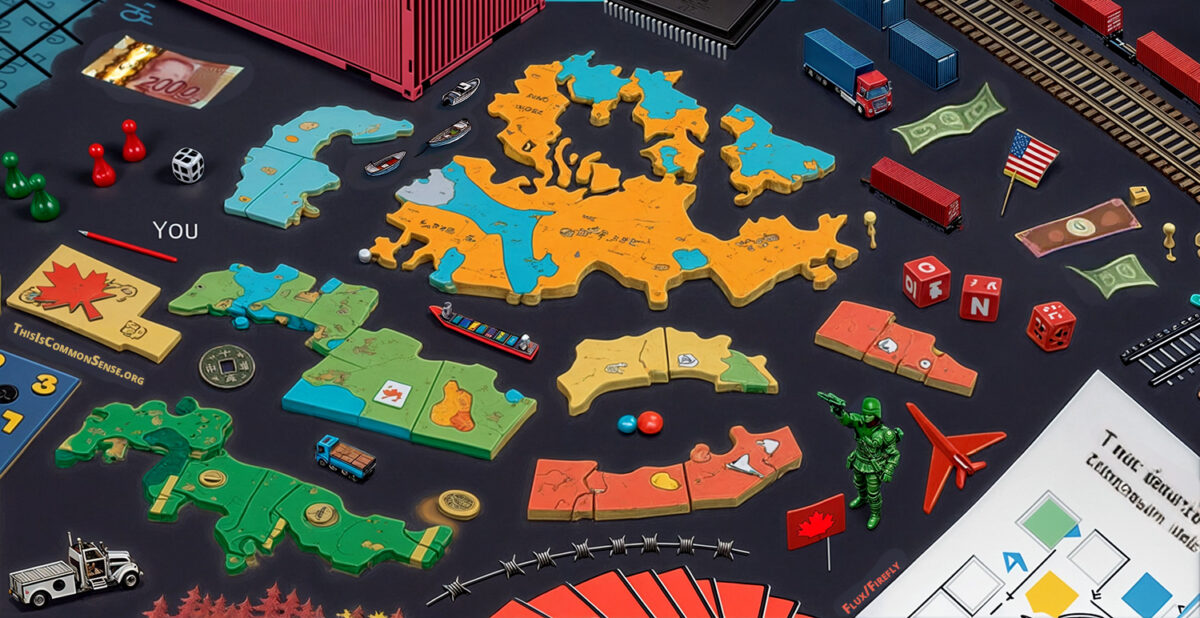
Trump’s Tariff Question

If Donald Trump fails to re-take the White House in November (and then for real in early 2025), his legacy may quickly devolve into a matter for historians, not live politics. After people calm down and the culture war stuff recedes (once again, if allowed by events), what will be left to argue over are a half-dozen major issues, which include war, mass migration . . . and tariffs.

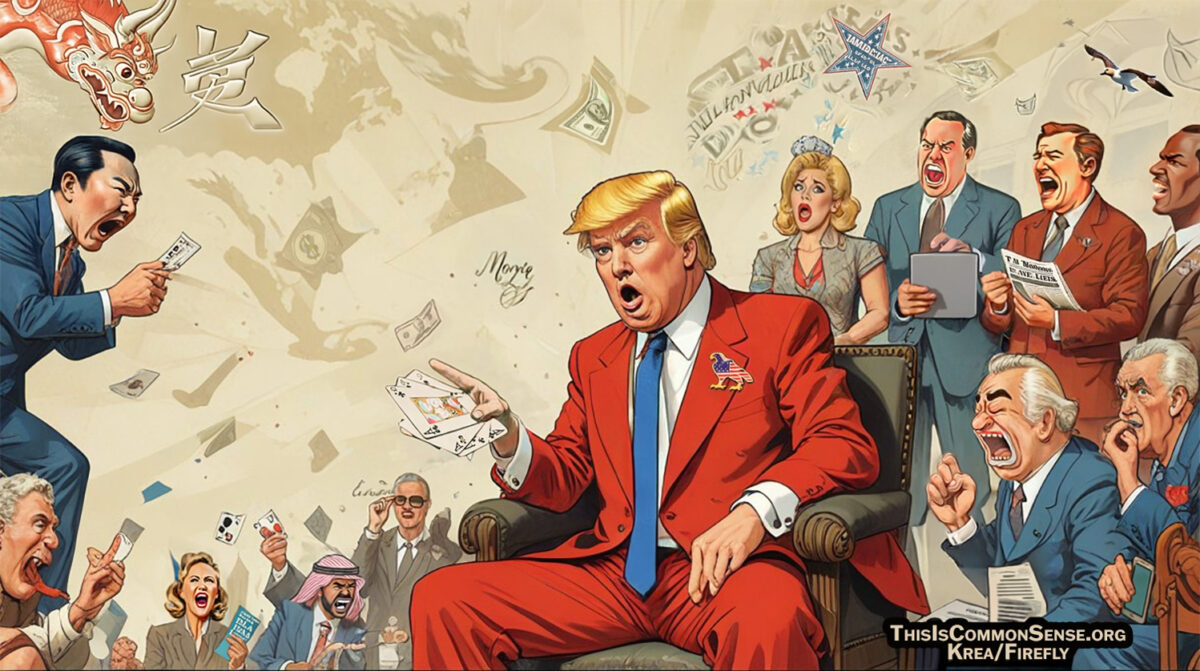
Tariffs have long been Mr. Trump’s major hobby horse; he gets excited about 100 percent levies. The whole business about the “bloodbath” quote was his insistence that American auto industry will be destroyed if Trump himself doesn’t get the chance to erect ultra-high tariffs against automobiles from Mexico.

Trump looks at tariffs on foreign goods as harming foreign nations and helping us, the Americans.

But it is worth noting that economists from Adam Smith and David Ricardo onward have regarded tariffs as chiefly harming consumers within the country that erects them. 

At Reason you can read Veronique de Rugy make the classic free-trade case, anew, in “No, Trump-Style Tariffs Do Not Grow the Economy.” If Frédéric Bastiat didn’t convince you, maybe de Rugy will.

But something’s missing. Surrounding Trump’s talk against free trade in general and China in particular there was always another element that neither Bastiat nor de Rugy emphasize: free-trading with China helps Chinese and Americans, sure; gotcha — but it also helps the Chinese state, and its ruling Communist Party. 

“Trump is an avowed restrictionist on both immigration and trade,” de Rugy writes. But both unchecked immigration and free trade present problems not economic so much as political. It’s about real bloodbaths, actual warfare, not metaphorical ones.

Even if Trump misdiagnosed the domestic economy, he saw problems with China perhaps more clearly than anyone else.

This is Common Sense. I’m Paul Jacob.


PDF for printing

Illustration created with PicFinder and Firefly

See all recent commentary
(simplified and organized)
See recent popular posts