Categories
Accountability general freedom individual achievement Popular

Settling the Science

A paper in the august science journal Nature,* on the oceans’ “thermal inertia” and the ominous temperature rise therein, has been corrected. But not before the BBC (and other media outlets) ballyhooed the results in the usual “climate change”/“global warming” narrative: “Climate change: Oceans ‘soaking up more heat than estimated’” (Nov. 1).

The paper’s initial new (and alarming) estimate, however, proved wrong.

Over at Real Climate, one of the co-authors clarified the changes that had to be made: “The revised uncertainties preclude drawing any strong conclusions with respect to climate sensitivity or carbon budgets . . . but they still lend support for the implications of the recent upwards revisions in” . . . well, I will let you make sense of it.

I am not a climate scientist, nor do I pretend to be one on the Internet.

What is important to note is that the “strong conclusions” reported on were found to be groundless. 

Mistakes were made.

How were those mistakes identified?

They were caught at the ClimateEtc.not an “august science journal” — published online at judithcurry.com.**

Nic Lewis, the astute blogger, identified a major source of the inaccuracy in the original paper as having arisen “primarily because of the inappropriate assumption of a zero error in 1991.”

We have just witnessed science in action — the public testing of published findings.

“The bad news,” Dr. Roy Spencer reminds us on his Global Warming blog, “is that the peer review process, presumably involving credentialed climate scientists” — note the dig — failed to catch the error “before publication.”

The crucial science happened afterwards, online. 

This is Common Sense. I’m Paul Jacob.


* “Quantification of ocean heat uptake from changes in atmospheric O2 and CO2 composition,” by L. Resplandy, R. F. Keeling, et al.

** I have had occasion to mention climate scientist Judith Curry in the past.

PDF for printing


» See popular posts from Common Sense with Paul Jacob HERE.
 

Categories
ideological culture individual achievement local leaders national politics & policies term limits

THRO

What can one person do?

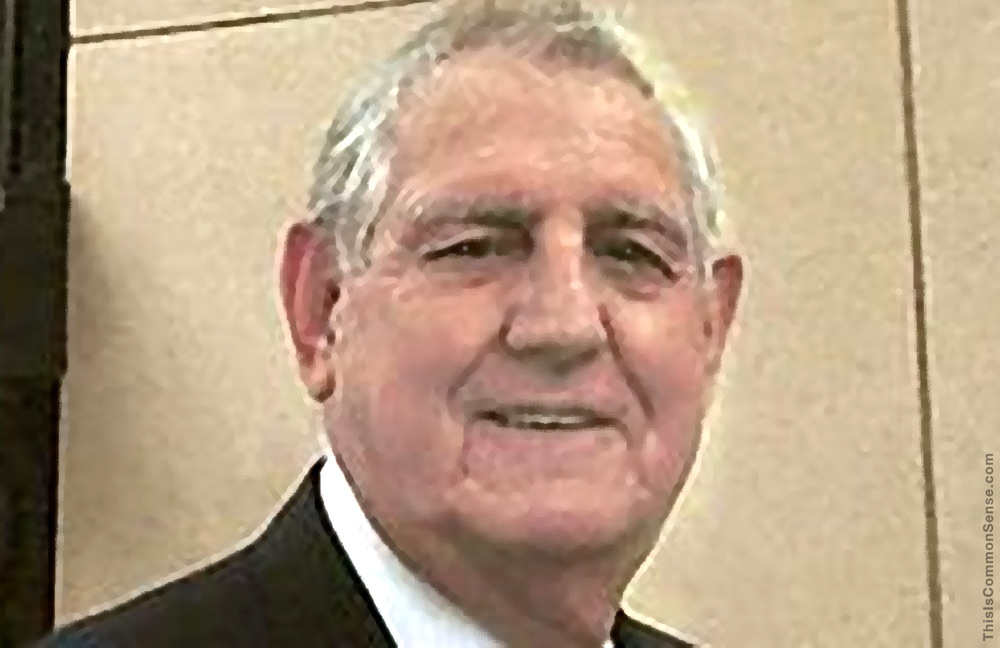
I wish Jack Gargan were here to answer that question — I can almost hear his characteristic chuckle, see the glint in his Irish eyes, in preparation. But sadly, Jack passed away late Sunday night or early Monday morning in Thailand, where he had retired. He was 88 years of age.

This loss, coming on the cusp of yesterday’s election, transported me back 28 years ago — to the 1990 election, when the anti-incumbency, pro-term limits movement was in its infancy.

I had worked all year in Illinois on my first-ever ballot initiative campaign, the Tax Accountability Amendment. Though polls showed our issue at 75 percent support, the Illinois supreme court tossed it off the ballot. I was pretty bummed.

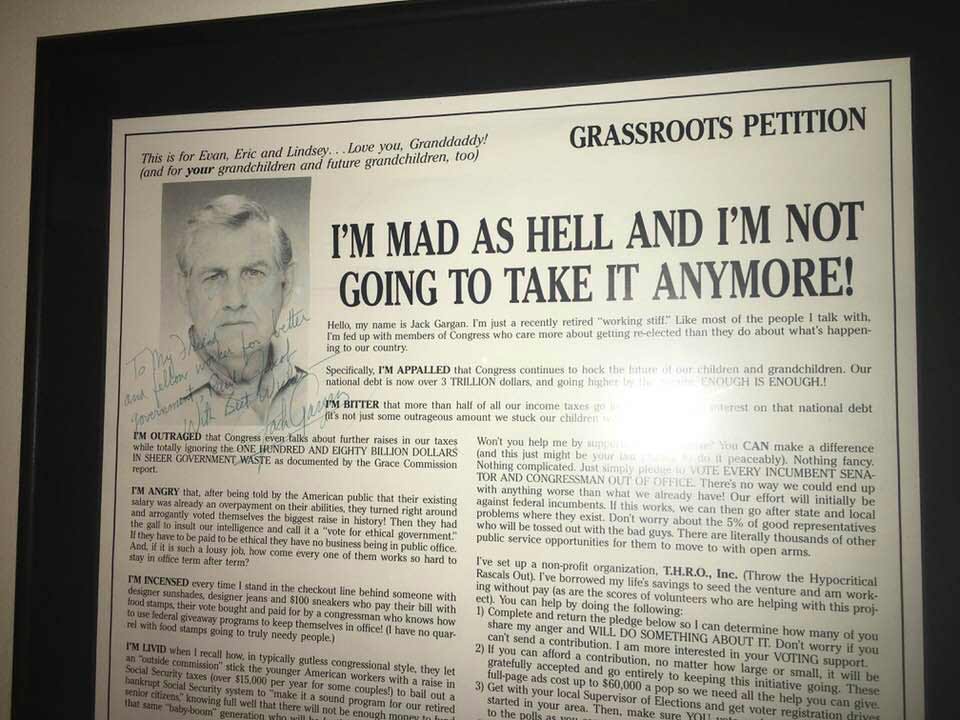
That’s when I saw a full-page newspaper advertisement with a picture of a regular-looking fellow next to a big, bold headline (borrowed from the 1976 movie, Network): “I’M MAD AS HELL AND I’M NOT GOING TO TAKE IT ANYMORE.”

The ad took politicians in Congress to task for “arrogantly [voting] themselves the biggest pay raise in history,” having “abetted” the Savings & Loan crisis, and turning the United States into “the world’s biggest debtor nation.”

Citizen Gargan pulled $50,000 out of retirement funds to purchase those first advertisements.

And my nerve wasn’t the only one touched. Hundreds of thousands of Americans contributed to allow his all-volunteer organization — Throw the Hypocritical Rascals Out (THRO) — to run, as Wikipedia records it, “633 full-page newspaper advertisements in nearly every major newspaper in the nation.”

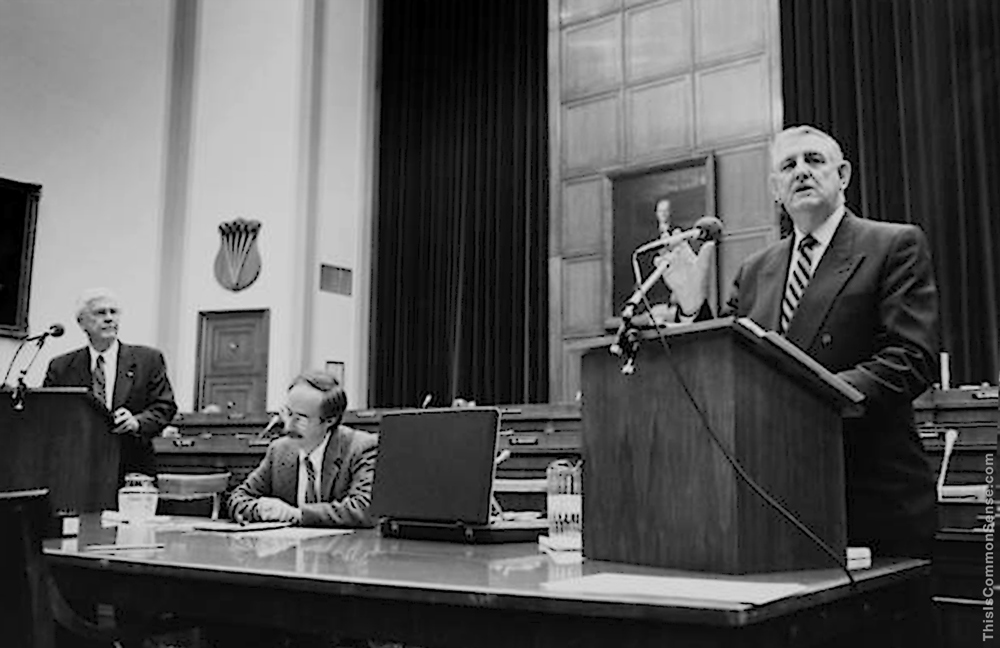
In addition to earning the title “the father of the term limits movement,” Jack Gargan also served as the driving force, Richard Winger’s Ballot Access News notes, in getting Ross Perot to run for president in 1992.

What one person can do!

This is Common Sense. I’m Paul Jacob.


Jack Gargan


PDF for printing


Categories
individual achievement obituary

Andrea Millen Rich

It has been hard to find the words to express my sense of loss upon the passing of Andrea Millen Rich, one of the sweetest, most glamorous, and toughest champions of liberty I have ever had the privilege to know. Fortunately, the Cato Institute has produced a beautiful short video in which many of her good friends pay tribute to her achievements, explaining why they benefited so much from their relationships with her.

For many years Andrea was the proprietor of Laissez Faire Books. She also played an important role in the early years of the Libertarian Party, among other things helping to develop the excellent Clark for President television ads in 1980.

Many in the video tribute speak glowingly of Andrea’s wisdom, candor (or “crankiness”), generosity, and ability to bring people together.

Tom Palmer observes that the lives of people all over the world “have been shaped in a positive way by Andrea. I think she was, globally, one of most important libertarian leaders of the last hundred years.”

Jim Powell, David Boaz, Ed Crane, Chris Edwards and Ian Vásquez discuss the role of Laissez Faire Books — with tough negotiator Andrea at the helm — in getting great libertarian books into the hands of people who would have had ready access to them in no other way. The situation has changed, now, in this age of the Internet and Amazon. But in the 1980s and 1990s, Laissez Faire Books — and the enthusiastic and illuminating way its wares were promoted by editors like Roy Childs and Jim Powell — was a lifeline for many friends of liberty.

Sandy Gelfond, Chris Hocker, Anita Anderson and others remember what a loving team Howie and Andrea Rich always were. They had met while working in the Libertarian Party in the early 70s and soon married. “Howie and Andrea always seemed like a perfect, perfect pair,” says Peter Goettler, “and seemed to have such a close and happy partnership. It’s inspiring to the rest of us.”

I can testify to that, having had the honor of working with Howie Rich for most of my adult life — as can my sister, Kathleen Jacob Wikstrom, who wore more than one hat at Laissez Faire Books and worked closely with Andrea for many years. And I will certainly never forget Andrea’s help when I faced prison for refusing to register for the draft, in my early twenties. She was there in my corner — bringing me to New York to speak.

During my lifetime, I have been lucky to know many inspiring people fighting for our freedom. Andrea Millen Rich will long inspire.

This is Common Sense. Thank you, Andrea.


PDF for printing


Categories
Accountability crime and punishment general freedom government transparency individual achievement media and media people moral hazard national politics & policies privacy Snowden U.S. Constitution

Happy Birthday, Edward Snowden

Edward Snowden turns 35 today and begins another year as a fugitive stuck in Russia.

Five years ago, he fled the country to Hong Kong, meeting with The Guardian’s Glenn Greenwald and documentary filmmaker Laura Poitras to discuss documents he had released showing illegal National Security Agency collection of our phone records, social media posts and mega other metadata.

It is not merely Snowden who calls the NSA’s programs unconstitutional, or me, but how a federal judge ruled.

Remember when James Clapper, President Obama’s Director of National Intelligence, wittingly misled Congress by claiming our private information was not being swept up, except “unwittingly.” We only know that Clapper fibbed because of what Snowden divulged.

“[T]he breaking point was seeing the Director of National Intelligence, James Clapper, directly lie under oath to Congress,” Snowden has explained. “There’s no saving an intelligence community that believes it can lie to the public and the legislators who need to be able to trust it and regulate its actions.”

Clapper is free, collecting his pension. Snowden has been indicted under the Espionage Act, which unconstitutionally limits his defense.

Snowden sure has paid for his courage. He was making very good money, and living with his girlfriend in Hawaii, when he decided he had a duty to alert us to our government’s lawlessness — at the cost of his livelihood, his future, his very life, perhaps.

While our leaders call him a traitor, I call him “friend.”*

Edward Snowden is a friend of every American who cherishes our Fourth Amendment right “to be secure in [our] persons, houses, papers, and effects, against unreasonable searches and seizures.”

Freedoms the government was secretly stomping upon.

It is time to bring him home.**

Ed Snowden, thank you for your service. Happy Birthday!

This is Common Sense. I’m Paul Jacob.


* I feel a connection to Mr. Snowden, and have an inkling of what it’s like to do what you believe is right and to find yourself wanted by the government, on the run, far from home.

** Snowden deserves a presidential pardon. But he has said he would even return to face prosecution, provided the charges did not preclude him from defending his actions in open court.


PDF for printing


Categories
general freedom individual achievement local leaders political challengers responsibility

Liberty Rising?

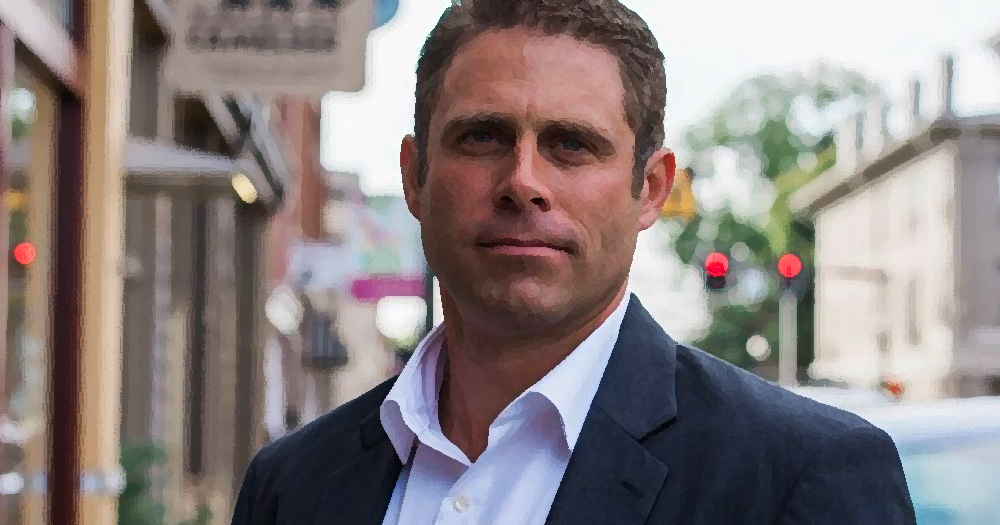
“Let me make something very clear,” Nick Freitas stated unequivocally. “I don’t have a political career.”

Freitas, a Republican member of Virginia’s House of Delegates announcing his candidacy for the United States Senate, was responding to advice that running against incumbent Sen. Tim Kaine “could hurt [his] political career.”

It’s music to my ears. And to Matt Kibbe’s. The leader of Free the People calls Freitas “the most interesting liberty Republican you’ve never heard of.”

Yet, in Virginia’s conservative networks, Freitas has made quite a name for himself, defending the Second Amendment and fighting Medicaid expansion in a one-seat GOP-majority House.

“You can’t fix everything through government force and coercion,” he explained to Kibbe. “If the path we’re going down, which is just ‘let us manage the federal government as it continues to expand, as it continues to increase debt,’ that’s just not a Republican Party I’m interested in.”

Del. Freitas added that the American people seem similarly uninterested.

Perhaps he is simply telling us what we want to hear. He wouldn’t be the first bait-and-switch politician. But Freitas isn’t exactly playing for the bleachers by naming Calvin Coolidge rather than Ronald Reagan as “the best president of the 20th century.”

And he talks about individual liberty, which, he explains, is “based off the premise that I have a right to pursue happiness in accordance of what my definition of happiness is, so far as it doesn’t infringe on your right to do the same thing.”

He had me with “I don’t have a political career.”

This is Common Sense. I’m Paul Jacob.


PDF for printing


Categories
general freedom individual achievement media and media people national politics & policies responsibility

Red Roadster Rides Outer Space

On Tuesday, SpaceX launched one of the largest rockets ever, the Falcon Heavy. Because it is still experimental, it didn’t carry up an expensive satellite. Too early for that. Instead, it has sent up a Tesla Roadster.

And it’s not aiming for orbit . . . around Earth.

It’s aiming for, well, “a precessing Earth-Mars elliptical orbit around the sun.”

All the while playing the late David Bowie’s “Space Oddity.”

This is all very bizarre, of course. But SpaceX is headed by Elon Musk, who is one of those daring people who do daring things. The very fact that he kept finding funding (no small amount of it from taxpayers, sadly) for Tesla Motors (which he also founded), while failing to make a profit, is a tribute to . . . something.

Sending Musk’s personal car into space — to circuit Sol for a billion years — is, the visionary says, at least not boring. (Musk, perhaps not coincidentally for that word choice, also founded the Boring Company.) The Roadster, “piloted” by a dummy “Starman,” is an upgrade with flair.

But who is he playing to? The masses of auto buffs? Stargazers? Science fiction fans?*

Maybe the mad-scientist/eccentric-mogul is playing for bureaucrats, Capitol Hill staffers, and politicians. For, by one estimate, his companies have received $4.9 billion in government subsidies.

So, think of what’s going into orbit as just another part of the skyrocketing — spacerocketing — federal debt.

This is Common Sense. I’m Paul Jacob.


* The odd payload choice might make sense in sci-fi context, for, in the early days of science fiction, one idea often mentioned was to literally send a bomb to the Moon: an explosion, after all, could be seen, in early Space Age days, with old technology right here from Planet Earth surface. This was the case in the boys’ book The Rocket’s Shadow as imagined in 1947.


PDF for printing


Categories
general freedom individual achievement

Happy New Year!

As we turn the page to a new calendar year, here’s hoping that 2018 is (a) as interesting as the year just past, while being (b) a bit more productive of freedom, accountability, and all the good stuff we strive to achieve in our personal, family, business and community lives.

Categories
general freedom individual achievement

Desert Royalty

I know people who are trying to set up their own countries. Folks at the Seasteading Institute, run by Milton Friedman’s grandson, Patri, are preparing for a floating civilization. But that scheme depends on homesteading the open sea.

Land would be easier, no?

Trouble is, there is not much land on the planet unclaimed by any modern state.

But there is at least one.

Which is where Suyash Dixit comes in. Mr. Dixit, described as an “Indian adventurer” at The Telegraph, “has declared himself the ruler of an unclaimed strip of land in North Africa and is encouraging interested parties to apply for citizenship,” writes Mark Molloy.

That “strip” of land (I’d call it a “patch,” since it looks like an irregular quadrilateral to me) is Bir Tawil. As a result of the vagaries of the British Empire’s map drawing and re-drawing efforts, and the subsequent push and pull of local politics, neither bordering nation (Egypt and Sudan) claims it as theirs.

Oops.

But their oops is Mr. Dixit’s opportunity. He hired a cab (paying a huge fare, he says) and travelled to and around the uninhabited region.

No one lives there. There is not much but desert sand and rock. But it is technically livable.

According to Dixit, the “ethics and rules” of ancient civilizations required that “to claim a land” one must “grow crops on it. I have added a seed and poured some water on it today. It is mine.” He calls Bir Tawil the Kingdom of Dixit, now, and has dubbed himself (à lá Game of Thrones?) “Suyash Dixit, first of my name.”

You can find him on Facebook as @KingSuyashDixit.

This is Common Sense. I’m Paul Jacob.


PDF for printing


Categories
general freedom individual achievement

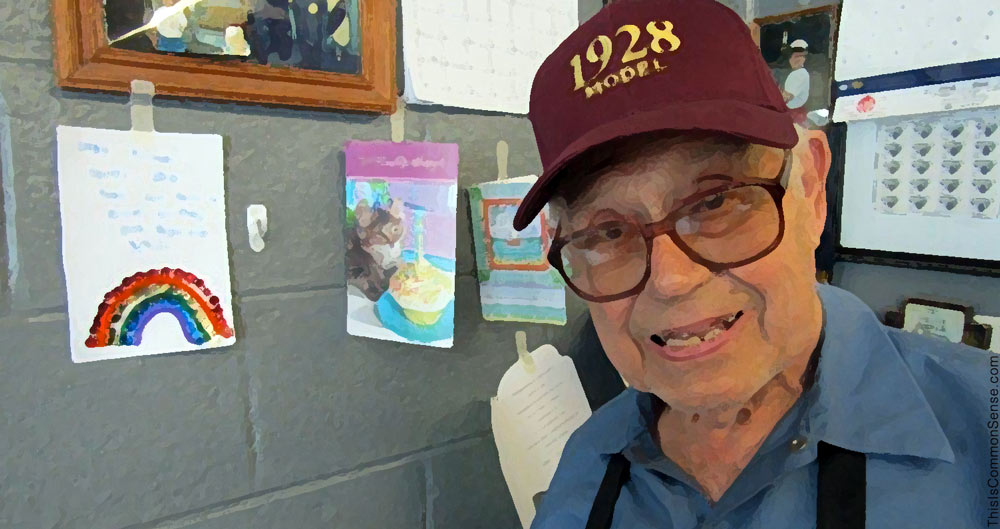
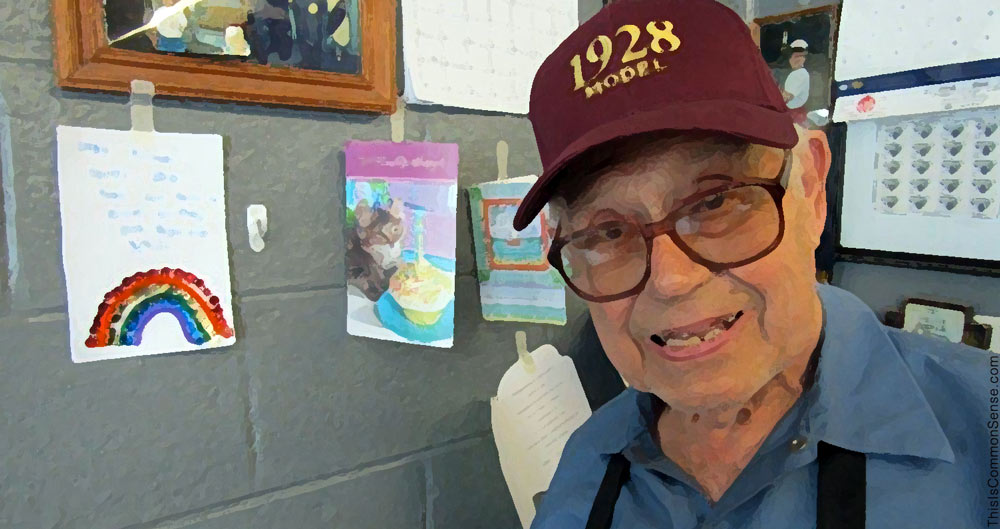
Hardy at 89

Hardy Johnson marked his 89th birthday by doing what he’s always doing, working as a cobbler at Custom Shoe Builders in Knoxville, Tennessee. His son, who manages the business that his dad founded in 1953, was out of town. The back orders had been piling up. And Johnson takes only one day off each week anyway.

In a profile for The Knoxville Focus, Steve Williams observes that many people make it to 89, but few “still work six days a week like Hardy . . . or on their birthday.”

Friends dropped by all week long, and on the day itself neighbors at Henson’s Automotive and Alignment swung by with cupcakes and coffee. Johnson also enjoys an ongoing sweet barter deal with the owner: Johnson supplies Steven Henson with shoe and other repair work, Henson supplies brake jobs and oil changes.

Henson testifies to the cobbler’s work ethic, saying he “can set my clock to Hardy every morning at 7:15 when he pulls into the parking lot. He’s the best neighbor I’ve ever had. He’s a great guy.”

Why didn’t Hardy Johnson take it easy on his birthday?

Maybe because doing work that he enjoys and does well is one of the things he’s celebrating as he enters his golden years. Maybe that — and being a great guy — is how you get to be 89 to begin with.

Not that he’s perfect. It doesn’t seem to bother him that his dog is an admitted Democrat.

This is Common Sense. I’m Paul Jacob.


PDF for printing


Categories
free trade & free markets individual achievement

Not Just a Recycled Rocket

Last Thursday, SpaceX successfully re-used a previously flown rocket to launch a payload into orbit.

Sure, NASA had re-cycled rocket parts before. That is, the U.S. space agency had recovered spent rockets.* But those were rebuilds.

SpaceX’s most recent triumph was to launch a “stage one” rocket that had gone into space before —and returned. Last April it delivered a payload to the International Space Station and then safely touched down vertically** — just like in 1950s sci-fi!

You could see the evidence: the weathered look of the rocket fuselage.

This Falcon 9 rocket not only placed its Luxembourg-owned SES-10 into orbit last week, it then returned — again! to its ocean “drone ship” platform.

A new age in space commerce thereby hit a new landmark.

Or would that be “spacemark”?

Re-using a rocket is like how airlines re-use jet aircraft. Less waste, expense. Making the whole industry more viable. The technology and expertise to safely land and recover the rocket is astounding.

Alas, videocasting of the most amazing part of the effort, the landing and recovery of the Falcon 9 rocket, failed — noticeable by its lack in both the live Periscope feed and the YouTube archive. But we had seen that very same rocket land last April, onto SpaceX’s charmingly named droneship, Of Course I Still Love You.

Ocean mark? Drone mark? It hit the mark, whatever you call it.

Elon Musk, head of SpaceX, had every reason to breathe a sigh of relief, as well as engage in some apt exultation, after the mission.

We can, too. Space industry privatization and progress? Actually happening.

This is Common Sense. I’m Paul Jacob.


* The Space Shuttle was a different technology entirely, a re-usable spacecraft. What we are talking about today is the powerhouse stage-one booster rocket, like the old Saturn V that the Apollo program famously exploited.

** The Space Shuttle, remember, landed horizontally, like an airplane. Future re-usable manned spacecraft will no doubt do this. A private return-entry spacecraft, like Virgin Galactic’s SpaceShip Two, put into orbit by a re-usable Falcon 9 rocket, would be the next logical new achievement. Though, obviously, these are different companies with tech that is not, I think, meant to work together.


Printable PDF