Categories
crime and punishment ideological culture media and media people

Police Supremacy

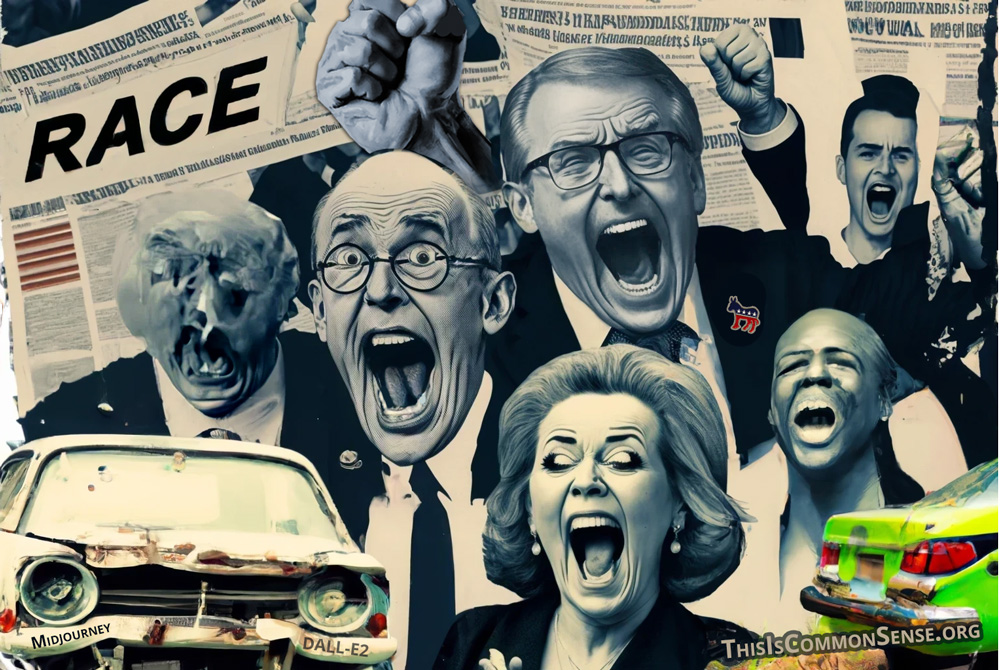
The homicidal beating of Tyre Nichols by five cops made the news, the reels and the opinion columns, quickly and “bigly.” You know that the first reaction was to cry Racism!, and that then, after it came out that the policemen charged with his murder were all black . . . it was still Racism! 

You might have laughed. If bitterly.

Van Jones’s headline seems, on the face of it, ridiculous: “The police who killed Tyre Nichols were Black. But they might still have been driven by racism” (January 27, 2023).

Yet, the actual arguments aren’t completely absurd.

Just the big picture is.

Today, we’ve been given a new set of definitions. Racism is no longer prejudiced discrimination against individuals based on antipathy against a hated group, now it’s “prejudice plus power,” and . . . somehow the new anti-racists don’t realize that power isn’t just about race.

It wasn’t likely internalized hatred for blacks that these black policemen exhibited. Far more likely it was exasperation and contempt for a man who wouldn’t submit to their control.

Police have a job, and are given a lot of license and leeway to take away our liberty after a suspected crime. Tyre Nichols did not readily submit to an arrest for reckless driving, but bolted, running away. When the cops caught up with him, they gave him a beating. Was it because he was black? Not likely, or at least not primarily. It was most likely because he wouldn’t obey.

This old police attitude is more understandable than racism, no?

But “understandable” isn’t excuse

We can meaningfully talk about reforms — such as getting rid of qualified immunity — but first, let’s stop calling it racism and “white supremacy.” The issue is cop supremacy, and it’s not really a mystery.

This is Common Sense. I’m Paul Jacob.


PDF for printing

Illustration created with Midjourney

See all recent commentary
(simplified and organized)
See recent popular posts

Categories
general freedom ideological culture international affairs

Brilliant Billionaire Buffoon

“[China’s] portion of the global economy and their portion of the global population match exactly,” Bill Gates informed his audience at Australia’s Lowy Institute. “Countries like Australia, U.S., we have per capita GDPs five times what the Chinese have, so we have a disproportionate share of the world’s economy.”

Funny that no one made a citizen’s arrest of the world’s fourth richest man, who, when it comes to personal wealth, is disproportionately disproportionate. But maybe the crowd has the respect for what people produce and earn that Mr. Gates appears to lack.

Gates main point was that China’s rise has been “great for the world.” 

While I’m not rooting for the Chinese people to be impoverished, I note that Uyghurs, Hong Kongers, Taiwanese and dissident Chinese aren’t exactly singing the Chinazis’ praises.

. . . except when Uyghurs are forced to sing Chinese Communist Party (CCP) propaganda songs in those re-education camps.

Australians are also well aware of China’s ugly behavior, having suffered under punishing economic sanctions ever since the Australian government suggested an international investigation into COVID’s origin and the CCP’s cover-up.

“Gates also leveled criticism at China,” explained Fortune: the billionaire “philanthropist” 

  • admitted that China is “not a democracy,” 
  • rebuked the country for not getting people vaccinated faster and 
  • referred to it as an “outlier today in terms of that level of wealth and still being as autocratic as they are.” 

Actually, “autocratic” is the nicest term available for such a regime. 

Bill Gates is a brilliant businessman, a billionaire many times over, but a complete buffoon (at best*) for failing to even mention the crimes against humanity being committed by the CCP government. 

When he thinks about world governance, now we know what he doesn’t think about.

This is Common Sense. I’m Paul Jacob.

* “Evil” is another explanation I’ve heard, but I’m not making that case here.

PDF for printing

Illustration created with Midjourney and DALL-E2

See all recent commentary
(simplified and organized)
See recent popular posts
Categories
folly ideological culture media and media people

Mr. Vehement

He’s vehement — vehement with the force of 600,000 Hiroshima-class atomic bombs exploding each and every day. 

Because he cares. 

He really does. 

He really cares about putting the days of Wooden Al Gore behind him and ushering in Apoplectic Foaming-at-the-Mouth-While-Bleeding-From-Every-Pore Al Gore.

It’s just unfortunate though that whilst ratiocinating at Davos, Mr. Gore destroyed the atmosphere and disarranged the solar system, further accelerating global warming and cooling.

If you’re wondering whether I am now just making stuff up, thank you for noticing; yes: I learned it from the best. But I’m sincere. Okay? I’m emoting very hard right now, for which I fully expect to receive social-credit points that I can tape to my COVID-19 passport and wave at the grocery-store clerk as I pay a thousand dollars for a half-dozen eggs.

If only vehemence were facts and cogency, Al Gore would be the most empirical, most logical man alive. As it is, a billion flabbergasted refugees have fled before the force of his rhetoric.

If you don’t believe that Gore not whispered but roared, nay, expectorated, the following, etc., at Davos about how the (man-made) greenhouse effect is trapping “as much extra heat as would be released by 600,000 Hiroshima-class atomic bombs exploding every single day on the earth!! That’s what’s boiling the oceans, creating these atmospheric rivers, and the rain bombs, and sucking the moisture out of the land, and . . . and . . . and —”

. . . then I refer you to the videotape. Roll it, Hal.

This is Common Sense. I’m Paul Jacob.


PDF for printing

Illustration created with Midjourney and DALL-E2

See all recent commentary
(simplified and organized)
See recent popular posts
Categories
folly general freedom ideological culture

The Wreckage of Racism

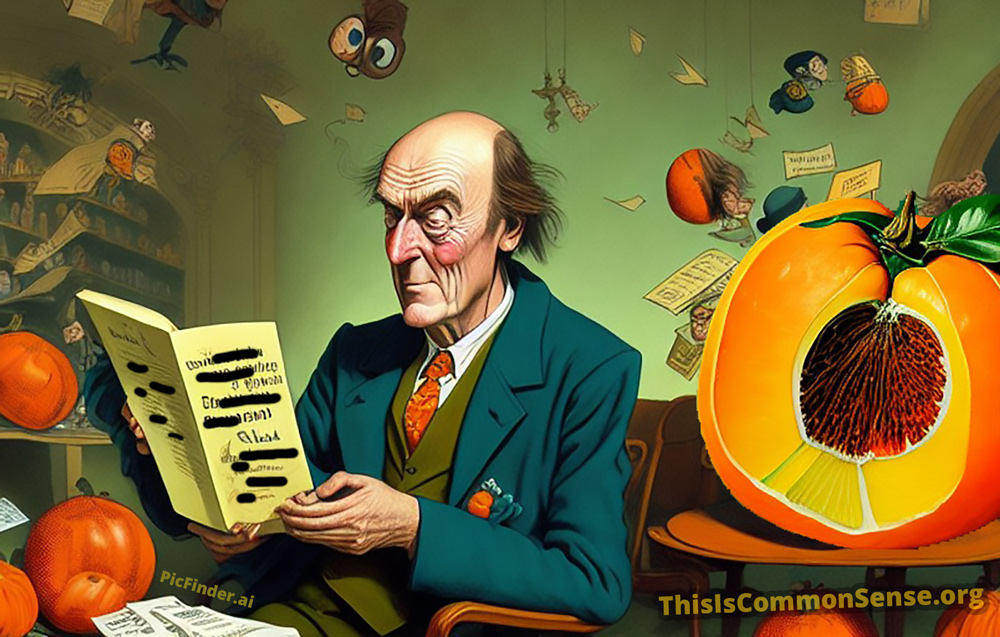
In the “urban forests” of our nation’s capital, several abandoned autos have been discovered. Which can mean only one thing: racism

“Deserted cars may be driving a type of racism,” The Washington Post headlined its take.*

The paper introduces readers to Nathan Harrington, executive director of the Ward 8 Woods Conservancy, who has discovered four decaying automobiles in those woods. 

No one knows how the cars got there. 

All that is known is that their presence is, well, racist

Blacks make up 87 percent of Ward 8’s population, one of the most heavily black areas of the city. “Advocates,” explains The Post, “call this neglect of Black neighborhoods ‘environmental racism.’”

An assistant professor of sociology and environmental studies at Boston College is offered to explain that, as The Post paraphrases, “environmental racism is linked to ‘racial capitalism’ — the idea that the economic value of a person is based on their race.”

And to think I was worrying that those rusting vehicles might be leaching dangerous elements into our environment!

“It’s deliberate inaction on the part of the agencies that control that land,” complains Harrington. Believable enough, on the surface, but we are presented with no specifics as to who has refused to help.

Nor are we provided any evidence that this failure of the DC government, if it even is one, can legitimately be ascribed to racial bias.

 The District of Columbia’s mayor happens to be black, as are eight of 13 city council members.

When four rusted-out cars in the woods become front-page fodder to focus on systemic racism, it seems things are looking up.

This is Common Sense. I’m Paul Jacob.


* This punny headline adorned the dead-tree edition. Online, the article’s headline is: “‘Environmental racism’ and the mysterious cars rusting in D.C. woods.”

PDF for printing

Illustration created with DALL-E2 and Midjourney

See all recent commentary
(simplified and organized)
See recent popular posts

Categories
First Amendment rights general freedom ideological culture

It’s His Party

If you’re a fan of freedom of speech, you’re probably also a fan of the First Amendment of the United States’ Constitution.

Unfortunately, governments keep trying to evade it.

When their censorship can’t itself be evaded, often the only thing to do is go to court. 

Merely showing a copy of the Constitution to the offending officials rarely suffices.

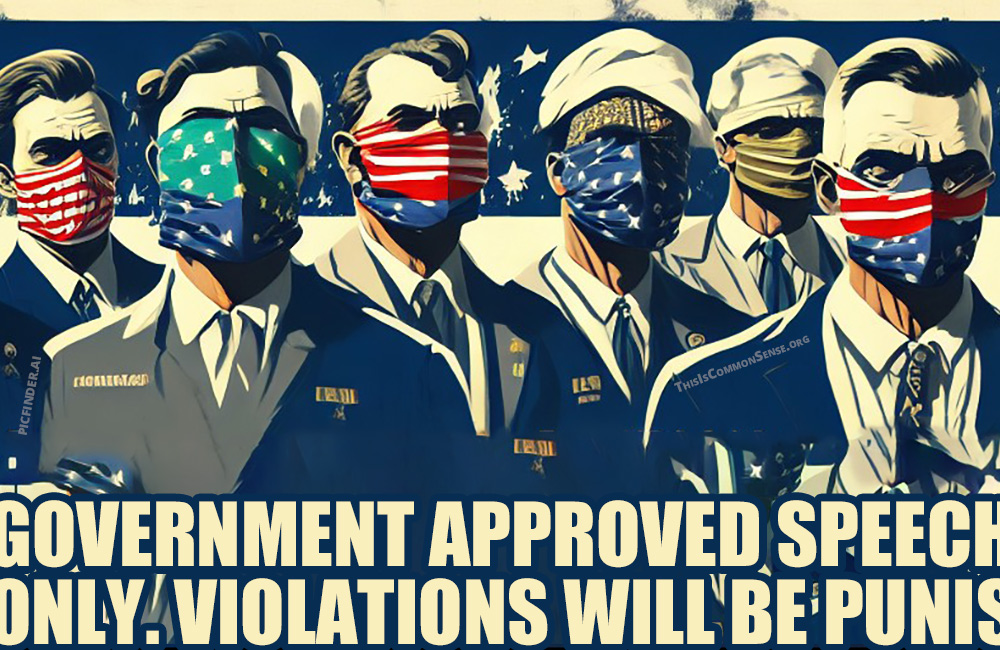
That’s why Kells Hetherington teamed up with the Institute for Free Speech to overturn a Florida statute requiring that “a candidate running for nonpartisan office may not state the candidate’s political party affiliation.” In a 2018 campaign for Escambia County School Board, Kells had been fined for calling himself a “lifelong Republican” as part of his candidate statement on the county’s website. In a later campaign, he kept silent to avoid another fine.

The Institute points out that in violating the First Amendment rights of candidates, Florida’s don’t-say-party law has especially hurt challengers. It has deprived them of a valuable shorthand way of indicating the tenor of their political views, a shorthand that incumbents have many more ways of communicating to voters outside the context of campaign statements.

Kells and IFS have won. Late last year, a district judge in Florida ruled that the First Amendment does indeed protect his right, as a candidate, to mention his political party.

Kells says that “hopefully, this will never happen again to any other candidates.” 

In any case, it’s clear that the Institute for Free Speech will never be out of a job. That First Amendment won’t enforce itself.

This is Common Sense. I’m Paul Jacob.


PDF for printing

Illustration created with Midjourney

See all recent commentary
(simplified and organized)
See recent popular posts

Categories
education and schooling general freedom ideological culture

Inherent Racism of Racism

New Hampshire bans public school teachers from telling kids they’re inherently racist or oppressive because of unchosen traits like skin color.

Some lawmakers want to overturn the ban.

The debated law, Right to Freedom from Discrimination in Public Workplaces and Education, is imperfect. But we live in a world where some taxpayer-funded educators, inspired by noxious doctrines like critical race theory, are eager to accuse students of being inherently racist or sexist or oppressive.

Obviously, though, moral wrongdoing is something chosen. One doesn’t commit it merely by having a certain hue, gender, or ancestors.

So how can one reasonably object to a provision stating that “No government program shall teach [that] an individual, by virtue of his or her age, sex, gender identity, sexual orientation, race, [etc.] is inherently racist, sexist, or oppressive, whether consciously or unconsciously”?

The law itself stresses that it’s not to be interpreted as prohibiting discussion of “the historical existence of ideas and subjects” like racism. Nevertheless, critics falsely claim that the law bans classroom discussion of racism as such. And their repeal bill, HB61, seeks not to perfect the current law but to repeal all sections “relative to the right to freedom from discrimination in public workplaces and education.”

New Hampshire lawmaker Jim Kofalt rightly reminds proponents of HB61 of the vision of Martin Luther King, a future where his children would “not be judged by the color of their skin but by the content of their character.”

This is Common Sense. I’m Paul Jacob.


PDF for printing

Illustrations created with Midjourney and DALL-E2

See all recent commentary
(simplified and organized)
See recent popular posts
Categories
ideological culture international affairs Regulating Protest

Making Symbolism Count

“Governments do unconscionable things every day; it is in their nature,” writes Katherine Mangu-Ward in the February Reason. “But not all transgressions are equal.”

Ms. Mangu-Ward’s piece is entitled “Bodies Against the State,” and though she doesn’t quite come out and say it, not all protests are equal, either, with some deserving more respect than others.

“In China, crowds of people line the streets,” Mangu-Ward writes. “They are holding blank sheets of paper.” This is something I’ve written about, too, in “Point Blank Protest” back in November. “The police nonetheless know what they mean. The leaders of the Chinese Communist Party know what they mean. The world knows what they mean.”

Helpfully, she explains: “the protesters’ goal is to make manifest the implied violence that authoritarian states use to keep order.”

Of course, in China, even more than here (not all transgressions being equal), the state’s violence is too often more than merely implied. 

And in America, the symbolism of protests has been marred by too much violence — something Mangu-Ward mangles in her piece. But the point of pitting oneself symbolically against state crimes remains important, as she explains: “The most perfect and enduring image of a person weaponizing his body against the state was taken after the brutal suppression of protests in Tiananmen Square in 1989. The unknown Chinese man standing in front of a tank didn’t have to hold a sign for the entire world to know exactly what the problem was.”

The art of protest needs some perfecting in the west. When our protests run to riot, their symbolic impact becomes confused, and adds to our ideological strife, clarifying nothing — quite unlike Tank Man, and the blank paper protests.

This is Common Sense. I’m Paul Jacob.


PDF for printing

Illustration created with DALL-E2

See all recent commentary
(simplified and organized)
See recent popular posts
Categories
general freedom ideological culture

It’s a Heroic Life

“An icon with such well-established status is an irresistible target,” The Bulwark’s Claire Coffey writes about the holiday season favorite, It’s a Wonderful Life, “and the competition to come up with the definitive contrarian takedown of the film is now a Christmas sub-tradition in its own right.”

Last year, I had to correct Washington Post columnist Monica Hesse, who belittled protagonist George Bailey as “the tortured Boy Scout-type,” arguing that Mary, his wife, was “the real hero.”

One of the nicest things about the movie is that mythical Bedford Falls has a lot of ordinary heroes . . . just like in real life. And Mary is right at the top of the list. But with her husband George, whom she dearly loves, not instead of or as his chief competition. 

“George Bailey Isn’t the Hero of ‘It’s a Wonderful Life,’” insists the headline to Mickey Randle’s recent column at Collider, where we learn that “many of [George’s] responses to hardship” are “less than admirable.” I don’t know about “many,” but George does throw something of a tantrum upon discovering that his business will go bankrupt and he likely end up in prison. 

Hate me if you must, but I might throw a momentary fit, too, at that set of circumstances.

“Mary bears almost identical burdens,” notes Randle, “and always responds productively.” Of course, even Mary gets angry in one scene and smashes one of her favorite records. Apparently, this wonderful woman is not perfect. Who knew?

Randle concludes by calling the movie “significant because of its observations on gender,” suggesting: “We just have to remember to see things from Mary’s perspective.” 

But can anyone who knows Mary claim that George is not a hero from her perspective?

One major point of attack on the film has been the idea that, if George “had never been born,” the sweet and beautiful Mary would certainly not be “an old maid,” as depicted. Granted, her being single would not be for lack of trying by every able-bodied, cisgendered male person in Pennsylvania. But in her piece at The Bulwark, Coffey gets this right by noticing, “Mary could marry any man in town. She doesn’t want to. She wants George.”

Seems to me the criticism is intended to obscure the powerful moral of this movie: that good guys and good gals are winners, not losers. And that two people in love and committed to doing what they think is right are as unconquerable as anything this world has ever known. 

When push comes to shove, I put my faith in that tantrum-throwing George Bailey and the record-smashing Mary Bailey . . . working together. 

This is Common Sense. I’m Paul Jacob.


PDF for printing

Illustration created with DALL-E2

See all recent commentary
(simplified and organized)
See recent popular posts

Categories
First Amendment rights ideological culture nannyism social media

Reversal of Charge

Using PayPal never guaranteed smooth sailing.

But until recently, the problems users encountered mostly pertained to PayPal’s targeting of fraud — not with whether a user uttered wrong thoughts or pursued projects disfavored by corporate implementers of a Chinazi-style social credit system.

More and more, though, PayPal is informing individuals with unwelcome thoughts that they can no longer use PayPal and that PayPal will hold their funds “for up to 180 days . . . we’ll email you. . . .”

PayPal has, for now, rescinded — or partially and temporarily rescinded — policy provisions pledging to fine users $2,500 for “misinformation” or “hate speech.” 

But PayPal is still targeting thinkers of wrongthink.

An example is Eric Finman, whose Freedom Phone provides access to apps banned elsewhere. After ousting him, PayPal held onto $1.2 million in his PayPal balance. Finman eventually recovered the money, but the delay “killed all the momentum.”

Biologist Colin Wright was ejected for criticizing gender ideology. PayPal won’t confirm this without a subpoena. But these and many other examples follow a similar pattern. Often, PayPal comes down like a ton of bricks right after a user utters a viewpoint PayPal dislikes.

I’m appalled. Many of PayPal’s founders — Peter Thiel, Elon Musk, David Sacks and Max Levchin — are appalled. They say that PayPal’s original mission of empowering people is being perverted.

We’ve seen how government officials and partisan political operatives have whispered in the ears of Facebook and Twitter, instructing such companies to censor and deplatform users. Are they also instructing PayPal?

This is Common Sense. I’m Paul Jacob.


PDF for print

Illustration created with DALL-E2

See all recent commentary
(simplified and organized)
See recent popular posts

Categories
ideological culture judiciary too much government

Right Color Only

The latest battle over race-conscious affirmative action policies is taking place over a loan forgiveness program in the Providence, Rhode Island, public school district.

The Legal Insurrection Foundation is suing to overturn an “overtly racist and discriminatory” program being implemented by a district that receives millions in federal funding. Which means that all taxpayers are indirectly subsidizing this sort of thing.

According to the district’s new policy, an applicant for a teaching post can get up to $25,000 in college loans paid off if he teaches for three years in a row in the district. The incentive seems innocuous enough until you learn that beneficiaries of the grant, being funded by a Rhode Island charity, must “identify as Asian, Black, Indigenous, Latino, biracial, or multi-racial.”

The specification that one must “identify as” a member of one of these races may sound as if persons of unambiguously blanco tint need merely “identify as” Black or Indigenous or the like to get around the whites-need-not-apply exclusion. But such a mode of circumvention — even if, as seems unlikely, it could succeed to the extent that officials pretended to believe the claim — would require applicants to lie or become delusional. 

To match this delusional policy, no doubt.

But the policy would still remain racist and discriminatory.

The Foundation’s filing quotes a dictum that if universally accepted would put an end to all this nonsense: “The way to stop discrimination on the basis of race is to stop discriminating on the basis of race.”

This is Common Sense. I’m Paul Jacob.


PDF for printing

Illustration created with DALL-E 2

See all recent commentary
(simplified and organized)
See recent popular posts