Categories
ideological culture national politics & policies regulation

Children’s Crusade Goes Forth

In 2015, a group of young people sued the federal government.

The government’s allegedly actionable dereliction was having “known for decades that carbon dioxide pollution was causing catastrophic climate change . . . and a nation-wide transition away from fossil fuels was needed to protect plaintiff’s constitutional rights.”

The government “recklessly allowed” transport of fossil fuels, combustion of fossil fuels, etc.

I blame the lawyers more than the kids for the filing’s falsehoods and non sequiturs. Outlawing fossil fuels would be the actual catastrophe and actual reckless violation of individual and constitutional rights.

Climate variations are nothing new in the earth’s four-billion-year history. We should expect to see all the usual dry spells, hurricanes, and tornadoes that have buffeted human beings since we emerged as human beings. Fossil fuels help us to protect ourselves from these things.

Government cannot outlaw fossil fuels slowly or quickly without in effect putting a gun to the heads of everyone who wants to use a gas-fueled car, bulldozer, or airplane and saying, “You have no right to take the actions required for your survival.”

Efforts by several states and the federal government to outlaw various uses of fossil fuels are what deserve lawsuits.

Judge Ann Aiken, who recently had a chance to end this litigation but is illogically allowing it to move forward, has one thing right: “Some may balk at the Court’s approach as errant or unmeasured. . . .”

I balk. It’s errant. And over the top.

This is Common Sense. I’m Paul Jacob.


PDF for printing

Illustration created with PicFinder and Firefly

See all recent commentary
(simplified and organized)
See recent popular posts

Categories
education and schooling ideological culture scandal

The “Racial Animus” Gambit

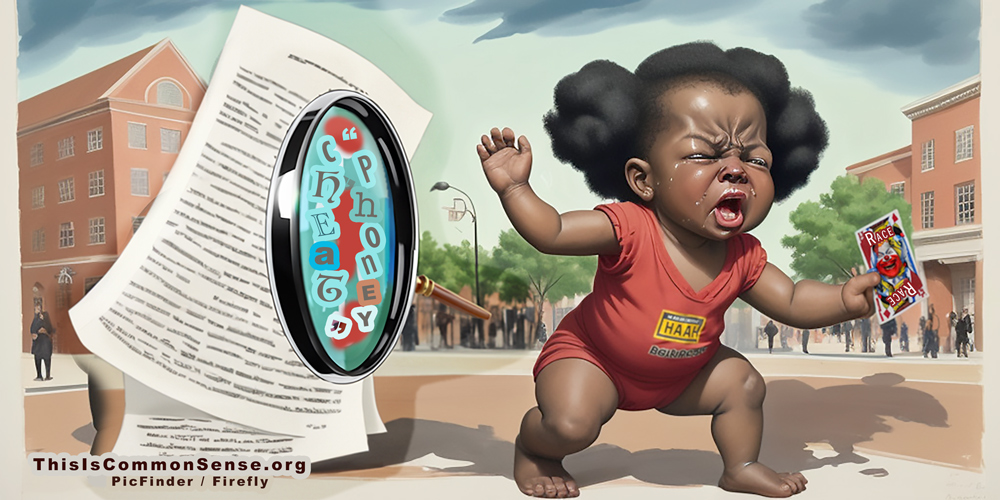
Among the deflections littering former Harvard President Claudine Gay’s resignation letter is the claim that major criticisms of her conduct are “fueled by racial animus.”

The controversies have made Gay, a black woman, very visible. She may have been subjected to racial attacks in emails or on somebody’s blog. I haven’t seen reports of such. It’s possible.

But her letter makes it seem as if she feels all of it, all the criticisms of her understanding of policies regarding the treatment of Jews on campus and criticisms of her own treatment of the words of others in her published work, were “fueled by racial animus.”

If only blacks alone were ever charged with ambiguity about antisemitism or committing plagiarism, the implication might be at least superficially plausible. 

But it’s not.

Yesterday, I discussed the considerations that properly affect campus speech policies (“The Resignation”).

Here let me note, first, that scholars of all hues and sexes have been plausibly accused of plagiarism. Example: historian Doris Kearns Goodwin, white woman. Male example: Steven Ambrose.

And, second, that Harvard’s backing and filling and own animus in response to documented charges of plagiarism have converted the matter from a problem mostly for Claudine Gay personally to a problem for Harvard as an institution. By violating its own policies for dealing with the charges and by attacking the messenger, Harvard seemed to be saying that standards of scholarship like “Don’t plagiarize” don’t matter.

But they do.

This is Common Sense. I’m Paul Jacob.


PDF for printing

Illustration created with PicFinder and Firefly

See all recent commentary
(simplified and organized)
See recent popular posts
Categories
education and schooling general freedom ideological culture

Division, Exclusion, Indoctrination

Wisconsin has decided to stop using tax dollars to subsidize ideological assaults on academic freedom.

Under the leadership of Assembly Speaker Robin Vos, the Wisconsin legislature struck a blow against DEI domination of the state’s university system.

The acronym means “diversity, equity, and inclusion.” Yet, the goal of DEI is to herd all participants in academic life into the same collectivist “antiracist,” anti-individualist straitjacket, no dissent permitted. What DEI really means, Vos says, is “division, exclusion, and indoctrination.”

The Vos-steered budget that passed in the last session eliminated $32 million from funding for the university system. It also hiked the pay of university employees and funded new campus buildings.

Using his line-item veto, the Democratic governor tried to thwart the move. But he couldn’t block the spending cut.

Then, after much negotiating, the university system agreed to freeze hiring of DEI officials, transfer DEI employees to other jobs, and implement race-blind, merit-based admissions policies.

Bullied by lefties, the board of rejects initially rejected the deal by a 9–8 vote. Vos wouldn’t budge. The board met again and accepted the deal.

As National Review’s editors put it, “when push came to shove, it wasn’t worth rejecting pay raises for all employees and putting building projects on hold for the sake of a handful of progressive ideologues.”

Until the whole house of cards collapses and there’s no longer any public funding of higher education, all states assailed by DEI should do the same kind of thing.

This is Common Sense. I’m Paul Jacob.


PDF for printing

Illustration created with PicFinder and Firefly

See all recent commentary
(simplified and organized)
See recent popular posts
Categories
ideological culture national politics & policies

A Great Big “Request”

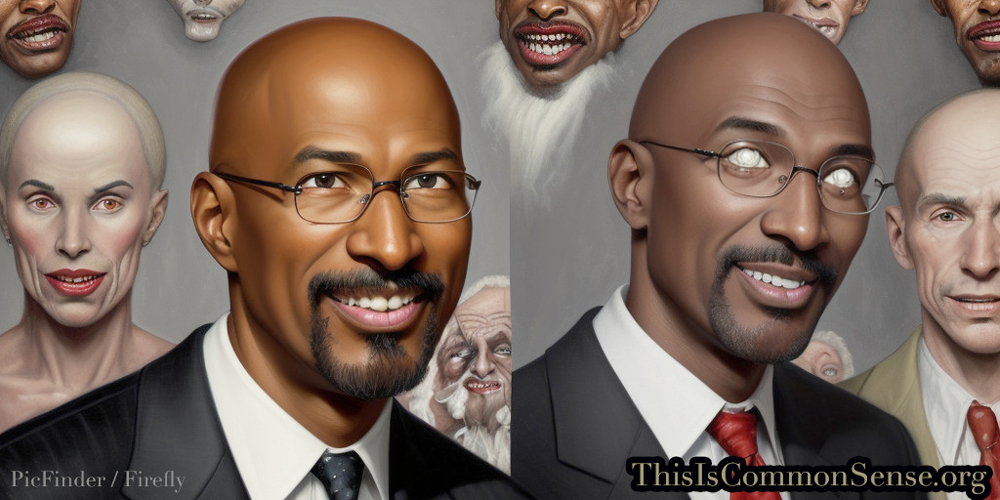
“You are witnessing the rise of an American demagogue,” said Van Jones.

He was not referring to himself.

The CNN talking head was reacting to something Vivek Ramaswamy said during the last Republican presidential candidates’ forum — another one lacking the main candidate, the overwhelming favorite Donald Trump.

Van Jones, who is African-American, called Vivek, who is Indian-American, “a very, very despicable person.”

At issue is something the Republican candidate discussed: “Great Replacement Theory,” which is the notion that politicians and other insiders are using a variety of means to discourage white people from having babies while encouraging brown people to have babies . . . and for non-Europeans to come into the country both legally and illegally. The idea is that with a white minority in America, a different (or same-old/same-old?) politics will emerge (solidify). 

The theory is plenty controversial, in no small part because a few racists have listed it as an excuse to “justify” mass shootings.

But also controversial? It looks like it is more than a theory, it is a plan.

Vivek pointed this out in a tweet. He produced a video from two years ago in which Van Jones himself outlined the “theory” as a strategy: “The request from the racial justice left: we want the white majority to go from being a majority to being a minority and like it. That’s a tough request, and change is hard.”

Yet Jones regards this “request” as something it would be demagogic — even racist — to refuse.

Jones’s leftism does not look like “racial justice” so much as a racial vendetta.

This is Common Sense. I’m Paul Jacob.


PDF for printing

Illustration created with PicFinder and Firefly

See all recent commentary
(simplified and organized)
See recent popular posts

Categories
ideological culture Internet controversy social media

Die, Disney, Die!

Disney is taking big financial losses, after a series of bombs on the silver screen and on its own channel, including a billion on last year’s four film fiascos.

Why?

The company went super-woke. And could, therefore, go broke.

Or, says Patrick Ben David, become a “zombie company,” unable to make profits, kept alive only by low interest rates and the hope that Apple will buy it.

Nevertheless, Disney joined a group of major players pulling their advertising off Twitter, er, X.

Why?

Because X’s new owner, Elon Musk, favorably forwarded a tweet about anti-white racism that was said, by many, to be antisemitic.

It’s the rage, now, not only to support Hamas’s terrorism but to excoriate Israel, Zionism, and even Jews in general, yet it was Musk’s forwarded tweet about how Jewish intellectuals and organizations too often support anti-white rhetoric that panicked the big companies, including Bob Iger-headed Disney.

Andrew Ross Sorkin, in an on-stage New York Times interview, asked Mr. Musk to respond to all this. “I hope they stop,” Musk said. “Don’t advertise.”

Musk went on: “If somebody’s going to try to blackmail me, with advertising — blackmail me with money? — ‘go f**k yourself.’”

Then Musk repeated that command, using hand signals. 

“Is that clear? I hope it is.” Smiling, he added, “Hey Bob . . . if you’re in the audience.”

Mr. Sorkin pressed X’s owner on the consequences.

“What this advertising boycott is going to do is kill the company,” said Musk, amidst his usual stutters. “And the whole world will know that those advertisers killed the company — and we will document it in great detail.”

“But those advertisers are going to say, ‘we didn’t kill the company.’”

“Oh, yeah? Tell it to Earth.”

Musk explained that both he and the boycotters will make their cases, “and we’ll see what the outcome is.”

The idea is to take the culture war outside educational institutions, the news media, and government bodies, and to shove it into boardrooms everywhere. It’s a great game of chicken, buck buck buck. And, unlike Gale Wynand in The Fountainhead, Musk appears more than willing to lose his investment in X just to prove the point.

An interesting place we’ve come to. The insider elites, and the ideological left, seek to advance woke ideology even if it ruins their own companies, such as Disney, and squelch free speech, even if it means betraying every last principle of American liberty.

So, in this war with other people’s fortunes, take sides: die, Disney, die — before X, let’s hope.

This is Common Sense. I’m Paul Jacob.


PDF for printing

Illustration created with PicFinder and Firefly

See all recent commentary
(simplified and organized)
See recent popular posts
Categories
Common Sense ideological culture

One by One

Before gratitude became a platitude, it was a way of life, a philosophy.

It’s been expressed in American culture chiefly as an “official day” proclaimed by the State: Thanksgiving. We trace this back to the Pilgrims’ early days in Massachusetts — as I have done here and here — but there is much more to it than the Pilgrim story. On December 18, 1777, during the Revolutionary War, an official Thanksgiving was declared over a victory in battle. But as historian Brion MacLanahan has noted, Virginians experienced not only “the first representative government in North America” but also “hosted the first English thanksgiving.” 

In 1619.

Sadly, the “nationalization” of late November’s holiday was not anodyne, as MacLanahan has taken pains to elaborate: it was a way for Yankees to replace Christmas, which Southerners celebrated but Purtian-dominated New England did not.

Still, let’s not relegate gratitude to sectarian politics or religion. For the philosophy of appreciation is much, much older than our America.

 “Gratitude is not only the greatest of virtues, but the parent of all the others,” said Marcus Tullius Cicero, whom our Founding Fathers called “Tully.”

Epicurus, earlier, found the key to happiness — or “ataraxia,” as he called it (a kind of spiritual peace) — in storing up good memories and concentrating on them, rather than on one’s woes. This is gratefulness. It is a discipline. 

It is not just a day or a good idea, it’s a key to virtue, as Cicero said.

But most of us of my generation probably remember the idea in a Sunday School song: “Count Your Blessings.”

Name them one by one.

As the world seems to spin into a kind of craziness, it may be hard to begin. So much madness and folly! Let me help:

We live in interesting times, and it is fascinating.

And maybe, if we keep our heads, we can help in setting some things right.

This is Common Sense. I’m Paul Jacob.


PDF for printing

Illustration created with PicFinder and Firefly

See all recent commentary
(simplified and organized)
See recent popular posts
Categories
ideological culture international affairs media and media people

The Outsider Who Won

On Saturday, before yesterday’s election in Argentina, The Washington Post called him “Trump-like”; The New York Times, on Sunday, compared him to Donald Trump in the first sentence of its results profile, proclaiming his win, in its title, a “victory for the world’s far right.”

The two pieces deserve careful study of how American media primes its center-left readership to fall in line with its ideological poses. Sad that I cannot provide that careful study, here; but happy for the occasion to probe the issues laid bare in these two less-than-stellar election coverages.

A decent profile of Argentina’s new president would inquire more honestly and deeply into just how badly Peronism and Kirchnerism have wounded the inflation-ridden South American country, and with less prejudice explore the actual beliefs of president-elect Javier Milei. Then, and only then, would they figure out why Milei’s been so successful.*

Against all previously determined odds.

For whatever else one may say about Milei, he’s not only the most thoroughly and vehemently anti-leftist politician in the world, but also the most thoroughly successful libertarian one.

Which is why the Times tries to make him sound “right-wing.” The factuality of the characterization is merely Milei’s fervent anti-socialism. But the comedy of the characterization is that, in previous times, North American leftists have characterized Peronism, which Milei opposed, as right-wing. So how does the “far right” win for defeating “far-right fascism,” as we used to think of Argentine mainstream politics?

This is a dance of misdirection, of course.

Truth is, Milei’s the ultimate outsider, making Trump seem insider-ish by comparison.

Our miseducating media doesn’t want you to consider that!

This is Common Sense. I’m Paul Jacob.


* Javier Milei’s victory margin was “the widest since Argentina’s return to democracy in 1983.”

PDF for printing

Illustration created with Midjourney and Firefly

See all recent commentary
(simplified and organized)
See recent popular posts

Categories
First Amendment rights ideological culture Internet controversy social media

Domination by Pseudo-experts

It’s official.

The overt and covert censorship of social-media posts over the last several years has been extensively documented in a new congressional report, “The Weaponization of ‘Disinformation’ Pseudo-experts and Bureaucrats: How the Federal Government Partnered With Universities to Censor Americans’ Political Speech.”

Anyone paying attention knew that this was happening. We knew that Google, Facebook, pre-Musk Twitter and others of the biggest social-media companies were systematically stopping account holders from uttering opinions that contradicted official government doctrines about COVID-19, elections, and other matters.

We also knew that government officials were publicly and vehemently “suggesting” that social media companies try harder to stomp speech that some government officials disagree with.

We didn’t know — until government emails and other documents came to light thanks to various lawsuits — how routinely, behind the scenes, many federal officials were directing the censorship of specific disapproved posts.

The report’s authors say that as the 2020 election approached and the pandemic raged, people sought to discuss “the merits of unprecedented, mid-election-cycle changes to election procedures” and other controversial matters. But “their constitutionally protected speech was intentionally suppressed as a consequence of the federal government’s direct coordination with third-party organizations, particularly universities and social media platforms.”

We have other sources of many of the facts here outlined. But the fact that the abuses are being formally acknowledged and detailed by the anti-censorship wing of the federal government — instead of being swept under the rug, as is traditional — may help prevent this form of election interference from happening again.

This is Common Sense. I’m Paul Jacob.


PDF for printing

Illustration created with PicFinder / Firefly / DALL-E2

See all recent commentary
(simplified and organized)
See recent popular posts
Categories
ideological culture national politics & policies

A New Speaker Conjures

The new House Speaker was a dark horse in the mad rush to fill the position vacated after Kevin McCarthy’s ouster in a historic political play. But Mike Johnson (R.-La.) appears to be a thoughtful man, known more for his prayers than backstabbing, and sporting an interesting set of principles. They are listed on his congressional web page; he calls them the seven “core principles” of conservatism:

  1. Individual Freedom
  2. Limited Government
  3. The Rule of Law
  4. Peace Through Strength
  5. Fiscal Responsibility
  6. Free Markets
  7. Human Dignity

Inspiring, but the devil can bog us in details — under each rubric his elaborations sound more like fantasied ideals than anything like current practice. And for a man who got ahead by having “no enemies,” any real advancement would hardly conjure up consensus and comity.

Johnson acknowledges current government failure — at least in his fifth principle, which he explains entirely in terms of political fault: “Because government has refused to live within its means, America is facing an unprecedented debt and spending crisis. Federal debt now exceeds $33.5 trillion, and our current fiscal path is unsustainable and dangerous, jeopardizing our nation’s economic growth, stability and the security of future generations.” He goes on to express a congressional “duty to resolve the crisis.”

Yet, only standard Republican talking points are offered as back-up, with zero acknowledgment of the bipartisan difficulty of reducing spending even a smidgen.

Truth is, each of his principles is honored by the federal government only in the breach. While we may hope and pray that the new Speaker takes all of these serious enough to work to change course, we have to wonder: Does he have a prayer? 

This is Common Sense. I’m Paul Jacob.


PDF for printing

Illustration created with Firefly and PicFinder

See all recent commentary
(simplified and organized)
See recent popular posts

Categories
education and schooling ideological culture sports

Un-Sportsmanlike Conduct

Tonight, the undefeated Dukes of James Madison University will travel to play the Thundering Herd of Marshall University in a Sun Belt Conference college football game. My youngest graduated from JMU, so I feel heavily invested in the team. 

Duuuuukes!

One might think this sport and spectacle a welcome relief from politics — and surely it is — but not entirely. Because, of course, these great college football programs are attached to public universities financed by us, by our tax dollars. 

The problem? As The Athletic put it recently: “For the second consecutive year, James Madison looks like one of the best teams in the Group of 5. And for the second consecutive year, the Dukes are ineligible for the postseason.”

The Group of 5 are the five best football-playing conferences after the best five conferences known as the Power-5. That’s pretty impressive — especially considering this is only the second year since James Madison made the jump from the second division into the first division of football-playing schools of higher yearning and earning. 

JMU is in the big leagues; it can now play for the national championship. Well, not now. Again, this year, like last year, JMU’s football team is banned from playing in a bowl game or being declared the champion of the conference . . . even though last year they did win the conference . . . except for the rule that says they cannot win the conference.

This year, the Dukes are 6-0 and could perhaps go undefeated. What if College Football’s Magic Computers pick them as among the best? They would still be denied a chance to compete.

Why? Well, those are the rules the colleges and conferences have agreed on. The rationales don’t hold much water. It seems like a hazing ritual holdover to me. 

But, of course, the universities can do whatever they want.  

And suffering the harsh two-year punishment is not so terrible for the coach who will possibly have a decade-long career, or the university that will play on in perpetuity. 

All the unfairness is placed on the shoulders of the student athletes. Denied the conference honors and the post-season play they deserve, these unpaid players who’ve earned millions for their schools have at least learned a lesson. When it comes to sports and money, the kids come last. 

This is Common Sense. I’m Paul Jacob.


PDF for printing

Illustration created with PicFinder.ai

See all recent commentary
(simplified and organized)
See recent popular posts