Categories
free trade & free markets national politics & policies

President Goes Postal?

A bullying bull in a China shop?

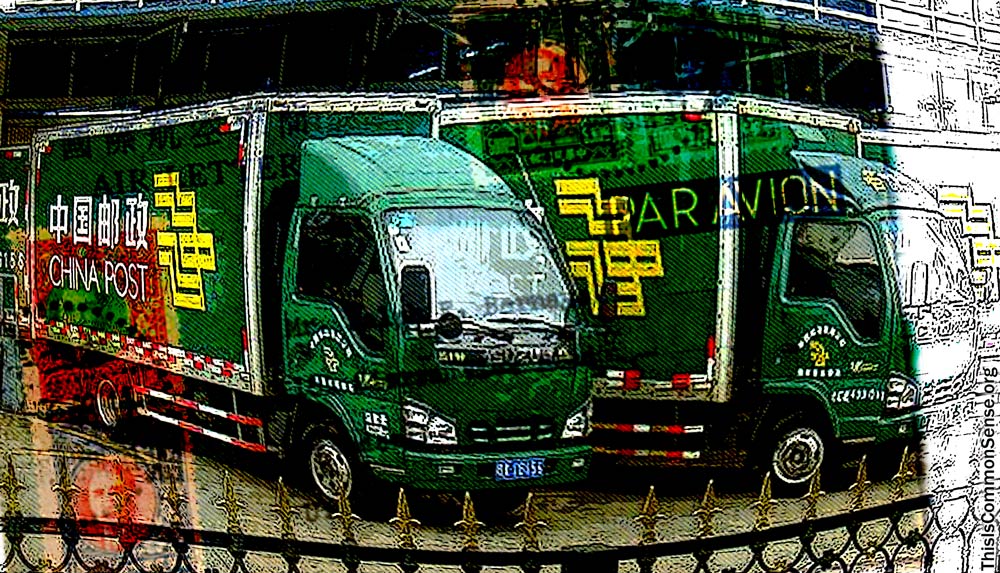
“President Donald Trump is taking another swipe at China,” Jen Kirby wrote for Vox back in 2018, “by ripping up an international treaty that’s more than a century old.”

We’re talking about the Universal Postal Union — or UPU. “At 144 years old, the UPU is one of the oldest intergovernmental agencies,” she explained. 

“The organization made possible the international mail system,” offered Washington-based attorney and UPU expert Jim Campbell. 

Wellesley College Professor Craig Murphy, “an international organizations expert,” called Trump’s threat “absurd.”

“It makes the international postal system run smoothly,” explained Kirby, “it’s the reason why you can get a package from South Africa or a postcard from your aunt on vacation in Bali.”

So why gum up the efficient delivery of letters and packages?

“Trump does have a legitimate gripe,” Kirby abruptly changed tone, “and administrations going back to Ronald Reagan have voiced similar complaints about the UPU.” 

But did nothing about it.

“Countries like China that were developing nations in 1969 . . . still pay the U.S. Postal Service a pittance to deliver mail,” Foreign Policy’s Keith Johnson clarifies, which “means that Chinese firms had a tiny edge in shipping goods to the U.S. market — making the Postal Service pick up much of the tab for actually delivering the package, even while costing U.S. firms potential sales.”

“Tiny edge”

Bull.

“[I]t’s actually cheaper to ship some products from certain places overseas to the US,” Kirby acknowledged, “than it is to deliver something between New York and Kansas.”

The gripe? 

The “disproportionately dramatic response . . . reveals the White House’s obsession with what it sees as China’s unfair advantage in global trade.”

Yet, this is an unfair advantage. 

Er, well . . . was

This is Common Sense. I’m Paul Jacob.


PDF for printing

See all recent commentary
(simplified and organized)
See recent popular posts

Categories
free trade & free markets too much government

Viral Michigan

Michigan is a state divided.

While Gov. Gretchen Whitmer (D) has become a veritable dictator, in her stated desire to curb the contagion, the infection and death rate in the U.P. (which stands for “Upper Peninsula”) would look like a success story . . . were anyone to believe that her policies deserved credit.

But to some extent, “social distancing” is just society-as-usual for rural Yoopers.

Whitmer’s stay-at-home orders are the most restrictive of any of our states. All public gatherings are shut down, as are most stores and shops, though lottery sales are still allowed. And enforcement has not been slack, as Reason informs us: “Police stopped landscaper Brandon Hawley for carrying on with his business, although he lives in the northern city of Alpena, which confirmed its first COVID-19 case on Saturday.”

Not on board with every one of the governor’s executive orders are four sheriffs in westside counties of the main part of the state. They have proclaimed they will not be enforcing every single one of her edicts. “While we understand her desire to protect the public,” they wrote in a joint statement, “we question some restrictions that she has imposed as overstepping her executive authority.”

And Michiganders have started to rebel, with the state experiencing our nation’s largest protests.

So far.

Recognizing that the state has the third highest coronavirus death count, though most are in the southeastern part of the state, does this menace justify the governor’s restrictive measures?

Well, that will be an ongoing debate in Michigan — as elsewhere.*

The perception of costs will grow rapidly as negative results from the shut-down become more numerous and more obvious.

This is Common Sense. I’m Paul Jacob.


* The most startling report shows the virus forming the same pattern of contagion and lethality everywhere, regardless of “mitigation” measures (as Dr Anthony Fauci dubbed them), i.e. shut-down or no shut-down. Meanwhile, a few contrasts: the 2017-2018 flu season was quite bad, with 80,000 deaths, including “high severity across age groups”; the U.S. coronavirus death count hasn’t hit half that yet, which is worth keeping in mind as projections of the contagion’s extent and death rate plummet in most models.

Gretchen Whitmer, pandemic, corona virus, covid, epidemic,

See all recent commentary
(simplified and organized)
See recent popular posts

Categories
free trade & free markets national politics & policies political economy

Cure and Consequences

From the beginning of the panic-induced shutdown of much of what we call “the economy,” many of us were wondering if the cure might not become worse than the coronavirus disease.

The ramifications of the near-total curtailment of the production, processing and movement of goods and services? Potentially disastrous.

The notion that politicians and bureaucrats inhabit that sweet spot which allows them to distinguish “essential” from “non-essential” work activities? Dubious at best. 

It smacks of what F.A. Hayek called “the fatal conceit” and “the pretense of knowledge.” The consequences of the shutdown have from the first suggested a tragedy in the making.

On Tuesday, The Washington Examiner’s Emma Colton reported on a tweet: “Kentucky Rep. Thomas Massie warned that the United States could face food shortages due to the ‘brittle’ supply chain, bankrupting farmers and forcing them to euthanize livestock.”

Massie does not mince words: “We are weeks, not months, away from farmers euthanizing animals that would have been sold for meat/food. Also, fruits and vegetables are going to rot in the fields.”

The late psychiatrist Thomas Szasz liked to use a word applicable here: iatrogenic. Doctor-caused.

The insistence that President Trump follow every jot and tittle of advice from Dr. Anthony Fauci and the federal medical establishment may provide an object lesson on why we must not trust “doctors” and “scientists” to make policy alone.

They specialize.

And our commercial society (as Adam Smith called “the economy”) is the very opposite: a veritable cosmos of human interaction.

Which makes the politicization of medical doctoring potentially quite fatal, as Rep. Massie warns.

Just ask anyone who’s lived through Communism’s command economy.

This is Common Sense. I’m Paul Jacob.


See all recent commentary
(simplified and organized)
See recent popular posts

Categories
free trade & free markets ideological culture media and media people

Dead Economists Walking?

Zombies don’t exist. Not like in the movies.

Or like in the pages of The New York Times.

The Times’s economist Paul Krugman has a new book out, Arguing with Zombies, and, if I ever had the tiniest margin of utility nudging me towards reading it, John Goodman’s review in Forbes has dissuaded me. For Krugman doesn’t argue with anyone — he argues against economists whom he mischaracterizes.

No, that’s apparently too kind. He argues against, says Goodman, economists who don’t exist. “Zombies are economists who believe that every tax cut pays for itself with increased revenue,” Goodman explains. “They hate the poor. They are closet racists. They do the bidding of billionaire puppet masters who pay their salaries and fund their research. Their goal in life is to make the rich richer and the poor poorer.”

Goodman concludes by noting that Krugman knows better, for “if you are thinking that Krugman has never met a Republican, you might be inclined to cut him some slack.” But no, “it turns out Krugman actually worked in the White House during the Reagan administration. That means he knows the tax cuts weren’t devised by economists whose motivation was to make the rich richer. He knows his fellow economic advisors to the president weren’t puppets, doing the bidding of billionaires. He knows they weren’t closet racists. He knows they didn’t hate the poor.”

Krugman — a Nobel Laureate — calls his enemies the worst names imaginable. Yet, Krugman the Zombie Hunter is one reason our political culture is so monstrous right now.

Not zombie-monstrous, partisan-monstrous. 

Meanwhile, the two sides that hate each other are united at least in one way, in creating another monster: the $2.2 trillion bailout, and the record new deficit.

This is Common Sense. I’m Paul Jacob.


PDF for printing

Paul Krugman, economist, propaganda,

See all recent commentary
(simplified and organized)
See recent popular posts


Categories
free trade & free markets too much government

The Exceptions Disprove the Rules

“I’ve instructed my prosecutors not to charge certain low-level nonviolent offenses to avoid people being held in jail unnecessarily,” Maryland’s Attorney General Marilyn Mosby informed the state’s Republican governor. She also urged the governor “to release all inmates in state prisons who are over 60,” explains The Washington Times, “approved for parole or scheduled to complete their sentences within the next year.”

This is all to avoid a prison pandemic. Meanwhile, the “Food and Drug Administration (FDA) announced Monday that it would permit states to create laboratories for designing COVID-19 tests,” Reason magazine tells us, adding that the FDA “has also decided to permit pharmacists to make their own alcohol-based hand sanitizers.”

Reason’s Robby Soave asks the obvious question: “Why do the people who are working hardest to fight the coronavirus have to ask a slow federal bureaucracy for permission to save lives?”

The New York Times reports that Dr. Helen Y. Chu, an infectious disease expert in Seattle, tried mightily to perform tests on subjects, early in the epidemic, to track how the virus was spreading. She was stymied every which way.

By bureaucracies.

The kludge of bad regulations and laws merely adds cost and annoyance during normal times; during emergencies they present major stumbling blocks to public health.

So, when our leaders make special exceptions, they demonstrate that the regulations were always bad — now just worse.

Real leadership would nix these rules, permanently.

And, for that matter, end the war on drugs — and prostitution and other victimless crimes.

One of the infractions Maryland’s AG decided to go lax on, however, is public urination. That crime has victims and ought to remain a public health violation.

Though perhaps not worth imprisonment.

This is Common Sense. I’m Paul Jacob.


PDF for printing

freedom, prohibition, rules, regulations, red tape, bureaucracy,

See all recent commentary
(simplified and organized)
See recent popular posts
Categories
free trade & free markets ideological culture

Gouging vs. Kicking

New crisis, old reactions.

The market has failed, we are told, to handle the coronavirus pandemic . . . even though it has just begun.

We hear demands for vast public takings (California Gov. Gavin Newsom commandeering hotels to add quarantine stations and hospital beds), huge transfer programs (including gargantuan Federal Reserve quantitative easing), and even war socialism (an old staple courtesy of John Dewey in 1918 — oops, John Cassidy, 2020, in The New Yorker).

But most galling?

Complaints of medical supply shortages while cracking down on “price gouging.”

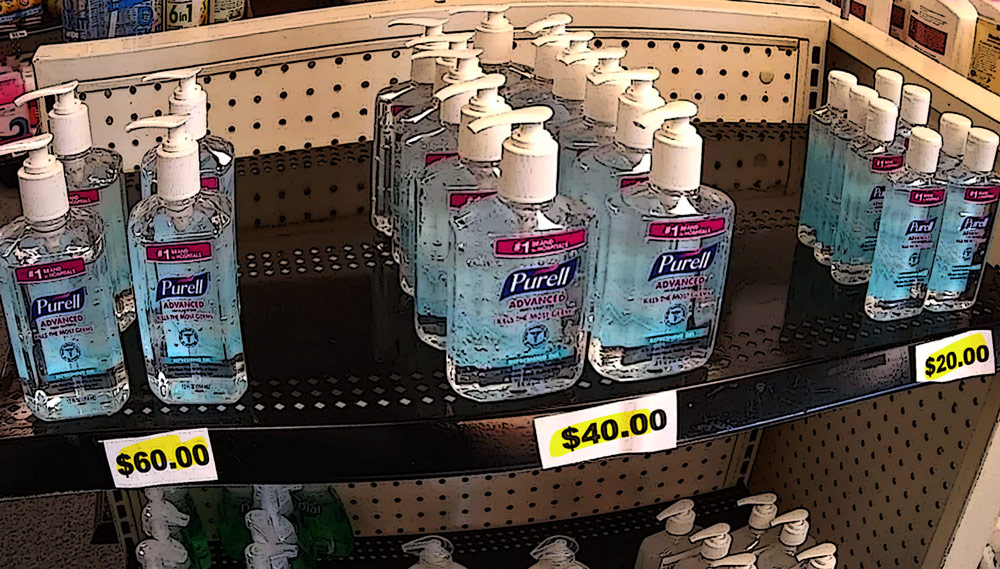
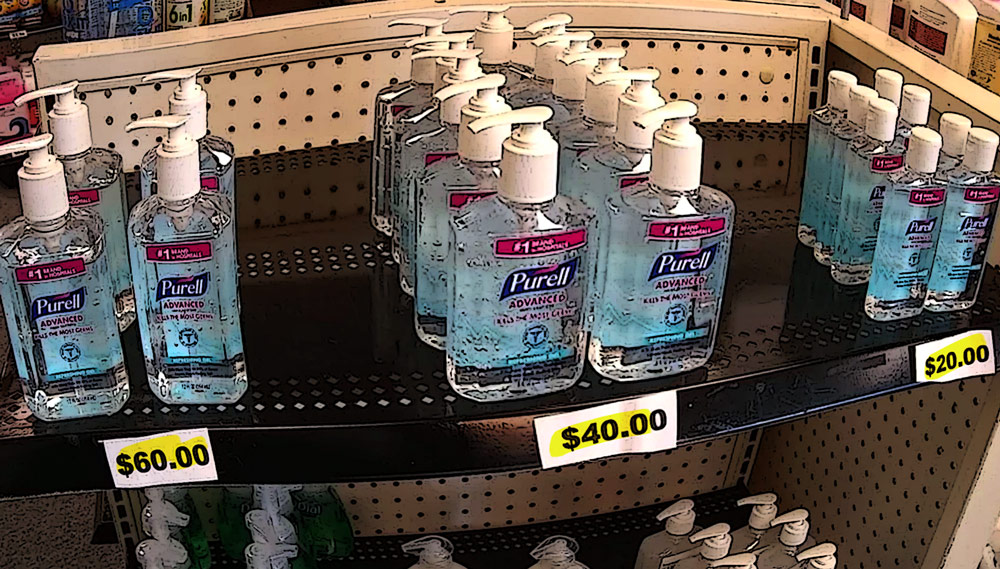
The most astounding case is of the man who scoured the countryside to hoard a truckload of hand sanitizer to sell later at higher prices — moving goods from a period of low, normal value to a time of higher value — only to discover that he was not allowed to sell them, by Amazon and eBay, not government.* The big Internet trading platforms object to normal entrepreneurial action, buying low and selling high, in times of crisis.

But how scandalous is it? In buying up a supply he sent a signal quicker to producers to ramp up production. And he took goods away — very temporarily — from early panicky buyers (who seized the same opportunity in a near-future scarcity but to hoard for personal use) to offer to truly needy people who would value the product enough to buy at higher prices.

Foolish enough to prohibit crisis pricing — or, here, kum-bah-yah prohibitions in solidarity. But then to castigate markets for being inefficient!

Banning “price gouging” and blaming the market is like taunting your victim on the ground as you kick him.

You’re the bully, not a noble savior.

And all that hand sanitizer goes unused.

This is Common Sense. I’m Paul Jacob.


* There are numerous anti-gouging laws around the country, too. The online market companies are merely mimicking very old political tropes.

PDF for printing

price gouging, price freeze, scalping,

See all recent commentary
(simplified and organized)
See recent popular posts

Categories
free trade & free markets international affairs

Albion, Weak or Strong?

The European Union is an anti-democratic, quasi-tyrannical mess. And Great Britain, having Brexited over the weekend, has a chance at a clean-up job. But that doesn’t mean that Britain won’t go down a very dark path, creating an even bigger mess.

Freedom provides opportunities to fail as well as to succeed.

On page 17 of the latest issue of The Economist, we get a hint at what can go wrong.

In a word: too much government. Too much regulation, taxation, etc.

“No longer such a smooth ride” reads the headline, with a tag just below it: “A weakened Britain hopes to draw strength from its alliance with the United States. Good luck with that.”

Snark aside, there is a lot wrong here. Post-Brexit Britain is not obviously weaker — indeed, actually following through on the Brexit issue itself is a sign of strength. Admittedly, Theresa May was weak. And the nearly destroyed communists of the Labor Party are weaker yet. 

But Britain has great opportunity to strengthen itself, now.

The first issue that The Economist notes throws cold water on Brexit ebullience is trade. “If the British government persists with plans for a digital-services tax that would hit tech giants, America has said it will retaliate with punitive tariffs on British car exports.” Well, yeah.

Britain would harm itself by not embracing a free trade agreement with the United States, post haste. The model should be the Cobden-Chevalier Treaty of 1860, which set Britain on a major upward course — and France, too. A similar treaty could be a bounty for both Britain and America.

But the usual ardor for taxes, regulation, and intrusive government could transform Brexit from boon to bust.

This is Common Sense. I’m Paul Jacob.


PDF for printing

British Liberty, British Flag, Brexit,

See all recent commentary
(simplified and organized)
See recent popular posts

Categories
free trade & free markets too much government

The Anti-Worker Ism

Progressives who lean socialist used to hide their worst intentions. Now they are letting it all hang out.

There have always been overt socialists in the U.S., of course. They would sometimes protest the reluctance of fellow travelers to fully embrace socialism’s moniker. But the sentiment “Ah, screw it, let’s just admit we want to destroy everything currently in existence” seems on the ascendance. Even a few major Democratic candidates for president are on board.

Exhibit 112 is the new nationwide push to stomp the gig economy.

Especially freelancing.

This follows Exhibit 111, the recent and so far successful push to stop independent contractors from engaging in voluntary transactions in California. (Many lawsuits are underway.)

After scanning the coiled legalese of 111 — I mean AB5, California’s law — many companies decided that ending relationships with California-based freelancers was prudence with a capital P. And that rhymes with G, and that stands for Golden. Which the Golden State used to, uh, B.

Not every self-employed person has been thrown out onto the street. There are carve-outs. Actually, the only known victims are taxi drivers, cleaners, nurses, comedians, writers, editors, musicians, transcriptionists, citizen initiative petitioners, etc., etc.

The crackdown on non-9-to-5 work arrangements has also resulted in much gnashing of teeth by gig-seekers of all ideological stripes. 

Obviously, then, such massive destruction of economic freedom must be inflicted on the federal level too. So House Democrats put AB5’s gig-killing provisions into Exhibit 112, that is, into HR2474, pending legislation.

Democratic candidates for president Pete Buttigieg, Elizabeth Warren, and Bernie Sanders have endorsed the California statute, a national version, or both.

Ludwig von Mises had a word for this. He called socialism “destructionist.”

This is Common Sense. I’m Paul Jacob.


PDF for printing

California, socialism, labor, progressivism, Democrats

See all recent commentary
(simplified and organized)
See recent popular posts
Categories
free trade & free markets ideological culture

Served and Disserved, New York Style

“Jacking up your prices on people trying to celebrate the holidays? Classy, @dominos,” tweeted former presidential aspirant and current New York City Mayor Bill de Blasio.

“To the thousands who came to Times Square last night to ring in 2020,” continued  Hizzoner’s New Year’s Day message from his official city Twitter account, “I’m sorry this corporate chain exploited you — stick it to them by patronizing one of our fantastic LOCAL pizzerias.”

Were you standing there in the Big Apple on New Year’s Eve getting “exploited”?

For the last 15 years, a Midtown Manhattan Domino’s franchise has been delivering hot pepperoni, cheese and onion pizzas for $30 each — “more than twice the regular $14.49 price of a large cheese pie” — to the “hungry tourists waiting in holding pens for the ball drop,” The New York Post reported.

“I have a lot of orders. I’m very busy,” remarked Ratan Banik, the Domino’s delivery man. The paper explained that he was “mobbed by starving tourists . . . many having camped out overnight.”

“He is our Santa,” offered one New Jersey man, who had not thought to bring any food with him into the city. “It’s absolutely worth it. It was hot. It seems like it just came out of the oven.

“If he comes back,” he added. “I will buy some more.”

“How is this different to a million other things? Airlines, Uber, property,” noted one of many tweets mocking the mayor’s. “It’s called supply and demand.”

If this be exploitation, make the most of it — with or without the extra toppings. 

Just hold the snipes.

This is Common Sense. I’m Paul Jacob.


PDF for printing

Pizza, DeBlasio, New York, New Year,

See all recent commentary
(simplified and organized)
See recent popular posts


Categories
free trade & free markets national politics & policies too much government

Plunger Politics

President Donald Trump may win re-election because he dares speak the truth about toilets.

A Washington Post tweet presents the president talking about the insanity of American plumbing: “People are flushing toilets ten times, 15 times, as opposed to once. They end up using more water.”

Jeffrey Tucker, in a terrific piece for the American Institute for Economic Research, focuses on our national disgrace: “I know a man — a proxy for tens of millions — who came from a foreign country, threw down $500 per night at a New York hotel, and was astonished to find himself plunging the toilet within the hour of checking in. 

“Not surprising,” Tucker writes. “Not unusual. American toilets don’t work right. This is why there are plungers next to every toilet.”

And Tucker suggests that Trump may beat whoever ends up as his Democratic challenger for no better reason than because, every now and then, Trump sides with common sense against bureaucrats, regulators, and politicians. And, in this case, seeks to do something about it.

Would any Democrat dare mention that it is Congress that ruined our commodes? 

Of course, Republicans let it happen. 

Our toilets, I have long insisted, provide a perfect object lesson for what is wrong with government today. Early in the history of this Common Sense commentary, I explored the theme: it has been over 20 years ago since I wrote of “A Congressman in Your Bowl”; a few years later, when I started writing columns for Townhall.com, I offered “Flush Congress.”

I don’t know precisely what Trump can do regarding either the plumbing issue or the clogged-up Congress issue, but I — plunger in hand — salute him for trying to do something.

This is Common Sense. I’m Paul Jacob.


PDF for printing

plunger, flag, regulations, laws, Trump, flush,

See all recent commentary
(simplified and organized)
See recent popular posts