Categories
crime and punishment First Amendment rights general freedom ideological culture moral hazard national politics & policies Regulating Protest U.S. Constitution

Thorns in the Parade

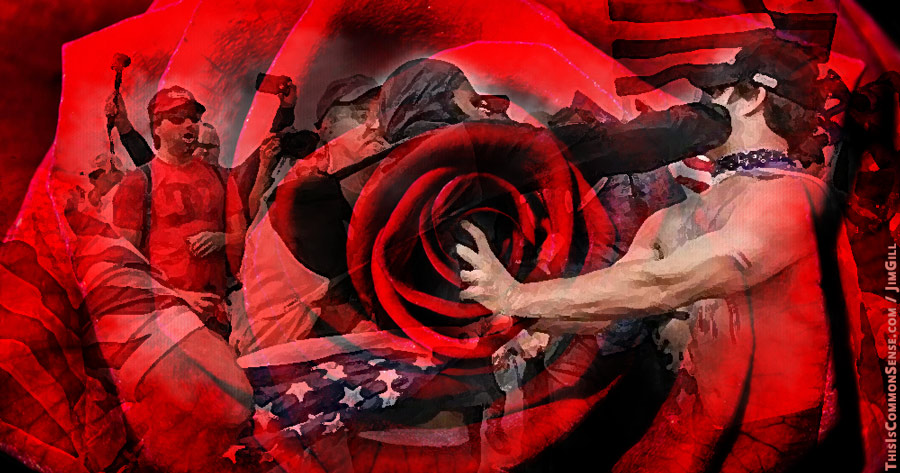
Portland, Oregon, styles itself as “The City of Roses.” For over a century, this Pacific Northwest city has held an annual Rose Festival, complete with multiple parades.

This year, there will be at least one parade less.

“The annual 82nd Avenue Rose Parade and Carnival scheduled for Saturday have been canceled because of threats against the Multnomah County Republican Party, a longtime participant in the parade,” we learn from the Portland Tribune. “In a Tuesday afternoon email, the 82 Avenue Business Association, which sponsors the Rose Festival-sanctioned event, said it canceled the entire event because [it] could not guarantee the safety of the community.”

KOIN-6 News reported that the threats came from the Direct Action Alliance, an “antifa”-styled group that “created a Facebook event called ‘Defend Portland from Fascists at the Avenue of Roses Parade.’ The group wanted to disrupt the march because of ‘Nazis and fascists’ participating.”

Now, what you regard as “white supremacist” and what young pseudo-antifascists think of as “white supremacy” are probably very different. I doubt that many real Nazis and fascists would have marched on Saturday.

But the identification issue is irrelevant. If fascists want to peacefully parade, let them.

What is objectionable? Those who engage in violence to suppress views of which they disapprove.

Also objectionable? The organizers and the City of Roses police, who, by caving in, let free speech and assembly be squelched.

Spontaneous marches did occur on parade day, corralled to the left and right sides of the street. Literally and figuratively. Three violent activists were arrested but not identified by affiliation.

Portlanders used to worry that the clouds would rain on their parades. Now, it is ideological violence casting a dark shadow.

This is Common Sense. I’m Paul Jacob.


Printable PDF


Categories
Accountability crime and punishment moral hazard nannyism national politics & policies property rights too much government

What’s Being Forfeited

What do you call those who prey upon the innocent, illegally snatching their money?

Thieves? Muggers? The Mob?

Government.

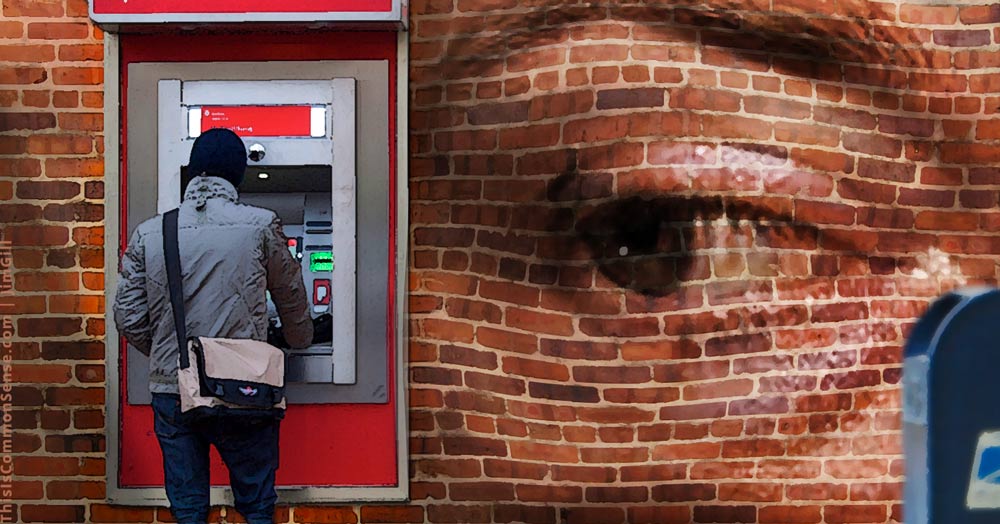
Last month, the Treasury Inspector General for Tax Administration (TIGTA) issued a report on the Internal Revenue Service’s use of civil asset forfeiture against Americans accused — well, not accused . . . more like suspected . . . well, not actually suspected of doing anything wrong, but willy-nilly deemed guilty without charge, judge, jury or conviction — of “structuring.” That’s depositing less than $10,000 in cash into a bank to avoid all the paperwork demanded by the United States Congress at that amount.

Congress passed the Bank Secrecy Act, making structuring illegal, supposedly to trip up drug traffickers and money-launderers. But that is obviously a ruse, as the TIGTA report makes abundantly clear. The IRS is simply snatching money — they won’t tell us how much — right out of individuals’ and businesses’ bank accounts.

Pity the cash-oriented business that doesn’t accumulate at least $10,000 to deposit.

The TIGTA report highlights that an incredible 91 percent of the time, the IRS acted “against individuals and businesses whose income was legally obtained,” and whom the IRS did not suspect of criminal activity. Also, through the IRS’s process of thievery “the rights of some individuals and businesses were compromised.”

Why is the IRS using the law to pilfer from the innocent, instead of the guilty?

As I explained Sunday at Townhall.com, it is easier and more profitable to make “quick hits” against innocent businesses rather than devious criminals.

When those responsible for protecting the innocent from criminals, instead, illegally twist the law to victimize the innocent, it’s called tyranny. And what is forfeited is much more valuable than mere money.

This is Common Sense. I’m Paul Jacob.

Printable PDF


Categories
Accountability crime and punishment government transparency responsibility

Ferguson Finally Wins

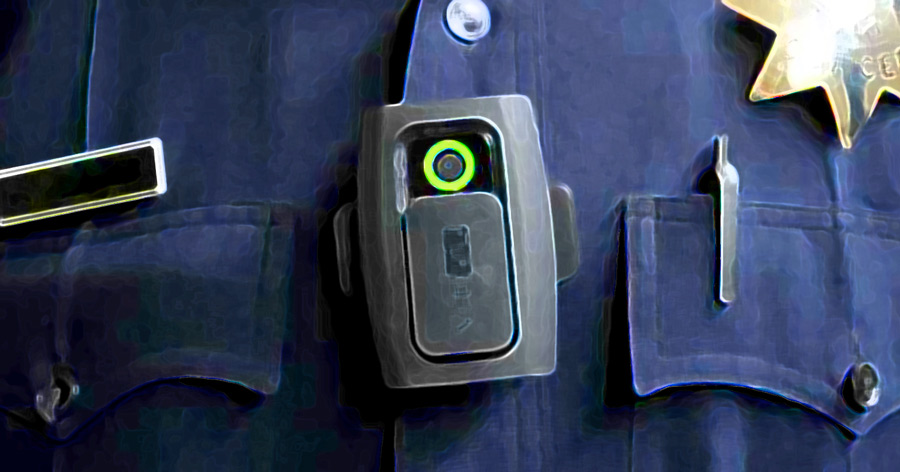
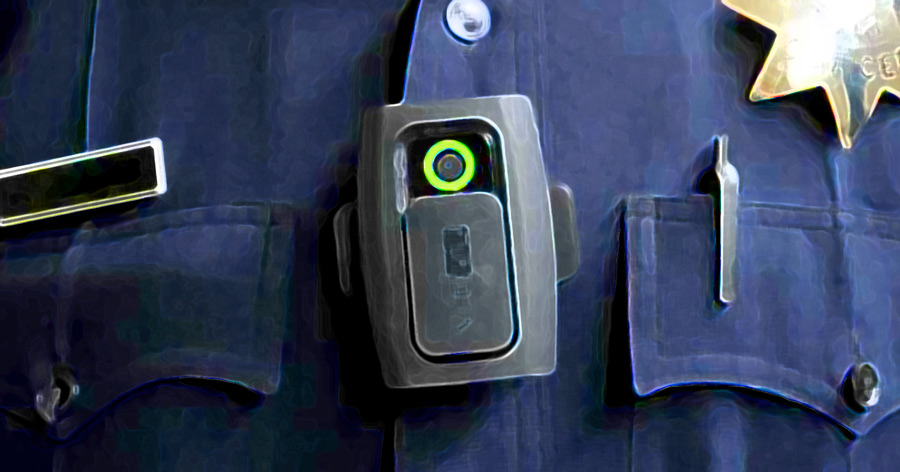
Yesterday, on the 49th anniversary of Martin Luther King’s assassination,* voters in Ferguson, Missouri, passed a charter amendment requiring police to wear body cameras while on duty. The measure also provides the public access to that footage, along with reasonable rules about privacy.

In August 2014, Ferguson came to the nation’s attention — and the world’s — when a black resident was shot and killed by a white policeman. In the aftermath, the nation witnessed a militarized police response to senseless riots that destroyed 17 local businesses.

People there and across the country jumped to fact-free conclusions about who was at fault: the deceased Michael Brown or the policeman, Officer Darren Wilson.

“If there’s one thing that I think everybody in Ferguson would agree on, it’s that we’d like to have a video of what happened on Canfield Drive back in August of 2014,” remarked ballot measure proponent Nick Kasoff.** “If we had that, Ferguson wouldn’t be a hashtag. It would be just another quiet suburb of St. Louis.”

Police began wearing body cameras after the Michael Brown shooting, and the consent decree the city reached with the Department of Justice set some useful parameters. But the rules in the just-enacted charter amendment go much further to guarantee the public access to the video.

Not to mention that just this week, Attorney General Jeff Sessions announced a review of all such consent decrees nationwide. Without yesterday’s victory at the ballot box, the police cams policy might simply be abandoned.

Not now. The voters have spoken, 71 to 29 percent.

Spurred by Ferguson, there’s been a ton of talk about reforming criminal justice in recent years. But I like action a whole lot better.

This is Common Sense. I’m Paul Jacob.
 

* Yesterday also reminds me of 1984, George Orwell’s classic dystopian novel, because the book’s protagonist Winston Smith begins his diary on April 4, 1984.

It’s my favorite book, and has enjoyed quite a surge in sales since last November’s election. Yesterday, the movie was shown in nearly 200 theaters in the U.S., the U.K., Canada, Croatia and Sweden.  

** Nick Kasoff led the six-resident committee that drafted and petitioned the measure onto the city ballot, with assistance from Liberty Initiative Fund (LIFe). Regular readers may remember that LIFe is where I have my day job — and that without contributions like yours, fewer successful measures like this Ferguson body camera initiative get off the ground.


More on the issue

Townhall: “Finding Ferguson

Townhall: “First Step for Ferguson

USA Today: “Ferguson residents push for body cameras

Townhall: “The Citizens Are In Session


Printable PDF


Categories
Accountability crime and punishment free trade & free markets general freedom initiative, referendum, and recall moral hazard nannyism national politics & policies property rights

Good and Bad News

On the issue of “civil asset forfeiture” — police seizing property from folks merely on suspicion, without a criminal conviction — there is good news.

In Idaho, House Bill 202a just passed both legislative chambers overwhelmingly. “Among other changes, HB 202a would no longer allow civil forfeiture of the vehicle of a person who merely possessed a controlled substance,” explained a Spokesman Review report, “without using the vehicle in connection with trafficking offenses or obtaining it with drug-trafficking proceeds. . . .” It also puts off the table “property that’s merely in proximity to illegal drugs” and the mere possession of cash.*

Legislation is moving forward in Arizona, too. House Bill 2477 passed to the Senate Judiciary Committee last week — which unanimously cleared it despite what the Arizona Republic calledstrong opposition from . . . primarily people representing law-enforcement and prosecutors’ groups that benefit from the funds.”

The bill heightens the standard of proof required for making seizures stick from “preponderance of the evidence” to “clear and convincing evidence.” HB 2477 also increases reporting requirements, and creates a process police must follow to spend seized funds.

Unfortunately, there is also bad news.

Even with the new Idaho law and the enaction of the Arizona legislation, police in both states will continue to take people’s stuff without a criminal conviction. The level of abuse would be diminished, but not ended.

Citizens in both states can and should use the ballot initiative process to end this injustice. In total.

We must restore the bedrock principle of innocent-until-proven-guilty.

This is Common Sense. I’m Paul Jacob.
 

* Other provisions include a court determination on “whether a property seizure is proportionate to the crime alleged,” absolving “innocent owners from having to pay the state’s costs associated with an attempted seizure,” and some required record-keeping.


Printable PDF


Categories
Accountability crime and punishment folly general freedom government transparency moral hazard national politics & policies too much government U.S. Constitution

Public Record

Police departments nationwide have begun to outfit their on-duty officers with body cameras. These small recording devices make great sense, so we can better judge police encounters.

And it turns out that not only do police behave better when wearing body cameras, so do the citizens with whom they interact.*

Yet, cameras aren’t magic. They do not work when turned off. And video recorded by police offers little value when tampered with or deleted.

On Monday, the Washington Post ran an in-depth feature about the 2014 fatal shooting of 19-year-old Mary Hawkes by Albuquerque, New Mexico, police, who pursued her for allegedly stealing a truck.

The Post explained that her case “has become a cautionary tale about the potential of new technology to obscure rather than illuminate, especially in situations when police control what is recorded and shown to the public,” raising concern “about whether a nationwide rollout of body cameras is fulfilling promises of greater accountability.”

Six police officers huddled in close proximity to the deadly incident — all wearing body cameras. The officer who shot Ms. Hawkes, however, had his turned off. Footage from three others “showed signs of alterations and a deletion.”

A federal investigation is underway.**

It is now obvious that cameras alone won’t suffice. Rules must require that the cameras be turned on — with consequences for non-compliance. The public needs access to the footage, too.

The Police Cameras for Ferguson initiative*** on the ballot April 4th does exactly that. We need similar legislation in Albuquerque and everywhere else.

This is Common Sense. I’m Paul Jacob.
 

* See Barak Ariel, William A. Farrar, Alex Sutherland, “The Effect of Police Body-Worn Cameras on Use of Force and Citizens’ Complaints Against the Police: A Randomized Controlled Trial,” Journal of Quantitative Criminology (September 2015, Volume 31, Issue 3), pp 509–535; reportage on this study can be found here.

** The probe has already revealed that a former Albuquerque police employee has declared, in an affidavit, “it was routine for officials to delete, alter or refuse to release footage because of ‘political calculations.’”

*** Your support is still desperately needed to educate voters in Ferguson, Missouri, about the Police Camera ballot measure. Please help today.


Printable PDF


Categories
Accountability crime and punishment folly ideological culture moral hazard nannyism responsibility

Walk on the Wilders Side?

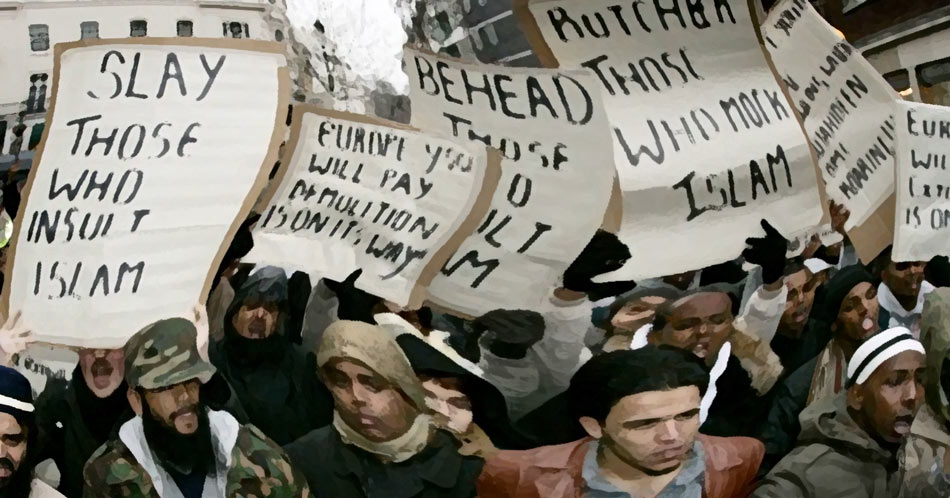
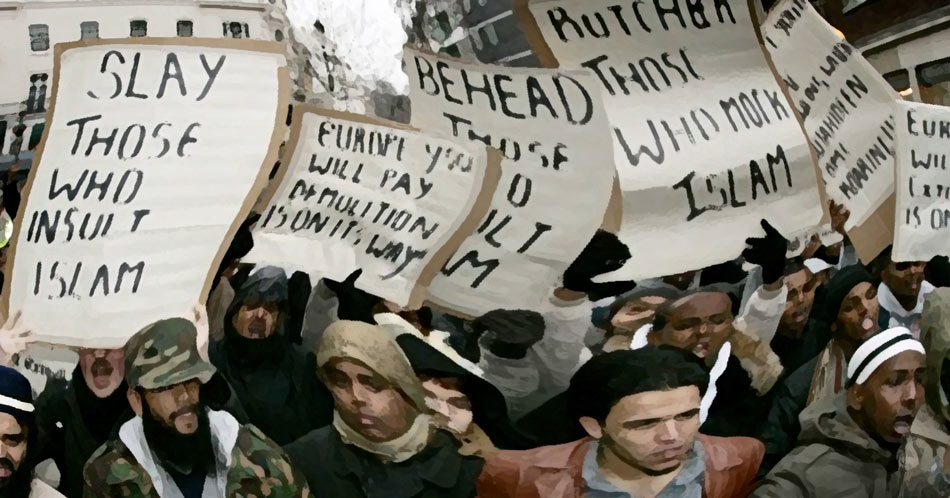
The Dutch were among the first to witness Islamic extremist violence against free speech. The November 2004 murder of Theo van Gogh by a Dutch citizen of Moroccan descent — a man whose first name, Mohammed, almost no one thinks is merely coincidental — stirred the nation.

And the world.

Van Gogh made a short film, with Somalian émigré Ayaan Hirsi Ali, about the unjust treatment of women in Islamic countries. The film criticizes Islam as well as the Muslim majority countries, and was considered an affront by many Muslims.

After van Gogh’s death, Ms. Ali fled to the United States.

This event is only the most famous of many similar conflicts between free-speech Dutch values and regulated-speech Islamist ones. The fact that the country has anti-blasphemy and anti-insult laws on the books, and these have been directed against a popular politician, has exacerbated the growing antagonism.

That very politician is today’s big news. According to The Atlantic, the “center-right People’s Party (VVD) for Freedom and Democracy is projected to win 24 seats in [today’s] election, slightly ahead of Geert Wilders’s far-right Dutch Freedom Party (PVV), which is expected to gain 22.”**

The Dutch center-left, like similar ruling groups in Britain, Germany, France and Sweden, often seems weak and timid before the rising illiberalism of Islamist terrorism and Sharia law.* Many suspect that the recent decision to block Turkish ministers from speaking at rallies in Holland, before Turkey’s referendum next month, is designed to counter this narrative.

Meanwhile, though Wilders is generally liberal (not “far right”) on most cultural issues, his “de-Islamization” program seeks to close mosques and outlaw the Quran***.

One extreme to another.

This is Common Sense. I’m Paul Jacob.
 

* This is not just a bugaboo. In 2006 the Minister of Justice floated the possibility of incorporating Sharia law into the constitution.

** The projection is within the margin of error, and with mass immigrant Turkish protests taking place over the weekend, the chance of a Trump-like upset is more than possible.

*** Geert Wilders compares the Quran to Adolf Hitler’s Mein Kampf.


Printable PDF


Categories
Accountability crime and punishment government transparency Popular responsibility

Five for Ferguson

Michael Brown is dead. No video can bring him back.

As the world remembers, Brown was the unarmed 18-year-old black man killed in a violent 2014 altercation with Officer Darren Wilson, who is white — making Ferguson, Missouri, famous.

Or rather, infamous.

With little information, folks quickly picked sides. Some claimed Brown was gunned down in cold blood with his hands up, yelling, “Don’t shoot.” After seeing footage from a convenience store surveillance camera, which showed Brown seeming to strong-arm an employee and steal cigarillos* mere minutes before the fatal police encounter, others placed the blame on Brown.

Subsequent rioting left dozens injured, seventeen businesses torched and millions in property damage. Meanwhile, President Obama’s Department of Justice found Officer Wilson’s actions justified.

However, had Wilson been equipped with a lapel camera, that footage would have enhanced finding justice. Moreover, the knowledge that the public could see the truth of what happened might have prevented the riots and recriminations.

More information is better.

That’s why the best news of all is this: on April 4, three weeks from today, the people of Ferguson will vote on The Public Video Recording Accountability Amendment to Ferguson’s City Charter. The charter amendment mandates that officers wear lapel cameras while on duty and sets sensible rules for allowing maximum public access.

The campaign needs your help to alert Ferguson voters about the election by mailing information on the ballot measure. For instance, studies demonstrate that not only do police behave better when wearing cameras, but so do the citizens with whom they interact.

Would you give five dollars for Ferguson?

Please help bring a better day for justice and transparency.

It’s Common Sense. I’m Paul Jacob.

* Over the weekend, more video surfaced from the convenience store as part of a documentary entitled, “Stranger Fruit,” which suggested Michael Brown had made a drug deal at the store, and not stolen anything. A St. Louis County prosecutor disputed the filmmaker’s interpretation, and released more footage.


Printable PDF


Categories
Accountability crime and punishment government transparency insider corruption local leaders moral hazard porkbarrel politics term limits

Another Political Crook

Last week, the other shoe dropped.

When last we touched upon Arkansas state legislator Micah Neal, he had pled guilty to steering hundreds of thousands of state tax dollars to a small private college in exchange for big, fat bribes.

He also implicated the state’s No. 1 term limits opponent, former State Senator Jon Woods, as chief hoodlum in the criminal scheme. Woods is best known for his dishonestly worded 2014 amendment responsible for hoodwinking voters into weakening term limits.*

And it is upon Woods that the shoe fell.

The fingered wheeling-and-dealing Woods, pursued by both the FBI and an angry electorate, chose not to run for re-election in 2016. Now he’s finally been indicted on 13 felony counts of fraud and bribery. Woods helped secure $600,000 in state funds to Ecclesia College, allegedly for tens of thousands in kickbacks.

“I do know this confirms what I’ve always suspected about Jon Woods,” wrote Max Brantley in the Arkansas Times. “He never had a job. He bragged about the good life he lived off state pay, per diem, travel and the hog slopping legislators enjoy. I should mention, too, that he was the architect of the so-called ethics amendment that provided a path to 1) longer terms in office; 2) higher pay; 3) an end-around an end to wining and dining restrictions despite the appearance that’s what voters had done.”

Former Sen. Woods does deserve a longer term . . . in jail.

This is Common Sense. I’m Paul Jacob.
* State term limits activists are currently gathering the more than 100,000 signatures they need on petitions to place their original, stricter term limits on the 2018 ballot and allow Arkansans an honest vote.


Printable PDF


Categories
crime and punishment First Amendment rights folly ideological culture moral hazard national politics & policies responsibility

Campus Freedom in Peril

  1. What is the percentage of tenured faculty on American campuses who are still unambiguously on the side of free intellectual exchange?
  2. What is the percentage of them who are willing to express that position openly?

Sociologist Charles Murray asked those questions near the end of his reflections on Thursday’s Middlebury College event, in which his speaking engagement was interrupted by shouting mobs and he and his colleagues were physically attacked*.

Murray thinks the answer to the first question is “more than 50 percent.” He doubts that is the answer to the second.

He is pessimistic about free inquiry on campus.

And has reason to be.

College faculty members are closing ranks, as many at Middlebury did, calling Murray — famous for books such as Losing Ground and The Bell Curve — “a discredited ideologue paid by the American Enterprise Institute to promote public policies targeting people of color, women and the poor”** and “not an academic nor a ‘critically acclaimed’ public scholar, but a well-funded phony.”

Mark J. Perry has listed many more complaints, all offered as reasons not to listen or debate with the famous intellectual.

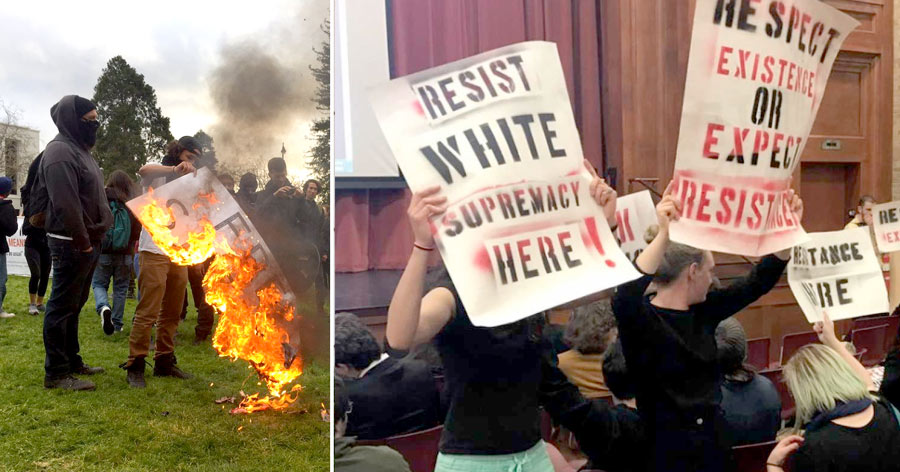
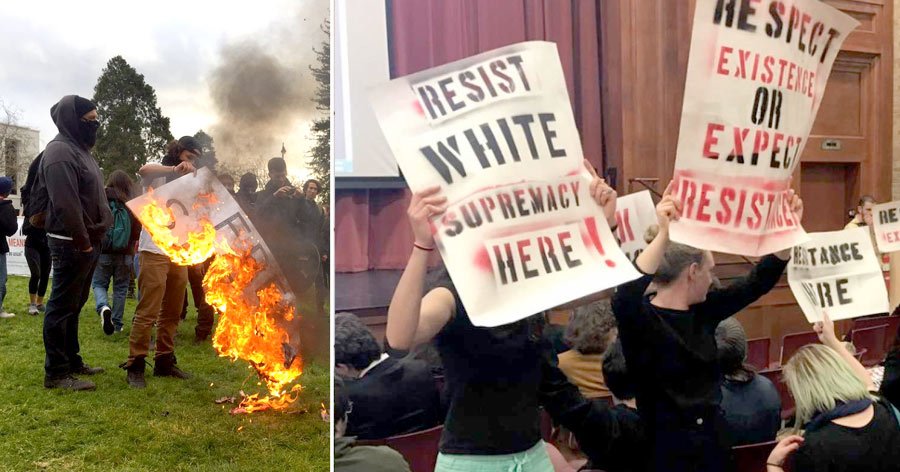
That was last Thursday. On Saturday, a pro-Trump, “Proud Boys” march in Berkeley culminated not only in violence, bloodied faces, destroyed property, but also in the burning of a purloined “Free Speech” placard.

The University of California at Berkeley seems uninterested in controlling the mobs. Berkeley City Police have poorly defended non-leftist protestors. It’s open season on freedom of speech and the right to peaceably assemble.

Unless something is done, officially, mobbing will be the new normal. And our basic rights? A memory.

This is Common Sense. I’m Paul Jacob.
 

* His colleague Professor Allison Stanger was seriously injured in the riotous shoving and grabbing. Murray tweeted yesterday, “Everybody in the mob could be criminally prosecuted, but those who injured Prof. Stranger must be.”

** It is worth noting that his recent Coming Apart was entirely devoted to the economic performance and culture of white Americans.


Printable PDF


Categories
crime and punishment First Amendment rights ideological culture moral hazard national politics & policies responsibility

Wolves Crying Wolf

People have a right to defend themselves. Right? Especially against rape and murder.

“This is not about free speech,” Yvette Felarca yelled to the crowd at the University of California-Berkeley, gathered weeks ago to “shut down” a scheduled speech by Milo Yiannopoulos, the controversial Breitbart editor.

Felarca, a national organizer for By Any Means Necessary (BAMN)*, the militant group with the incendiary name, argued that Milo wasn’t “interested in any genuine debate.”

She continued, “But what they’re really trying to do is they’re trying to assert their power, threaten us, intimidate us, rape us, kill us! This is real. This is life and death.”

Given such sentiments, it is hardly surprising that the protest turned violent — leaving people beaten, bloody on the pavement, and racking up $100,000 in property damage.

Not to mention causing the cancellation of the talk sponsored by the Berkeley College Republicans. Felarca called this a smashing success. Asked by reporters how she could justify violence to squelch speech, Felarca simply dubbed Milo “a fascist.”

Yesterday, in my Townhall column, “Hate Is Our Business,” I addressed the Southern Poverty Law Center’s just-released report, “The Year in Hate and Extremism.” The report continued the SPLC’s habit of calling entirely peaceful conservative and religious organizations “hate groups.”

The man who shot a security guard at the Family Research Council in 2012, but was thankfully blocked from further mayhem, used the SPLC’s “Hate Map” to target their office.

In its reports, the “progressive” SPLC completely ignores BAMN and violent left-wing groups. And by crying wolf in mislabeling non-violent organizations as “hate groups,” it provides the unhinged — BAMN, Antifa, and lone-wolf lunatics — very dangerous ammunition.

This is Common Sense. I’m Paul Jacob.
 

* Ms. Felarca also has a day job, as a public school teacher at Martin Luther King, Jr. Middle School in the Berkeley Unified School District. That has generated some controversy.


Printable PDF