Categories
Accountability crime and punishment First Amendment rights general freedom government transparency local leaders moral hazard Regulating Protest too much government U.S. Constitution

Lock Her Up

“Who Are We?” I asked Sunday at Townhall.com.

Today’s question: What have we come to?

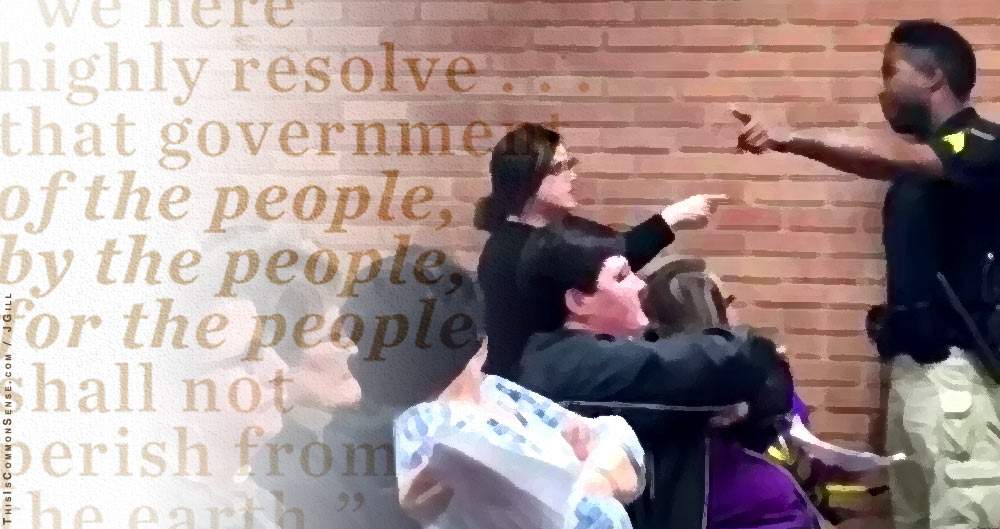
Under a seemingly click-bait headline in The Atlantic, “Can Government Officials Have You Arrested for Speaking to Them?” Garrett Epps examines last week’s outrageous handcuffing and arrest of a Louisiana teacher, Deyshia Hargrave, for speech displeasing to the Vermilion Parish school board at a public meeting.

The elementary school teacher complained about a $30,000 raise the board was giving the superintendent, noting that teachers had not seen an increase in nearly a decade. After asserting that the raise would be “basically taken out of the pockets of teachers,” she was ruled out of order by the school board president and then asked to leave the premises. She calmly left the meeting room . . . only to be forced to the floor, handcuffed and arrested once in the hallway.

Police claimed the arrest was for “remaining after having been forbidden” and “resisting an officer.”

The school district announced it won’t press charges. Very funny. Anyone can see from the video that her treatment was excessive.

Next month, the U.S. Supreme Court will hear oral arguments in Lozman v. Riviera Beach, Florida, where an arrest was clearly retaliatory, but the city is newly claiming another violation it could have used to arrest Mr. Lozman.

Does this after-the-fact adding on of charges provide governments with an escape clause? As Epps argues, a Lozman decision “could either rein in, or embolden, the tiny-handed tyrants who rule county buildings and city halls around the country.”

If respectfully challenging our so-called public servants in meetings designed for that can lead to being arrested, handcuffed and dragged off, we no longer live in ‘the land of the free.’

This is Common Sense. I’m Paul Jacob.


PDF for printing


Categories
Accountability folly government transparency local leaders moral hazard porkbarrel politics responsibility too much government

Babylon Goes Broke

A few Babylonian, er, California cities going bankrupt — Stockton, Vallejo, and Bell — should be seen as more than dead canaries in a coalminer’s care.

Indeed, you don’t need special prophetic gifts to see the dangers posed by over-promising cushy pensions to government workers. Californians are coming around. And the state’s governor, Jerry Brown, appears to be “calling for reductions in gold-plated, unsustainable public-sector pensions,” as Nick Gillespie informs us at Reason.

But statewide reforms will not be easy. The problem is huge, presenting grave costs. “Absent the ability to alter pensions, states and localities have to devote more and more of their taxes to simply covering the costs of retired workers,” Gillespie explains. “Worse still, they often raise taxes to cover rising costs, typically at the expense of providing basic services such as police and road maintenance.”

Yes, over-promising defined-benefit pension packages effectively distributes wealth away from basic government services and into the pockets of the people with whom politicians work most closely.

Unfortunately, the courts long ago decided that politicians’ promises to employees outweigh basic government duties. That is, the courts determined that “public-sector employees at all levels of government had an inviolable right to the pension benefits that existed on the day they were hired.”

But the courts seem to be lightening up on this “California Rule,” and the governor has dared mention that, come “the next recession,” some headway might be possible.

No matter what you may think of this rather desperate hope, the writing is on the wall. And it is in red ink and numbers, not Babylonian.*

As America’s Babylon is finding out.

This is Common Sense. I’m Paul Jacob.


* And not “Mene, Mene, Tekel, Upharsin.”


PDF for printing


Categories
Accountability government transparency insider corruption moral hazard national politics & policies porkbarrel politics too much government

Earmark This Bad Argument

With President Trump endorsing a return to earmarks, House Republicans too are reportedly “reconsidering” their usefulness and pondering “how they might ease back into the practice.” Lawmakers fret that they have lost too much power by giving up this instrument of corruption. (Not their characterization.)

Wikipedia defines “earmark” as a budgetary provision that “directs funds to a specific recipient while circumventing the merit-based or [competitive] allocation process.” An earmark is a taxpayer-funded goodie bestowed on a congressman’s constituent, the sort of crony willing to contribute to the bestower’s next election campaign in return.

Quid pro quo, pay-for-play, bribery. Whatever you call it, there’s darn good reason why political leaders who fight corruption have fought to end earmarks.

Congressional Republicans imposed a ban on earmarks in 2011 to show that they were anti-corruption. So why relapse? Well, “the time is right,” according to GOP Representative John Culberson, for Congress to prove it can use earmarks responsibly. His bad argument is that the “excesses” of a decade ago were committed by “knuckleheads [who] went overboard.”

Somebody alert Culberson to the fact that many of the same knuckleheads are still in office. Ahem. Congress is not yet term-limited, remember?

The more basic point is that earmarks are by nature corrosive of sound government. President Trump’s only metric is apparently “getting [things] done” as opposed to obstructionism, preferring “the great friendliness” when we had earmarks. Sure, stuff got done — a lot more spending, a lot more bad stuff.

To the extent they’re gone, earmarks should stay gone. The only appropriate action is to make it even harder to bring them back.

This is Common Sense. I’m Paul Jacob.


PDF for printing


Categories
general freedom media and media people national politics & policies too much government U.S. Constitution

Happy Birthday, America!

What? Oh, sure, I know the United States of America has its birthday on July 4th, that day in 1776 when the Second Continental Congress adopted the Declaration of Independence.

Let’s agree I’m early. (Oh, how I wish it were July.)

But the interesting thing about history is how we get to those moments wherein the great “we” declare our independence or fill the streets or storm the beaches — or the polls. The many big, important days that lead to THE day.

Today is such a date, because 242 years ago on January 10, 1776, Thomas Paine published Common Sense. Without this day 242 years ago, we wouldn’t have had Independence Day six months later.

Using common and direct language, and speaking to all the “inhabitants of America,” Common Sense made the case for both independence from Britain and the establishment of a democratic republic. Boy, did it make the case. On a per capita basis, Paine’s pamphlet is the bestselling American publication in history.

His pamphlet or parts were read publicly, reprinted in newspapers and spread throughout the colonies. This common man — barely an American,* having landed on our shores in November 1774 — used the universal language, speaking truth to power.

“Every spot of the old world is overrun with oppression,” Paine told his fellow Americans. “Freedom hath been hunted round the globe. Asia, and Africa, have long expelled her. Europe regards her like a stranger, and England hath given her warning to depart. O! receive the fugitive, and prepare in time an asylum for mankind.”

The original idea of these United States was freedom.

And that, my friends, is Common Sense. (I’m Paul Jacob.)


* Of course, this makes Paine almost quintessentially American.


PDF for printing


Categories
Accountability crime and punishment folly free trade & free markets general freedom moral hazard nannyism national politics & policies too much government U.S. Constitution

The Ninth and the Tenth of It

When Attorney General Jeff Sessions rescinded the Obama Administration enforcement guidelines regarding the states that have legalized (in their 29 different ways) marijuana, last week, supporters of freedom expressed some worry.

But we had to admit, one excuse for Sessions’s nixing of the mostly hands-off policy seemed to make sense on purely legal grounds. If we want to liberalize drug laws, then our Cowardly Congress should do it.

Definitely not the Executive Branch.

And yet, over at the Volokh Conspiracy, Will Baude argues that “the rule of law” does not require “renewed enforcement of the Controlled Substances Act.”

If anything, he argues, it “requires the opposite.”

Baude mostly rests his case on the Constitution’s Commerce Clause, which does not authorize regulation of intra-state trade. An issue on which the AG does possess a duty to weigh in.*

This rubs against FDR-Era constitutional theory, of course, which treats all commerce as regulate-able interstate trade. But this makes no sense. The Tenth Amendment declares that states possess powers not given to the federal government. An interpretation of the Constitution cannot be justified if it effectively nullifies other parts of the Constitution. (If all trade is “inter” state, what’s left for the states? Powers to do what? And how could there be any constraints on federal power?)

And then there is the Ninth Amendment, which states that the people retain rights not listed in the Constitution.

When citizens assert rights — such as the option to cultivate, sell, buy or ingest a common and quite hardy plant — in their states (largely through ballot initiatives), the federal government should butt out.

This is Common Sense. I’m Paul Jacob.


* “Members of the executive branch have their own obligation to interpret the Constitution,” Baude writes, “and if a federal law is unconstitutional in part then the executive branch, no less than the courts, should say so. It is the Constitution, not the Court, that is the ultimate rule of law in our system.”


PDF for printing


Categories
crime and punishment folly free trade & free markets general freedom nannyism too much government

Beaver State Bliss

The Great State of Oregon is not at DEFCON 1. Nor are Beaver State residents gnashing their teeth over a new law that went into effect earlier this week.

News reports proclaimed: “People in Oregon are freaking out about the thought of pumping their own gas under a new law.” But don’t believe everything you read.

For starters, Oregon’s new law doesn’t actually force anyone to do anything. It merely allows “retailers in counties with a population of less than 40,000 . . . to have self-service gas pumps.”

But a Facebook post by KTVL CBS 10 News in Medford took it an apparently frightening step further, asking, “Do you think Oregon should allow self-serve gas stations statewide?” The post went viral nationwide because of responses such as this:

I’ve lived in this state all my life and I REFUSE to pump my own gas . . .

This [is] a service only qualified people should perform. I will literally park at the pump and wait until someone pumps my gas.

Oregon is one of only two states — New Jersey, the other — where gas stations are banned from permitting customers to put gas in their own cars. Folks in the other 48 states have managed, as one Facebooker explained, “to pump gas without spilling the whole tank and triggering a Star Wars-style explosion.”

Still, if Oregonians so revere their regulatory regime, protecting them from the indignity of pumping gas, why change the law even partially?

Well, for economic reasons. As you might expect, gas stations across rural Oregon were closing at night, stranding many motorists.

Freer markets offer greater protection for real people . . . those not too perplexed by the prospect of pumping their own petrol.

This is Common Sense. I’m Paul Jacob.


PDF for printing


Categories
Accountability general freedom ideological culture media and media people national politics & policies responsibility too much government

The Times Must Change

“Political leaders prefer to project a noble history, sometimes by turning complicity in atrocities into claims of victimhood,” the New York Times informed us last Sunday. “In Russia, Mr. Putin and many of his lieutenants came from the K.G.B. and resisted fully confronting its repressive history. And they, like many of their countrymen, prefer to portray Stalin not only as the architect of the Gulag but also as the leader who built Russia’s industrial might and led it to victory in the Great Patriotic War.”

The Gray Lady here marks the passing of Arseny Roginsky, an organizer and activist who kept alive the memory of state mass murder in his homeland. The Times quotes the late hero as insisting that common talk of “victims of repression” is nowhere near enough. The repression did not merely descend upon the people as “a plague.”

The victims were targets of “state terror.”

But there was something missing in this too-brief notice. Though the Nazis were mentioned, the Union of Soviet Socialist Republics wasn’t.

Communism was not.*

State terror did not infect its perpetrators biologically, like the world’s worst case of x-oplasmosis. It neither descended from the heavens nor ascended from the swamps. The infection was ideologicalthe result of Marxian socialism, of unworkable communism.

By not mentioning socialism or communism or even the USSR, the New York Times carries on its sad history of leftist apologetics. The case of the lying propagandist Walter Duranty — the Times’ award-winning foreign correspondent and author of Mission to Moscow — should have been the last of that.

It isn’t, apparently. The Times still protects its safe-space socialist readers.

This is Common Sense. I’m Paul Jacob.


* The omissions were also present in the Timesinitial obituary.


PDF for printing


Categories
Accountability general freedom moral hazard nannyism political challengers too much government

How to Prevent Democracy

Quick — what is the very first thing government should do this year?

Maine’s Secretary of State Matthew Dunlap has urgent legislation. And just so you don’t get the wrong idea, “It’s really not a shadow effort to restrict the people’s right to petition their government,” he insists. “That is not our intent.”

Got that?

Citing voter and election official complaints — without documenting any specific person or incident — the secretary seeks to “virtually ban” signature gathering at the polls on Election Day. His special bill, L.D. 1726, would create a 50-foot buffer so that voters can get to the polls, cast their ballots, and rush back home without ever being approached by fellow citizens seeking their signatures to place an issue on the ballot.

Polling places, Dunlap thinks, should be more “civilized.”

“State lawmakers in recent years have lamented the number of citizen-initiated bills that have been approved by voters,” explained the Portland Press Herald, “including major changes to marijuana law, voting, taxation and the minimum wage in just the last two years alone.”

Legislators, apparently, do not like following laws enacted by voters.

It is interesting that the Ranked Choice Voting ballot initiative, which Mainers passed last November — and Dunlap strongly opposed — gathered tens of thousands of signatures at the polls. In a statement, that citizen committee declared, “Our constitutional right to direct democracy is under attack in Maine.”

Why would a Secretary of State so blatantly favor politicians over the people? In Maine, legislators choose the Secretary, not voters. It’s a bad system, lacking proper separation of powers.

Removed from the people.

This is Common Sense. I’m Paul Jacob.


PDF for printing


Categories
general freedom government transparency ideological culture moral hazard national politics & policies too much government

A Tale of Two Sectors

“It was the best of times, it was the worst of times,” begins Charles Dickens’ popular 1859 novel, A Tale of Two Cities. The British master was not prophesying our times. He was describing the period of the French Revolution.

But the judgment feels awfully familiar.

Over at the Foundation for Economic Education, Antony Davis and James R. Harrigan talk up the case for “the best of times,” for optimism: “Global illiteracy rates are below 14 percent. Global rates of extreme poverty are below 10 percent. Despite there being more people currently alive on the planet than ever before, there are also more calories per capita than ever before.”

Davis and Harrigan provide actual reasons for thankfulness as we meet the New Year.

Is there a case for pessimism, nevertheless? Yes. And Davis and Harrigan discuss at length a topic covered here earlier this month: the Ballou High School educational improvement scandal.

Optimism and pessimism, rationally speaking, fall into two camps: private sector progress and government-sector regress.

So, following Dickens’ checklist, ours is an age of

  • wisdom and foolishness —  check (both)
  • belief and incredulity — check (pick your subject)
  • Light and Darkness — check (just move your eyes from higher ed’s hard science departments to the humanities)

and on and on.*

But the most unsettling thing about the “best of times” is that sometimes the great feeling of ebullience can end suddenly: one feels great in free fall — unburdened! free! — right before one hits the pavement.

Splat.

Maybe the best thing we can do this coming New Year is watch our governments as if we were hawks. To avoid the splat.

This is Common Sense. I’m Paul Jacob.


* Dickens’ long and memorable first paragraph: “It was the best of times, it was the worst of times, it was the age of wisdom, it was the age of foolishness, it was the epoch of belief, it was the epoch of incredulity, it was the season of Light, it was the season of Darkness . . .”


PDF for printing


Categories
Accountability folly general freedom insider corruption local leaders moral hazard nannyism porkbarrel politics too much government

The Biggest Loser

Government is supposed to serve everybody . . . according to good, old-fashioned republican theory. But most governments serve some more than others. We can define as “corruption” any attempt to make government serve a few at the expense of the many — or the many at the expense of the few.

Illinois is corrupt, and most of us can only watch it get worse. But what can we say about those who live under the Prairie State’s thumb? When citizens see an institution slipping out of control, they can remain passive or take charge. Illinois citizens have petitioned for term limits, redistricting reform and a more transparent legislature only to be blocked again and again by the state supreme court.

What more can conscientious citizens, folks I like to call “liberty initiators” do? Well, they can

  • express themselves in criticism as well as offer alternatives;
  • vote thoughtfully and be well informed;
  • consider running for office or work for good candidates;
  • donate money to reform projects.

Alas, these and other expressions of “voice” have not exactly forestalled disaster.

The last resort is to “exit,” leave — vote with your feet.

The population of Illinois has declined. Many have pulled up stakes and fled across the border to Indiana and elsewhere. In the most recent year for which we have data, Illinois lost nearly 34,000 people, more than any other state.*

Unfortunately, this population loss is only an indicator of how bad Illinois State Government is doing. It offers no solution.

Except, of course, for the people who leave.

This is Common Sense. I’m Paul Jacob.


* Idaho has experienced the biggest population increase. See Reason’s reportage.


PDF for printing