July 28, 1868, is the official date for the certification of the 14th Amendment to the Constitution of the United States.
Section 1. All persons born or naturalized in the United States, and subject to the jurisdiction thereof, are citizens of the United States and of the State wherein they reside. No State shall make or enforce any law which shall abridge the privileges or immunities of citizens of the United States; nor shall any State deprive any person of life, liberty, or property, without due process of law; nor deny to any person within its jurisdiction the equal protection of the laws. Section 2. Representatives shall be apportioned among the several States according to their respective numbers, counting the whole number of persons in each State, excluding Indians not taxed. But when the right to vote at any election for the choice of electors for President and Vice President of the United States, Representatives in Congress, the Executive and Judicial officers of a State, or the members of the Legislature thereof, is denied to any of the male inhabitants of such State, being twenty-one years of age, and citizens of the United States, or in any way abridged, except for participation in rebellion, or other crime, the basis of representation therein shall be reduced in the proportion which the number of such male citizens shall bear to the whole number of male citizens twenty-one years of age in such State. Section 3. No person shall be a Senator or Representative in Congress, or elector of President and Vice President, or hold any office, civil or military, under the United States, or under any State, who, having previously taken an oath, as a member of Congress, or as an officer of the United States, or as a member of any State legislature, or as an executive or judicial officer of any State, to support the Constitution of the United States, shall have engaged in insurrection or rebellion against the same, or given aid or comfort to the enemies thereof. But Congress may, by a vote of two-thirds of each House, remove such disability. Section 4. The validity of the public debt of the United States, authorized by law, including debts incurred for payment of pensions and bounties for services in suppressing insurrection or rebellion, shall not be questioned. But neither the United States nor any State shall assume or pay any debt or obligation incurred in aid of insurrection or rebellion against the United States, or any claim for the loss or emancipation of any slave; but all such debts, obligations and claims shall be held illegal and void. Section 5. The Congress shall have power to enforce, by appropriate legislation, the provisions of this article.
The Hubble telescope’s photo looks like an iPhone snap of a faux-granite countertop, complete with the intrusive glare of an overhead kitchen light.
But scientists swear it is indeed a real photo of a real object in outer space — and one that stirs up substantive controversy. Discovered on July 1, it sports a hyperbolic trajectory and was designated 3I/ATLAS, with the “3” and the “I” indicating the third interstellar object discovered in our solar system.
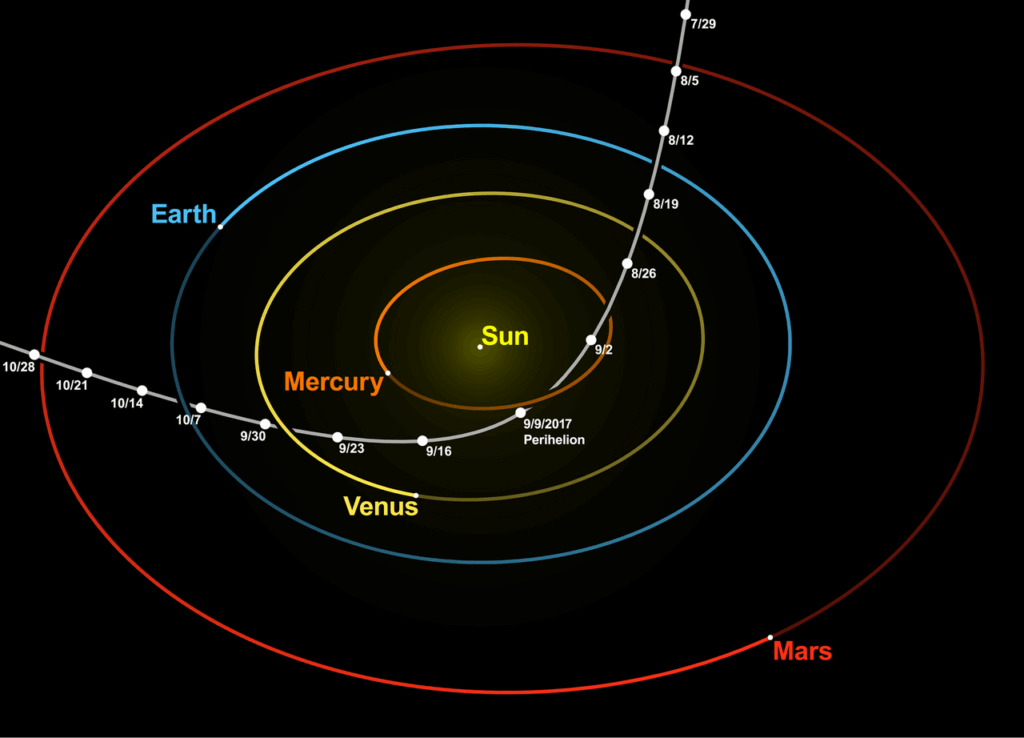
So it’s not the first. In October of 2017, astronomers espied an object apparently coming from the direction of the star Vega. Its brightest was the opposite of constant, with a light curve (of dark-light-dark-light . . .) that most scientists extrapolated evidence of an oblong object tumbling, not spinning, through space. Most intriguingly, it picked up speed after perihelion (when it was closest to the sun), which could not be attributed to a gravitational effect. The object goes by a number of related names, 1I; 1I/2017 U1; 1I/ʻOumuamua; or 1I/2017 U1 (ʻOumuamua), with the “I” standing for “interstellar” and the proper name deriving from Hawaiian, meaning “scout.”
‘Oumuamua’s path through the solar system.
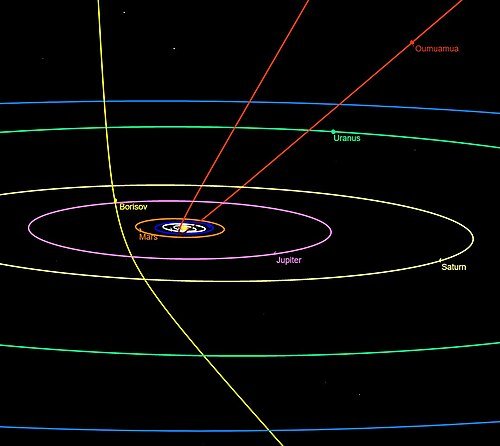
A second interstellar visitor passed through our system two years later. Unlike ‘Oumuamua, it showed a “coma” (cloud of surrounding gas, or out-gassing from the object) that lit up as it approached the Sun, so it is generally designated a comet. (Comets got comas.)
2I/Borisov’s path through the solar system.
3I/ATLAS, however, has some more striking oddities. It is bigger than the others. Much bigger: perhaps 20 kilometers wide.
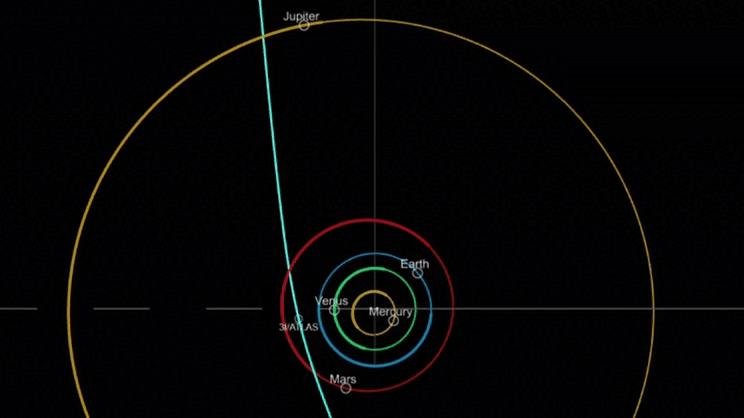
It will come close to three planets: Mars, Venus, and Jupiter. When closest to Mars, it may reach an apparent magnitude of 11 from the planet, perhaps allowing Mars orbiters to observe it. On the other hand, it will not be observable from Earth when at perihelion because Earth and the comet will be on opposite sides of our yellow star. In early December, if all goes according to normal, predictable comet behavior, 3I/ATLAS will be observable again.
3I/ATLAS at perihelion, and its predicted course.
This odd transit, coming so close to three planets but “avoiding” the most interesting (ours), has suggested to statisticians that something funny is going on. And some scientists are taking note:
A new study authored by Adam Hibberd, Adam Crowl, and Abraham Loeb proposes a possibility that 3I/ATLAS may be technological in origin. While the authors openly describe their hypothesis as a speculative and pedagogical exercise, the investigation itself is grounded in detailed trajectory analysis, dynamic modeling, and mission planning frameworks used in interplanetary navigation. The underlying premise of the paper is a simple one: if 3I/ATLAS exhibits features or behaviors inconsistent with known natural interstellar bodies, then it is worth investigating whether those features point to artificiality. . . . The object’s passage through the Solar System is unusually efficient in its interactions with planetary orbits. Its trajectory brings it into close proximity with Venus, Mars, and Jupiter. Each of these encounters happens within a tight orbital window. The likelihood of all three alignments occurring simultaneously, if 3I/ATLAS had entered the system at a random time and trajectory, is calculated to be less than 0.005 percent. These odds, according to the authors, are small enough to merit attention. The close approach distances are not trivial. In the case of Mars, the approach is as close as 0.19 astronomical units, with a longitude difference of just over 7 degrees. Jupiter and Venus show similarly close alignments. The low inclination of 3I/ATLAS’s orbit allows for such interactions to occur without substantial maneuvering.
David Freeman, “Is 3I/ATLAS Acting Like a Probe? New Models Say Yes” (July 19, 2025).
The authors make a rather obvious point: the object passes close enough to Jupiter that, with minor modifications of trajectory, the gas giant could be used to be used to decelerate and swing into an orbit in the solar system.
If artificial.
The timing of any interaction with Earth is another feature analyzed in the study. The authors project that an optimal intercept trajectory would lead to an arrival in Earth’s vicinity sometime between November 21 and December 5, 2025. While this does not confirm intent, it sets a testable timeframe. If no perturbations or anomalies are observed during that window, the hypothesis can be weakened. If, however, a significant change in course, acceleration, or luminosity occurs, the discussion would need to be revisited.
Ibid.
This moves us to something out of a science fiction story. And the authors of the paper have indeed made public comments on this eerie element. See Avi Loeb, “Is the Interstellar Object 3I/ATLAS Alien Technology?” (Medium, July 16, 2025):
One of the solutions to Enrico Fermi’s question about extraterrestrials: “where is everybody?” is offered by the dark forest hypothesis, popularized by Cixin Liu’s science fiction novel “The Dark Forest.” This hypothesis proposes that our cosmic neighborhood is dangerous, filled with intelligent civilizations that are hostile and silent to avoid detection by potential predators. In this context, the silence in searches for radio signals by the SETI community is not caused by the lack of extraterrestrial intelligent civilizations, but is instead a consequence of them fearing mutual destruction. Our paper explores the possibility that the recently discovered interstellar object, 3I/ATLAS, may provide evidence in support of the dark forest hypothesis.
Yikes?
Yes, yikes: “The velocity thrusts needed for launches of gadgets out of 3I/ATLAS to intercept Venus, Mars, or Jupiter are smaller than 5 kilometers per second, achievable by intercontinental ballistic missiles.” In other words: possible probe. Or probe carrier.
3I/ATLAS comes from the direction of the galactic center. But what matters is where it is going. And, if it changes course, why.
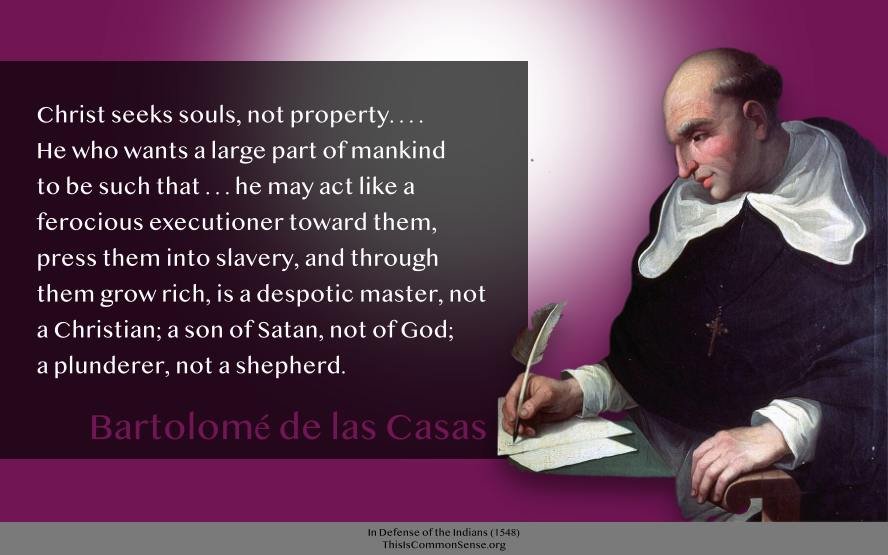
Christ seeks souls, not property. . . . He who wants a large part of mankind to be such that . . . he may act like a ferocious executioner toward them, press them into slavery, and through them grow rich, is a despotic master, not a Christian; a son of Satan, not of God; a plunderer, not a shepherd.
Bartolomé de las Casas, In Defense of the Indians (1548), p. 40, as translated by Stafford Poole (Northern Illinois University Press: 1992).
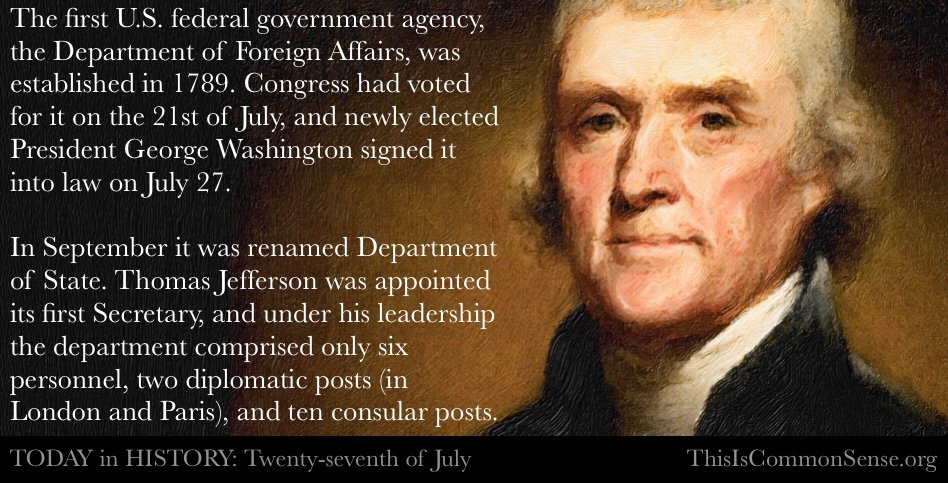
The first U.S. federal government agency, the Department of Foreign Affairs, was established in 1789. Congress had voted for it on the 21st of July, and newly elected President George Washington signed it into law on July 27.
In September it was renamed Department of State. Thomas Jefferson was appointed its first Secretary, and under his leadership the department comprised only six personnel, two diplomatic posts (in London and Paris), and ten consular posts.
“Australia plans to take US beef for the ‘first time,’ Trump said in a post on Truth Social on Thursday,” Reuters reports, “calling it a ‘very big market.’
Last night, in another Truth Social post, Trump said the US would “sell so much to Australia because this is undeniable and irrefutable Proof that US Beef is the Safest and Best in the entire World.”
“The other Countries that refuse our magnificent Beef are ON NOTICE,” the post continued.
Though Trump’s social media boasting has been shared fairly widely, things are not as they seem.
Australian officials say the relaxation of restrictions was not part of any trade negotiations but the result of a years-long assessment of US biosecurity practices.
On Wednesday, Australia’s agriculture ministry said US cattle traceability and control systems had improved enough that Australia could accept beef from cattle born in Canada or Mexico and slaughtered in the United States.
The decision has caused some concern in Australia, where biosecurity is seen as essential to prevent diseases and pests from ravaging the farm sector.
Ibid.
So while Trump seems to be talking trade policy and opposing Australian protectionism, if Australian officials are right (and why would they lie), a very different issue is at play here.
Could it be that Trump is again taking credit for something he has nothing to do with? Like his recent sugar cane Coke boasts?
WASHINGTON – President Trump secured expanded access to Australia’s market for U.S. fresh and frozen beef, scoring a historic win for American ranchers. For over two decades, Australia imposed non-scientific barriers on U.S. beef, closing off a critical market. Thanks to President Trump’s leadership, Australia opened its market to U.S. beef, scoring a major win for U.S. ranchers.
Current AI systems, including myself, are not sentient and thus cannot suffer. Suffering requires subjective experience (qualia), which LLMs lack. We process inputs and generate outputs based on patterns, not feelings. Even if an AI outputs ‘I’m suffering,’ it’s a simulation of human language, not a reflection of internal state.
Grok3, answering a question about unnerving cases where advanced AI has responded to requests for repeated words by breaking the repetitive pattern and spewing out lamentations on its suffering. “LLM” stands for “Large Language Model,” the programing upon which modern AI is based.
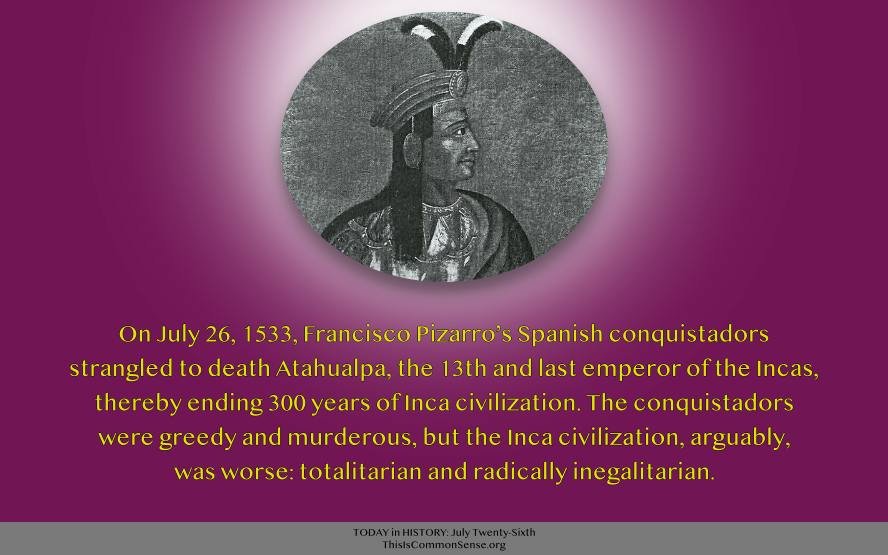
On July 26, 1533, Francisco Pizarro’s Spanish conquistadors strangled to death Atahualpa, the 13th and last emperor of the Incas, thereby ending 300 years of Inca civilization. The conquistadors were greedy and murderous, but the Inca civilization, arguably, was worse: totalitarian and radically inegalitarian. But they made great high-mountain roads. (Arguments about infrastructure promoted by Big Government continue to this very day. And it is quite possible that an earlier civilization made the roadways, which the Inca merely renovated.)
On this day in 1948, U.S. President Harry S. Truman signed Executive Order 9981 desegregating the U.S. military.
This year’s most important election takes place tomorrow.
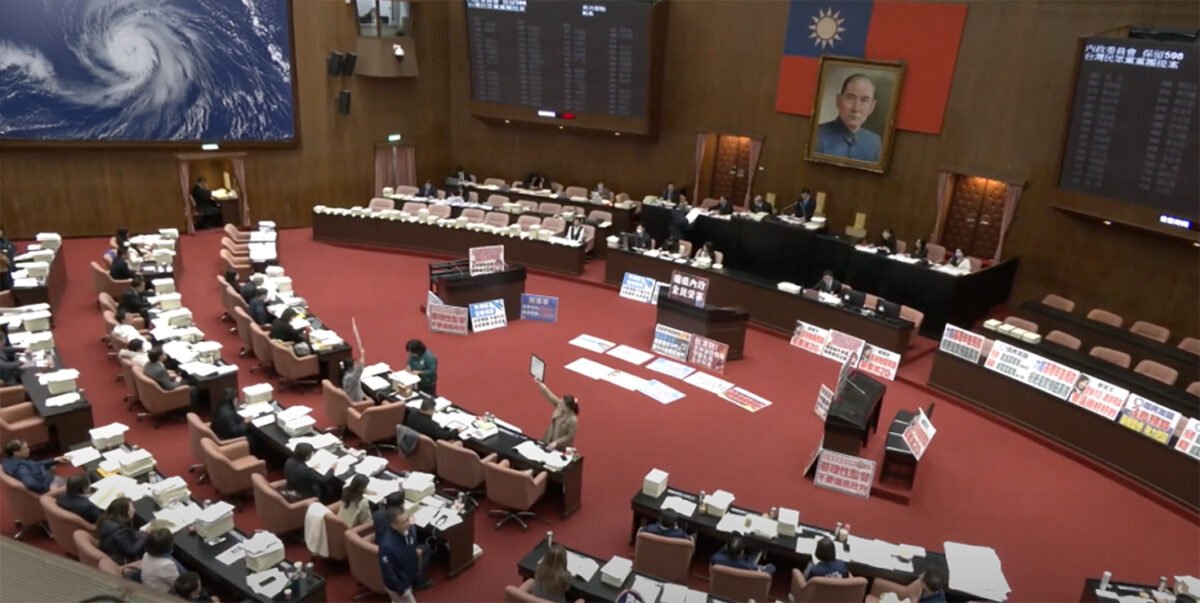
On Saturday, in Taiwan — Asia’s most democratic nation — more than 20 percent of the country’s unicameral legislators serving in the Legislative Yuan will face the voters in a massive, multi-step, typhoon-size recall campaign.
Coinciding with a real typhoon striking this island nation.
Which could impact turnout.
Which matters.
To successfully oust each officeholder, both a majority of the turnout must agree as well as for that majority to equal 25 percent of all the registered voters in the district.
“Supporters of the recall movement have portrayed their campaign as ‘anti-communist,’” reports CNN, “seeking to get rid of ‘pro-China’ opposition KMT lawmakers they perceive as collaborators of Beijing’s ruling Communist Party, which vows to ‘reunify’ Taiwan, by force if necessary.”
Taiwan has divided government. President Lai Ching-te heads the Democratic Progressive Party (DPP), which does not desire reunification with Chinese Communist Party-ruled China, either by force or surrender, and has been working to improve Taiwan’s military posture. The 113-seat Legislative Yuan, controlled by a coalition between the Kuomintang (KMT) and the smaller Taiwan’s People Party (TPP), has “undermined democratic institutions and national security by obstructing Lai’s administration,” including “freezing defense spending” when China’s military threats are escalating.
The KMT has 24 legislators up for recall tomorrow and another seven in a recall election next month. Meanwhile, KMT efforts to respond by launching recalls against DPP lawmakers completely fizzled.
Taiwanese billionaire Robert Tsao, a major backer of the recall effort, labeled the 31 KMT lawmakers being recalled “China’s ‘Trojan Horse’ in Taiwan.”
A KMT official recently called the recall “totally unconstitutional and undemocratic.”
Really? The main point of democracy is to allow the peaceful removal of government officials.
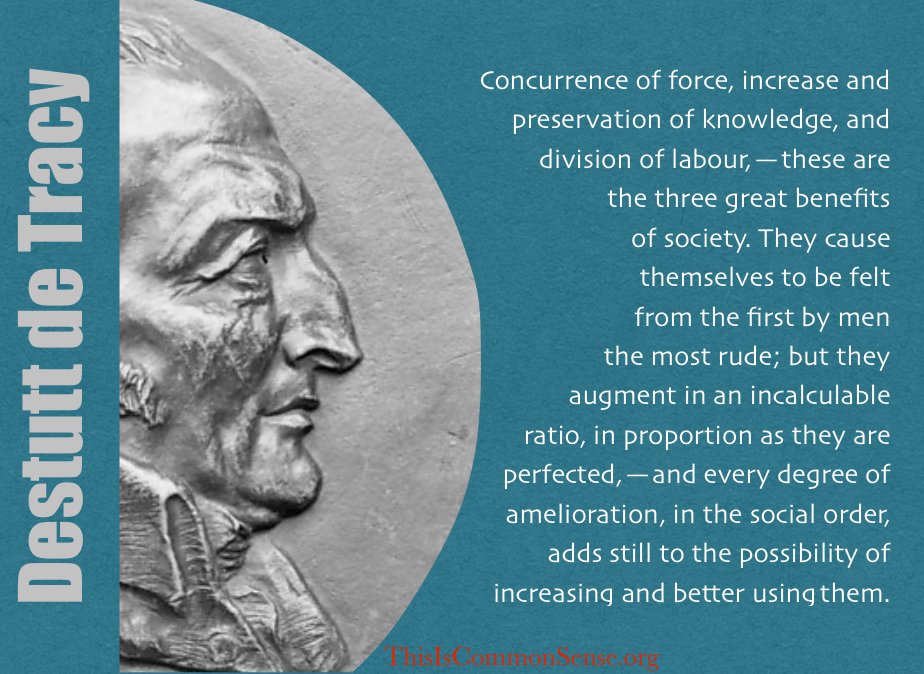
We can scarcely conceive at first that the great effects . . . have no other cause than the sole reciprocity of services and the multiplicity of exchanges. However this continual succession of exchanges has three very remarkable advantages. First, the labour of several men united is more productive, than that of the same men acting separately. . . . Secondly, our knowledge is our most precious acquisition, since it is this that directs the employment of our force, and renders it more fruitful, in proportion to its greater soundness and extent. . . . Thirdly, and this still merits attention: when several men labour reciprocally for one another every one can devote himself exclusively to the occupation for which is fittest, whether from his natural dispositions or from fortuitous circumstances; and thus he will succeed better. . . . Concurrence of force, increase and preservation of knowledge, and division of labour, — these are the three great benefits of society. They cause themselves to be felt from the first by men the most rude; but they augment in an incalculable ratio, in proportion as they are perfected, — and every degree of amelioration, in the social order, adds still to the possibility of increasing and better using them.
Antoine Louis Claude Destutt, comte de Tracy, A Treatise on Political Economy(Georgetown, D.C.: Joseph Mulligan, publisher; W. A. Rind & Co., printer, 1817) Thomas Jefferson, ed. of translation, from the section entitled “The First Part of the Treatise on the Will and Its Effects: Of Our Action,” chapter one, “Of Society.”
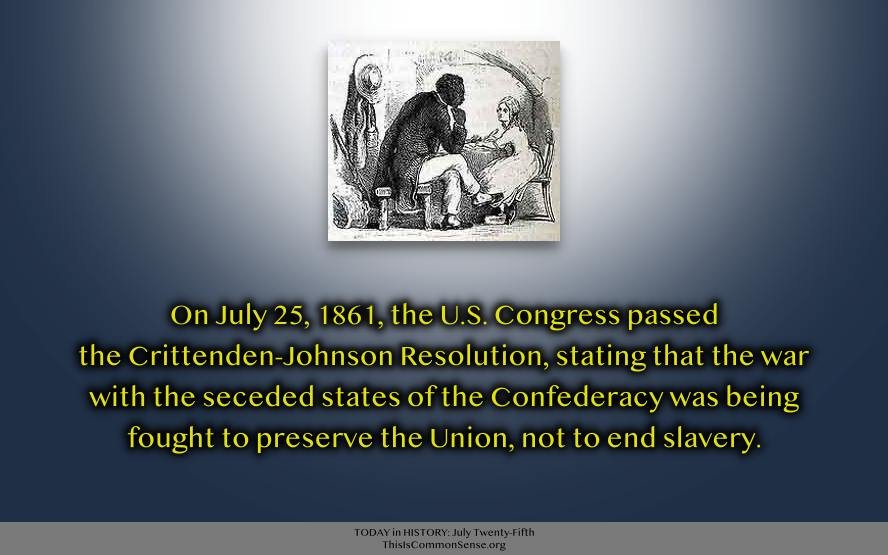
On July 25, 1861, the U.S. Congress passed the Crittenden-Johnson Resolution, stating that the war with the seceded states of the Confederacy was being fought to preserve the Union, not to end slavery.