Far from creating a futuristic utopia where — once our security needs are met — we are all liberated to pursue our dreams, become great scientists, scholars, artists, and entrepreneurs, the universal basic income threatens a totalitarian horror the likes of which we are used to seeing imagined only on The Twilight Zone and The Outer Limits.
Certainly the poor, who depend solely on their handouts to survive, will quickly become very cautious of what they say and do, but even reasonably affluent people will think twice before risking a sum that is high enough to live on. The UBI will institutionalise the state as each of our patrons — and us as wards of the state. Once this relationship is established we will enter into a frightening era where the government is our provider and the UBI can easily be weaponized by our rulers to shape us into compliance.
Remember during Hillary Clinton’s 2016 presidential campaign, when she promised “to put a lot of coal miners and coal companies out of business”?
She seemed surprisingly surprised that coal miners were so displeased.
Have no fear, however — quickly she highlighted her $30 billion plan to provide sustenance and re-training to these soon-to-be displaced miners.
Leading in the latest Iowa poll,Sen. Bernie Sanders (Ind.-Vt.) opines his own deep commitment to enacting “Medicare for All” and, by the magic of Washington statecraft, summarily executing private health insurance in these United States.
“The private health insurance business employs at least a half a million people, covers about 250 million Americans, and generates roughly a trillion dollars in revenues,” reportsThe New York Times. “Its companies’ stocks are a staple of the mutual funds that make up millions of Americans’ retirement savings.”
In last night’s debate, CNN’s Abby Phillip read the Vermont senator a question from an Iowa Democratic voter: “Des Moines is an insurance town. What happens to all . . . the health insurance industry here if there is ‘Medicare for All’? What happens to all the jobs and the livelihoods of the people that live in insurance towns like Des Moines?”
“We build in to our ‘Medicare for All’ program a transition fund of many, many billions of dollars,” Sanders explained, “that will provide for up to five years income and health care and job training for those people.”
Come on, don’t get uptight about whether your job — or your whole industry — is terminated. Uncle Bernie will set you up with a new gig, and some cash to hold you over.
The separation of state and church must be complemented by the separation of state and science, that most recent, most aggressive, and most dogmatic religious institution.
Paul Karl Feyerabend, Against Method (1975), p. 295.
On January 15, 1777, New Connecticut declared independence from the crown of Great Britain and the colony of New York.
Delegates first named the independent state New Connecticut and, in June 1777, finally settled on the name Vermaont, an imperfect translation of the French for Green Mountain.
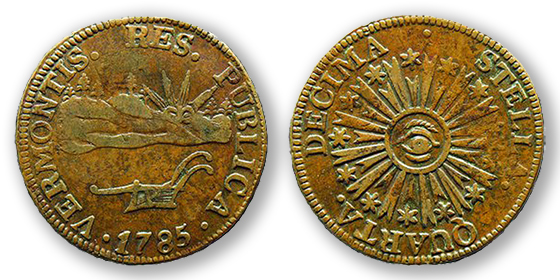
This new “Vermont Republic” minted copper coins (see above), first struck in 1785. The people of Vermont took part in the American Revolution although the Continental Congress did not recognize the jurisdiction, because of vehement objections from New York, which had conflicting property claims.
In 1791, Vermont was admitted to the United States as the 14th state, upon which its minting of coins ceased.
The persecuting spirit has its origins morally in the disposition of man to domineer over his fellow-creatures, intellectually in the assumption that one’s own opinions are infallibly correct.
John Fiske, “The Philosophy of Persecution,” North American Review (D. Appleton & Co., January 1881), No. CXXXII, p. 12.
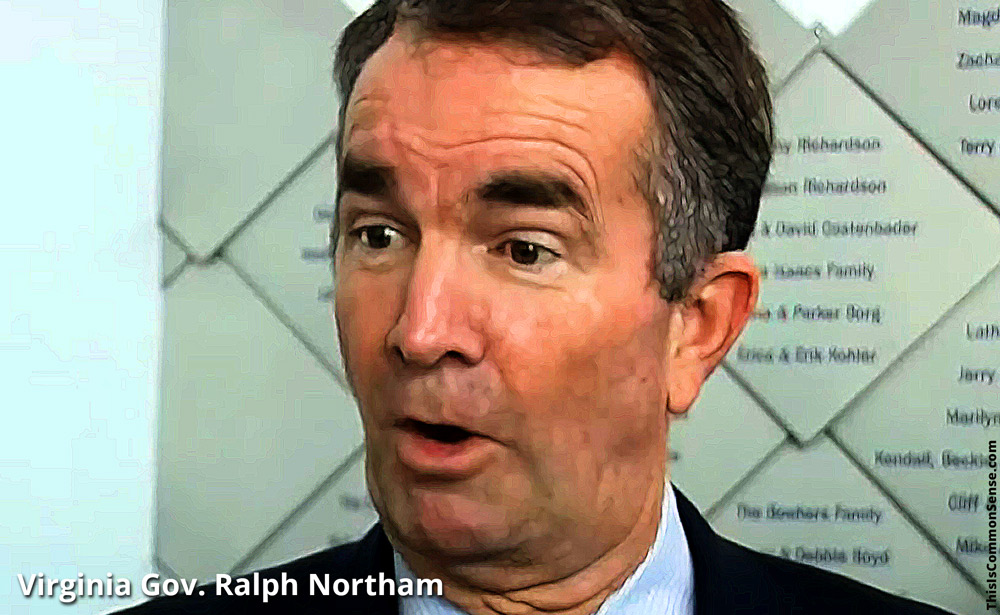
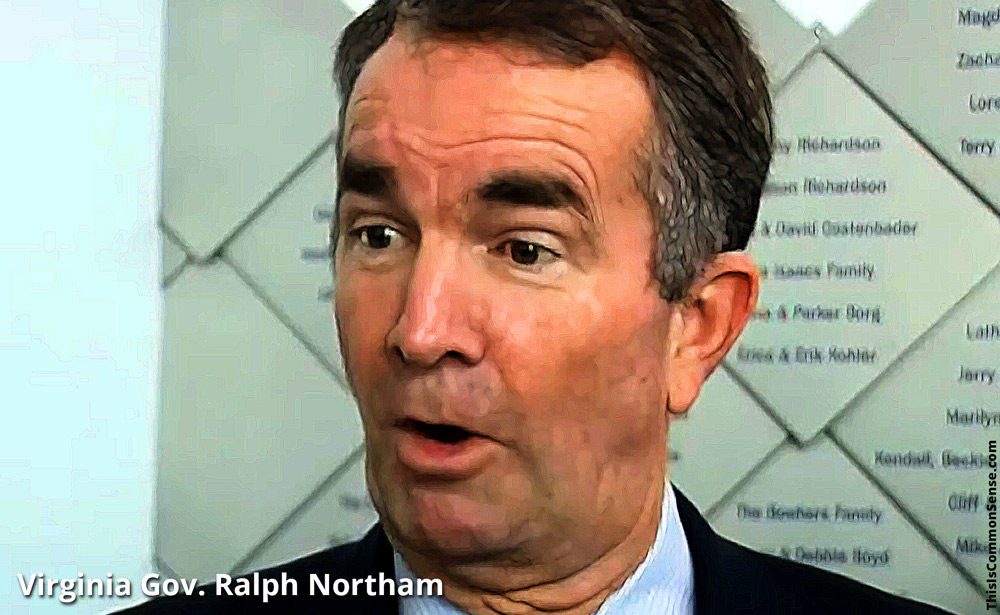
“Let’s have an honest conversation based on fact,” Virginia Gov. Ralph Northam chided in his annual State of the Commonwealth speech before assembled legislators last week.
“Not fear.”
Last year, fear was more popular. In the frightful aftermath of a Virginia Beach city employee shooting and killing 12 co-workers, Northam was quick to call a special session of the legislature to pass gun control legislation.
Republicans said no, however, and adjourned.
With Democrats newly in control of both chambers of the state legislature, the governor now runs interference for “a package of eight gun-restricting measures, including universal background checks; banning assault-style weapons; requiring owners to report lost or stolen guns; and a ‘red flag law’” — along with raising the legal age to purchase a gun from 18 to 21.
“When the General Assembly passes new guns safety laws,” proclaims Attorney General Mark Herring, a Democrat, “they will be enforced, and they will be followed.”
In response, Virginia’s many Second Amendment defenders are stepping up. Already, more than 110 cities and counties have declared their status as Second Amendment sanctuaries.
“These resolutions have no legal force,” informs the AG, adding, “and they’re just part of an effort by the gun lobby to stoke fear.”
Oh, yes, unmistakable stoking has occurred. On January 20, the Virginia Citizens Defense League is organizing a massive lobby day at the capital, where the stoked will politically poke their delegates.
Join us.
This is Common Sense. I’m Paul Jacob.
* You may recall Northam as that fellow whose personal medical school yearbook page contained a photo of a man in black-face next to someone donning a KKK robe. First, the governor apologized, then reversed course, claiming he had no idea how the picture mysteriously materializedinto the yearbook — though he acknowledged other instances of wearing black-face in the past. A limited investigation by a law firm hired by the medical school came to no conclusion and the media seemed to move on.
Should Lincoln Chafee invert a boot and place it on his head?
It might help him compete. The famous Republican turned Democratic politician from Rhode Island — former U.S. Senator and Governor, both, and sometime presidential hopeful — has filed to run for the presidency.
The Libertarian Party started out nearly fifty years ago as a venue for libertarians disgusted with Richard Nixon and the Republican Party to make a pitch to the American people to abandon the lying, thieving, murderous statism of our times and swap it for freedom. In the words of its first presidential nominee, philosopher John Hospers, the idea was to “challenge the cult of the omnipotent state and defend the rights of the individual.”
The Libertarian Party has pulled in supporters from left, right and center, but mostly from the GOP, as seen in a solid one third of its past presidential runs:
former Republican elector Roger MacBride (1976)
former and future Republican U.S. Representative Ron Paul (1988)
former Republican U.S. Representative Bob Barr (2008)
former Republican New Mexico Governor Gary Johnson (2012; 2016)
The Libertarians are an earnest lot, trying to get the attention of earnest American voters by putting up men with political credentials. In the case of Gary Johnson’s last campaign, the strategy “paid off” with over 4.4 million votes. The LP attracts ambitious politicians and publicity seekers who do not quite fit in with the two parties, in no small part because Libertarians have done a great job of obtaining all-important ballot status in most if not all 50 states in presidential elections.
Libertarian Party members have so far avoided non-political celebrity candidates, such as the late activist and actor Russell Means (1988) and gonzo millionaire John McAfee (2012). Chafee would be the first Democratic pol to get the nomination. But he is running against some strong libertarian activists (Kim Ruff, Jo Jorgensen, Jacob Hornberger, et al.) as well as a return bid from McAfee (who also happens to be on the run from the IRS).
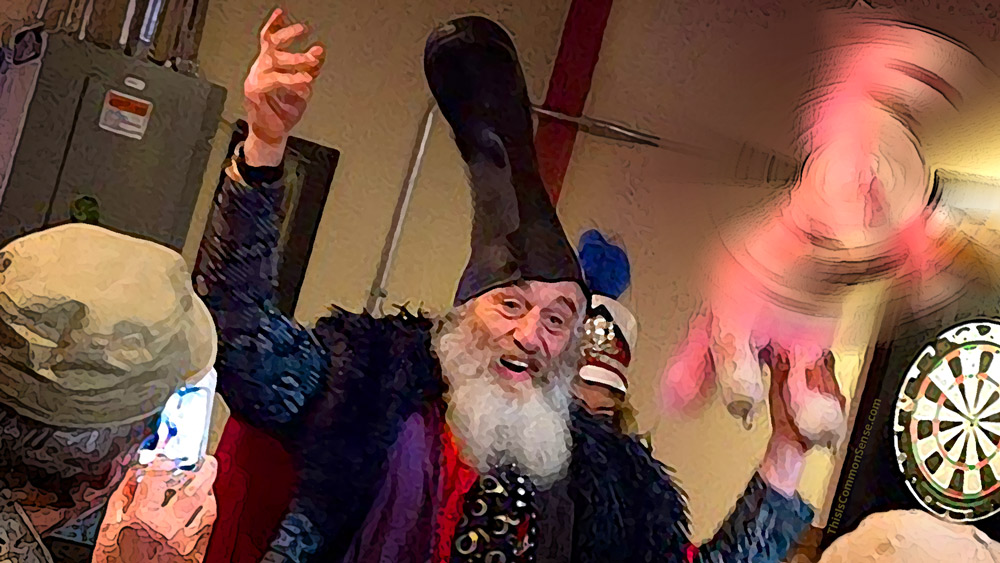
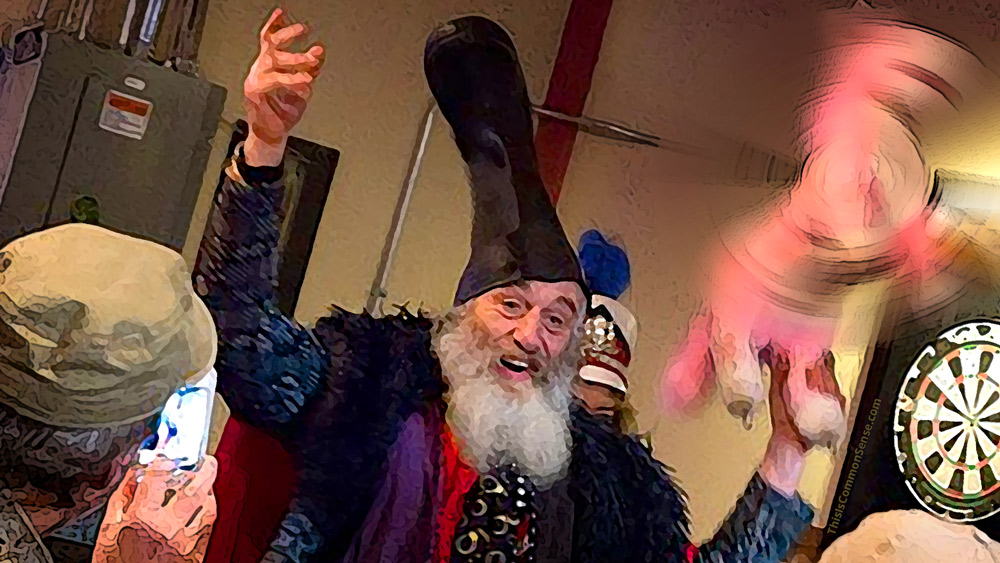
A parody candidate calling himself “Vermin Supreme” and running on a joke (and quite anti-freedom) platform (mandatory ponies for everyone!), has just won the Libertarian position in the New Hampshire Primary’s non-binding preference poll — 26 to Chafee’s 4, perhaps because he wears a boot on his head.
Tough competition for Chafee, who seems only a little more libertarian than Vermin.
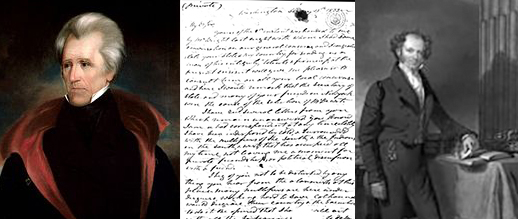
On January 13, 1833, United States President Andrew Jackson (pictured, top left) wrote to Vice President Martin Van Buren (pictured, top right) expressing his opposition to South Carolina’s defiance of federal authority in the Nullification Crisis. Jackson insisted that “the crisis must be now met with firmness” and “the modern doctrine of nullification & succession put down forever.”
South Carolina had blamed protectionist high tariffs for the severity of the economic slump of the time, and Andrew Jackson’s compromise Tariff of 1832 was still too much special-interest “protectionism” for South Carolina, which threatened to nullify the law as unconstitutional. Jackson, a nationalist at heart, had no sympathy for dissidents in the southern states. (The tariffs were designed by northern politicians to encourage the growth of industry. The belief among most economists of that time was that such high “protective” tariffs favored certain businesses at the expense of the general consumer, particularly farmers and agricultural producers.) After the crisis subsided, tariffs were further reduced from the 1832 level, much lower than of 1828’s “Tariff of Abominations,” which had been signed into law by President John Quincy Adams — and written mainly by Martin Van Buren as a way to precipitate the election of Jackson.
Since the somewhat ambiguous end to the Nullification Crisis, the doctrine of state prerogatives — “states’ rights” — has been asserted by opponents of the Fugitive Slave Act of 1850, proponents of California’s Specific Contract Act of 1863 (which nullified the Legal Tender Act of 1862), opponents of Federal acts prohibiting the sale and possession of marijuana in the first decade of the 21st century, and opponents of implementation of laws and regulations pertaining to firearms from the late 1900s up to 2013. State opposition to ObamaCare has also recently conjured up the issue.
On January 13, 1898, Émile Zola’s J’accuse exposed the Dreyfus affair.