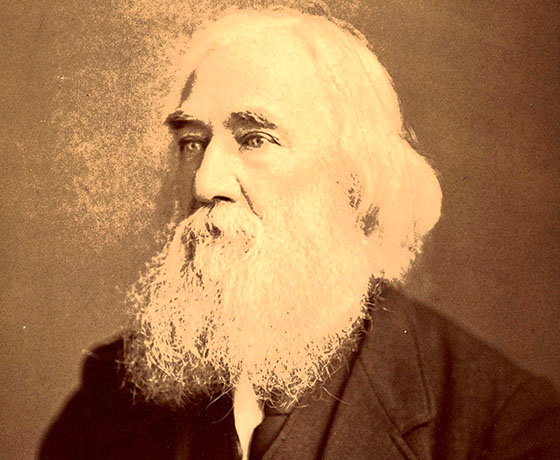
Spooner’s achievements in American life, law, and political philosophy, are among the most colorful of the 19th century. Studying law privately, he sued to practice without joining the bar, and won the suit. He set up a postal service that directly competed with the United States Postal Service, delivering mail at a fraction of the cost. He wrote The Unconstitutionality of Slavery, and convinced noted Garrisonian abolitionist Frederick Douglass of his argument. (The book became the centerpiece of intellectual ammunition for the Free Soil Party.) Later in life Spooner turned against constitutionalism itself, and penned some of the most radical political works of his day, including Vices Are Not Crimes and The Constitution of No Authority. Spooner also clearly articulated a “jury nullification” position in his classic treatise Trial by Jury.
Individualism . . . means neither egotism nor isolation. It means voluntary beneficence and public spirit, as against all attempts to enforce these by penal laws. It means voluntary cooperation as contrasted with the forced cooperation of the State.
When time and labor had developed riches, cupidity restrained by the laws, became more artful, but not less active. Under the mask of union and civil peace, it fomented in the bosom of every state an intestine war, in which the citizens, divided into contending corps of orders, classes, families, unremittingly struggled to appropriate to themselves, under the name of supreme power, the ability to plunder every thing, and render every thing subservient to the dictates of their passions; and this spirit of encroachment, disguised under all possible forms, but always the same in its object and motives, has never ceased to torment the nations.
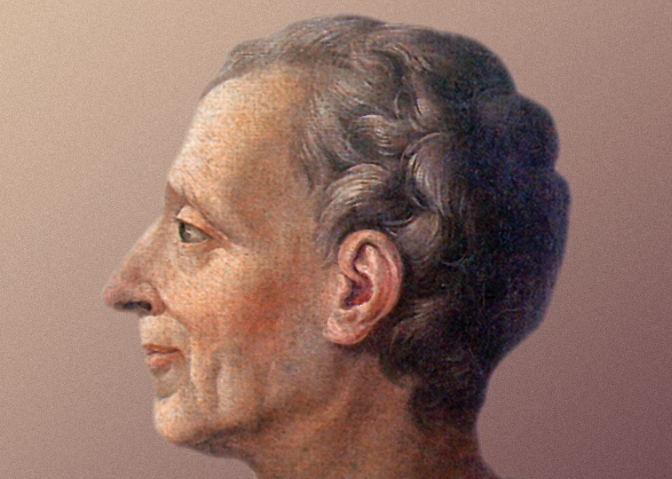
On January 18, 1689, Charles-Louis de Secondat, Baron de La Brède et de Montesquieu, French satirist and philosopher, was born.
His treatise The Spirit of the Laws was a major influence upon America’s founding generation. He is famous for his articulation of the theory of separation of powers, which is implemented in many constitutions throughout the world. He did more than any other author to secure the place of the word despotism in the political lexicon.
In 1811, former U.S. President Thomas Jefferson translated and published Destutt de Tracy’s Commentary and Review of Montesquieu’s ‘Spirit of Laws,’ a very popular review of republican principles — which helps demonstrate how important these French writers were to the American form of government.
The impeachment trial of President Donald J. Trump began yesterday, after much stalling by House Speaker Nancy Pelosi, who had postponed sending the House impeachment documents to the Senate after the finalization of the impeachment vote a month ago. Supreme Court Chief Justice Roberts swore in the assembled senators — 99 of 100 signed their oaths — and a schedule was announced.
The question of new documents and testimony remains a bit up in the air. “House Speaker Nancy Pelosi says a federal watchdog’s report on President Donald Trump’s freeze of aid to Ukraine makes it more important for Congress to get new testimony and documents,” according to the Associated Press. Seems odd that a trial would require more information than was present in the original indictment, er, impeachment, but I’m no scholar of the legality of this issue.
I do remember the last presidential impeachment.
And it was a real partisan — indeed, all-around — let-down.
Interestingly, that trial was held around the time Bill Clinton was to give 1999’s State of the Union address. And he gave it, indeed, in the midst of the whole brouhaha.
Defiantly.
What will President Trump do? What should he do?
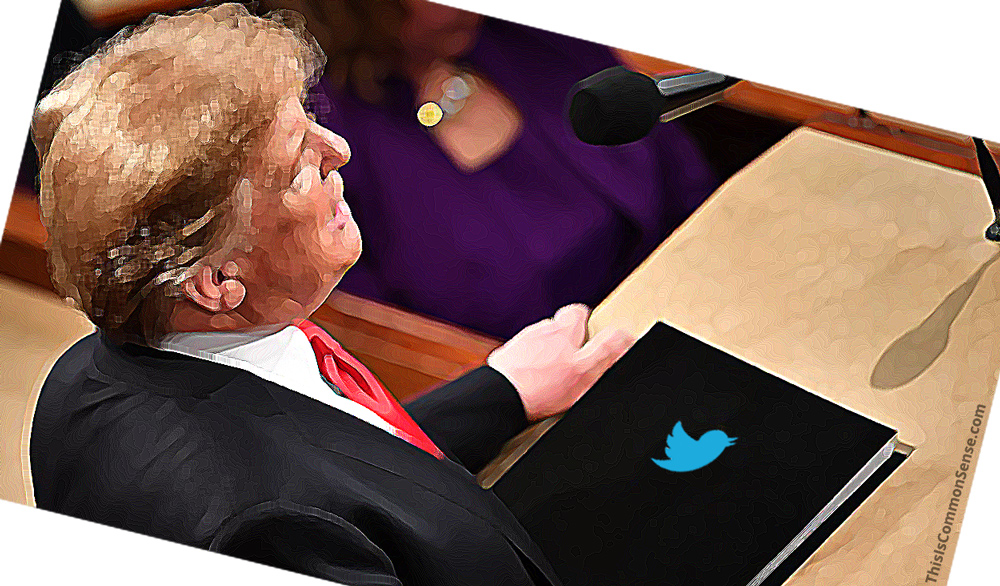
I don’t know. But I know what would be fun: deliver it via Twitter.
The Constitution, as I’ve noted before, does not specify a format of the annual presentation before Congress. Thomas Jefferson wrote it out and had it delivered. No speech at all.
But the idea of the Twitterer-in-Chief tweeting it and even not correcting the spelling errors? Priceless.
On January 17, 1937, Chicago School economist George Stigler was born. Stigler won a Nobel Memorial Prize for his work. His autobiography is entitled Memoirs of an Unregulated Economist.
The most important event in the history of the last hundred years is the displacement of liberalism by etatism. Etatism appears in two forms: socialism and interventionism. Both have in common the goal of subordinating the individual unconditionally to the state, the social apparatus of compulsion and coercion. . . . Etatism assigns to the state the task of guiding the citizens and of holding them in tutelage. It aims at restricting the individual’s freedom to act. It seeks to mold his destiny and to vest all initiative in the government alone.
Ludwig von Mises defining “statism” in Omnipotent Government: The Rise of the Total State and Total War (1944).
It seems like just last week we were arguing about how it is not OK to go around “punching Nazis.”
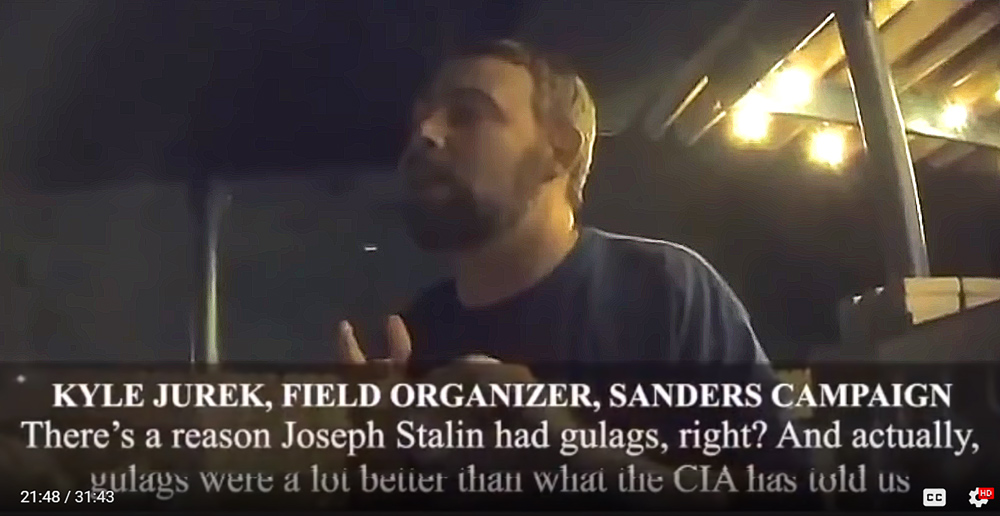
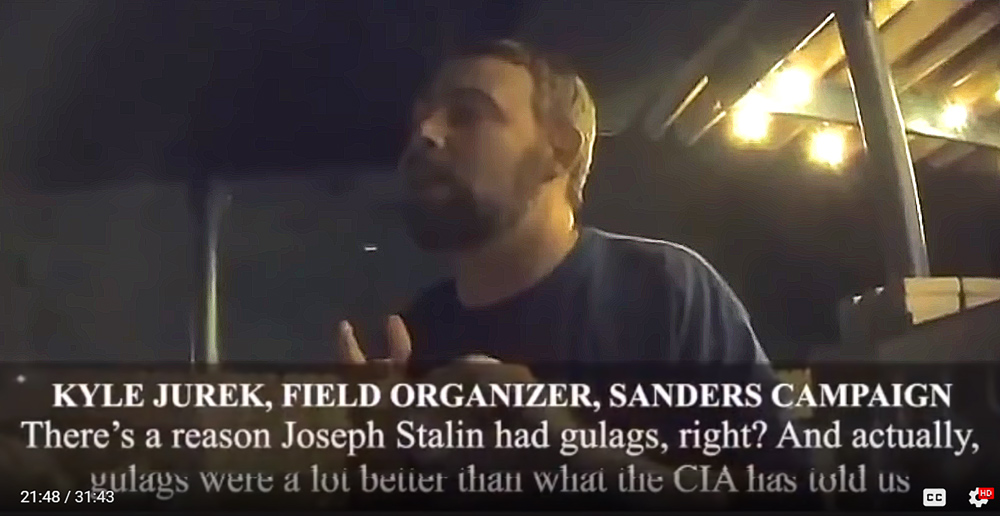
Now we have a Bernie Sanders campaign employee fuming about putting people he disagrees with into “re-education camps.”
“The only thing that fascists understand is violence,” said a Field Manager in the campaign’s Iowa office, as caught on all-too-candid camera by Project Veritas. “So, the only way you can confront them is with violence.”
It is one thing to get called a “fascist!” or “Nazi!” by a leftist for disagreeing with a leftist, it is another thing to be sucker-punched by a leftist for disagreeing with a leftist — and something far, far worse to be put into a concentration camp for expressing non-leftist-approved views.
His name is Kyle Jurek. Project Veritas has certainly not dubbed him a typical Bernie voter. His views are described as “extreme left-wing fringe,” and the utility of the clandestine recordings, taken over months, said to lie in the insight they provide “into the mentality of many Sanders staffers and what they truly believe.”
Jurek’s beliefs include extra-legal violence and Soviet Gulag revisionism, expressed with f-bombs and mf-barrages. “You want to fight against the revolution, you’re going to die for it, mother—” Jurek lashes out at “fellow” Democrats . . . and MSNBC . . . and Trump voters. He talks about setting Milwaukee afire. And not rhetorically.
We’ve long worried about the Vermont senator, who has defended horrific Soviet and Cuban rule throughout his long history of communist apologia.
I guess the real test is how Jurek’s comrades — er, fellow Sanders supporters — react to the revelations.
This is Common Sense. I’m Paul Jacob.
N.B. As this commentary posts, the only official response has come from the Iowa state director for the Sanders campaign, Misty Rebik, who dismissed the video, saying, “The hundreds of thousands of Iowans we’ve talked to this caucus season don’t care about political gossip . . .” Jurek has not been dismissed. A search of the Washington Post and New York Times websites show neither paper has reported on the story.
The Babylon Bee made the obvious “democratic gulag” joke.