In recapping the big stories of the week, Paul adds a lot more information and opinion than you get daily here. This is a more forgiving medium, allowing for greater length.
Yes, this is the weekend podcast:

In recapping the big stories of the week, Paul adds a lot more information and opinion than you get daily here. This is a more forgiving medium, allowing for greater length.
Yes, this is the weekend podcast:

On Feb. 9, 1737, Thomas Paine was born in Thetford, England.
Paine would come to America in 1774 and by 1776 publish Common Sense, urging American independence. Later works included The Rights of Man (1792) and The Age of Reason (published in three parts in 1794, 1795, and 1807).
Paine died in 1809.
The big stories this last week will loom over our imaginations and in memory for quite a long time:
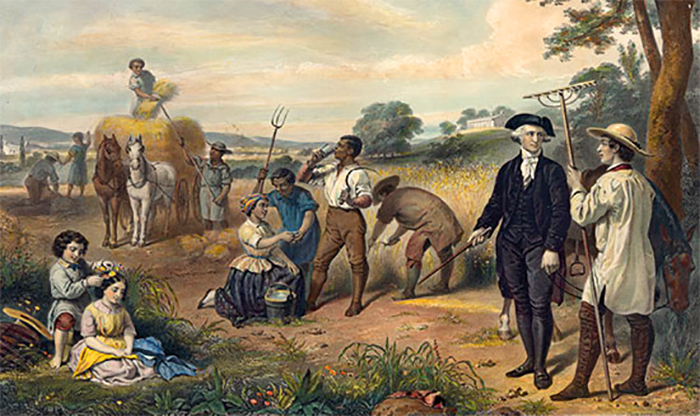
On February 8, 1865, Delaware voters rejected the Thirteenth Amendment to the U.S. Constitution, voting to continue the practice of slavery. Delaware belatedly and symbolically ratified the amendment on February 12, 1901.

The impeachment of President Donald J. Trump, just concluded in the Senate with an acquittal, was — so far as the Senate trial portion of the exercise is concerned — the least partisan presidential impeachment in U.S. history.
That’s because Senator Mitt Romney (R-Utah) was the first senator ever to vote against his own party in such a proceeding.
Before we give the notorious flip-flopper a ticker-tape parade, or query too deeply into his personal animus against Trump, let’s acknowledge that the House impeachment, proper, was heavily partisan, and is only going to get more-so.
What? you ask.
How can a past event get more or less of anything?
Well, House Republicans, expecting a big backlash against Democrats next November, are already plotting to “expunge” the impeachment from the record.
As if to stick it to Speaker Nancy Pelosi’s bizarre point that her House’s action would be “an impeachment that lasts forever.”
Sorta like Pharaoh Thutmose III chiseling his mother’s name — Hatshepsut — off the monuments of Egypt.
The Republicans’ planned “damnatio memoriae” is a good clue to the moral of this story: the impeachment process is . . . “not good,” to apply a Trumpian mantra.
Now, the process of impeachment has long seemed to me like a great idea — another one from those wise framers of the Constitution.
But with persistent partisanship, this constitutional recourse has not worked out very well.
Overall.
Historically.
Whether in 1868, with Democrat Andrew Johnson, or 1999, with Democrat Bill Clinton, or today, with Trump’s failed ouster, the impeachment process has proved (Romney notwithstanding) maddeningly partisan, and looks like it will only get more partisan — with House Democrats already talking about a second impeachment of Trump.
We need some new form of recall.
Citizen-based, perhaps?
This is Common Sense. I’m Paul Jacob.

See all recent commentary
(simplified and organized)
See recent popular posts

Happily for the busy lunatics who rule over us, we are permanently the United States of Amnesia. We learn nothing because we remember nothing.

On February 7, 1990, the Central Committee of the Soviet Communist Party agreed to give up its monopoly on power, thus ushering the way for the dissolution of the putatively communist empire.

The biggest stories don’t always come in threes, but they sure did this week.
The Iowa Democratic Caucus debacle, President Trump’s State of the Union Address, and the Senate’s acquittal of the president after the House’s impeachment — big stories of big losses for Democrats.
As I write this, we still lack a “winner” on the Democratic side in Iowa. Blame is publicly given to the goofy “app” the Iowa Democratic Party bought to make the caucusing and counting oh-so-much easier. But I wouldn’t blame Bernie supporters for engaging in a little conspiracy conjecturing — the maker of the app has close ties to the Clinton machine.
And if you cannot sniff a concerted anti-Bernie agenda on the part of establishment Democrats, your sniffer is broken.
Indeed, The Young Turks ably showed how major-media news sources skew stories away from the socialist from Vermont — by emphasizing the candidacies of Biden and Buttigieg.*
One can see why centrist Democrats would want to scuttle a serious socialist movement within their party, but it may be too little too late. After decades of courting the Gimme-Gimme vote with Loot the Rich demagoguery, socialistic attitudes have long been on the menu. So getting a hot, steaming socialism served back at them as a Blue Plate Special?
Priceless.
Literally.
But not costless.
For the cost is reasonability and decorum. After Trump ceased speaking before Congress yesterday, Speaker of the House Nancy Pelosi ripped up copies of the president’s address just to show her disdain for the president.
But it also shows frustration. The speech is over. Impeachment is over. Iowa is, incredibly, not yet over. And Pelosi’s party — under her guidance — is in complete and utter disarray.
This is Common Sense. I’m Paul Jacob.
* Ana Kasparian makes a pretty convincing case that Senator Bernie Sanders is the most popular of the three, and could even bring in independent voters.

See all recent commentary
(simplified and organized)
See recent popular posts

In all of my years, one thing does not change,
However you disguise it, this thing does not change:
The perpetual struggle of Good and Evil.

On February 6, 1778, the Treaty of Alliance and the Treaty of Amity and Commerce were signed by the United States and France, signaling official recognition of the new republic. Exactly a decade later, the State of Massachusetts became the sixth in the union to ratify the new United States Constitution.
February 6 marks the birthdays of Aaron Burr (1756 – 1836), third Vice President of the United States and infamous Weehauken duelist, and Ronald Reagan (1911 – 2004) 40th President of the United States.