Categories
Thought

Simone Weil

It is not religion but revolution which is the opium of the people.

Simone Weil, Gravity and Grace (1947; 1972), p. 140.
Categories
Today

Soviets Give Up

On February 7, 1990, the Central Committee of the Soviet Communist Party agreed to give up its monopoly on power, thus ushering the way for the dissolution of the putatively communist empire.

Categories
general freedom ideological culture privacy

Something to Protect

Some people, enemies of drawing the curtains, say: “If you aren’t doing anything wrong, you have nothing to hide.”

Doesn’t follow. Hiding is a form of protecting. We all have things to protect. Innocent people advisedly hide information from neighbors, from bureaucrats eager to erode liberty, from plain criminals.

And from the political fanatic who acts as a criminal. 

If you’re a political activist with a public profile, or even just a voter, it may be a good idea to prevent ideological criminals from knowing where you live or work. That’s why God gave us post offices boxes and commercial mail receiving agencies.

Somebody recently firebombed the offices of Powerline’s John Hinderaker, a pro-liberty activist. One fire was set in an office that he subleases in “the building that houses Center of the American Experiment,” Hinderaker’s organization, another near a law center that he works with in the same building.

The suspects are many. Why? Well, as Hinderaker told federal investigators, CAE is “unusually effective across a broad range of issues.”

If bad guys can do something to hurt you — doxxing, stalking, firebombing — once they’ve got certain information about you, it is eminently reasonable to keep that information as private as possible.

Even when such data is already circulating, you can take significant steps to improve your privacy. Among the better books on how to do so is How to Be Invisible by J. J. Luna. More current and comprehensive is Michael Bazell’s Extreme Privacy.

Worth consulting, since — without the recourse these resources provide — the cost of political activism could induce us to cede to evil people the future of our country and the world.

This is Common Sense. I’m Paul Jacob.


PDF for printing

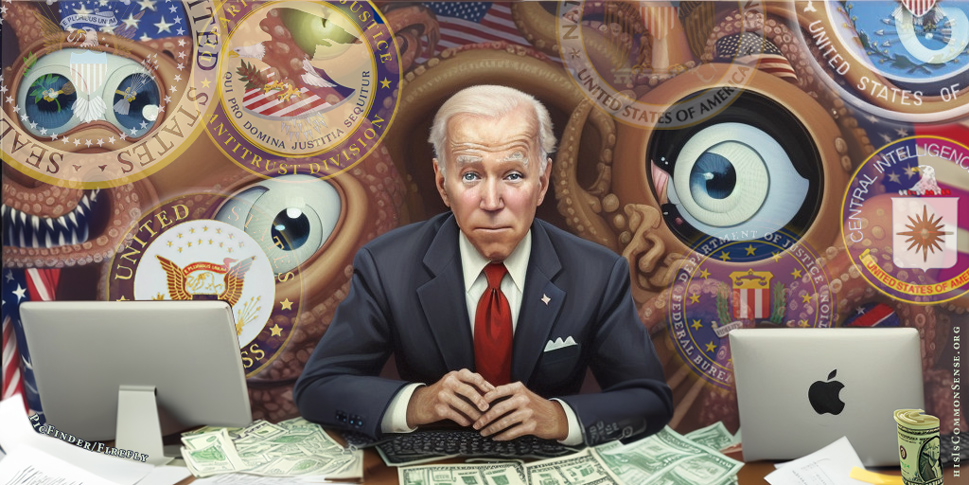
Illustration created with PicFinder and Firefly

See all recent commentary
(simplified and organized)
See recent popular posts
Categories
Thought

Poul Anderson

[F]reedom means having no masters except your own consciences and common sense.

Poul Anderson, The Stars Are Also Fire (1994), p. 16.
Categories
general freedom judiciary too much government

The Vaxxers’ War on Truckers

It’s always good when a federal court tells a federal government that it shouldn’t have done some horrible autocratic thing.

Much better had it never been done in the first place — but at least now there is official acknowledgement and, hope against hope, a chance that it won’t recur. 

Hey, a guy can dream.

According to a ruling by Canadian Federal Court Justic Richard Mosley, although truckers’ protests a few years ago against insane pandemic mandates “reflected an unacceptable breakdown of public order” (he seems to be forgetting that the government unacceptably broke things first), invoking of an Emergencies Act “does not bear the hallmarks of reasonableness — justification, transparency and intelligibility.”

No, it doesn’t bear those hallmarks. There “was no national emergency justifying invocation of the Emergencies Act.”

The truckers were clogging traffic to bring attention to a plight caused by the government. That’s it. The truckers weren’t nuking cities or anything. But in reply, the government nuked the rights of truckers by, among other things, freezing their bank accounts and even penalizing people who had donated five bucks to help the truckers out.

Truckers were protesting the fact that they were not being allowed to decide for themselves whether to risk an experimental vaccine. The government banned them from crossing the Canada–U.S. border unless they got the shot.

Luckily, Canada’s federal government has announced that it has seen the error of its ways and — ah, who am I kidding? It is appealing the decision.

This is Common Sense. I’m Paul Jacob.


PDF for printing

Illustration created with Midjourney and Firefly

See all recent commentary
(simplified and organized)
See recent popular posts
Categories
Thought

Walter Bagehot

[T]here is a tendency in descendants to be like their progenitors, and yet a tendency also in descendants to differ from their progenitors. The work of nature in making generations is a patchwork — part resemblance, part contrast. In certain respects each born generation is not like the last born; and in certain other respects it is like the last. But the peculiarity of arrested civilisation is to kill out varieties at birth almost; that is, in early childhood, and before they can develop. The fixed custom which public opinion alone tolerates is imposed on all minds, whether it suits them or not.

Walter Bagehot, Physics and Politics (1872).
Categories
Today

Sir Robert Peel

On February 5, 1788, Robert Peel was born. He would become one of the United Kingdom’s most important prime ministers, ushering in some reforms that led to the liberalization of England in the 19th century.

Peel is also regarded as the father of the modern British police — the popular term “bobbies” refers to “Bob” Peel — and as one of the founders of the modern Conservative Party.

Robert Peel died in 1850.

Categories
Thought

Simone Weil

The human soul has need of truth and of freedom of expression. 
The need for truth requires that intellectual culture should be universally accessible, and that it should be able to be acquired in an environment neither physically remote nor psychologically alien.

Simone Weil, Draft for a Statement of Human Obligation (1943).
Categories
Today

First President

On February 4, 1789, George Washington was unanimously elected as the first President of the United States, under the new Constitution, by the U.S. Electoral College.

On the same date five years later, the French legislature abolished slavery throughout all territories of the French Republic.

Categories
Thought

Walter Bagehot

The great difficulty which history records is not that of the first step, but that of the second step. What is most evident is not the difficulty of getting a fixed law, but getting out of a fixed law; not of cementing (as upon a former occasion phrased it) a cake of custom, but of breaking the cake of custom; not of making the first preservative habit, but of breaking through it, and reaching something better.

Walter Bagehot, Physics and Politics (1872).