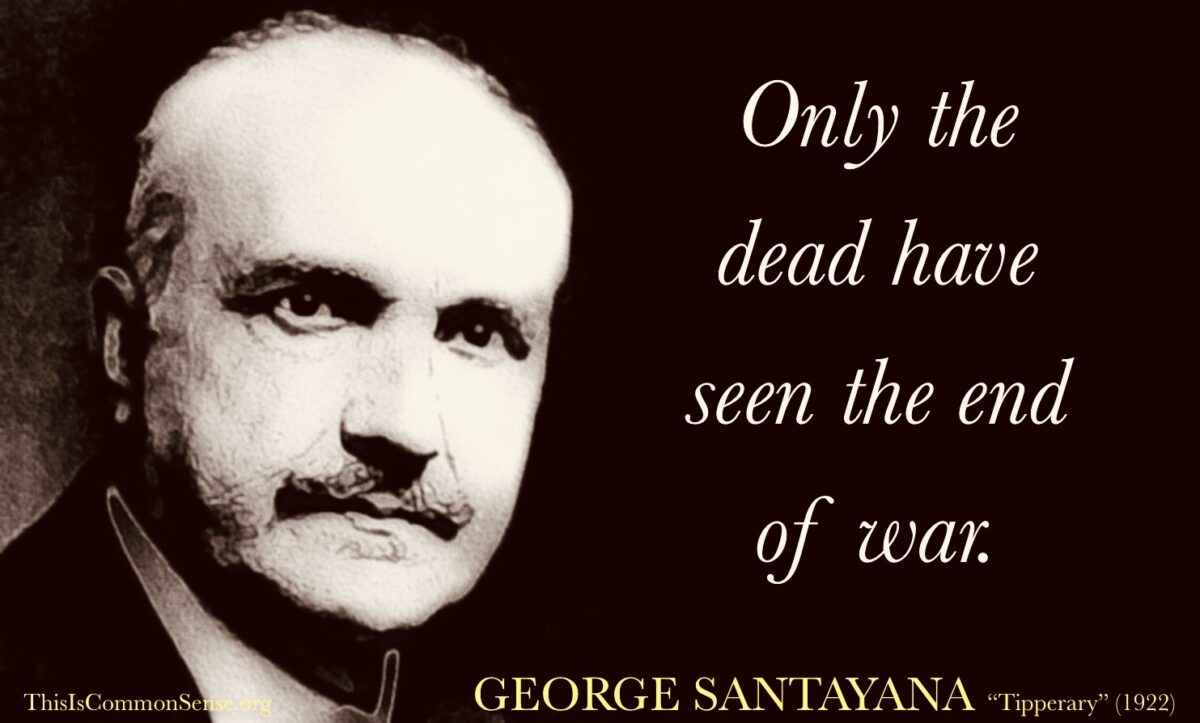
Only the dead have seen the end of war.
George Santayana, “Tipperary,” Soliloquies in England and Later Soliloquies (1922).
Categories
George Santayana
Only the dead have seen the end of war.
George Santayana, “Tipperary,” Soliloquies in England and Later Soliloquies (1922).
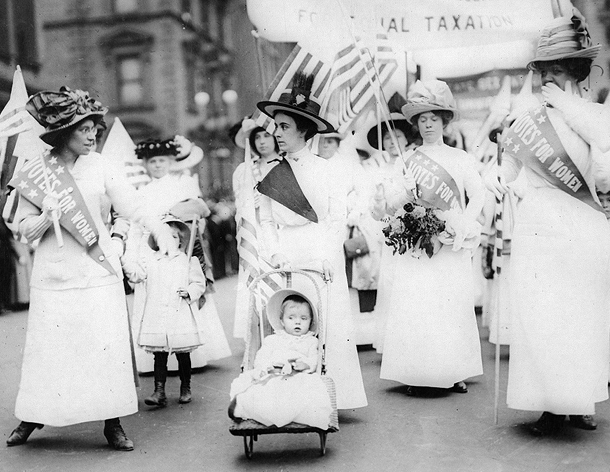
On August 26, 1920, the 19th amendment to United States Constitution took effect, giving women the right to vote in every state of the union.
Prior to the passage of this amendment, 15 states allowed women to vote. Most of them were west of the Mississippi. The territory of Wyoming was the first to extend voting rights to women in 1869.

After the racial tensions over cops shooting black people became a big story with the Ferguson incidents, Paul Jacob worked on several citizen initiatives to require “body cams” on police officers in cities around the country. Resistance to the practice has come from several quarters, not infrequently the police themselves — despite the “cop cams’” utility being to protect cops as much as anyone.
But the strangest wrinkle to this ongoing story came recently. Consult Jacob Sullum at Reason, whose article “Albuquerque’s Police Chief Says Cops Have a 5th Amendment Right To Leave Their Body Cameras Off” tells the strange behavior of Police Chief Harold Medina, who got in a crash after driving by a homeless encampment on the way to a press conference, with his wife in the department-issued pickup truck. And yes, he pled the Fifth.
“Medina is suggesting that cops have a constitutional right to refrain from recording their interactions with the public whenever that evidence could be used against them,” explains Sullum. “By turning on their cameras in those situations, he argues, police could be incriminating themselves. That is the whole point.”
But read the whole article. It’s quite a story.

Eric Hoffer, The True Believer: Thoughts on the Nature of Mass Movements (1951), pp. 10-11.
For though ours is a godless age, it is the very opposite of irreligious. The true believer is everywhere on the march, and both by converting and antagonizing he is shaping the world in his own image.

On August 25, 1945, the Cold War began (some say) when, ten days after World War II ended with the Japanese surrender, armed supporters of the Chinese Communist Party killed Baptist missionary Capt. John Birch (1918-1845).

Each civilization follows the path of a particular religion that represents it; turning to other religions, it loses the one it had, and ultimately loses them all.
Fernando Pessoa (1888–1935), The Book of Disquiet (Livro do Desassossego: Composto por Bernardo Soares, ajudante de guarda-livros na cidade de Lisboa; translated by Richard Zenith based on the 1998 Assírio & Alvim edition, edited by Richard Zenith), §306.

In 1814 on this day, British forces burnt down the White House. Unlike audience reaction to the 1996 movie Independence Day (pictured), there was no widespread cheering among Americans for the building’s destruction.
One year later, the modern Constitution of the Netherlands received its empowering signatures.
August 24 birthdays include that of British anti-slavery activist William Wilberforce (1759-1833), Argentine literary genius Jorge Luis Borges (1899-1986), and French historian and author of a magisterial study of the rise of capitalism in Europe, Fernand Braudel (1902-1985).
On August 24, 1682, William Penn received an area of territory to add it to his colony of Pennsylvania. The area comprises, today, the state of Delaware.

Back when there were only three channels in the U.S., and when most cities had a newspaper or two, all competing to “cover the news,” we thought that there was some objectivity to it all — that facts were paramount. That may have been naive. But with the rise of cable television news and the 24-hour news “cycle,” and then Internet blogging, vlogging, and podcasting, all fixed around a few social media company platforms, all pretense of rigorous reporting has evaporated.
Even corporate tool Stephen Colbert now admits that the very idea of objectivity is popularly regarded as a joke.
As it was in the beginning of the country — with Federalist papers competing with Republican papers — so it is today, except most major media outfits are Democrat, and only one major channel, Fox News, presents anything like a “Republican” spin on “the news.”
So, let’s congratulate the Democrats for finally recognizing reality.
At their national convention, just wrapped up, most journalists were not allowed on the floor. Press passes were given to loyal Democratic “journalists,” sure, but not to any of the few still trying to do actual reporting. Glenn Greenwald was refused a pass.
Instead, the Democratic Party let in a whole bunch of “influencers” and TikTokers.
Greenwald sees this as a horrific degradation of the role of honest journalism.
But maybe we should see it as the only sign of honesty we can expect from Democrats.
If propaganda be the norm, accept it and “move on.”
Silly Republicans, stuck in the past, allowed all sorts of reporters into their convention.
This is Common Sense. I’m Paul Jacob.
Illustration created with PicFinder and Firefly
See all recent commentary
(simplified and organized)
See recent popular posts

Statesmen are gamesters, and the people are the cards they play with.
David Crockett, first sentence of The Life of Martin Van Buren, Heir-apparent to the “Government” and the Appointed Successor to General Andrew Jackson (Tenth edition, 1836).

On August 23, 1989, two million people from Estonia, Latvia and Lithuania stood on the Vilnius-Tallinn road, holding hands, as part of the “Singing Revolution” that helped set the Soviet Union to its fateful implosion.