Categories
Thought

Fernando Pessoa

Sejamos simples e calmos,
Como os regatos e as árvores,
E Deus amar-nos-á fazendo de nós
Belos como as árvores e os regatos,
E dar-nos-á verdor na sua primavera,
E um rio aonde ir ter quando acabemos . . .
E não nos dará mais nada, porque dar-nos mais seria tirar-nos mais.

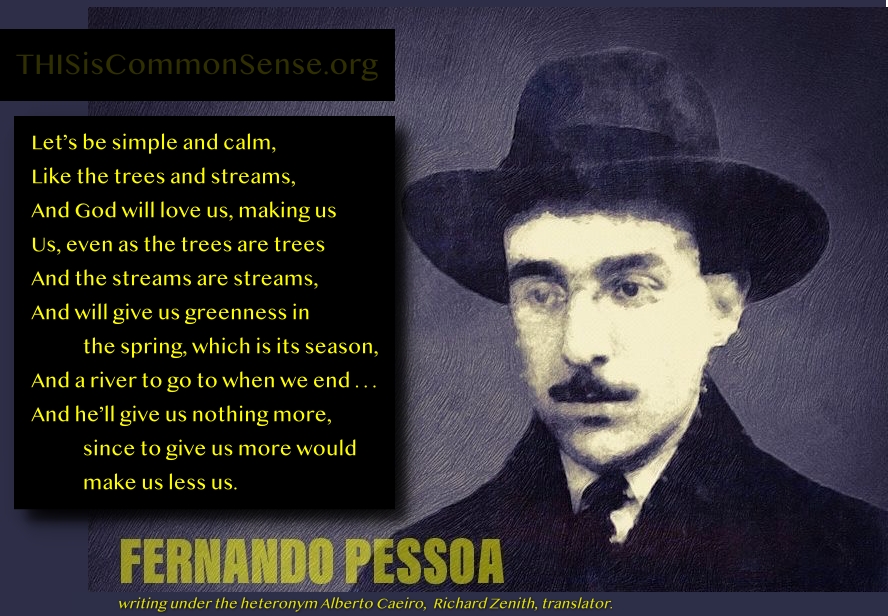
Let’s be simple and calm,
Like the trees and streams,
And God will love us, making us
Us, even as the trees are trees
And the streams are streams,
And will give us greenness in the spring, which is its season,
And a river to go to when we end . . .
And he’ll give us nothing more, since to give us more would make us less us.

Fernando Pessoa writing under the heteronym Alberto Caeiro, O Guardador de Rebanhos (“The Keeper of Sheep”), VI — in A Little Larger Than the Entire Universe, trans. Richard Zenith (Penguin, 2006).
Categories
Today

An Attack

On April 12, 1861, the Confederate attack on Fort Sumter marked the start of the American Civil War. Firing on the Union-held fort for 34 hours, the Confederate bombardment killed no soldiers in the exchange of artillery fire.

The Union garrison, led by Major Robert Anderson, surrendered on April 13, 1861, and was allowed to evacuate without loss of life.

During the evacuation on April 14, however, a Union soldier, Private Daniel Hough, was killed, and another, Private Edward Galloway, was mortally wounded due to an accidental explosion of a cannon during a salute to the U.S. flag. These are the only recorded deaths associated with the Fort Sumter incident.

Categories
defense & war international affairs

Resisting Invasion

“China is the Department’s sole pacing threat, and denial of a Chinese fait accompli seizure of Taiwan — while simultaneously defending the U.S. homeland,” Secretary of Defense Pete Hegseth declared (using the latest jargon) in a memo setting forth global U.S. strategy, “is the Department’s sole pacing scenario.” 

Recently shared with military brass and congressional national security committees, and recently leaked, Hegseth’s Interim National Defense Strategic Guidance is, according to The Washington Post, “extraordinary in its description of the potential invasion of Taiwan as the exclusive animating scenario that must be prioritized over other potential dangers.”

While I can’t find a copy of the leaked document, The Post relates that “given personnel and resource constraints,” the United States will focus on China and “pressure allies in Europe, the Middle East and East Asia to spend more on defense to take on the bulk of the deterrence role against threats from Russia, North Korea and Iran.”

This makes enormous sense. We are already at war in Ukraine and across the Middle East, while China, the most dangerous aggressor, has been ratcheting up its bullying and threats against its neighbors whom we have pledged to defend. 

Taiwan is too important — especially strategically, but also economically, and even symbolically, as an incredible democratic success story — to allow it to be gobbled up by the genocidal Chinese Communist Party regime. 

Europe can step up to defend itself and is increasingly doing so. Germany has troops and tanks headed to Lithuania, the first such deployment since the Second World War.

These are serious times. Glad to have a more serious plan to address them. And to count other free countries as allies. We will need each other.

This is Common Sense. I’m Paul Jacob.


P.S. On four separate occasions, President Biden publicly promised that the United States would come to Taiwan’s assistance militarily should China’s repeated threats to invade come to fruition, but where President Trump would stand in his second term seemed uncertain. Would he make a deal with Xi Jinping that sold out Taiwan, as John Bolton, his former national security advisor, has claimed? Bolton has been wrong before.


PDF for printing

Illustration created with Krea and Firefly

See all recent commentary
(simplified and organized)
See recent popular posts
Categories
Thought

Samuel Adams

The truth is, all might be free if they valued freedom, and defended it as they ought.

Samuel Adams, essay, written under the pseudonym “Candidus,” in The Boston Gazette (October 14, 1771).
Categories
Today

Buchenwald

On April 11, 1945, the American Third Army liberated the Buchenwald concentration camp, near Weimar, Germany, a camp that would later be judged second only to Auschwitz in the horrors it imposed on its prisoners.

Among those in the camp saved by the American soldiers was Elie Wiesel, who would go on to win the Nobel Peace Prize in 1986.


Shown in photograph: German citizens ushered to the camp by American soldiers, post-conquest.

Categories
free trade & free markets international affairs tax policy

The Tariff King

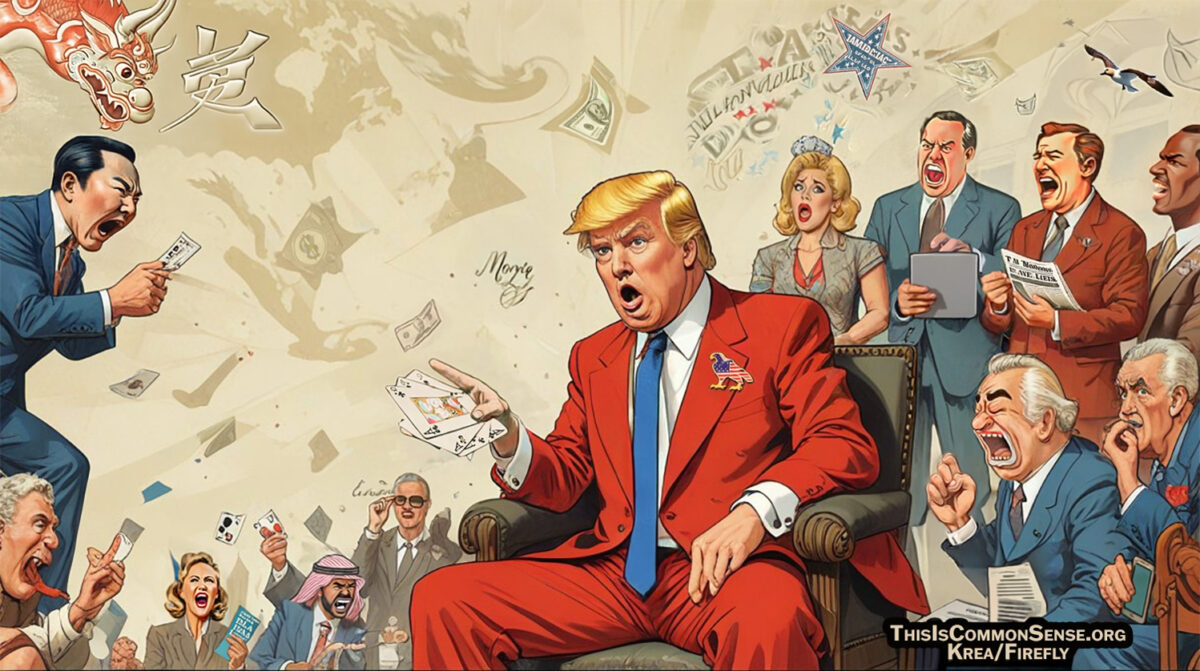
The fight over the president’s tariffs is taking place in Congress. 

Or is it?

“House Republicans blocked on April 9 an effort by Democrats to force a vote on halting the reciprocal tariffs imposed by President Donald Trump,” explains The Epoch Times, “which are currently paused for three months.”

Let’s make that clearer. These now-infamous/much-debated “reciprocal tariffs” went “into effect” immediately after midnight yesterday. As Republicans “sneakily” worked to change the rules to disallow any congressional move to dissolve the president’s declared emergency — which, by Congress’s own legislation, gives the executive a great deal of latitude to change tariff rates — and Democrats moved to do just that, get rid of the “state of emergency,” President Trump put most of his tariff hikes on hold for three months.

Except for those on China — now in effect, at a rate of 125 percent.

It sure looks like Trump’s main concern is trade relations with China, not Lesotho or Israel or anywhere else. And much can be said about China’s trade policies (try selling American consumer goods in China) or respect for intellectual property. But it is the matter of constitutionality that interests me most.

Whatever the alleged merits of high tariffs, unilateral free trade, or any of these issues, these policies should not be decided by the president; the Constitution gives Congress the responsibility “to lay Taxes, Duties, Imposts and Excises” and “regulate Commerce with foreign Nations.”

By handing the president “emergency” powers to change tariff policy in the first place, Congress has abdicated its role in setting tax policy. Republicans in the House seem gung-ho about Trump’s prerogatives. And Democrats haven’t sought to repeal the International Emergency Economic Powers Act, which gives the president legislative taxing authority.

Apparently, Congress wants the president to be king.

This is Common Sense. I’m Paul Jacob.


PDF for printing

Illustration created with Krea and Firefly

See all recent commentary
(simplified and organized)
See recent popular posts

Categories
Thought

George Mason

That no man, or set of men, are entitled to exclusive or separate emoluments or privileges from the community, but in consideration of public services; which, not being descendible, neither ought the offices of magistrate, legislator, or judge to be hereditary.

George Mason, Virginia Declaration of Rights (1776), Article 4.

Categories
Today

Good Friday Agreement

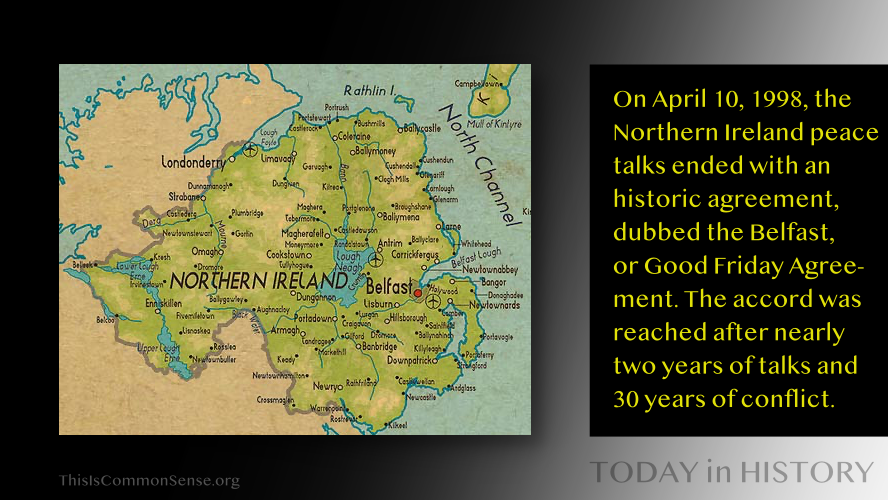
On April 10, 1998, the Northern Ireland peace talks ended with an historic agreement, dubbed the Belfast, or Good Friday Agreement. The accord was reached after nearly two years of talks and 30 years of conflict.

The agreement was approved by voters across the island of Ireland in two referendums held on May 22, 1998. The agreement came into force on December 2, 1999. 

Categories
media and media people national politics & policies

Praying to the Deep State

The Deep State does not exist.

How do we know?

If it did exist, it would have stopped Trump’s tariffs!

Welcome to modern political theology and ideological theodicy — by way of late-night “comedic entertainment.”

Because of Trump’s tariffs, “we’ve had the worst day for our economy since Covid,” quipped Stephen Colbert on Thursday’s Late Show. “Just a reminder: this time he’s the disease.”

I found his setup somewhat funny, goofy looks and all, and I don’t usually find Colbert funny. But as the bit progressed . . .

“It’s all pretty solid proof that there is no Deep State.”

I’ve already given away his punchline, because it was not so much funny as eye-roll-worthy.

“Because if there was, they would have stopped this s**t.”

The assumption here is that, by definition, the Deep State must be omnipotent. While we can point to existing institutions working under the new rubric of “Deep State,” it’s never been all-powerful. It’s just very powerful, working in mysterious (secret) ways.

“But if they do exist,” Colbert continued, “I just want to say to the cabal of financial and governmental elites who pull all the strings behind the scenes, ‘maybe put a pause on your 5G chip/JFKjr/adrenochrome/chemtrail orgy and jump in here cuz we’re f**king dying!’”

Here’s the deal: Trump was hounded with unprecedented state surveillance, impeachments, lawfare, and speech suppression . . . and dodged bullets from assassins. While we know nothing, if we catch a whiff of anything it’s that “non-existent” Deep State.

So begging it to take out Trump is . . . late-in-the-game.

The cabal has already tried. Many times. And failed. Proving itself perhaps more desperate than competent.

This is Common Sense. I’m Paul Jacob.


PDF for printing

Illustration created with Krea and Firefly

See all recent commentary
(simplified and organized)
See recent popular posts

Categories
Thought

Samuel Adams

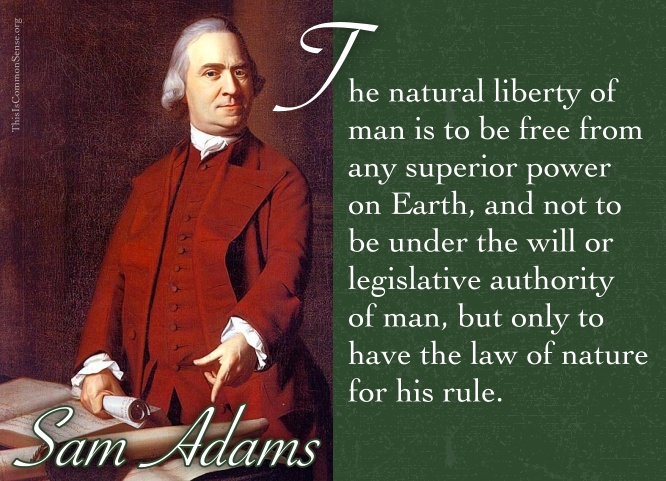
The natural liberty of man is to be free from any superior power on Earth, and not to be under the will or legislative authority of man, but only to have the law of nature for his rule.

Samuel Adams, The Rights of the Colonists: The Report of the Committee of Correspondence to the Boston Town Meeting, Nov. 20, 1772.