On Wednesday, Paul Jacob discussed the cultural erasure involved in the Cracker Barrel re-branding effort. One of the curious elements to the story is that previous icon branding erasures all focused on what might be called “icons of color,” Paul mentioning Aunt Jemima, Uncle Ben, and Mia the Land O’Lakes maiden. All gone now. They were “stereotypical” and thus somehow “racist.”
It is pretty obvious, however, that icons must be stereotypical — that is how they succeed as icons!
But this time a white — not to say “cracker” — icon was slated for erasure.
First they came for the icons of color (IoCs) and then for white icons. Why?
Paul suggested that cultural erasure may be the real point. A people without history or shared culture are easier to rule. Orwell was not alone to teach us that.
Thankfully, the issue was explored humorously by The Babylon Bee:
And even more thankfully, Uncle Herschel was spared, remaining on the logo.
“Define woke as erasure in the name of non-erasure,” Paul suggested. The Cracker Barrel erasure attempt wasn’t woke, obviously. It was a misguided erasure for the sake of modernization, of trying to … what?
The general trend in corporate (and perhaps the general) culture is to dispense with the past and its associations. As if that is the way to make money.
The announcement of the new logo on August 19, 2025, led to a significant drop in Cracker Barrel’s stock, shares falling over 12 percent in two days, and an additional 7 points by the 26th. After the reversal, the stock recovered quickly — the title at The Street was “Cracker Barrel Hasn’t Gone Woke Nor Has It Gone Broke.”
Cultural critics were all over the map. The Atlantic’s critique argued that Cracker Barrel’s brand has always been a “simulacrum of rural life” rather than authentic Americana — obvious enough. The backlash was misguided, the piece went on, because the corporate chain was founded to sell gas along highways, contributing to the erosion of genuine local culture by replacing it with a homogenized, nostalgic aesthetic; the new logo’s blandness was not “woke” but a continuation of this corporate sanding-down of regional identity. That doesn’t seem quite right, though. The earlier corporate branding served to entice rural Americans away from authenticity, sure, but with an appeal to traditional Americana style. The rebranding betrayed that, and if Americans objected, in a culture war way, they had a point.
But it wasn’t woke, true. It was too cynical and stupid for that.
Most of the critiques from the intelligentsia, including Paul’s foil David French, regarded the “political” reactions as “overdone” and “exaggerated.” But that is hardly up for them to decide. If consumers feel betrayed, their outrage is surely more sincere than the critics’ sniping.
Meanwhile, it might surprise most readers to learn that “Uncle Herschel” was an actual person with an actual connection to the company: Herschel Cawthon McCartney, uncle of Cracker Barrel’s founder, Dan Evins.
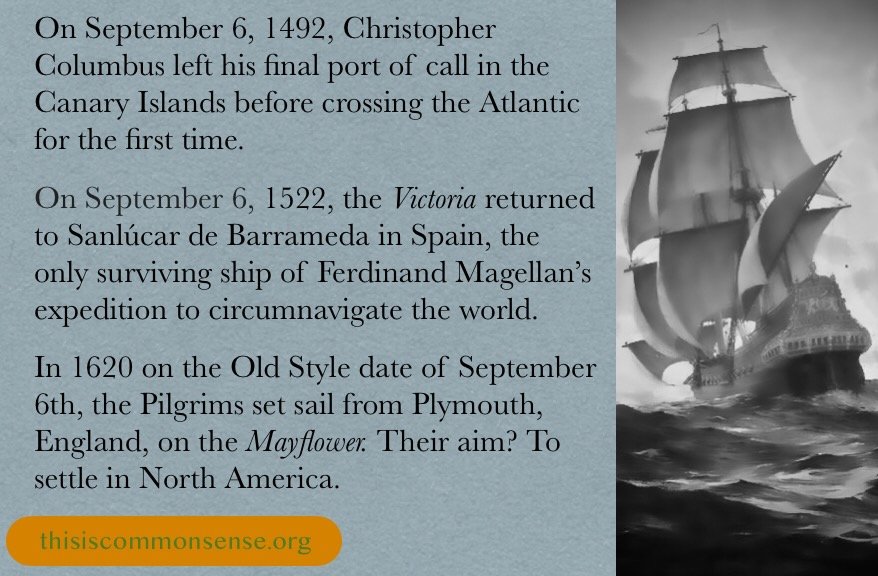
On September 6, 1492, Christopher Columbus left his final port of call in the Canary Islands before crossing the Atlantic for the first time.
On September 6, 1522, the Victoria returned to Sanlúcar de Barrameda in Spain, the only surviving ship of Ferdinand Magellan’s expedition to circumnavigate the world.
In 1620 on the Old Style date of September 6th, the Pilgrims set sail from Plymouth, England, on the Mayflower. Their aim? To settle in North America.
Last week, rumors echoed that President Donald Trump had died. Some famous people, such as Minnesota Governor (and future presidential hopeful?) Tim Walz, got “in trouble” for saying things that sounded a little too much like wishing Donald Trump dead.
Trump, of course, was alive and making news on Monday.
But for real death rattles in politics we have to go to Germany.
An election is looming and it appears from news reports that more than a handful of politicians standing for election died suddenly. But it’s not a general curse upon politicians. The deaths have happened in one party, the controversial “far right” party Alternative for Germany (AfD).
“Six candidates from Germany’s right-wing AfD Party have died within a 13-day span,” The Daily Wire reports. “As local elections approach, officials say that at least two deaths have been confirmed to be the result of natural causes and that no foul play is currently suspected.”
The two designated natural deaths occurred within the same state, North Rhine-Westphalia.
Two candidate deaths in the same party in the same political region leading up to the same election day has to raise eyebrows. A fluke?
It turns out that the other four suspiciously dead candidates hailed from the same region, and the authorities still suspect nothing.
“Despite the police ruling out suspicious circumstances, retired economist Stefan Homburg claimed in a post on X that the number of candidates’ deaths was ‘statistically almost impossible,’” the U.S. edition of The Independentinforms us. “His post was later retweeted by the AfD’s co-leader Alice Weidel, while AfD supporter and billionaire Elon Musk responded to the tweet with an exclamation mark.”
Rumors about this won’t die as quickly as the Trump rumors last weekend.
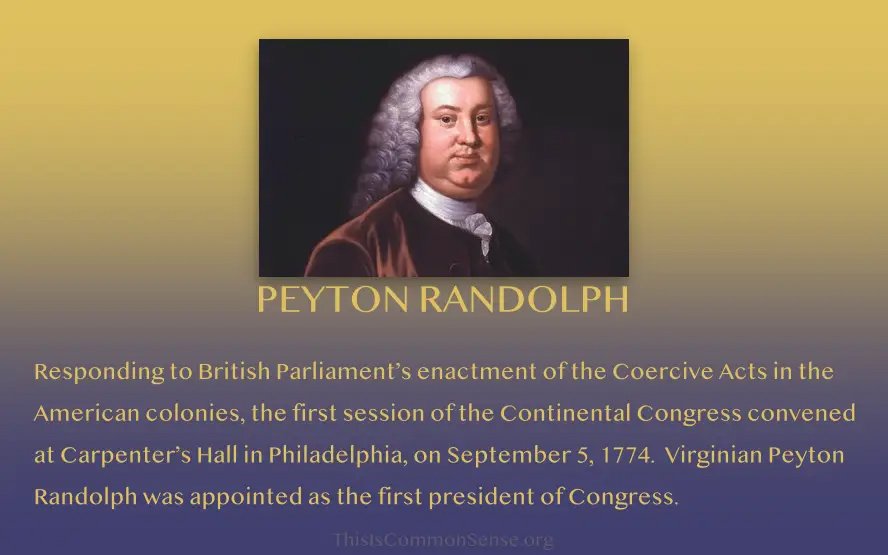
Responding to British Parliament’s enactment of the Coercive Acts in the American colonies, the first session of the Continental Congress convened at Carpenter’s Hall in Philadelphia, on September 5, 1774. Virginian Peyton Randolph (pictured) was appointed as the first president of Congress. John Adams, Patrick Henry, John Jay and George Washington were among the delegates.
Civil forfeiture laws allow officers of the law to commit theft. Sometimes they have to return the money they stole. But they don’t get punished.
Under civil forfeiture, authorities can grab cash or other possessions without proving criminal wrongdoing and without making an arrest. Since 2000, though, a federal law has made the federal government liable for reasonable attorney fees when a victim “substantially prevails” in court.
This law enabled Brian Moore, a rap artist, to eventually obtain compensation for thousands in legal costs after he sued to recover the $8,500 taken from him by federal drug agents.
One day in 2021, Moore took this cash, which he had inherited from his grandfather, to the airport. He hoped to fund production of a music video in Los Angeles, his destination. He was thwarted.
Even after a judge ruled that Moore could get his money back, he had to keep fighting, now with the help of Institute for Justice, to be compensated for legal fees. Eventually, he won that battle too.
But he won only after wasting a lot of time and suffering a lot of anxiety because officers of the law, with no evidence of wrongdoing, treated a person carrying cash as guilty of something just for carrying cash.
It was like Mount Everest. The officers took Moore’s stuff because it was there.
And they knew what they were doing. Such conduct should be punishable. If it were, it wouldn’t happen so often.
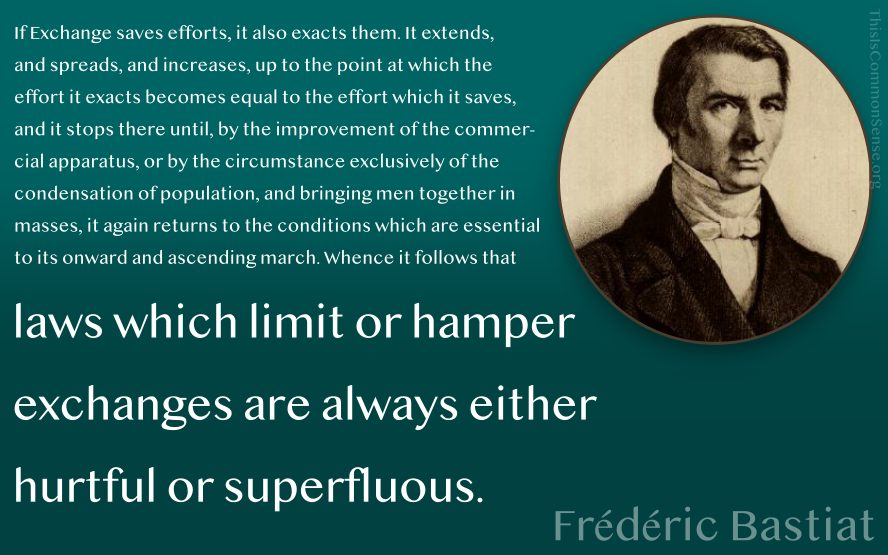
If Exchange saves efforts, it also exacts them. It extends, and spreads, and increases, up to the point at which the effort it exacts becomes equal to the effort which it saves, and it stops there until, by the improvement of the commercial apparatus, or by the circumstance exclusively of the condensation of population, and bringing men together in masses, it again returns to the conditions which are essential to its onward and ascending march. Whence it follows that laws which limit or hamper Exchanges are always either hurtful or superfluous. Governments which persuade themselves that nothing good can be done but through their instrumentality, refuse to acknowledge this harmonic law. Exchange develops itself NATURALLY until it becomes more onerous than useful, and at that point it NATURALLY stops. In consequence, we find governments everywhere busying themselves in favouring or restraining trade. In order to carry it beyond its natural limits, they set to conquering colonies and opening new markets. In order to confine it within its natural bounds, they invent all sorts of restrictions and fetters.
Frédéric Bastiat, Harmonies of Political Economy (from the Third French Edition, Patrick James Stirling, trans.).