Categories
Accountability folly ideological culture judiciary national politics & policies term limits U.S. Constitution

A Trout in the Milk

This week, the Senate Judiciary Committee grilled Judge Neil Gorsuch, President Trump’s nominee for the U.S. Supreme Court. Talk about a silly rite. Senators repeatedly fired questions about specific legal views that no High Court nominee ever answers.

Why not? Because to answer would be to pre-judge possible future cases.

That didn’t prevent displays of faux-outrage from committee Democrats, though. “You have been very much able to avoid any specificity,” Sen. Dianne Feinstein (D-Calif.) criticized, “like no one I have ever seen before.”

In Washington, isn’t that a compliment?

Into this kabuki theater, Republicans added their own inanity. Sen. Jeff Flake (R-Ariz.) inquired of Gorsuch, “What’s the largest trout you’ve ever caught?”

So that is how to determine whether to confirm someone for a lifetime position.

But even a lifetime doesn’t beat Congress. Elected every two years in the House or six years in the Senate, congresspersons often rack up longer tenure than do justices appointed for life.

The longest serving justice in our history was William O. Douglas, who spent nearly 37 years on the High Court. But if Douglas had spent that epoch in Congress, he wouldn’t place first, but 80th.

In fact, three Judiciary Committee members — Senators Patrick Leahy, Chuck Grassley and Orrin Hatch — have already served longer than any High Court justice in American history.

Interestingly, of the 20 longest serving justices, half served before 1900. Conversely, all of the 20 longest continuously serving members of Congress served after 1900.

Careerism in Congress beats lifetime tenure.

It’s time for term limits.

This is Common Sense. I’m Paul Jacob.


Printable PDF


Categories
Accountability crime and punishment folly general freedom government transparency moral hazard national politics & policies too much government U.S. Constitution

Public Record

Police departments nationwide have begun to outfit their on-duty officers with body cameras. These small recording devices make great sense, so we can better judge police encounters.

And it turns out that not only do police behave better when wearing body cameras, so do the citizens with whom they interact.*

Yet, cameras aren’t magic. They do not work when turned off. And video recorded by police offers little value when tampered with or deleted.

On Monday, the Washington Post ran an in-depth feature about the 2014 fatal shooting of 19-year-old Mary Hawkes by Albuquerque, New Mexico, police, who pursued her for allegedly stealing a truck.

The Post explained that her case “has become a cautionary tale about the potential of new technology to obscure rather than illuminate, especially in situations when police control what is recorded and shown to the public,” raising concern “about whether a nationwide rollout of body cameras is fulfilling promises of greater accountability.”

Six police officers huddled in close proximity to the deadly incident — all wearing body cameras. The officer who shot Ms. Hawkes, however, had his turned off. Footage from three others “showed signs of alterations and a deletion.”

A federal investigation is underway.**

It is now obvious that cameras alone won’t suffice. Rules must require that the cameras be turned on — with consequences for non-compliance. The public needs access to the footage, too.

The Police Cameras for Ferguson initiative*** on the ballot April 4th does exactly that. We need similar legislation in Albuquerque and everywhere else.

This is Common Sense. I’m Paul Jacob.


* See Barak Ariel, William A. Farrar, Alex Sutherland, “The Effect of Police Body-Worn Cameras on Use of Force and Citizens’ Complaints Against the Police: A Randomized Controlled Trial,” Journal of Quantitative Criminology (September 2015, Volume 31, Issue 3), pp 509–535; reportage on this study can be found here.

** The probe has already revealed that a former Albuquerque police employee has declared, in an affidavit, “it was routine for officials to delete, alter or refuse to release footage because of ‘political calculations.’”

*** Your support is still desperately needed to educate voters in Ferguson, Missouri, about the Police Camera ballot measure. Please help today.


Printable PDF


Categories
Accountability free trade & free markets moral hazard national politics & policies political challengers porkbarrel politics responsibility subsidy too much government

Trump Proposes a Budget

Will Donald Trump, infamously successful businessman, actually do something about the federal government’s out-of-control deficits and mounting debt?

Economist Pierre Lemieux, writing in the Financial Post, finds some reason for hope in President Trump’s “America First: A Budget Blueprint to Make America Great Again”:

The proposal to eliminate funding for agencies like the Corporation for Public Broadcasting, the National Endowment for the Arts, and the National Endowment for the Humanities is welcome. Artists should be able to stand on their own two feet with the support of private sponsors and organizations, of which there are many in America. Lovers of concerts should finance their own passion.

Though Lemieux gives good reason to want to cut “official arts and humanities” subsidies even sans their budgetary implications, imagine the backlash from Democrats, the media and the whole collegiate sector!

Actually, the backlash has already begun.

Can united government under the GOP cut even these most obviously least necessary aspects of government subsidy?

I’m not holding any pockets of air in my two lungs.

“Many monstrous bureaucracies would be reined in,” Lemieux goes on, listing proposed cuts to the Environmental Protection Agency (-31 percent), Department of Labor (-21 percent), and other departments of the so-called “discretionary” budget. But this is all small potatoes. “Really cutting federal expenditures would require reducing the welfare state — which Trump has no intention of doing.”

And the fortunes Trump wishes to throw at the military? No knack for parsimony there.

Though we can expect a little exceptional hack-and-slashery from Trump, Lemieux remains skeptical of any overall major effect.

Get used to ballooning debt.

Like you haven’t already.

This is Common Sense. I’m Paul Jacob.


Printable PDF


Categories
meme

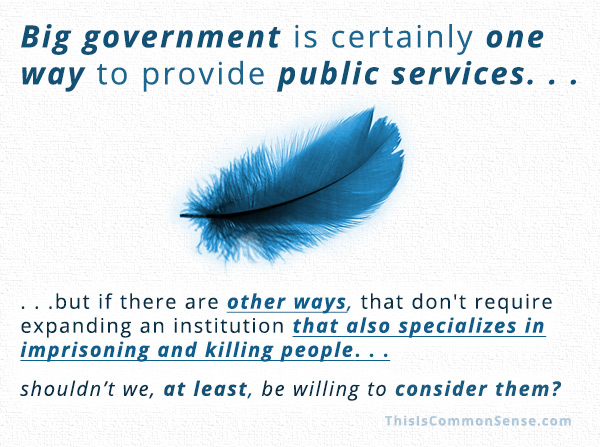
A simple question. . .

Government is a dangerous servant. . . as the American left has recently discovered.


Categories
free trade & free markets general freedom media and media people moral hazard nannyism property rights too much government

Of Salt and Socialism

Nearly 75 percent of Venezuelans have lost 19 pounds or more in 2016. “People have become so desperate,” the Miami Herald reported recently, “that they are butchering and eating flamingos.”

While acknowledging the problem, TeleSUR, a television network based in Venezuela and funded by governments including Cuba, Ecuador, Nicaragua, and Venezuela, called the Herald’s story “kooky” and suggested taking reports “like alleged flamingo eating with a grain of salt.”

If, in socialist Venezuela, one could find a grain of salt.

In America, salt is necessary, too, when listening to our socialist Hollywood celebs blather about their kooky diets, for which some are blaming President Trump.*

Socialism kills. The deprivations in Venezuela are no joke, for along with economic chaos, Venezuelans are experiencing political repression on a grand scale. A new report from Luis Almagro, secretary general of the Organization of American States (OAS), documents the thousands arrested for protesting or “having posted something against the national government or a public official on Twitter.” The report details the “curtailment of civil, political and electoral freedoms” and “torture” and “censorship.”

Almagro calls for the suspension of Venezuela’s membership in the OAS, which is long overdue. The Human Rights Foundation demanded that nine years ago.

The Obama administration opposed such a move, as the Washington Post editorialized, in order to pursue “a legacy-making détente” with “the Castro regime in Cuba.”

At Townhall,** I urged Trump to support the effort to boot Venezuela out of the OAS, which might provide some assistance toward political change there . . . and Venezuelans eating more.

And perhaps to socialists in Hollywood and elsewhere eating crow . . . but not flamingo.

This is Common Sense. I’m Paul Jacob.


* I covered this last week, when I compared their Trump Diet nonsense to the “Maduro Diet,” named for Venezuelan President Nicolás Maduro, the socialist dictator presiding over the complete economic collapse of what, prior to socialism, had been South America’s richest country.

** From which this Common Sense is adapted.


Printable PDF


Categories
Accountability free trade & free markets national politics & policies property rights too much government

Three, Three, Three Mints in One!

Microsoft just announced an innovation that might give folks who fear business behavior — or are extremely skeptical of the positive public outcome of markets pause.

The Bellevue, Washington, company is adding Google calendar connectivity for its Macintosh users of Outlook 2016.

[Pause.]

You see, monopolies give us the willies. We do not trust them. Yet, despite our fears and suspicions, big business activity in a free market does not lead inevitably to One Corporation Ruling Them All. Or chaos.

Why believe that? This Microsoft Outlook story.

Most folks’ worries about monopoly come down to fear of out-of-control competition. In many industries, for the industry to work, there must be general cooperation among competitors. (Think of telephones and electricity distribution, etc.) The reason many people* want to regulate “natural monopolies” is that it seems only natural that businesses would balk at working together on shared standards — they would balk at any form of cooperation . . . they’re competitors, dagnabbit!

But evidence of competitors cooperating for consumer good is all around us. The classic case? Railroads, when the rail gauges in America were standardized to 4′ 9″ — without government edict.

The current case? This, where one of the three biggest computer outfits in the world offers customers on a competitive platform (Apple) easy syncing with a company that competes directly with it as well as its platform competitor (Google).

Why do this?

The better to serve their customers. As much as Microsoft might want to shun their competitors’ products, its customers do not share that view.

And that is enough.

Welcome to free-market capitalism.

This is Common Sense. I’m Paul Jacob.**


* It is worth noting that economists have a different concern regarding natural monopolies. Something about “cost curves.” Meanwhile, the opposite fear — of cooperation among businesses when cooperation would be generally harmful (price fixing) — has been an issue dealt with by economists since Adam Smith.

** Full disclosure: this came to my attention courtesy of a story on Apple’s News app.


Printable PDF


Categories
folly general freedom ideological culture media and media people moral hazard nannyism political challengers responsibility too much government

Dutch Election Oddities

There were many strange forces at play in the Netherlands’ elections on Wednesday. In my report, I concentrated on the biggest story, the possibility that Geert Wilders’s Freedom Party might take a huge number of parliamentary seats — though I quoted The Atlantic’s coverage predicting a narrow loss to Mark Rutte’s Liberal Party.

What I did not mention were some of the . . . oddities.

Did you know that Geert Wilders is the only official member of the Freedom Party?

Did you know that there is a 50+ Party in Holland — to represent folks . . . in my age bracket?

Irksome. A party organized just for an age group bugs me almost as much as the most extreme elements of Wilders’s anti-Islamism. But then, all parties bug me a bit, for the same reason the founding fathers desperately feared “factions” . . . that is, political parties. Factionalism turns government into tribal warfare, with legislation counting as . . . counting coup.

But no one in the Netherlands is asking how “bugged” I may or may not be.

The outcome of the March 15 elections? Labour lost the most, and the Freedom Party did not do as well as predicted . . . or feared. Instead of over 20 seats, it won 16, according to Bloomberg (quoting i & o research).

Here’s a not-so-odd oddity: I had to wade through quite a few reports on the election before I found any actual numerical results. The papers all seemed too busy gloating that the Freedom Party failed. I guess that counts as enough reporting. For them.

More evidence that we live in a post-fact society?

This is Common Sense. I’m Paul Jacob.


Printable PDF


Pictured: Ledger drawing of a mounted Cheyenne warrior counting coup with lance on a dismounted Crow warrior, 1880s.


Categories
Accountability folly free trade & free markets general freedom moral hazard nannyism national politics & policies responsibility too much government

DumpCare

Speaker of the House Paul Ryan insists that his “TrumpCare” plan to replace ObamaCare will decrease medical insurance rates. Others argue that his American Health Care Act will increase those rates. Likewise, he expects it to reduce strain on federal budgets; others deny this outright. The “coverage” issue is just as contentious.

TrumpCare is a mess because it is isn’t “DumpCare.” What’s needed is not yet another regulation-plus-subsidy system. We need repeal and then . . . more repeals.

Unfortunately, President Donald Trump has never really been on board with this. He has promised that no one would lose “coverage,” assuming that “coverage” is “health care.”

It is not. State charity programs like Medicaid (upon which ObamaCare relied way too much) are merely ways to pay for services. Dumping a gimcrack payment system is not the same as decreasing medical services. “DumpCare” wouldn’t dump care, only insane government.

For example, we know that health care outcomes for poor folks without Medicaid turn out to be better than poor folks with Medicaid.* Increasing the number of people on formalized subsidy programs is no panacea.

Besides, ObamaCare severely under-delivered on “coverage.”

New programs, nevertheless, are traps, regardless of demerit: once you provide a benefit, folks come to rely on it and demand more — objecting when it’s taken away. Which is why few programs are ever repealed, despite failing to meet original expectations.

So far, the “small government party” hasn’t found the courage to actually limit government. Do Republicans really believe what they say, that fewer regulations and subsidies will lead to lower costs and better service?

It seems Republicans won’t take their own prescription.

This is Common Sense. I’m Paul Jacob.


* Oregon’s 2008 Medicaid “natural experiment” provides reasons to question the merits of the program. As the initial, randomized, controlled study found, “Medicaid coverage generated no significant improvements in measured physical health outcomes in the first 2 years, but it did increase use of health care services. . . .”


Printable PDF


Categories
Accountability crime and punishment folly ideological culture moral hazard nannyism responsibility

Walk on the Wilders Side?

The Dutch were among the first to witness Islamic extremist violence against free speech. The November 2004 murder of Theo van Gogh by a Dutch citizen of Moroccan descent — a man whose first name, Mohammed, almost no one thinks is merely coincidental — stirred the nation.

And the world.

Van Gogh made a short film, with Somalian émigré Ayaan Hirsi Ali, about the unjust treatment of women in Islamic countries. The film criticizes Islam as well as the Muslim majority countries, and was considered an affront by many Muslims.

After van Gogh’s death, Ms. Ali fled to the United States.

This event is only the most famous of many similar conflicts between free-speech Dutch values and regulated-speech Islamist ones. The fact that the country has anti-blasphemy and anti-insult laws on the books, and these have been directed against a popular politician, has exacerbated the growing antagonism.

That very politician is today’s big news. According to The Atlantic, the “center-right People’s Party (VVD) for Freedom and Democracy is projected to win 24 seats in [today’s] election, slightly ahead of Geert Wilders’s far-right Dutch Freedom Party (PVV), which is expected to gain 22.”**

The Dutch center-left, like similar ruling groups in Britain, Germany, France and Sweden, often seems weak and timid before the rising illiberalism of Islamist terrorism and Sharia law.* Many suspect that the recent decision to block Turkish ministers from speaking at rallies in Holland, before Turkey’s referendum next month, is designed to counter this narrative.

Meanwhile, though Wilders is generally liberal (not “far right”) on most cultural issues, his “de-Islamization” program seeks to close mosques and outlaw the Quran***.

One extreme to another.

This is Common Sense. I’m Paul Jacob.


* This is not just a bugaboo. In 2006 the Minister of Justice floated the possibility of incorporating Sharia law into the constitution.

** The projection is within the margin of error, and with mass immigrant Turkish protests taking place over the weekend, the chance of a Trump-like upset is more than possible.

*** Geert Wilders compares the Quran to Adolf Hitler’s Mein Kampf.


Printable PDF


Categories
Accountability crime and punishment government transparency Popular responsibility

Five for Ferguson

Michael Brown is dead. No video can bring him back.

As the world remembers, Brown was the unarmed 18-year-old black man killed in a violent 2014 altercation with Officer Darren Wilson, who is white — making Ferguson, Missouri, famous.

Or rather, infamous.

With little information, folks quickly picked sides. Some claimed Brown was gunned down in cold blood with his hands up, yelling, “Don’t shoot.” After seeing footage from a convenience store surveillance camera, which showed Brown seeming to strong-arm an employee and steal cigarillos* mere minutes before the fatal police encounter, others placed the blame on Brown.

Subsequent rioting left dozens injured, seventeen businesses torched and millions in property damage. Meanwhile, President Obama’s Department of Justice found Officer Wilson’s actions justified.

However, had Wilson been equipped with a lapel camera, that footage would have enhanced finding justice. Moreover, the knowledge that the public could see the truth of what happened might have prevented the riots and recriminations.

More information is better.

That’s why the best news of all is this: on April 4, three weeks from today, the people of Ferguson will vote on The Public Video Recording Accountability Amendment to Ferguson’s City Charter. The charter amendment mandates that officers wear lapel cameras while on duty and sets sensible rules for allowing maximum public access.

The campaign needs your help to alert Ferguson voters about the election by mailing information on the ballot measure. For instance, studies demonstrate that not only do police behave better when wearing cameras, but so do the citizens with whom they interact.

Would you give five dollars for Ferguson?

Please help bring a better day for justice and transparency.

It’s Common Sense. I’m Paul Jacob.

* Over the weekend, more video surfaced from the convenience store as part of a documentary entitled, “Stranger Fruit,” which suggested Michael Brown had made a drug deal at the store, and not stolen anything. A St. Louis County prosecutor disputed the filmmaker’s interpretation, and released more footage.


Printable PDF