Categories
Today

U. S. Constitution

On September 17, 1787, the Constitution of the United States was signed in Philadelphia, Pennsylvania.

In 1849 on this same day in September, Harriet Tubman escaped to freedom in Philadelphia, but soon returned to Maryland to rescue her family. She made at least 13 trips into the slave-owning South to liberate more than 70 slaves before the Civil War (in which she served as a spy for the North).

Categories
deficits and debt tax policy too much government

No Shock and Awe

They’ve crunched the numbers and the shocking truth is . . . Democratic Presidential candidate Joe Biden wants to raise taxes and debt.

The word “shocking” needs quotation marks, of course, for sheer lack of any shock whatsoever.

Also not shocking is who pays.

You see, “80 to 90 percent of the total proposed tax increases in Biden’s plan would fall on the top five percent of earners,” according to the Committee for a Responsible Federal Budget. That is the target taxpayer cohort, anyway. Economists know a hidden truth: the incidence of a tax’s burden shifts. All taxes siphon off production, but — because production is engaged in for consumption’s sake — in the end consumers pay.

In politics, of course, the idea is not to acknowledge this, instead focusing on the targets, tempting voters to get on board with spending and taxing and borrowing just so long as some other (preferably non-voting) people pay. 

“While tax burdens would rise by 0.2 to 0.6 percent for most households, they would rise by 2.3 to 5.7 percent for the top 20 percent of earners and by 13.0 to 17.8 percent for those in the top 1 percent in 2021.” The Democrats would have the highest earners in America pay an extra “$300,000 per year” and call that a benefit . . . to those who would pay less.

Meanwhile, the “additional revenue that would be raised through Biden’s tax plan would only pay for a portion of his overall spending agenda.” It would take “$6 trillion more . . . to stabilize debt-to-GDP at today’s near-record levels.”

According to the CRFB, because of pandemic panic spending, and before any proposed Biden add-ons, “debt will grow from 79 percent of GDP before the crisis to 101 percent by the end of 2020 and 118 percent of GDP by 2030.”

Have our politicians set out to revise Ben Franklin’s maxim? There is nothing more certain than death and taxes — and debt.

This is Common Sense. I’m Paul Jacob.


PDF for printing

See all recent commentary
(simplified and organized)
See recent popular posts

Categories
Thought

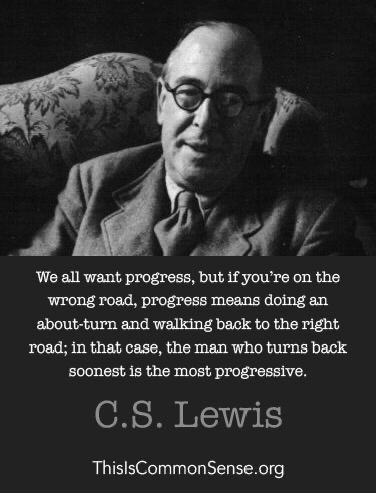
C. S. Lewis

We all want progress, but if you’re on the wrong road, progress means doing an about-turn and walking back to the right road; in that case, the man who turns back soonest is the most progressive.

Clive Staples Lewis, The Case for Christianity (the first part of Mere Christianity, printed separately).
Categories
Today

Independence Days

September 16 marks the Independence Days for Mexico (celebrating the declaration of independence from Spain in 1810) and Papua New Guinea (commemorating the exit from Australia in 1975).

Categories
crime and punishment ideological culture

Down Among the Non Sequiturs

There is a rule in respectable writing, particularly academic: don’t quote “down.”

This means that academics don’t cite newsletter writers as authorities, scientists don’t consult table-rappers as purveyors of relevant data, politicians don’t quote tweets.

But of course that’s all changed now, thanks to Trump.

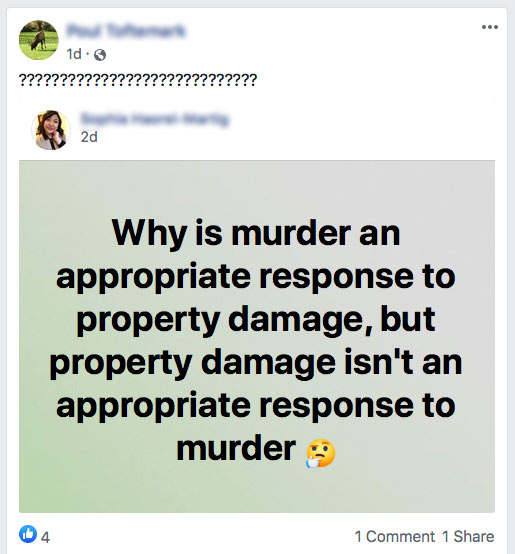
Which perhaps excuses me to deal with a simple Facebook “meme” that I’ve seen shared around among progressives. It’s a deceptively simple question; the point in criticizing it is not to castigate the person who first posed it.

Here it is: “Why is murder an appropriate response to property damage, but property damage isn’t an appropriate response to murder?”

I confess: this really startled me. Not because it is hard to answer, but because what it says about discourse in our time.  

Note what is obviously wrong with it:

1. Murder is not an apt response to anything, for murder is unlawful and/or immoral killing. The premise is absurd.

2. Some people do indeed kill rioters and others who are attacking them or their property. This can be justified because self-defense is the basis of all our rights, and a violent attack doesn’t just fit into neat little “I’m only destroying your property” box. 

3. The proper response to murder, after the fact of some violent moment, is lawful arrest and trial, not killing. Self-defense is for moments of conflict. Some time after an illegal act? Then we proceed by the rule of law.

Of course, this little thought experiment was designed to justify riots.

It does not.

It justifies, really, only this episode of

Common Sense. I’m Paul Jacob.


PDF for printing

See all recent commentary
(simplified and organized)
See recent popular posts

Categories
Today

After Porto

On September 15, 1820, an uprising occurred in Lisbon, Portugal, following similar insurrection in Porto the previous month. This was no bloodthirsty mob, but, instead, a popular demand for constitutional government. Unfortunately, the country was beset with imperial and monarchical problems for some time to come.

The United Nations established September 15 as International Day of Democracy, in 2007. An Independence Day is celebrated on this date in Guatemala (a Patriotic Day), El Salvador, Honduras, Nicaragua, and Costa Rica, commemorating independence from Spain in 1821.

Categories
initiative, referendum, and recall term limits

Lifetime Politicians Ruin Christmas

Legislators, anxious to further weaken their own term limits, placed Issue 2 on the Arkansas ballot. 

The current limit is already a loiteringly long 16 years — thanks to a dishonestly worded, legislatively referred 2014 ballot amendment, which weakened the voter-initiated limits.*  

Voters came back in 2018 to restore the original six-year House and eight-year Senate limits, placing a measure on the ballot that from various public reports received nearly 80 percent of the vote. But an Arkansas supreme court decision forbade counting those votes.

Still, politicians are back with another term limits attack. Issue 2 lowers the 16-year limit to 12 years. Huh, lowers? Stay with me. Issue 2 grandfathers everyone elected this year or before. Current office holders get the full 16 years — plus no lifetime limit (that gets nixed), allowing politicians to return for another 12 years after a short break. 

No wonder the citizens’ group Arkansas Term Limits opposes Issue 2, calling it “The Lifetime Politician Amendment.”

Not unrelated, there is also Issue 3. Arkansas legislators have repeatedly attacked term limits and the only way for citizens to get a real term-limit on the ballot: the citizen petition process. 

“Advocates acknowledged the amendment, [Issue 3], would make it harder to qualify proposals for the ballot,” the Arkansas Times’ Max Brantley explained, “but generally saw that as a good thing.”

One poison-pill provision would slice six months from the petition process, moving the deadline from warm, sunny July to cold, dark January — and forcing campaigns to flood Christmas shopping with petitioners trying to gather signatures.

Call it “The Ruin Christmas Amendment.” 

Putting 2 and 3 together: The Lifetime Politicians Ruin Christmas Amendments.

This is Common Sense. I’m Paul Jacob.


* Want to holler at that politician author who hoodwinked voters? Go to a federal prison . . . where Senator Woods relocated after convictionson political corruption. 


PDF for printing

See all recent commentary
(simplified and organized)
See recent popular posts

Categories
Today

Missing Eleven Days?

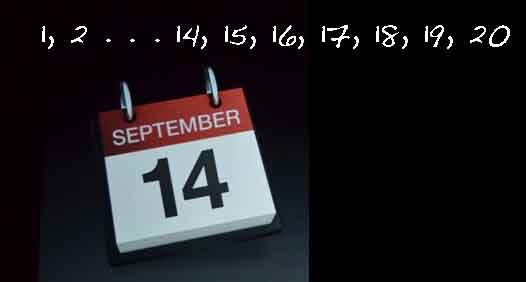
In 1752, throughout the British Empire, September 2 was followed, the next day, by September 14, as the government adopted the Gregorian calendar, skipping eleven days.

On September 14, 1944, Maastricht becomes the first Dutch city to be liberated by allied forces.

Categories
Thought

Adam Smith

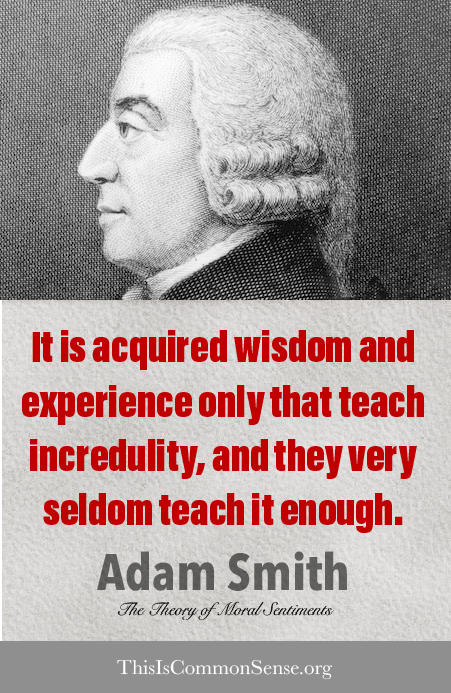
It is acquired wisdom and experience only that teach incredulity, and they very seldom teach it enough.

Adam Smith, The Theory of Moral Sentiments (1801, Ninth Edition).

Categories
audio podcast

Listen: It’s Not in the Politician

The second part of this weekend’s podcast:

This Week in Common Sense, September 8-11, 2020.