Categories
First Amendment rights ideological culture media and media people

Gun Group Deplatformed

Mailchimp is an “all-in-one integrated marketing platform” that helps businesses send newsletters and other email to customers, prospects, and supporters. In January it blocked the Virginia Citizens Defense League from sending email to members about an annual rally in defense of gun rights and told the organization to get lost.

Some help.

According to the president of the Defense League, Philip Van Cleave, “There was no justification. They provided nothing. Basically, they just said we need to get our stuff and be prepared to move on.”

Well, Mailchimp’s boilerplate letter did also state that its “automated abuse-prevention system, Omnivore, detected serious risks associated with [your] account. . . . This risk is too great for us to continue to support the account.”

What risk? Oh, why bother to specify. The point is, the automated system detected it. I’m guessing that certain scary words were flagged, like “gun,” “Second Amendment,” “Constitution,” “rights.”

It seems that any kind of assembling on behalf of certain constitutionally protected rights or to petition for redress of grievances is to be regarded as a rationale for summarily ejecting politically right-leaning customers — at least by firms going along with this accelerating strategy to abet repression.

Mailchimp has violated the terms of service upheld by those who respect freedom of speech and do not respect arbitrary assaults on costumers. If you’re using it, look for an alternative.

The Defense League’s “Lobby Day” rally was peaceful again this year — as the group’s website informs, “just a lot of patriots sending a strong message to the General Assembly to keep their hands off our gun rights.”

This is Common Sense. I’m Paul Jacob.


PDF for printing

See all recent commentary
(simplified and organized)
See recent popular posts

Categories
international affairs

The China Syndrome

Is the Chinese government under Xi Jinping becoming as murderously totalitarian as it was in the time of Mao?

Since Mao was responsible for the slaughter of tens of millions, today’s China is not, at least yet, Maoist bad. But as Doug Bandow reports in a recent overview (“China’s Terrifying Return to Maoism”), it is indeed awful.

The scuttling of presidential term limits is the merest tip of a titanic iceberg of tyranny. 

Beneath the surface is China’s intensified repression of the Uyghurs, Tibet, and Hong Kong; prolific use of torture; a rise in coerced televised confessions; increased censorship and detaining of foreign journalists; massive expansion of the surveillance state with the help of technology firms like Huawei; and new crackdowns on practices of religion.

A few years ago, churches in many provinces of China could carry on without interference as long as they steered clear of politics. Hardly a minor restriction. But today, writes Bandow, “ministers are arrested, churches are closed or destroyed, members are barred from bringing their children and forced to display communist agitprop, and the [Chinese Communist Party] even wants to rewrite Scripture. Islam, Buddhism, and Daoism are also under sustained attack.”

Bandow bases his observations in part on a Human Rights Commission report just published by the UK Conservative Party.

Too often, journalists, politicians and others ignore or whitewash what the Chinese regime is doing at home and abroad. Whatever our policies toward China should be, they should be based on eyes-wide-open reality.

This is Common Sense. I’m Paul Jacob.


PDF for printing

See all recent commentary
(simplified and organized)
See recent popular posts
Categories
Thought

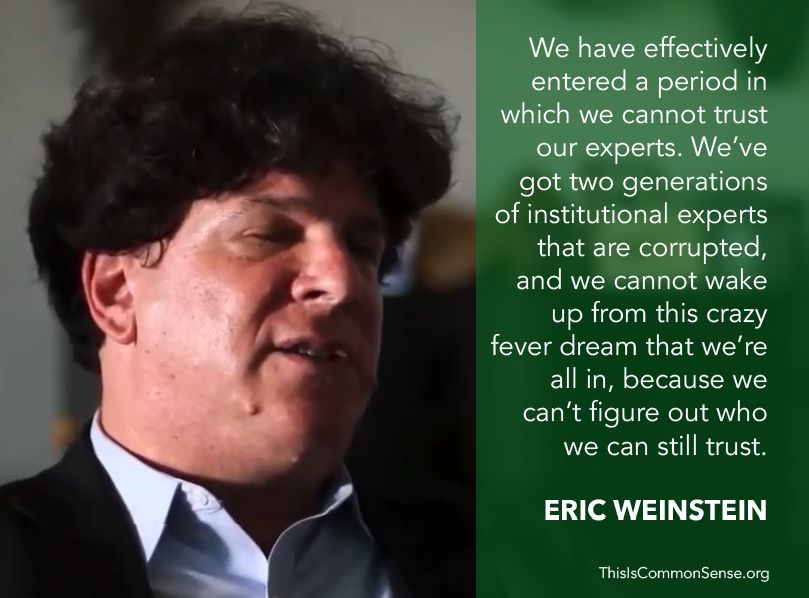
Eric Weinstein

We have effectively entered a period in which we cannot trust our experts. We’ve got two generations of institutional experts that are corrupted, and we cannot wake up from this crazy fever dream that we’re all in, because we can’t figure out who we can still trust. The doctors are compromised; the professors are compromised; the journalists are compromised; the politicians are compromised. About the only thing that isn’t badly compromised are people with an independent source of sustenance.

Eric Weinstein, in interview for the Glitch in the Matrix non-fiction film.
Categories
ideological culture national politics & policies

The Day and the Hour

Time is almost up!

“Three years ago, scientists gave us a pretty stark warning: They said we have 12 years to avoid the worst consequences of climate change,” John Kerry, former U.S. Senator (D-Mass.) and Secretary of State and current US Special Climate Envoy, stated last week. 

“And now we have nine years left,” the 2004 Democratic presidential candidate added, “to try to do what science is telling us we need to do.”

Science speaks to Kerry. Just nine years, though? Not much time. 

But it could be worse. 

And apparently already is.

According to BBC environmental correspondent, Matt McGrath, who reported roughly 18 months ago that “there’s a growing consensus that the next 18 months will be critical in dealing with the global heating crisis.”

“The climate math is brutally clear,” Potsdam Climate Institute founder Hans Joachim Schellnhuber argued. “While the world can’t be healed within the next few years, it may be fatally wounded by negligence until 2020.”

“Healed”? Or brought to heel?

That time is running out “is becoming clearer all the time,” McGrath noted then, before quoting the eminent scientist, the Prince of Wales: “I am firmly of the view that the next 18 months will decide our ability to keep climate change to survivable levels and to restore nature to the equilibrium we need for our survival,” declared his royal highness, speaking at a reception more than 18 months back. 

Prince Charles Philip Arthur George Mountbatten-Windsor is also considered something of an expert on receptions.

For my part, regarding these prophecies, I’m with Gavin Schmidt, the head of NASA’s Goddard Institute for Space Studies, who advised, “All the time-limited frames are bullsh*t.”

I can follow that science.

This is Common Sense. I’m Paul Jacob.


PDF for printing

See all recent commentary
(simplified and organized)
See recent popular posts

Categories
Today

Corn Law

On January 31, 1849, the Corn Laws were abolished in the United Kingdom, one of the most impressive and far-reaching anti-protectionist moves of all time. “Corn” stood for all grains, including wheat, oats, barley, etc.; the free-trade agitation by John Bright and Richard Cobden was one of the main impetuses for the reform.

On Jan. 31, 1865, the United States Congress proposed the Thirteenth Amendment to the U.S. Constitution, submitting it to the states for ratification. The Amendment’s main section reads: “Neither slavery nor involuntary servitude, except as a punishment for crime whereof the party shall have been duly convicted, shall exist within the United States, or any place subject to their jurisdiction.”

On Jan. 31, 1990, the first McDonald’s fast food restaurant opened in the Soviet Union. Having once traveled to Moscow, I’m exceedingly thankful for this.

Categories
Thought

Auberon Herbert

Is the majority morally supreme, or are there moral rights and moral laws, independent of both majority and minority, to which, if the world is to be restful and happy, majority and minority must alike bow?

Categories
Today

Non-Violence … and Violent Reaction

On Jan. 30, 1948, Indian leader Mohandas K. Gandhi, known for his non-violent, non-cooperation struggle for freedom and national independence, was assassinated by a Hindu extremist.

On Jan. 30, 1956, Martin Luther King, Jr.’s home was bombed in retaliation for his work on the Montgomery Bus Boycott.

On Jan. 30, 1972, British soldiers killed fourteen unarmed civil rights marchers in Northern Ireland in what came to be known as “Bloody Sunday.” Soldiers shot 26 unarmed protesters and bystanders – 13 males, seven of whom were teenagers, died immediately, while another man died of his injuries nearly five months later. In the immediate aftermath, an investigation by the British Government largely cleared the soldiers and British authorities of blame. A second investigation begun in 1998, released a report in 2010 declaring that all of those shot were unarmed, and that the killings were both “unjustified and unjustifiable.”


Not quite fitting today’s “non-violence elicits violence” theme, on January 30, 1835, Richard Lawrence attempted to shoot former military leader and then-President Andrew Jackson, but failed. He was subdued by a crowd, including several congressmen. That marked the first attempt on the life of a sitting U.S. president.

Categories
ideological culture national politics & policies

Grace the Notes

Harriett Tubman was an American hero, the great Underground Railroad liberator of slaves, worthy of many honors. 

But should she grace the $20 Federal Reserve Note?

This issue was raised during the Obama administration, when movement was made towards swapping the current Gracer of the Note, President Andrew Jackson, for Tubman. But President Trump stalled the swap.

Now, with Biden in office, it’s back!

How should we “feel” about it?

As I explained in 2016, Tubman is my kind of hero. Jackson, on the other hand, was great with his opposition to the Second National Bank, but his horrific removal of the Cherokee left a great stain on his reputation. Much different for Tubman — a criminal in her day, a secular saint in ours. Jackson owned slaves; Tubman freed slaves.

Yet, take a step back:

Is it an honor to be on a Federal Reserve Note?

The American dollar has been in jeopardy for a very long time — at least since President Richard Milhous Nixon closed the Treasury’s gold window, but probably since the forming of the Federal Reserve . . . our plutocratic “Third National Bank.”

Why place someone as excellent as Tubman onto a doomed currency?

The argument to keep Andy Jackson there is stronger than putting Ms. Tubman on it: he opposed central banking, and to festoon his likeness on the second most-used note of our central bank’s denominational line-up is a way of dishonoring him. 

The reason today’s Democrats want to remove their party’s first president from the Twenty is the very reason to keep him on.

But if they must replace, a better candidate might be . . . Dick Nixon.

This is Common Sense. I’m Paul Jacob.


PDF for printing

See all recent commentary
(simplified and organized)
See recent popular posts
Categories
Thought

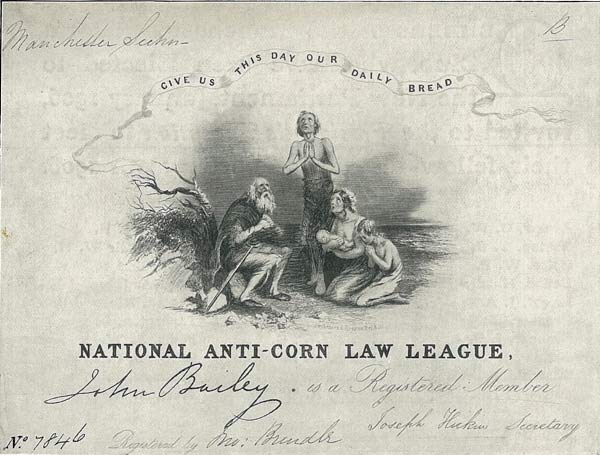
Irving Kristol

Democratic socialism turns out to be an inherently unstable compound, a contradiction in terms. Every social-democratic party, once in power, soon finds itself choosing, at one point after another, between the socialist society it aspires to and the liberal society that lathered it.

Irving Kristol, as quoted in “Capitalism, Socialism, and Democracy: A Symposium,” edited by William Barrett, Commentary (1978).
Categories
Today

Deregulated

On January 28, 1912, Belgian economist Gustave de Molinari died. Molinari was one of the last major economists of the French Liberal School, heir to Frederic Bastiat, and a prominent advocate of free trade. His last book, The Society of To-morrow (the only one of his many books to be translated into English in his day) envisioned a future of extremely limited government, and argued against the growing tide of socialism and war that was becoming all too apparent as the future of Europe.

Indeed, the old liberal order of Europe ended with the beginning of the Great War, exactly two and one half years after Molinari’s demise.


On Jan. 28, 1981, President Ronald Reagan lifted the federal government’s remaining domestic petroleum price and allocation controls in the United States, helping to end the 1970s energy crisis and begin the 1980s’ oil glut.

The deregulatory move had been begun by Democrats in Congress, particularly Sen. Ted Kennedy, but had been placed on a gradual schedule, and the whole effort clouded with talk of “windfall profits” and a tax on those allegedly unfair returns on investment.