Categories
media and media people national politics & policies responsibility

Lab Rats III: Doubling Down on Danger

Ten months ago, I commented on a Newsweek article informing that “the National Institute for Allergy and Infectious Diseases, the organization led by Dr. [Anthony] Fauci, funded scientists at the Wuhan Institute of Virology and other institutions for work on gain-of-function research on bat coronaviruses.”

A deadly worldwide pandemic along with possibly explosive implications as to its origin, notwithstanding, the story went nowhere. 

Last week, I highlighted new evidence that aligns with the lab transmission theory pooh-poohed in the World Health Organization report, which was quickly discredited — including by the WHO Director-General.

Yesterday, I went further into the cover-up, and how the “conspiracy theorist” charge has been used by the confreres of the Wuhan scientists to dissuade anyone from looking in the direction of the dangerous research that had been conducted there. 

Josh Rogin’s Washington Post column gives greater context to the need to investigate the theory, expressed by Robert Redfield, former director of the Centers for Disease Control under President Trump, that SARS-CoV-2 was transmitted to humans accidentally through a Wuhan lab:

“Richard H. Ebright, a Rutgers University microbiologist and biosafety expert . . . said the entire genre of research Redfield was referring to, known as gain-of-function research (in which viruses are captured from the wild and developed in lab settings to make them more dangerous), needs to be thoroughly reexamined.” 

Worse? “The world’s current plan to respond to the pandemic entails a huge expansion of precisely this type of research,” Rogin explains. “The $200 million program meant to ‘predict’ virus outbreaks is set to grow into a $1.2 billion Global Virome Project . . .”

“The plan is,” Ebright told Rogin, “having failed to predict and preempt and having possibly triggered the current pandemic, to increase the scale six times.”

Emphasis added because, well, can it be emphasized enough?

This is Common Sense. I’m Paul Jacob.


Earlier in this Series:

12 Monkeys in Charge

June 18, 2020 

Lab Rats

March 31, 2021

Lab Rats II: The Conspiracy

April 6, 2021

PDF for printing

See all recent commentary
(simplified and organized)
See recent popular posts
Categories
Thought

FDR

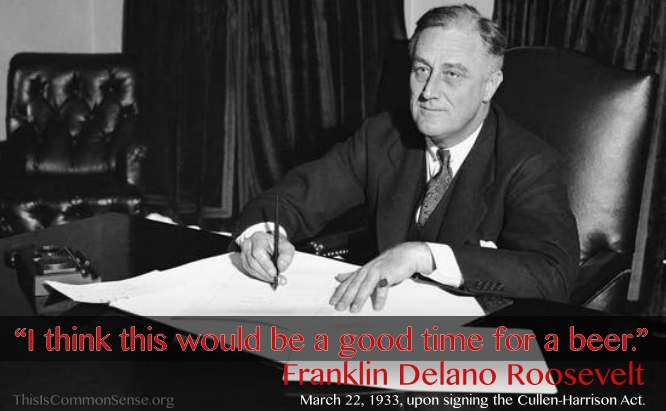
I think this would be a good time for a beer.

Franklin Delano Roosevelt, 32nd President of the United States, March 22, 1933.
Categories
Today

Prohibition Begins to End

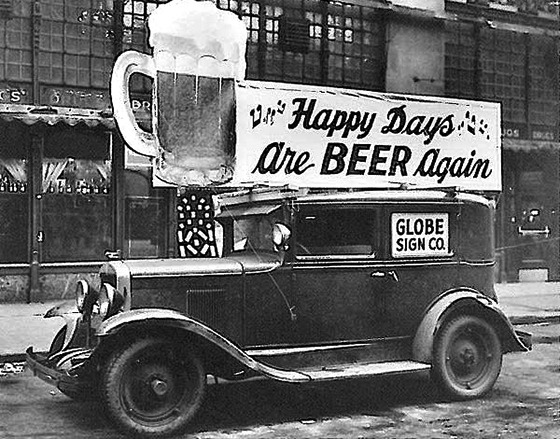
On April 7, 1933, Prohibition in the United States was repealed for beer of no more than 3.2 percent alcohol by weight — eight months before the ratification of the XXI amendment, which repealed the 18th (or Prohibition) Amendment.

The enabling legislation was the Cullen–Harrison Act, which figured the low alcohol content as the excuse to get around the 18th Amendment’s prohibition of intoxicating beverages. The act passed Congress on March 21, 1933, and was signed into law by Franklin Delano Roosevelt the next day.

Categories
international affairs media and media people

Lab Rats II: The Conspiracy

“What if Robert Redfield is right about the Wuhan labs?” inquires Washington Post columnist Josh Rogin.

Redfield is the former director of the Centers for Disease Control under President Trump and a virologist at the University of Maryland School of Medicine, where he co-founded the Institute of Human Virology. He told CNN he thought “the most likely etiology of this pathogen [SARS-CoV-2] in Wuhan was from a laboratory.” 

The doctor was clear: this is his educated conjecture, lacking incontrovertible evidence — which all of the other operating theories also lack. 

“Before Redfield,” Rogin writes, “the mere discussion of the still-unproven theory that the covid-19 outbreak might have been connected to human error at a research laboratory in the Chinese city of Wuhan was considered taboo.”

Which is not to suggest that Dr. Redfield was not attacked and marginalized for mentioning the quite viable “lab theory” for human transmission of the contagion. “Redfield tosses viral kindling,” The Baltimore Sun’s editorial ridiculously accused, “on anti-Asian fires.”

Last week, I lamented our incurious media and the Chinese cover-up. But Rogin takes the charge much further: “The Chinese government and U.S. scientists who are close associates of the Wuhan scientists doing bat coronavirus research have tarred anyone who uttered it as conspiracy theorists, or worse (in their eyes), as pro-Trump.”

Yet, “the Biden administration has confirmed some of the Trump team’s factual claims about suspicious and still-undisclosed work at the Wuhan Institute of Virology,” added the columnist.

“Conspiracy theorist” is a handy way to deflect attention from bad acts. Conspirators love the term, as do all cover-up artists.

This is Common Sense. I’m Paul Jacob.


PDF for printing

See all recent commentary
(simplified and organized)
See recent popular posts
Categories
Thought

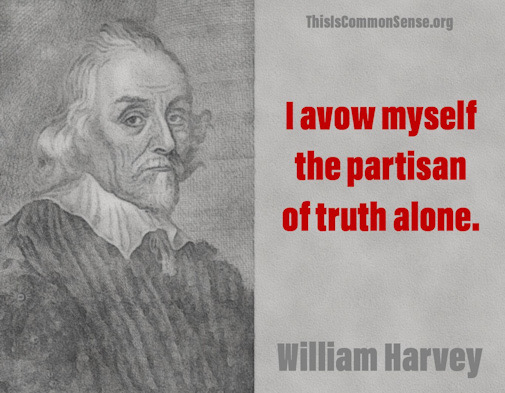
William Harvey

I avow myself the partisan of truth alone.

William Harvey, “Dedication to Dr. Argent and Other Learned Physicians,” Exercitatio Anatomica de Motu Cordis et Sanguinis (1628).

Categories
Today

Salt Rebel

On April 6, 1930, Mohandas K. Gandhi raised a lump of mud and salt, declaring, “With this, I am shaking the foundations of the British Empire.”

Thus began the Salt Satyagraha.

Categories
Thought

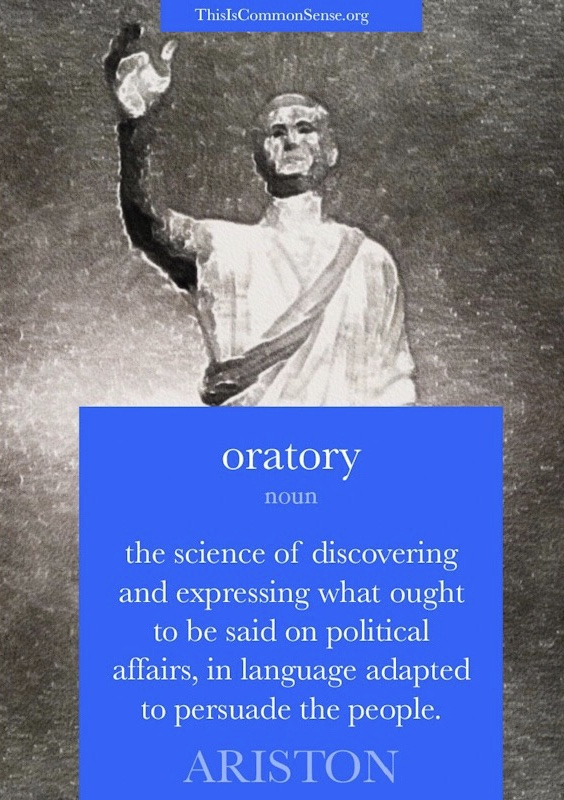
Ariston

oratory

noun : the science of discovering and expressing what ought to be said on political affairs, in language adapted to persuade the people.

Definition of Ariston, disciple of Critolaus, as quoted in Quintilian, The Institutes of Oratory (Rev. John Selby Watson, translator, London: Bell & Daldy, 1873), p. 143.
Categories
Today

Two Washingtons

On April 5, 1792, George Washington exercised the first presidential veto of a congressional bill, a new plan for dividing seats in the House of Representatives, which would have increased the number of seats for northern states. Washington vetoed only one other bill during his two terms in office, an act that would have reduced the number of cavalry units in the army.

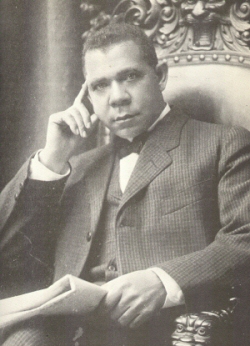
On April 5, 1856, Booker T. Washington, American educator, first leader of the Tuskegee Institute in Alabama, author of 14 books, including his autobiography, “Up From Slavery,” was born a slave in southwestern Virginia. Though Washington faced criticism from leaders of the new NAACP, especially W. E. B. Du Bois, for not protesting the lack of civil rights more strongly, he secretly funded litigation for civil rights cases, such as challenges to southern constitutions and laws that disfranchised blacks.

Categories
Thought

William Harvey

Man comes into the world naked and unarmed, as if nature had destined him for a social creature, and ordained him to live under equitable laws and in peace; as if she had desired that he should be guided by reason rather than be driven by force; therefore did she endow him with understanding, and furnish him with hands, that he might himself contrive what was necessary to his clothing and protection. To those animals to which nature has given vast strength, she has also presented weapons in harmony with their powers; to those that are not thus vigorous, she has given ingenuity, cunning, and singular dexterity in avoiding injury.

William Harvey, De Generatione Animalium (1651).
Categories
Today

Tippecanoe (and, sadly, MLK, too)

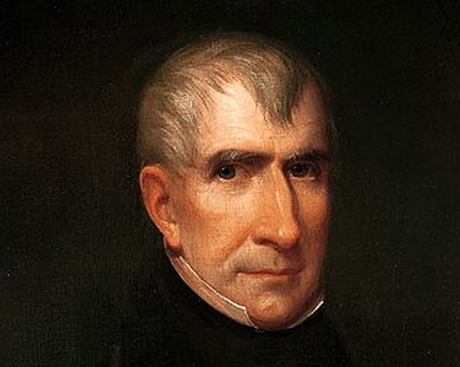
On April 4, 1841, William Henry Harrison died of pneumonia, becoming the first President of the United States to die in office and the one with the shortest term served (he died on his 32nd day as president). A renowned Indian killer (having risen to fame for his part in 1811’s Battle of Tippecanoe), a proponent of the expansion of slavery into Northwest Territories, and a Whig, Harrison won the presidency in part by turning the Democrats’ “log cabin and hard cider” aspersions on his character as the basic symbols of the campaign.

Though hardly a “limited government man,” some limited government history buffs proclaim him the Greatest President, on the ostensibly droll and possibly cynical grounds that he spent so little time in office.

On a much sadder note, Martin Luther King, Jr., was assassinated on this day in 1968.